


3,49 €
Mehr erfahren.
- Herausgeber: Mount Street Press
- Kategorie: Krimi
- Sprache: Englisch
When Hollywood star Dorothy Dacres plummets six floors from her hotel terrace on the night of her greatest triumph, it initially looks like a tragic accident. But her death is so very convenient to her many enemies that press-man Freddy Pilkington-Soames, who was there on the night she died, begins to suspect foul play. And when cocaine is found in her room, it only complicates matters further. Soon Freddy is chasing across London on the trail of drug dealers, in reluctant company with his deadly rival Corky Beckwith, the most unscrupulous reporter in Fleet Street, who will do anything for a story. With the future of a film studio at stake, can Freddy find the culprit—and get one up on Corky—before he becomes the killer's next victim?
Das E-Book können Sie in Legimi-Apps oder einer beliebigen App lesen, die das folgende Format unterstützen:
Veröffentlichungsjahr: 2020
Ähnliche









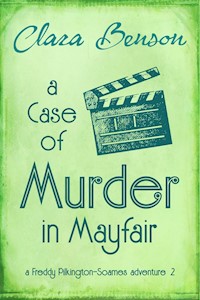
A Case of Murder in Mayfair
A Freddy Pilkington-Soames Adventure 2
Clara Benson
© 2016 Clara Benson
All rights reserved
The right of Clara Benson to be identified as the author of this work has been asserted by her in accordance with the Copyright, Designs and Patents Act, 1988
The characters and events portrayed in this book are fictitious. Any similarity to real persons, living or dead, is coincidental and not intended by the author
This book is sold subject to the condition that it shall not, by way of trade or otherwise, be lent, resold, hired out, or otherwise circulated without the publisher's prior consent in any form of binding or cover other than that in which it is published and without a similar condition including this condition being imposed upon the subsequent purchaser
clarabenson.com
Cover spine and back by Shayne Rutherford
WickedGoodBookCovers.com
Contents
A Case of Murder in Mayfair
Chapter 1
Chapter 2
Chapter 3
Chapter 4
Chapter 5
Chapter 6
Chapter 7
Chapter 8
Chapter 9
Chapter 10
Chapter 11
Chapter 12
Chapter 13
Chapter 14
Chapter 15
Chapter 16
Chapter 17
Chapter 18
Chapter 19
Chapter 20
Chapter 21
Chapter 22
Chapter 23
Chapter 24
Chapter 25
Chapter 26
Chapter 27
Books by Clara Benson
A Case of Murder in Mayfair
When Hollywood star Dorothy Dacres plummets six floors from her hotel terrace on the night of her greatest triumph, it initially looks like a tragic accident. But her death is so very convenient to her many enemies that press-man Freddy Pilkington-Soames, who was there on the night she died, begins to suspect foul play. And when cocaine is found in her room, it only complicates matters further. Soon Freddy is chasing across London on the trail of drug dealers, in reluctant company with his deadly rival Corky Beckwith, the most unscrupulous reporter in London, who will do anything for a story. With the future of a film studio at stake, can Freddy find the culprit—and get one up on Corky—before he becomes the killer's next victim?
If you’d like to receive news of further releases by Clara Benson, you can sign up to my mailing list here.
Or follow me on Facebook.
Chapter One
It was a bright, brisk November day, the sort that shows off autumn at its finest. The afternoon sun shone low in the sky, glancing off the windows of the buildings, highlighting the trees in all their multi-coloured magnificence, and dazzling the eyes of the people hurrying about their daily business. A keen wind was blowing, cold, with a hint of frost to come, and the fallen leaves rattled as they skittered merrily along the ground, as though swept by the hand of an invisible giant. London looked pleasant in the sunshine—or this particular corner of London did, at any rate; the corner in which sat the Abingdon Hotel, that well-known haunt of royalty, statesmen, actors and other wealthy people of note. This elegant establishment, which occupied almost half a block in a quiet part of Mayfair not far from Bond Street, offered both luxury and discretion to those who could afford it, and was well used to the comings and goings of its guests at odd times, as well as their sometimes eccentric demands, which it prided itself on its ability to meet. In turn, its wealthy patrons appreciated the superabundance of amenities that were to be had therein, for behind the modest façade of red brick lay a degree of opulence and comfort of which the man in the street could only dream, but which the sort of clientèle the hotel attracted considered as the minimum necessary to make life at all bearable.
On this particular Tuesday, anyone passing by would have seen a little knot of people standing outside the Abingdon’s grand entrance, chattering to one another with an air of suppressed excitement. The hotel’s commissionaire, smart in his top hat and long coat with silver bands at the wrists, was watching them covertly while appearing not to, in case they decided—against all the rules of good manners and human decency—to rush him in a body and attempt to storm the place. He did not really expect this to happen, but he took his responsibilities very seriously, and was determined that no-one should ever say he had been caught napping. Indeed, the little crowd seemed quite content to stand patiently outside the hotel for as long as necessary. Occasionally, a motor-car would turn into the street, and they would all watch it eagerly as it drew towards them, then sigh and resume their conversations as it continued past without stopping. Several times had they been disappointed in this fashion, but they did not appear to be in any way discouraged, and looked set to stand there for the whole day if necessary.
Standing back from this group, lounging against a wall on the other side of the street in an attitude of supreme boredom, stood a young man. He wore a battered old Burberry with the buttons fastened up the wrong way and a crushed poppy in the lapel, which he had neglected to remove. His hat looked as though he had rammed it onto his head as an afterthought. A cigarette dangled from one corner of his mouth, and round his neck on a leather strap he carried a contraption that closer investigation revealed to be a folding camera. He had been there for some time, and was in no mood to appreciate the beauties of the day, for he had had little sleep and no lunch, and the cold wind was biting at his extremities most disagreeably. All he wanted was to get the job over and done with, then find the nearest eating-place that served hot meals and spend half an hour or so remedying his current deficiencies of comfort and nourishment.
He shifted his position and sighed, and at that moment noticed that he was being observed by an elderly man whose eccentric attire and paucity of teeth pronounced him to be a vagrant. The tramp saw he had been spotted, and sidled up to the young man with a look of speculation in his eyes.
‘Got a light, guv’nor?’ he said.
The young man produced a match. The tramp waited expectantly, and the other sighed and dug out a cigarette, which he handed over.
‘You’re a gentleman,’ said the tramp, drawing on the gasper with great satisfaction and a smacking of the lips. He gestured at the camera. ‘What’s all this then? You waiting for somebody?’
‘Dorothy Dacres,’ said Freddy Pilkington-Soames.
‘Who’s that, then?’
‘She’s an American film star who is known for her beauty, grace, charm and acting ability. I dare say she’s a whiz at quadratic equations and does good works for the sick and needy, too.’
‘Never heard of her,’ said the tramp, and spat.
‘Don’t let her hear you say that,’ said Freddy. ‘That sort of talk is death to one of her type. They must be the name on everybody’s lips or they consider their existence to be futile.’
‘That so?’ said the tramp. He puffed on the cigarette and ruminated briefly. ‘I ain’t never watched a moving picture except once,’ he said. ‘And I’m half-blind anyway, so I didn’t see much of it. Is that why she’s come? To make one of these pictures?’
‘So the rumour has it. There’s to be a big production of some famous play or other, and they’re making it here in England, and everybody’s been wondering who is going to play the leading rôle. The latest word is that it’s going to be Dorothy Dacres, and I’m here to see if she’ll tell us whether that’s true.’
‘All foolery if you ask me,’ said the tramp. ‘A lot of people running around, flapping their mouths and not saying anything. How are we supposed to know what’s happening?’
‘Oh, but this is to be a talking picture,’ said Freddy. ‘It’s quite a different thing.’
‘A talking picture? Get away with you,’ said the tramp jocularly, in the manner of one who has been entreated to believe in the existence of winged horses.
‘It’s true. They’re all the rage now, and rather good fun, too. Why—’
He was interrupted by a sudden outburst of excited chatter from the little crowd across the road, who had seen another car turn into the street. This time it looked as though it were the real thing, for as it approached the Abingdon it began to slow. Freddy opened his camera and joined the throng, as the car came to a halt outside the front entrance and the commissionaire sprang forward to do his duty. The crowd seemed suddenly to have grown in number, and had to be held back by two or three smartly-uniformed men who had just emerged from the hotel to assist.
The first person to alight from the car caused the crowd to emit a sigh in unison. He was a tall, handsome man of twenty-five or so, with expressive brown eyes and a boyish smile. This was Robert Kenrick, an English actor who had lately been mentioned as having received several offers from studios in Hollywood to make films for them. He waved at the watchers, then stooped to hand a woman out of the car. The crowd let out a cheer as they saw her, and she put her hand to her breast and blinked, then smiled shyly, as though astonished at such a welcome. Dorothy Dacres had arisen seemingly from nowhere to star in many of the most profitable films of the past few years, and was considered one of the leading actresses of the day. Her golden hair, classical beauty and brilliant smile were loved by the camera and the public alike. She had not made a picture in some time, however, and there were those who whispered that, at thirty-six, she was getting past the useful age, and that her time in the spotlight was coming to an end. Still, as she preened and waved at her adoring audience, nobody could have possibly imagined that she had any such worry on her mind, or that the end of her career was anything but a dim spot on the horizon.
It now became evident that the crowd consisted of more than just Miss Dacres’ ‘fans,’ for one or two young men with notebooks had appeared as if from nowhere, and began to shout questions at her. Freddy recognized them as fellow-reporters from other publications. They were asking whether she had anything to say about her presumed rôle as the tragic wife Helen Harper in For Every Yesterday, the film that was expected to begin production shortly.
‘I can’t say anything at this time,’ she said. ‘But we expect to make an announcement soon.’
‘What about the rumours of an engagement between you and Mr. Kenrick?’ said one young man.
‘Oh, that’s nonsense,’ said Dorothy Dacres, with a peal of laughter. ‘Wherever did you hear such a thing? Why, Bob and I are merely good friends.’
Here she turned to touch Kenrick’s arm and give him a flirtatious glance which did nothing to quell the speculation.
Freddy had been worming his way to the front of the crowd, and now held up the camera to take a picture. Miss Dacres gave him her best side.
‘I heard that Augusta Laing is to play the part of Helen Harper,’ said another reporter.
Dorothy Dacres’ smile faltered, and for a second she looked exceedingly cross, just as the shutter on Freddy’s camera clicked. The smile returned almost immediately.
‘Well, you’ll just have to wait and see,’ she said, with a wag of the finger.
She and Kenrick signed an autograph or two, then turned and were bowed into the Abingdon by the commissionaire. The crowd waited until they were out of sight, then began to disperse. Freddy struggled with the camera, which did not seem to want to fold up again, and grimaced. He feared he had lost his moment.
‘Wish I’d brought one,’ said a reporter from the News, gazing enviously at the machine. ‘But they sent me here in a hurry.’
‘I think I fluffed the shot anyway,’ said Freddy, prodding at the bellows, which had stuck.
‘Tough luck,’ said the other. ‘She wasn’t saying much, was she? I don’t suppose you’ve got anything?’
‘No. You?’
The News reporter shook his head.
‘Oh, well,’ he said. ‘I suppose it’ll be the usual puff from the studio again.’
They both looked up as another car arrived and two people got out. One of them was a young man with an air of great concentration about him. He brought out with him two or three heavy-looking cases, one of which he handed to the commissionaire with an admonishment to be careful with it.
‘It’s Seymour Cosgrove, the photographer,’ said the News man. ‘I wonder whether he’s come to do some publicity shots for the film. That must mean they definitely have given her the part. Who’s the other one?’
‘No idea,’ said Freddy.
Whoever he was, he was quite obviously American, given the style of his dress. Perhaps fifty years of age, he was short and powerfully built, with a crumpled face that gave him something of the appearance of a fighter. He strode in through the front door of the Abingdon without hesitation, followed by Seymour Cosgrove.
‘I expect he’s one of the film people,’ said the News man. He glanced at his watch. ‘Well, we didn’t get much, but I’d better think of something if I’m to catch the early evening edition. I’d get a new camera if I were you,’ he added. ‘I think that one’s on its last legs. Cheerio.’
And with that he was off. Freddy struggled with the camera a little while longer, and finally succeeded in shutting it up. He, too, had a story to write, but there were more important things to attend to first, for his stomach was grumbling. He could easily scribble something down while he was eating. He thrust his hands in his pockets and turned away from the cold wind, heading in search of warmth and sustenance.
Chapter Two
In Dorothy Dacres’ palatial suite on the top floor of the Abingdon, all was confusion as Seymour Cosgrove set up the scene for the photographs he was about to take. From the cases had emerged a mountain of photographic equipment, and Cosgrove was currently sitting on the floor in among it all, putting together a tripod. The suite was the best accommodation the Abingdon offered—although they no longer called it a suite, but had recently begun describing it as a penthouse, in order to move with the times—and was reserved for the hotel’s most revered guests. It had three bedrooms and an enormous living-room, in which a baby grand piano stood in pride of place on a fur rug that must have been four inches thick, at least. Above the piano hung a glass and chromium-plated chandelier of such splendour that it quite took one’s breath away. The walls and furnishings were of the latest style—all inlaid walnut and reflective surfaces, tasteful beiges and pastels, with here and there a daring marble statue or a potted palm. The fabrics were from Paris, and the paintings on the walls—depicting subjects that ranged from the angular and garish to the wholly incomprehensible—were the work of the most noted modern artists. The penthouse had not one, but two terraces, the largest of which led off the living-room and was big enough to entertain a hundred people. Of the tariff it is better not to speak, except to say that all inquiries of that nature were referred to the manager, who was the only one permitted to communicate the terms, and who did so in a hushed, discreet voice he kept precisely for that purpose. Miss Dacres herself was reclining on a magnificent sofa which was upholstered in a particular shade of grey that matched her eyes and contrasted beautifully with her dress in coral red. The whole tableau created a pleasing effect of which she was fully aware.
‘Will this take long, darling?’ she said to Seymour Cosgrove. ‘I’m awfully tired.’
He looked about him, then jumped up and went across to the baby grand.
‘I like this piano,’ he said, running his hand over it with a frown. ‘We can do it here. Just you, or you and Kenrick, with the piano and the chandelier. Dramatic, but not too posed.’
He picked up a photographic lamp and placed it to greater advantage, then studied it for a second and moved it a few inches to the left.
Robert Kenrick came in from outside. He had achieved fame only recently, and was still new enough to the game to be impressed by everything.
‘I say, there are splendid views from the terrace,’ he said.
‘Are there?’ said Dorothy, with the jaded air of one used to luxury. ‘I haven’t looked.’
‘Oh, but you must. I could see the rooftops of all the buildings for miles around.’
‘There’s another terrace off my bedroom, facing the front,’ she said. ‘Go and see if there are still people waiting outside.’
He did so, and returned after a minute.
‘No, it’s all quiet now,’ he said.
‘Oh,’ she said, disconcerted. ‘I guess this cold weather puts people off. In Hollywood the fans will wait outside for hours.’
‘I must say, I’m looking forward to seeing America,’ said Kenrick. ‘England’s all very well, but if one wants to be really famous then Hollywood is where it’s at.’
His enthusiasm and naïveté were quite disarming, and Miss Dacres laughed.
‘You’re ambitious and not a bit ashamed of it,’ she said. ‘I like that. Most of you Britishers like to pretend you’re above all that kind of thing, but not you—you make no bones about it.’
‘But why should I? I want to be famous and have lots of money. I don’t see it’s anything to be ashamed of. I say,’ he went on, as a thought struck him. ‘People aren’t really saying we’re engaged, are they? Why, we only met two weeks ago. Where did they get that idea?’
‘Oh, I telephoned the newspapers and told them,’ said Dorothy. ‘I pretended to be somebody else, naturally, but if people are being slow then sometimes one has to give them a little helping hand.’
‘But why did you tell them that?’
‘Because if one isn’t in the papers then one might as well be dead. And everyone was talking about Augusta Laing getting the part, so I thought it was time I reminded them that she’s nobody, and that I’m far more interesting than she is. And besides,’ she added casually, ‘I was doing you a favour. You’re going to be the new boy in Hollywood, and you need to get off on the right foot.’
‘But it will be in all the papers, won’t it? I already have a girl, and she won’t be too happy when she reads it.’
‘Oh, you have a girl, do you? Well, she won’t last long. I dare say I’ve done her a good turn, too. Better let her down gently now rather than string her along. She can’t last, you know. And this is much more important. The publicity will do us both good. We’re starring in this picture together, and people go wild for two romantic leads who are also in love off the screen.’
‘But we’re not.’
‘Who cares?’ she said. ‘The public believe it, and that’s all that matters.’
Robert Kenrick was dismayed.
‘But I mean to say, Sarah really won’t be happy, as she’s rather the worrying kind. And her mother never approved of me much to start with, because I’m an actor, you know. What if they believe it too? I shall be in the most awful trouble. I think I shall have to call the papers to deny it. No offence meant, Dorothy, but I don’t want them getting the wrong end of the stick.’
Dorothy Dacres pursed her lips in displeasure.
‘Better not, darling,’ she said. ‘You’re in it now, whether you like it or not. You’ll soon see it’s how things work in this business.’
‘But—’
‘Besides,’ she went on, twisting a lock of her beautiful golden hair around her finger and gazing at him with innocent eyes, ‘you don’t want people to think you’re not interested in me, do you? A lot of men would kill to be in your shoes right now. If people get even the tiniest idea that you’re not keen on women then they might start to wonder.’
‘Wonder what?’
‘Oh, you know. You’d be surprised how rumours get around. People will talk, and Hollywood is very sensitive about the morality of its stars. I could tell you stories of people who’ve been black-listed for that kind of thing.’
‘I don’t know what you mean,’ said Kenrick, taken aback.
‘Don’t you? Well, never mind. Let’s just say that if you don’t want to find yourself on the first boat home you’d be better off doing as I tell you. It’s only for a little while. And you’ll soon see there are a lot of beautiful girls in America. Far better looking than this Sally of yours, I’ll bet.’
‘Sarah.’
She waved a hand and promptly forgot the subject, leaving Robert Kenrick in a state of some perturbation as he absorbed his first unpleasant lesson in Hollywood politics. He said no more, but wandered back out onto the terrace—although this time the view did not appeal quite as much as it had before.
A young woman who bore some resemblance to Miss Dacres, albeit with darker hair and eyes, came into the living-room, bearing a huge bouquet of flowers.
‘These just came from Mr. Aston,’ she said.
‘Oh, aren’t they just divine?’ said Dorothy, giving them the briefest of glances. ‘Eugene, darling,’ she said, calling to a man who was talking loudly and urgently on the telephone at the other side of the room. ‘Is that Henry? Thank him for the flowers, won’t you?’
The man addressed as Eugene nodded and carried on talking. Eventually he put the telephone down and came across.
‘We’re all set,’ he said.
Dorothy was examining her fingernails idly.
‘Do you know,’ she said, ‘one of those horrid press-men outside said that Augusta Laing is going to be Helen Harper. He must have been talking to Kenneth Neale. You know he doesn’t want me to have the part. You don’t think he’s going to pull some stunt, do you?’
‘Don’t worry about him,’ he replied. ‘He’s all talk, but he’ll play ball. There’s too much money at stake not to.’
Eugene S. Penk was the man Freddy had seen arriving with Seymour Cosgrove. Despite his rough and pugilistic appearance, he was in fact a rich and powerful man. He had started his career as a professional boxer, then had moved into the film business, first as an extra, then as a stunt-man and bit-part actor, until he had worked his way up to become head of production at one of the biggest Hollywood studios. But working for others did not suit him, and he had warred constantly with the studio executives. At last he had decided to strike out on his own, and had recently formed his own company, Aston-Penk Productions, in partnership with Henry Aston II, the son of the late industrial tycoon, who provided the financial backing. Their first two pictures had not been successes, and it had begun to look as though the venture were destined to fail, for Aston knew little about the film business and was a nervous investor, alternately trying to interfere and threatening to withdraw. However, Penk had made every effort to convince him that For Every Yesterday would be a hit, and hoped that the danger had passed for the moment.
‘Now listen, Dorothy,’ Penk went on. ‘That’s something I wanted to talk to you about. You’ve got to switch that famous charm of yours on and start talking nice to Kenneth Neale. I promised Henry I’d get him over to Hollywood, and I’ve got to do it. But I can’t do it with you getting his wife all riled up every time you see her.’
‘Why should I be nice to him when he doesn’t want me in his picture?’ said Dorothy, pouting a little.
‘Because he’s the best director in Europe and I want to hire him,’ said Penk impatiently. ‘And Henry wants him too. We’ve got to make a success of this one, or we’re all going to be on the skids.’
‘Oh, nonsense. One director is just like another. And who’s heard of him back in the States? What’s he done that anyone cares about? Nothing that I recall. I’m the one they’re paying to see, and I think people ought to remember that a little more often when they tell me I can’t have what I want.’
‘Now, you’re not going to start being difficult, are you?’ said Penk. ‘If he pulls out then we have to begin all over again, and Henry will get the heebie-jeebies, and you might find yourself without a part.’
‘Well, all right, then,’ said Dorothy with a sulky toss of her immaculate head. ‘I’ll play nice. Anyway, I didn’t mean to upset Patience. But that ghastly child of theirs really is the limit. Do we have to have her in the movie?’
‘Yes we do. She’s a big hit over here with the British. They adore her, and she’s the surest way of getting them to come and see it. And the surest way of getting Neale to come to Hollywood, too,’ he added. ‘We hire his little girl, we make him happy and he does whatever we want.’
‘Ugh,’ said Dorothy, wrinkling up her nose in disgust. ‘So we have to have this Adorable Ada, or whatever she’s called, and I guess Augusta Laing will be hanging around wanting a supporting rôle too, now that I’ve been given the plum one. I can’t think why Kenneth wants Augusta so badly,’ she went on petulantly. ‘It’s not even as though she’s all that pretty. That hair of hers! It quite blinds one. And her acting is so insipid. Of course, with a little more experience she mightn’t be too bad one day, but I don’t think she’s cut out for leading rôles—and she most certainly can’t carry the part of Helen.’
‘You have to admit she’s closer to the right age,’ said the young woman who had brought the flowers. ‘It’s a long time since you saw twenty-five.’
Dorothy sat up suddenly and glared at her.
‘At least I can still pass for twenty-five,’ she said. She looked the other woman up and down. ‘Such a pity the camera never loved you as much as it did me, isn’t it, darling? It always made you look so old and haggard. Why, no-one would ever have guessed that I’m seven years older than you. Do you know, Seymour,’ she went on, addressing the photographer, ‘there was more than one occasion when we were younger that Cora and I were mistaken for twins—by age, I mean. Not by resemblance.’
‘Are you sure about that?’ said Cora sweetly. ‘As I recall, most people commented on how mature you looked for your age. And most of your parts lately have been characters much older than you. What was that last one you did two years ago? I can’t quite remember the name—but then I guess no-one else can either. It’s such a shame how one can go from being the latest thing to nobody at all in just a few months. It can’t be because of your age that you’re not getting the parts any more, though, can it? I mean, after all, you just told me you can still pass for twenty-five.’
‘Yes I can,’ said Dorothy. ‘And that’s why I’m going to play Helen Harper.’ She returned her sister’s sweet smile. ‘This is a hard business, and only the very best make it. I think you made a wise decision when you retired. Stars come and go, but Hollywood will always need secretaries and assistants like you.’
Cora flushed, but said nothing more, as Seymour Cosgrove, who had ignored—or perhaps not heard—the exchange, broke in and said:
‘I think we’re ready now. Dorothy, I want you over here by the piano.’
Dorothy swung herself up from the sofa with languorous grace and did as she was bid.
‘Just lean against it like that,’ said Seymour, and peered through the view-finder. A shade of doubt passed over his face.
‘That dress—the colour’s no good,’ he said finally. ‘It won’t show up. You’ll have to put a paler one on.’
‘I have something in eau de nil,’ said Dorothy. ‘Mildred, bring it out—and the white silk too.’
A silent maid duly brought out several frocks and submitted them to the judgment of the photographer, who held them up one by one against Miss Dacres and squinted at her dispassionately. At last, he selected an evening-dress in pale blue.
‘How does this one drape?’ he said, then, without waiting for an answer: ‘Go and put it on.’
At last she was dressed to his satisfaction, and the session began. Everybody watched as Dorothy Dacres struck a range of artistic and occasionally outlandish poses according to Cosgrove’s instructions, while he took pictures from several different angles.
‘Now you,’ he said at last to Robert Kenrick. ‘Come and stand next to her.’
‘You’re so dreadfully blunt and rude,’ said Dorothy to Cosgrove. ‘But I don’t mind it. You always take such beautiful photos. Did Eugene tell you you’re going to be working with me for the rest of this movie?’
‘No can do,’ said the photographer as he worked. ‘Didn’t I mention it? I’m off to America next week. Out Of Town have come across with the contract at last. I’m to be exclusive with them for five years. If there hadn’t been a little delay I shouldn’t even be here today. That’s right—gaze into his eyes. Now turn to the camera and give a sidelong glance as though you knew something he didn’t.’
‘Silly,’ said Dorothy. ‘That’s all off now.’
‘What do you mean, it’s all off now?’
‘Why, I told them you wouldn’t be coming,’ she said, opening her eyes wide as though it were obvious.
‘You told them what?’ said Seymour Cosgrove. For the first time he looked up from his equipment and at Miss Dacres.
‘I said you weren’t coming. I need you here,’ she explained. ‘You don’t mind, do you? There’s no-one else can capture Dorothy Dacres like you do, and since this movie is to be my come-back, in a manner of speaking—not that I ever went away, of course—I’m going to need all the help I can get. This rôle is going to be a triumph for me, I can feel it, and I want you to be a part of it.’
‘But I don’t want to be a part of it,’ said Cosgrove. He pulled at his hair, and seemed stunned. ‘I want to go to the States and take pictures for magazines. Out Of Town are paying me a ridiculous amount of money to go over there, and they’re going to let me do whatever I want. I’ll have full artistic control. This is the opportunity I’ve been waiting for ever since I started in this business.’
‘Oh, well, as to the money, I’m sure Eugene will match that,’ said Dorothy. ‘You will, won’t you, Eugene?’
‘What?’ said Eugene Penk, to whom this was all evidently news.




