


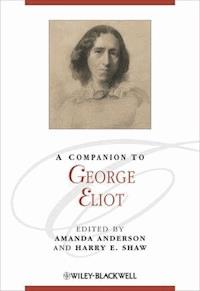
A Companion to George Eliot E-Book
32,99 €
Mehr erfahren.
- Herausgeber: John Wiley & Sons
- Kategorie: Geisteswissenschaft
- Serie: Blackwell Companions to Literature and Culture
- Sprache: Englisch
This collection offers students and scholars of Eliot’s work a timely critical reappraisal of her corpus, including her poetry and non-fiction, reflecting the latest developments in literary criticism. It features innovative analysis exploring the relation between Eliot’s Victorian intellectual sensibilities and those of our own era.
- A comprehensive collection of essays written by leading Eliot scholars
- Offers a contemporary reappraisals of Eliot’s work reflecting a broad range of current academic interests, including religion, science, ethics, politics, and aesthetics
- Reflects the very latest developments in literary scholarship
- Traces the revealing links between Eliot’s Victorian intellectual concerns and those of today
Sie lesen das E-Book in den Legimi-Apps auf:
Seitenzahl: 1277
Veröffentlichungsjahr: 2013
Ähnliche




















Table of Contents
Blackwell Companions to Literature and Culture
Title page
Copyright page
Notes on Contributors
Introduction
Imaginative Form and Literary Context
Works
Life and Reception
Eliot in Her Time and Ours: Intellectual and Cultural Contexts
Part I: Imaginative Form and Literary Context
1: Eliot and Narrative
2: Metaphor and Masque
3: “It Is of Little Use for Me to Tell You”: George Eliot’s Narrative Refusals
Unnarration and Disnarration
The Subnarratable: What Needn’t Be Told Because It’s Normal
The Supranarratable: What Can’t Be Told Because It’s Ineffable
4: Surprising Realism
Sympathy and Knowledge
Realist Surprises
Realism’s Plots
5: Two Flowers: George Eliot’s Diagrams and the Modern Novel
Viewpoints
Time Slips, Focal Shifts
Impressions of Theophrastus Such
Time Slips the Other Way
Conclusion
Part II: Works
6: Scenes of Clerical Life and Silas Marner: Moral Fables
Scenes of Clerical Life
Silas Marner
7: Adam Bede: History’s Maggots
8: The Mill on the Floss and “The Lifted Veil”: Prediction, Prevention, Protection
Introduction: Beginnings and Endings
The Future in “The Lifted Veil”
Predicting the End in The Mill on the Floss
Conclusion: Development, Reading, and the Futures of The Mill on the Floss
9: Romola: Historical Narration and the Communicative Dynamics of Modernity
10: Felix Holt: Love in the Time of Politics
11: Middlemarch: January in Lowick
12: Daniel Deronda: Late Form, or After Middlemarch
13: Poetry: The Unappreciated Eliot
Opportune Anomaly
Soundings
Pulse Taking
Amateur Standing
14: Essays: Essay v. Novel (Eliot, Aloof)
15: Impressions of Theophrastus Such: “Not a Story”
Part III: Life and Reception
16: The Reception of George Eliot
17: George Eliot Among Her Contemporaries: A Life Apart
Fellowship and Isolation
Being “George Eliot”
18: Feminist George Eliot Comes from the United States
The George Eliot Question and Feminist Criticism of Women Writers
Transatlantic Literary Relations and Reform
Harriet Beecher Stowe, James T. and Annie Fields, and the Brother Question
Elizabeth Stuart Phelps and the Woman Question
19: Transatlantic Eliot: African American Connections
Eliot and “the Negro Novel”
African American Deployments of Eliot
Part IV: Eliot in Her Time and Ours: Intellectual and Cultural Contexts
20: Sympathy and the Basis of Morality
The Neglect of Sympathy
Types of Sympathy
Morality Founded on Emotion, not Principle
Sympathy: Indicative or Constitutive?
Sympathy and Accuracy
The Escape from Moral Stupidity
The Relation of Sympathy to Morality
21: George Eliot, Spinoza, and the Emotions
Introduction: The Importance of Spinoza
Traditions of Affect
Spinoza on Love and Hate
Middlemarch and Daniel Deronda
22: George Eliot and the Law
Eliot and the Criminal Law
Eliot and the Civil Law
23: George Eliot and Finance
Beginnings
Blood and Money
George Eliot’s Wealth
Of Human Bondage
Human Transactions
An Aged Commercial Soul
24: George Eliot and Politics
Everything is “Poltics”
In Defense of the Common
The Commons and the World
25: Imagining Locality and Affiliation: George Eliot’s Villages
Villages Remembered and Imagined
Village Realism
Printed Villages, Modern and Ancient
26: George Eliot’s Liberalism
27: George Eliot: Gender and Sexuality
28: The Cosmopolitan Eliot
29: The Continental Eliot
The Real God-Man
From God-Man to Historical Women
30: George Eliot and Secularism
31: Living Theory: Personality and Doctrine in Eliot
32: George Eliot and the Sciences of Mind: The Silence that Lies on the Other Side of Roar
33: George Eliot and the Science of the Human
We Belated Historians
Involuntary, Palpitating Life
The Natural History of Human Life
The Limits of Variation
Shadows of the Coming Race
34: Eliot, Evolution, and Aesthetics
Index
Blackwell Companions to Literature and Culture
This series offers comprehensive, newly written surveys of key periods and movements and certain major authors, in English literary culture and history. Extensive volumes provide new perspectives and positions on contexts and on canonical and post-canonical texts, orientating the beginning student in new fields of study and providing the experienced undergraduate and new graduate with current and new directions, as pioneered and developed by leading scholars in the field.
Published Recently
This edition first published 2013
© 2013 John Wiley & Sons, Limited
Wiley-Blackwell is an imprint of John Wiley & Sons, formed by the merger of Wiley’s global Scientific, Technical and Medical business with Blackwell Publishing.
Registered Office
John Wiley & Sons, Ltd, The Atrium, Southern Gate, Chichester, West Sussex, PO19 8SQ, UK
Editorial Offices
350 Main Street, Malden, MA 02148-5020, USA
9600 Garsington Road, Oxford, OX4 2DQ, UK
The Atrium, Southern Gate, Chichester, West Sussex, PO19 8SQ, UK
For details of our global editorial offices, for customer services, and for information about how to apply for permission to reuse the copyright material in this book please see our website at www.wiley.com/wiley-blackwell.
The right of Amanda Anderson and Harry E. Shaw to be identified as the authors of the editorial material in this work has been asserted in accordance with the UK Copyright, Designs and Patents Act 1988.
All rights reserved. No part of this publication may be reproduced, stored in a retrieval system, or transmitted, in any form or by any means, electronic, mechanical, photocopying, recording or otherwise, except as permitted by the UK Copyright, Designs and Patents Act 1988, without the prior permission of the publisher.
Wiley also publishes its books in a variety of electronic formats. Some content that appears in print may not be available in electronic books.
Designations used by companies to distinguish their products are often claimed as trademarks. All brand names and product names used in this book are trade names, service marks, trademarks or registered trademarks of their respective owners. The publisher is not associated with any product or vendor mentioned in this book. This publication is designed to provide accurate and authoritative information in regard to the subject matter covered. It is sold on the understanding that the publisher is not engaged in rendering professional services. If professional advice or other expert assistance is required, the services of a competent professional should be sought.
Library of Congress Cataloging-in-Publication Data
A companion to George Eliot / edited by Amanda Anderson and Harry E. Shaw.
pages cm
Includes bibliographical references and index.
ISBN 978-0-470-65599-3 (cloth)
1. Eliot, George, 1819–1880–Criticism and interpretation. I. Anderson, Amanda, 1960– editor of compilation. II. Shaw, Harry E., 1946– editor of compilation.
PR4688.C57 2013
823'.8–dc23
2012046823
A catalogue record for this book is available from the British Library.
Cover image: Samuel Lawrence, Portrait of George Eliot, c. 1857. Reproduced by permission of the Mistress and Fellows, Girton College, Cambridge.
Cover design by Richard Boxall Design Associates
Notes on Contributors
James Eli Adams is Professor of English and Comparative Literature at Columbia University. He is the author of Dandies and Desert Saints: Styles of Victorian Masculinity (1995) and A History of Victorian Literature (2009), both of which received a Choice award as an outstanding academic title, and the co-editor, with Andrew Miller, of Sexualities in Victorian Britain (1996).
Amanda Anderson is Andrew W. Mellon Professor of Humanities and English at Brown University and Director of the School of Criticism and Theory. She is the author of Tainted Souls and Painted Faces: The Rhetoric of Fallenness in Victorian Culture (1993), The Powers of Distance: Cosmopolitanism and the Cultivation of Detachment (2001), and The Way We Argue Now: A Study in the Cultures of Theory (2006).
Isobel Armstrong is Emeritus Professor of English (Geoffrey Tillotson Chair) at Birkbeck, University of London. She has published widely on Victorian literature and culture, particularly poetry, and is currently revising her Victorian Poetry: Poetry, Poetics and Politics (1993). Her Victorian Glassworlds. Glass Culture and the Imagination (2008) received the MLA’s James Russell Lowell Prize. She has taught at Harvard University and Johns Hopkins University as Visiting Professor.
Alison Booth, Professor of English at the University of Virginia, is the author of Greatness Engendered: George Eliot and Virginia Woolf (1992) and How to Make It as a Woman (2004), and editor of Wuthering Heights (Longmans). Her research exploring the transatlantic reception of authors and biography of or in groups continues in a digital project, Collective Biographies of Women (http://womensbios.lib.virginia.edu), and a book on literary tourism, biography, and museums, “Writers Revisited.”
James Buzard is the author of Disorienting Fiction: The Autoethnographic Work of Nineteenth-Century British Novels (2005) and The Beaten Track: European Tourism, Literature, and the Ways to “Culture,” 1800–1918 (1993), as well as numerous essays on nineteenth- and twentieth-century British literature and culture, the history of travel, and cultural theory. He coedited Victorian Prism: Refractions of the Crystal Palace (2007). Buzard is Professor and Head of the Literature Faculty at MIT.
Ian Duncan is Florence Green Bixby Professor of English at the University of California, Berkeley. His books include Scott’s Shadow: The Novel in Romantic Edinburgh (2007), Modern Romance and Transformations of the Novel: The Gothic, Scott, Dickens (1992), Scotland and the Borders of Romanticism (coeditor, 2004), and editions of novels by Walter Scott and James Hogg. He is a member of the editorial board of Representations and a general editor of Hogg’s Collected Works.
Simon During is an Australian Professorial Fellow at the University of Queensland. He has previously taught at the University of Melbourne and Johns Hopkins University. His books include Modern Enchantments: The Cultural Power of Secular Magic (2001), Exit Capitalism: Literary Culture, Theory and Post-secular Modernity (2010), and Against Democracy: Literary Experience in the Era of Emancipations (2012).
Monika Fludernik is Professor of English Literature at the University of Freiburg, Germany. Her major fields of interest include narratology, postcolonial studies, law and literature, and eighteenth-century aesthetics. She is the author of The Fictions of Language and the Languages of Fiction (1993), Towards a “Natural” Narratology (1996), and An Introduction to Narratology (2009). She has edited Hybridity and Postcolonialism (1998), Diaspora and Multiculturalism (2003), Postclassical Narratology (with Jan Alber, 2010), and Beyond Cognitive Metaphor Theory (2011).
Laura Green is Associate Professor and Chair of the Department of English at Northeastern University, where she has taught since 2001. She is the author of Educating Women: Cultural Conflict and Victorian Literature (2001) and of the forthcoming study Literary Identification from Charlotte Brontë to Tsitsi Dangarembga.
Rae Greiner received her PhD from the University of California, Berkeley in 2007, and joined Indiana University that year as Assistant Professor of English. She is the co-editor of the journal Victorian Studies and has published essays in Narrative, ELH, and Victorian Studies. Her first monograph, on Adam Smith’s theory of sympathy, nineteenth-century realism, and narrative form, is forthcoming from the Johns Hopkins UP.
Daniel Hack is Associate Professor of English at the University of Michigan. Author of The Material Interests of the Victorian Novel (2005) and articles in journals including Critical Inquiry, ELH, Novel: A Forum on Fiction, and Victorian Studies, he is currently writing a book on the uses of Victorian literature in nineteenth-century African American literature and print culture.
Nancy Henry is Professor of English at the University of Tennessee at Knoxville. She is the author of George Eliot and the British Empire and The Cambridge Introduction to George Eliot. She is also the co-editor of Victorian Investments: New Perspectives on Finance and Culture. Her Life of George Eliot was published by Blackwell’s Critical Biography Series in 2012.
T. H. Irwin is Professor of Ancient Philosophy in the University of Oxford and a Fellow of Keble College. From 1975 to 2006 he taught at Cornell University. He is the author of Plato’s Gorgias (1979), Aristotle’s First Principles (1988), Classical Thought (1989), Plato’s Ethics (1995), The Development of Ethics( 2007–09), and of Aristotle’s Nicomachean Ethics (translation and notes; Hackett. 2nd ed., 1999).
David Kurnick teaches English at Rutgers University. He is the author of Empty Houses: Theatrical Failure and the Novel (2012), and articles on nineteenth-century literature, queer theory, and the history of the novel.
Carolyn Lesjak is Associate Professor and Graduate Chair of English at Simon Fraser University. She is the author of Working Fictions: A Genealogy of the Victorian Novel (2006), as well as numerous articles and contributions to studies of the Victorian novel. Her current book project examines the character and ethics of Victorian object relations. Other projects include work on contemporary Marxist theory and the status of theory and the university within the current neoliberal moment.
Caroline Levine is Professor of English at the University of Wisconsin-Madison. Author of The Serious Pleasures of Suspense: Victorian Realism and Narrative Doubt (2003) and Provoking Democracy (2007), she is writing a book on form.
Jonathan Loesberg is a Professor of Literature at American University. He is the author of three books, including A Return to Aesthetics: Autonomy, Indifference, and Postmodernism (2005), as well as articles on Victorian literature and literary theory. He has recently completed a book on Browning and belief.
Daniel S. Malachuk, Associate Professor of English at Western Illinois University, is the author of Perfection, the State, and Victorian Liberalism (2005) and the coeditor with Alan M. Levine of A Political Companion to Ralph Waldo Emerson (2011).
Josephine McDonagh is Professor of Nineteenth-Century Literature at King’s College London. She is author of De Quincey’s Disciplines (1994) and Child Murder and British Culture (2003), as well as a short volume on George Eliot (1997), and coeditor of a number of volumes, most recently Charles Dickens and the French Revolution (2009). Her current work is on the nineteenth-century novel and the print cultures of migration.
Stefanie Markovits is Professor of English at Yale University. She is the author of The Crisis of Action in Nineteenth-Century English Literature (2006) and The Crimean War in the British Imagination (2009).
Jill L. Matus is Professor of English at the University of Toronto, where she also holds the position of Vice-Provost, Students. A Fellow of the Royal Society of Canada, she has published widely on Dickens, Gaskell, George Eliot, and the Brontës and is the author of Unstable Bodies: Victorian Representations of Sexuality and Maternity (1995), Tony Morrison (1998), Shock, Memory and the Unconscious in Victorian Fiction (2009), and editor of The Cambridge Companion to Elizabeth Gaskell (2007).
Andrew H. Miller is Professor of English at Indiana University and co-editor of Victorian Studies. His publications include the books The Burdens of Perfection (2008) and Novels Behind Glass (1995). “‘Bruising, Laceration, and Lifelong Maiming’; Or, How We Encourage Research” (ELH 2003) concerns Eliot’s Theophrastus Such. “Lives Unled in Realist Fiction” (Representations 2007) and “For All You Know” (in Stanley Cavell and Literary Studies, 2012) derive from his current project, On Not Being Someone Else.
Hina Nazar is Associate Professor of English at the University of Illinois at Urbana-Champaign. She is the author of Enlightened Sentiments: Judgment and Autonomy in the Age of Sensibility (2012) and several articles on Enlightenment literature and moral philosophy, the nineteenth-century novel, and feminist political theory. She is currently at work on a manuscript that explores the interface between contemporary theory and Enlightenment feminism, especially as regards their respective understandings of rationality and education.
Jeff Nunokawa is Professor in the Department of English at Princeton University. He teaches and writes on subjects ranging from the Victorian novel to the history of the essay in English. Currently his most conspicuous scholarly passion consists of writing very brief essays (a paragraph or two in length at most) on an internet platform called Facebook. He has written thousands of them, and a miscellany of them will be published as a book soon.
Adela Pinch is Professor of English at the University of Michigan. She is author of Strange Fits of Passion: Epistemologies of Emotion, Hume to Austen (1996) and Thinking About Other People in Nineteenth-Century British Writing (2010).
John Plotz is Professor of Victorian Literature at Brandeis University. He is the author of The Crowd: British Literature and Public Politics (2000) and Portable Property: Victorian Culture on the Move (2008); his current project is “Semi-Detached: The Aesthetics of Partial Absorption.”
Bruce Robbins is Old Dominion Foundation Professor in the Humanities at Columbia University. He is the author of Perpetual War: Cosmopolitanism from the Viewpoint of Violence (2012), Upward Mobility and the Common Good (2007), Feeling Global: Internationalism in Distress (1999), The Servant’s Hand: English Fiction from Below (1986), and Secular Vocations: Intellectuals, Professionalism, Culture (1993). He has edited and coedited several books including Cosmopolitics (1998) and Immanuel Wallerstein and the Problem of the World (2011).
Jan-Melissa Schramm is a Fellow at Trinity Hall and a University Lecturer in the Faculty of English at the University of Cambridge, where she teaches Victorian literature. She is the author of Testimony and Advocacy in Victorian Law, Literature, and Theology (2000) and Atonement and Self-Sacrifice in Nineteenth-Century Narrative (2012) as well as a number of articles and book chapters on representations of the law in the works of Dickens and Eliot, Victorian satire, and first-person narration. She is also co-editor of Fictions of Knowledge: Fact, Evidence, Doubt (2011). She currently holds a Leverhulme Research Fellowship to complete a monograph provisionally entitled “Democracy, Censorship, and Victorian Sacred Drama.”
Harry E. Shaw is Professor of English at Cornell University. He is the author of The Forms of Historical Fiction (1993), Narrating Reality: Austen, Scott, Eliot (1999), and (with Alison Case) Reading the Nineteenth-Century Novel (2008).
David Wayne Thomas is Associate Professor of English at the University of Notre Dame and co-editor of the interdisciplinary journal Nineteenth-Century Contexts. He has authored a book entitled Cultivating Victorians: Liberal Culture and the Aesthetic (2004) and assorted essays treating Victorian literature, literary theory, and the literatures of the British Empire.
Herbert F. Tucker has written extensively on Victorian poetry and poetics, including books on Browning, Tennyson, and nineteenth-century epic. He is associate editor of New Literary History and series coeditor in Victorian literature and culture for the press at the University of Virginia, where he holds the John C. Coleman Chair in English.
Lynn Voskuil is the author of Acting Naturally: Victorian Theatricality and Authenticity (2004), which includes chapters on the drama criticism of George Henry Lewes and on the forms and function of theatricality in George Eliot’s life and fiction. She is currently writing Horticulture and Imperialism: The Garden Spaces of the British Empire, 1789–1914, a study that explores Victorian Britain’s fascination with exotic plants and horticulture. Voskuil is Associate Professor of English at the University of Houston.
Robyn Warhol, Arts and Humanities Professor of English at Ohio State University, specializes in narrative. She wrote Having a Good Cry (2003) and Gendered Interventions (1989), and coedited Feminisms (1991, 1997) and Feminisms Redux (2009).
Alex Woloch is Associate Professor of English at Stanford University. He is the author of The One vs. the Many: Minor Characters and the Space of the Protagonist in the Novel (2003) and the co-editor of Whose Freud?: The Place of Psychoanalysis in Contemporary Culture (2000).
Michael Wood is Professor of English and Comparative Literature at Princeton University and the author, most recently, of Yeats and Violence (2010). Earlier books include The Magician’s Doubts (1994) and Literature and the Taste of Knowledge (2005).
Introduction
Amanda Anderson and Harry E. Shaw
On the eve of her novelistic career, George Eliot wrote an essay for the Westminster Review, “The Natural History of German Life” (1856), that ranged widely across discussions of literature, art, science, and social science (or what Eliot classed as “natural history”). In the essay, Eliot famously insists on the importance of fiction in cultivating the sympathies of its readers and in bringing them to a better understanding of those with whom they share their worlds. She argues against idealizing tendencies in the literary and visual arts, especially in portrayals of peasant and rural life, and makes the case for realistic portrayals of ordinary and common people. The German sociologist Wilhelm von Riehl, whose works are under review in the essay, is for Eliot exemplary in his careful, experience-based observations of rural life in his native land. But as important as this essay is for its artistic statement on the cusp of what was to be an impressive literary debut, it is equally important in indicating Eliot’s intellectual range and ambition. Indeed, Eliot saw her own literary efforts as actively in dialogue with a broad range of contemporary developments—not only in the social sciences as practiced by people like Riehl, but in philosophy, religion, and science as well. It is for this reason that her work remains responsive to such a broad range of scholarly and critical questions, particularly at a time when scholars in the humanities are exploring interdisciplinary approaches and newly considering the domain of ethics, questions of religion, and a number of issues pertaining to transnational perspectives.
In assembling this Companion, we have therefore tried not only to bring together exciting new work on Eliot by important scholars working in the field, but also to give as full a sense as we can of the ways in which Eliot’s work speaks to contemporary intellectual questions. This approach is evident not only in the topical essays gathered under the third and largest section of the Companion, “Eliot in Her Time and Ours: Intellectual and Cultural Contexts,” but also in the chapters specifically addressing questions of literary history and form (“Imaginative Form and Literary Context”), individual writings (“Works”), and life and reception (“Life and Reception”). It is often impossible to keep life and art entirely distinct when seeking to make interpretive sense of Eliot’s body of work: many of the topical essays thus appeal to the life and especially to the cultural and intellectual milieu Eliot inhabited. As several of our contributors show, Eliot’s views on a range of matters, including money, travel, internationalism, and gender, were notably informed by her experience, and many of the essays here help to illuminate this fact, as well as the significant ways in which cultural contexts and norms conditioned her art and thinking. To read these essays is to rediscover the reach of Eliot’s artistic, intellectual, and moral achievement, and to recognize her relevance to contemporary concerns in the humanities, including questions of ethics, politics, religion, gender, aesthetics, and the relation between literature and science.
Imaginative Form and Literary Context
When Henry James announced that Middlemarch “sets a limit . . . to the development of the old-fashioned English novel,” part of his purpose was to pronounce an epitaph that would make room for novels written on different lines from those of Eliot, including his own.1 The comments made by one great novelist about another have a particular value, even if in the end we cannot agree with them. Today, no writer seems more central to the institution of the British novel than does Eliot. In “The Reception of George Eliot,” James Eli Adams explains the progression by which Eliot dropped from the company of major British novelists in the earlier part of the twentieth century, only to be reinstated after World War II. Adams traces in Eliot’s own day a growing recognition that she was the premier novelist of her time, but also a growing discomfort about the way in which she increasingly seemed to be using her fiction to convey intellectual and especially ethical doctrine. In the period between Eliot’s death and World War II, distrust of the allegedly doctrinal bent of her fiction remained, but a belief in her preeminence did not. This changed in the 1940s. According to Adams, the post-war revival of respect for Eliot rested on two pillars. First, the rich intellectual texture of her novels came to be seen, not as an imposition of alien content on fictional form, but as an integral part of that form. Critics of many persuasions have found Eliot’s works useful in exploring society and religion, philosophy and gender. Second, literary critics in the period after World War II learned to read novels in ways that revealed in Eliot an unexpected artistry. This countered the doubts about Eliot’s craftsmanship expressed by James, who found in excellent parts but an “indifferent whole” (958), a view that recalls the celebrated question he elsewhere asked about novels by Thackeray, Dumas, and Tolstoy: “what do such large loose baggy monsters, with their queer elements of the accidental and arbitrary, artistically ?” In the last half-century, a number of answers to this question have emerged. As we have seen, a standard criticism of Eliot, during her life and beyond, involved Eliot’s inclusion of what was seen as “doctrine,” and particularly ethical doctrine. Why wouldn’t Eliot stick to her story and her characters? Why did the novels have to be so “difficult”? Viewed in the context of form, this became an objection to the way Eliot’s narrators “intruded” into her narratives, delivering ideas and sentiments to readers directly, in an attempt to engage the reader in a dialogue about the work instead of using the world of the fiction to enact its meaning. Today, Eliot’s narrators are no longer routinely accused of being “intrusive”: instead, their contribution to a given novel is more likely to be explored. The essays in this section reflect a broadening of interest in Eliot’s narrative craftsmanship: they range from a discussion of Eliot’s narrative technique taken as a whole to the examination of her use of a single trope, metaphor.
Lesen Sie weiter in der vollständigen Ausgabe!
Lesen Sie weiter in der vollständigen Ausgabe!
Lesen Sie weiter in der vollständigen Ausgabe!
Lesen Sie weiter in der vollständigen Ausgabe!
Lesen Sie weiter in der vollständigen Ausgabe!
Lesen Sie weiter in der vollständigen Ausgabe!
Lesen Sie weiter in der vollständigen Ausgabe!
Lesen Sie weiter in der vollständigen Ausgabe!
Lesen Sie weiter in der vollständigen Ausgabe!
Lesen Sie weiter in der vollständigen Ausgabe!
Lesen Sie weiter in der vollständigen Ausgabe!
Lesen Sie weiter in der vollständigen Ausgabe!
Lesen Sie weiter in der vollständigen Ausgabe!
Lesen Sie weiter in der vollständigen Ausgabe!
Lesen Sie weiter in der vollständigen Ausgabe!
Lesen Sie weiter in der vollständigen Ausgabe!
Lesen Sie weiter in der vollständigen Ausgabe!
Lesen Sie weiter in der vollständigen Ausgabe!
Lesen Sie weiter in der vollständigen Ausgabe!
Lesen Sie weiter in der vollständigen Ausgabe!
Lesen Sie weiter in der vollständigen Ausgabe!
Lesen Sie weiter in der vollständigen Ausgabe!
Lesen Sie weiter in der vollständigen Ausgabe!
Lesen Sie weiter in der vollständigen Ausgabe!
Lesen Sie weiter in der vollständigen Ausgabe!
Lesen Sie weiter in der vollständigen Ausgabe!
Lesen Sie weiter in der vollständigen Ausgabe!
Lesen Sie weiter in der vollständigen Ausgabe!
Lesen Sie weiter in der vollständigen Ausgabe!
Lesen Sie weiter in der vollständigen Ausgabe!
Lesen Sie weiter in der vollständigen Ausgabe!
Lesen Sie weiter in der vollständigen Ausgabe!
Lesen Sie weiter in der vollständigen Ausgabe!
Lesen Sie weiter in der vollständigen Ausgabe!
Lesen Sie weiter in der vollständigen Ausgabe!
Lesen Sie weiter in der vollständigen Ausgabe!
Lesen Sie weiter in der vollständigen Ausgabe!
Lesen Sie weiter in der vollständigen Ausgabe!
Lesen Sie weiter in der vollständigen Ausgabe!




