


7,19 €
Mehr erfahren.
- Herausgeber: Unicorn
- Kategorie: Poesie und Drama
- Sprache: Englisch
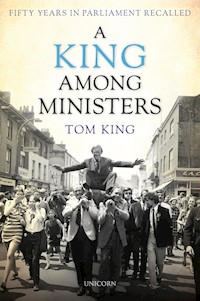
Tom King's personal memoirs range across a life of exceptional activity and interest. Aged nineteen, he found himself commanding a military company against Mau Mau terrorists in Kenya; at thirty he became the youngest ever general manager in a major printing and packaging group, in charge of a factory with a staff of 700 and dealing with nine different trade unions. Elected as an MP in 1970, nine years later he took through the legislation that transformed London's vast derelict docklands into the thriving business district of Canary Wharf. Subsequently his five Secretary of State roles saw him carrying through the law that gave union members the right to a secret ballot before a strike, then facing IRA terrorism and Unionist opposition when he launched what became the start of the peace process, then watching the fall of the Soviet Union and the Iron Curtain and being responsible for the massive UK deployment to help liberate Kuwait. Told with a sharp recollection of his fifty years in Parliament, Tom King's memoirs cover a particularly interesting period of history and his part in shaping the events that led up to the world we live in now.
Das E-Book können Sie in Legimi-Apps oder einer beliebigen App lesen, die das folgende Format unterstützen:
Veröffentlichungsjahr: 2020
Ähnliche














3
AKING AMONG MINISTERS
Fifty Years in Parliament Recalled
TOM KING
CONTENTS
INTRODUCTION
I never really intended this book to see the light of day for a wider public. I had it in mind originally as a memoir for my grandchildren, all born after I left office, and, up to now, blissfully unaware of this tangled web! However, as I remembered many of the remarkable events in which I was involved, I realised that they could well be of interest to a much wider audience and recognised how relevant some of the lessons learnt from them are to the challenges of today.
This memoir is certainly not a complete account of every step of the way, but rather the highlights of a fairly busy life, even before my arrival in Parliament, of which this happens now to be my fiftieth anniversary.
Some excellent schooling, which started under the threatening shadow of a German invasion in World War II, an adequate classical education, and a surfeit of sport led to a national service spent in part commanding, at the age of nineteen, a company on active service against the Mau Mau in the Kenyan forests. Then came Cambridge, and further African adventures.
This was an unusual preparation for a career in the printing industry and, as a young general manager of a large printing factory, I had an early immersion in difficult trade union relations, which were elsewhere doing such damage to the British economy at that time.
It was the relevance of that industrial experience that led friends and colleagues to encourage me to stand for Parliament, and after an early front-bench apprenticeship in opposition, I was ready for the major challenge of government, in which I served for Margaret Thatcher’s full term as Prime Minister and briefly also with John Major. I then decided to take a break, only to be invited back shortly afterwards to be the founder Chairman of the Intelligence and Security Committee, and later founder Chairman of Excel London, the exhibition centre.
I was proud to be part of a government under Margaret Thatcher that did much to restore Britain’s pride and regain respect in the eyes of the world. Of the five different offices I held in the Cabinet, the first two, Environment and Transport, were necessarily brief, but the next ones were longer – two 8years at Employment, culminating in the successful introduction of the requirement for secret ballots before strikes; four years in Northern Ireland, including seeing through the contentious Anglo-Irish Agreement, in which the acceptance of the principle of consent became a key ingredient in the start of the peace process, all against a background of some particularly nasty terrorist incidents; then three years in Defence, a most remarkable three years in the life of the Ministry of Defence, with the collapse of the Soviet Union and the tearing down of the Iron Curtain, followed shortly thereafter by the first Gulf War, involving the biggest deployment of British troops and heavy armour since World War II. This spectacularly successful war achieved its objectives in a remarkably short time and with minimal casualties, a model that should have provided a blueprint for any subsequent engagements, but which has sadly been ignored in both Afghanistan and Iraq to this day.
I was fortunate to be active in an exceptional period of years, with close involvement not just with Margaret Thatcher, but also with a raft of fascinating figures round the world, including an unplanned private meeting with Saddam Hussein in Baghdad, some years before the Gulf War; being hosted in Moscow by the Defence Minister, Marshal Yazov, later a leader of the conspiracy against President Gorbachev; working with Dick Cheney and ‘Stormin’ Norman’ Schwarzkopf; Charlie Haughey and Ian Paisley; François Mitterand and Helmut Kohl; George Bush and Teddy Kennedy; King Fahd of Saudi Arabia, Iain Macleod, Alan Clarke and Boris Johnson – and the crowning achievement of going viral on YouTube with my old friend Jean Trumpington, with her famous two-finger salute!
As I said, this is not an exhaustive account of every phase of an eventful life but rather seeks to present the main features and to include as well some of the lighter-hearted moments, which I hope will make for not only interesting but enjoyable reading as well.
1 FAMILY AND EARLY YEARS
In describing the history of my family, my researches have shown how ignorant I have been of it, and it has been a real pleasure to discover it now. Starting on my father’s side, my great-grandfather Tom King farmed at Chadshunt in Warwickshire. It must have been quite a considerable farm, because at the time of the Great Exhibition in London, in 1851, he took a fifty-strong party of his employees and their families to visit it. He sent my grandfather, also Tom King, to Mercombe House School at Overbury in Worcestershire, a house once owned by his uncle. This was later bought by Alfred Robinson, who changed the name to Kemerton Castle, and with the wonders of Google you can see that it was quite a substantial house – which further suggested that the King family was rather better established than I ever knew. It was at the school, when he was sixteen, that Tom King met Alfred Robinson, whose father owned the paper mill at Overbury. Alfred offered Tom a job in the paper business that he and his elder brother, Elisha Smith Robinson, had started in Bristol. Tom King accepted the offer and at the age of sixteen went to Bristol to join E.S. and A. Robinson. He worked there all his life, starting in the general office in the Redcliffe Street building; he then became a sales representative and subsequently, in 1898, a director. In 1917 he became managing director and retired in 1929.
An excerpt from the Board minutes of E.S. and A. Robinson Ltd dated 28 October 1929 states:
In accepting the resignation of Mr Thomas King, the board desires to place on record its keen appreciation of the great services he has rendered to the company. Joining as a boy in 1880 he rapidly advanced and was appointed a director in 1898, managing director in 1917. This period covers many important events in the company’s history including the disastrous fire in 1903, additions to the Bedminster works, the building 10of Malago and Fishponds factories, and the development and extensions of the company’s business in many directions. The company owes a debt of gratitude to Mr King not only for the energy and vision shown in the direction of the business, but for his constant exercise of an influence which is, to a considerable extent, responsible for the happy relations which today exist between all ranks of the company’s officers and workers. The board realises with much regret that Mr King’s health prevented him continuing his active association with the business he has served so faithfully for nearly fifty years and hopes that he still has many years of happy life before him.
The reference to his influence is echoed in other material, where it is clear that he took a great interest in the welfare of all the Robinson employees, as indeed did my father when he was the director responsible for human resources. TK’s influence extended not least to promoting the sports facilities that flourished with the Robinson teams. He gave real moral leadership to the business, introduced pensions for women employees, reduced the hours of work for all, and, together with my grandmother, took a particular interest outside the business in the Adult School Movement. They were strong supporters of Women’s Suffrage, and he introduced profit-sharing for all employees, similar to the scheme now operated by the John Lewis Partnership.
This of course became possible because of the success of the business, which started as a paper-merchant specialising in supplying paper and bags to shopkeepers. In those days shopkeepers had reels of paper to wrap the purchases. That moved on to bags, which were handmade. The real breakthrough came with the introduction of bag-making machines, which could work at fantastic speeds to meet the growing demand. I remember, when I joined the company in 1956, seeing two machines in the bag-making factory at Malago, in Bristol, totally committed to producing brown paper bags for Woolworths, millions per order. As retailing changed with the arrival of the supermarkets, so the demand for more sophisticated packaging grew, and Robinsons grew with it into a very big packaging group, with major competitors like Metal Box and Bowater’s. One major customer was its Bristol neighbour, W.D. and H.O. Wills, the country’s largest cigarette 11and tobacco company, and Robinson’s was particularly involved in the development of cigarette cards, a major feature of early cigarette packaging.
My grandmother was a Walters. Her family had been farming since the early 1800s at Cullompton in Devon, and in the 1850s there were three sons. The eldest inherited the farm, and the second, my great-grandfather, was a carpenter and builder, who moved to Bristol and built some of the fine houses in Clifton. The third had a particularly interesting life. He went into the army and served in both the Crimean War and the Indian Mutiny.
He then returned to England, left the army, and emigrated to Australia, taking his new wife and his horse with him. On arriving in Adelaide, he found his wife a place to stay and then rode out until he found somewhere that looked like Devon. That was Mount Gambier, on the South Australia/Victoria border. He secured some land, and, having collected his wife, proceeded to build a Devon farmhouse. He did it well enough for it now to be listed by Heritage Australia. From this enterprising beginning the Walters family flourished, and when my nephew, Giles Clarke, arranged to visit Mount Gambier to meet some of our relations, 300 people turned up.
Tom King having married Ada Walters, they had one son, my father Jack, although they subsequently adopted the illegitimate daughter of a doctor and a nurse. My grandmother was a strong Methodist, and the baby had been advertised in the Methodist paper. She was my aunt Molly, a very lively and artistic person.
My father gained a scholarship to Clifton College, and he was both a good classical scholar and a keen games player, good enough on the rugger field to play some games subsequently for Rosslyn Park. As well as a good cricketer, he was also a scratch golfer. He left Clifton in April 1918, joined the Army, and was sent to Officer Cadet School in Brighton on 1 May. He cannot have had too many illusions about what might await him in France, as the life expectancy for a young officer in the trenches was said to be ten days, and he had sat in the Clifton College Chapel every Sunday for the last four years, when the Headmaster would read out the names of the Old Boys who had been killed, many of whom had left only the year before and were well known to them all. The Armistice was signed just before he was due to go, but he then caught the Spanish flu. Luckily he survived the epidemic, which in the end killed more people than all those slaughtered in the war.12
He left the Army and went to Cambridge, where he gained a double first in classics and English. He used to write poetry and must have been an exceptional scholar as, in 1923, at the age of twenty-four, he was offered the post of Professor of English Literature at Tokyo University. I do not know if he was tempted to take it, but he turned it down, probably because he was an only son of quite elderly parents, and Tokyo in those days was obviously a very long way away. He was very lucky that he did not go. In the 1970s I met a man who had taken up a new position in Tokyo in 1923. He told me how he and his wife had sailed into Yokohama Harbour and were met and taken to their company house. Having barely unpacked, he reported for his first day in his new office in Tokyo, which came to an abrupt halt at 11.30am when the office fell down, and he found himself caught up in the horror of the Tokyo earthquake, which destroyed the whole city. Total chaos ensued, with huge casualties and all normal life destroyed. He set out to get back to Yokohama, to find his wife, but it took him three days through raging fires and total devastation. When he eventually reached his house there was no sign of his wife, and after searching everywhere for her, he finally sought refuge on an American ship in the harbour which took him to the safety of the Philippines. It was weeks before he discovered that his wife had also survived, and had been taken by a Canadian ship to Vancouver.
I subsequently discovered that after my father turned down the offer from Tokyo University, it was taken up in 1924 by the well-known poet Edmund Blunden, which suggests that Tokyo had been remarkably quick in getting back on its feet after the disaster.
Instead of Tokyo, my father went to join E.S. and A. Robinson, and stayed there for the rest of his life, save for serving in the RAF in an administrative role in World War II.
I now turn to my mother’s family. She was Molly Riches, the daughter of Cecil Riches, a dentist in Cardiff, with a home in Penarth. He was one of seven children of Eliza, Mrs Charles Hurry Riches, a famous figure in Cardiff. Eliza herself had come from a large family. Her father was descended from Fergus I of Scotland, and her mother was a Thomas of Raglan, who claimed 13descent from Llewellyn, the last native prince of Wales. Whether it was because there were simply too many children for the parents to cope, or for whatever reason, Eliza was subsequently adopted by a Mrs Wyndham Lewis. This lady had started life as a milliner, but had subsequently married a person of considerable wealth, owning substantial property in Wales but also a house at Grosvenor Gate in Park Lane, London. After Mr Wyndham Lewis’s death she married Benjamin Disraeli, and later became the Countess of Beaconsfield. The house in London became the scene of much entertaining, and she was an outstanding hostess in top political circles. Eliza grew up in this fascinating environment, and then married Charles Hurry Riches and moved to Cardiff. In later life she used to entertain her friends with stories of the social life of the Disraelis, with such guests as the Duke of Wellington, Sir Robert Peel, the Duchess of Kent (the mother of Queen Victoria), Louis-Napoléon, Marshal Soult, the Shah of Persia, Daniel O’Connell, and many, many more.
My grandmother was the daughter of Canon Bruce, the younger brother of the Marquess of Aberdare, who was descended from King David Bruce, the son of Robert the Bruce. I understand that the Bruce connection with South Wales started when they moved from Scotland at the time that James VI of Scotland became James I of England in 1603. To add to the historical interest, I discovered that her mother, Canon Bruce’s second wife, was an Olivier, and a relation of the great actor Laurence Olivier. I wondered how the Oliviers came to be in Wales, but apparently they were originally Huguenots from the Basque Pyrenees near Pau and, to avoid religious persecution, had fled from France, possibly first to Holland and then to England, as in 1688 an Olivier was chaplain to William of Orange.
The Riches family have certainly left their mark in a number of ways, with, more recently, a distinguished general and the captain of Glamorgan County Cricket Club. My favourite is my great-great-uncle, T. Hurry Riches, who was clearly an outstanding engineer and a brilliant teacher. I remember that when I was Secretary of State for Transport I went to make a speech at the Institution of Mechanical Engineers in Great George Street, by Parliament Square. My private secretary noticed the list of previous presidents. She thought that the name Hurry Riches was particularly apt, and was amused to find that he was my great-great-uncle.
I did a bit more research and discovered that at the age of twenty-seven 14he became the youngest ever superintendent of the Taff Vale Railway. He himself designed the motor trains that were a very important feature of the Taff Vale service. He was frequently consulted on the latest scientific advances, and on one occasion, when interviewed on the future development of British locomotives, he said that electric power would come but that it should be generated by means of the locomotive carrying a steam engine, which would produce enough power to haul the train. Having recently watched the laborious process of erecting overhead electric lines on the Great Western Railway, as these lines move to electric power I find myself wondering whether his idea could have been developed further, and thinking how much time could have been saved.
He held the position of superintendent for nearly forty years, and his fame was such that he became president of the Institution of Mechanical Engineers, in 1907 and again in 1908, having been previously elected as the youngest member of the Council. He was also chairman of the technical education committee of Cardiff Council, and there he gave enormous practical advice to hundreds of students, who subsequently showed their loyalty and respect by keeping him posted about any new development from wherever they were in the world. It was said that he was a student to the last, and that his great hobby was to inspire the young men of the city to seek to succeed in life, and to leave the world better than they found it in whatever spheres they were working. His addresses to the students were regarded as an admirable compendium of instructive facts and sympathetic advice – that sounds a very good combination.
My mother was the third of four sisters. I know little about their early life, except their holidays – because they used to come every year to what was later to become part of my constituency. I found out that they used to travel by steamer from Penarth to Minehead. There they would be met by a horse and cart, on which they loaded their luggage, and they would walk to a cottage they rented in Wootton Courtenay, on the edge of Exmoor. I do recall one story that clearly demonstrated the incredible change in means of transport during the twentieth century. In 1910 my aunt, Bobby, suddenly got appendicitis, and the doctor was needed urgently. The neighbouring farmer quickly saddled up his horse and galloped into Dunster. He woke the doctor, who in turn saddled up his horse and galloped back with him to 15Wootton Courtenay, using the means of transport that had been unchanged in country areas for a thousand years. Bobby lived to a good age, and shortly before she died she flew by Concorde to Australia to visit her son and his family, who had emigrated there.
But things changed very rapidly with the onset of World War I, and this was illustrated very clearly by a photograph that I have of my mother dressed in auxiliary uniform, standing by a large army car, when she was the driver of the pilot car on the occasion of the visit by the Prince of Wales, later Edward VIII, to South Wales. The picture came from a Cardiff newspaper in March 1918, when she would have been barely eighteen, and there could not have been many girl drivers at that time. What it also confirmed is that with the huge death toll of men in the war, girls were taking over many of the jobs previously done by men.
My father started work with Robinson’s in Bristol, but quite soon he was appointed area sales manager for Scotland, based in Glasgow. My father and mother had met before he had gone to Scotland. They married in 1928 and lived in Pollokshields until 1934. They made many good friends and my father certainly made the most of life there, becoming a scratch golfer and playing bridge for Scotland. However, it was the time of the recession nationally, and Glasgow was hit particularly hard. My mother worked as a volunteer in the Gorbals, and she never forgot the impact of the terrible poverty, with forty people sharing one tap in the tenement blocks in that most deprived part of Glasgow, and with the children in rags.
In 1932 my sister, Stella, usually known as Tess, was born and I followed one year later. In 1934 my father returned to Bristol as the director in charge of the colour-printing factory at Bedminster. The family came to live initially at Flax Bourton, just outside Bristol, our home until the war, when my father joined the RAF. In 1940 my mother rented a holiday bungalow at Mortehoe in North Devon, and while we were there the Germans started bombing Bristol. Although our home was a few miles outside the city, a large lighting system was installed on a nearby hill, and was switched on when the German bombers were coming, in the hope of fooling them that 16this was Bristol and its docks. When the bombing started, my aunt, who was in Bristol, suggested to my mother that we stay in North Devon and keep the bungalow that we had rented for the holiday.
At that time there was a real fear of a German invasion, and a number of schools in Kent and Sussex decided to move to a safer place. The first of these was a girls’ school called Bartrum Gables, from Broadstairs in Kent, right on the invasion coast. They found the Watersmeet Hotel in Woolacombe, a large hotel with understandably little business at that time, and moved the whole school there. As luck would have it, it was just down the hill from our bungalow and so Tess joined them. The headmistress said that I could join too, and for one term I was the only boy in this girls’ school. It was only one term because almost immediately another school arrived, this one for boys, St Michael’s from Uckfield in Sussex, which took over Tawstock Court, near Barnstaple, the substantial home of the Wrey family. My luck was that St Michael’s had an outstanding new young Headmaster, Cecil Cook, and was an excellent school. By modern standards it was very small, with only seventy pupils, but that made his impact all the greater. That was borne out for me in a photograph taken forty years later in Northern Ireland with Ian Stewart, the Minister of State, Air Vice-Marshal David Brook, Air Officer Scotland and Northern Ireland, and myself as Secretary of State, all contemporaries from this tiny school.
I was extremely lucky, in this oasis of peace in the North Devon countryside, to have such a good school, and it nearly never happened. With the fear of invasion, arrangements were being made for many children to go to Canada. My mother had in fact arranged for Tess and me to go and we had already acquired lots of warm clothes for the Canadian winter. Three times the sailing was cancelled, and then, fortunately, my mother decided to drop the idea.
At St Michael’s I had started to learn Latin and Greek with a delightful elderly master. I found one of his reports on me: ‘Considering the amount of time spent (a) chewing his pen, (b) staring out of the window, (c) doing (a) and (b) at the same time, the exam results were surprisingly good!’ With that encouraging endorsement I went to Rugby School. An Old Rugbeian friend had recommended to my father that I should go to Sheriff House, which had an outstanding housemaster. Unfortunately, by the time I arrived, 17he had suddenly died and his replacement, while he had a reputation as a demanding but very effective teacher, was quite unsuited to the wider role of housemaster. However, in my case this was more than compensated by the succession of exceptional teachers that I enjoyed in my various forms. I continued my Latin and Greek with them at Rugby, starting with a delightful man, James Hunt, who later rose to the position of Second Master and combined his classic teaching with producing the school play, in which I briefly appeared as an English soldier in Shaw’s St Joan.
I moved up a form, where my master was David Ashcroft, who went on to become Headmaster of Cheltenham College; I then joined the lower sixth form, called the Lower Bench, whose master was Michael McCrum. He arrived at Rugby with a first-class degree from Corpus Christi College, Cambridge, a degree course that had been interrupted by a couple of years’ service in the Royal Navy. He was an outstanding teacher, as his subsequent career so clearly confirmed. Having married Christine fforde, the Headmaster’s daughter, he was invited to return to Corpus Christi as the youngest senior tutor in any college. After eleven years in that role, he became Headmaster of Tonbridge School for a further eight years, and the climax of his career was as Headmaster of Eton for the next ten years, before returning to Corpus as Master. It was an outstanding career, and I was extremely lucky to be taught by him in my last years at Rugby.
I have many humorous memories of Rugby, two in particular. There was a tradition that the Head of House would write brief profiles of the other Sixth Form prefects in the House, and his deputy would write one of him. One year it was memorably said of the current holder, ‘He lived in a world of his own, in which he had great influence,’ and we have all met others that well fit that description!
Once we had a serious outbreak of athlete’s foot in the school, against which the Headmaster launched a major campaign. This couldn’t pass unnoticed in the New Rugbeian, a literary magazine run by the boys, in a parody of Jerusalem:
And did those feet in ancient time
Suffer from foot rot worse than ours,
And was that soft and healing balm18
On mantelpieces found in jars?
I will not cease by day or night,
I’ll powder yet through cold or heat,
Till we have brought back cleanliness
To Rugby’s green and rotting feet.
The particular feature of Rugby was the wide range of activities in which the boys (and in those days it was only boys) could take part. Of course, games were extremely popular, but many other activities flourished as well. One friend of mine from Sheriff went on to teach at Harrow School, and a particular difference that he noticed was that at Harrow then it was only the games players who were respected as the real stars by other boys, whereas at Rugby, if you were a good artist or a musician or had taken the lead in the school play, those achievements were also respected. I plead guilty to the charge that games certainly were my greatest interest, and I was lucky enough to be for two years in the 1st XI for Cricket, in the Rugger XV, and also Captain of Fives, Rugby Fives of course, a game that Rugby had invented. On the rugby field, I had the doubtful privilege in the Schools seven-a-side competition at Rosslyn Park of having to balance one side of the Rugby three-man scrum against the three-stone heavier Ewen Fergusson, a gigantic figure who went on to play for Scotland. We happily met many times again later, in less physically demanding circumstances, in his distinguished career in the Foreign Office, which he ended as an outstanding ambassador in Paris.
My cricket career was commemorated elsewhere in a question in the sports section of the game ‘Trivial Pursuits’, with the question ‘Which Cabinet Minister opened the batting at Lords?’ I fear very few would have got that right, unless they happened to know that the high spot of the season for Rugby was their game at Lords against Marlborough, and some smart question-setter had spotted that and linked me to it. A further item appeared in Wisden, the great annual record of all things cricket. As Secretary of State for Northern Ireland, I used to have regular police protection wherever I went. On one occasion in my constituency, in the village of Holford, I was asked to play in a team against the village, which was celebrating its centenary. Unfortunately there was some problem over the umpires, and two of my policemen volunteered to stand in. Wisden discovered this, and 19reported that it was the first occasion ever in a match where both umpires were armed!
Another enjoyable activity was the Rugby School Jazz Band, founded by a good friend of mine, Tom Lane. An excellent trumpeter, he later went on to start a band, the Red Hot Chillies, which became very popular in the Lincolnshire area where he farmed. He recruited me, with my very limited skills, to pluck the double bass as a noisy member of the rhythm section, and I found my batting gloves the ideal protection for my tender hands. Humphrey Lyttelton was our inspiration, and we made a tremendous noise.
Last of the Rugby memories was the Sheriff House play where I had the role of the bumbling Mayor in Gogol’s The Government Inspector. Three years later, I found myself playing it again at Cambridge, when Emmanuel College chose it. It would be nice to claim that my reappearance in the part was by overwhelming popular request, but sadly it was pure chance!
As my time at Rugby was drawing to an end, the question of National Service arose, which was then compulsory for men. You were required to serve for eighteen months, and so the plan was that I would sit the scholarship exam for Emmanuel College in October, leave Rugby in December, do my eighteen months’ service and go up to Cambridge in October 1953. However, the Korean War and other dramas had put extra pressure on the manning levels in the services, and so National Service was increased to two years. This meant that if I stayed to take the scholarship exam in October and left in December I would lose a year and not go up to Cambridge until 1954. It was then agreed that to avoid this I would leave at the end of the summer term in 1951 without staying to take the exam. I am suitably embarrassed now to say what happened next. As a former Emmanuel undergraduate, my father knew the Master of Emmanuel well, as he had been the senior tutor. My father wrote to the Master and told him that I could not now take the scholarship exam but that he still hoped I could come to Emmanuel. The Master, having heard that I was going to take the exam, and under the serious illusion that I must be a real chip off the undoubtedly impressive scholarship block that was my father, said what a disappointment it must be for me not to be able to sit it, but that I would certainly have a place at Emmanuel after my National Service. I don’t think I would ever have got the scholarship, and yet, without any exam or interview, I had a place at Emmanuel.
2 NATIONAL SERVICE, AFRICA, CAMBRIDGE AND FIRST JOB
For my National Service, I had applied to join the Somerset Light Infantry, the local regiment. I therefore started by reporting to the Jellalabad Barracks in Taunton. Our group was quickly transferred to the Light Infantry Training Depot at Bordon in Hampshire. There we spent eight weeks being knocked into shape by some very tough sergeants and corporals, trying their best to make soldiers out of some pretty unlikely material. From there, the depot moved to Strensall in Yorkshire, where I was promoted to a leadership platoon. I went next to Eaton Hall, where all the National Service infantry officers were trained, and four months later, as a second lieutenant in the Somerset Light Infantry, I was ready to join the regiment.
However, there was a problem. At that time the Somersets were in Malaya, on active service against the communist insurgency. They were due back in three months’ time, but I would have to do a jungle training course before I could join them. Because this would leave too little time before they returned from Malaya, I was told that I would be attached to another regiment in Germany, to await their arrival there.
While I was digesting this news, a fellow officer cadet, Charles Thatcher, suggested that there was an alternative option, that you could join the King’s African Rifles, the colonial regiment whose battalions were based in British colonies in East Africa, with British officers and African troops. His father had been a district commissioner in Nyasaland, so he was keen to return to Africa and encouraged me to go as well. As it happened I had an aunt, my mother’s youngest sister, who had gone to Kenya in the 1920s and married a white hunter. The lure of a few safaris and the excitement of Africa had obvious attractions over the reputed boredom of serving in Germany, and I jumped at the idea. As soon as we passed out at Eaton Hall as newly commissioned second lieutenants, it was full speed ahead to get our tropical 21kit and be ready to sail. And sail it was on His Majesty’s Troopship Empire Ken for our stately month-long voyage to Mombasa. Gibraltar – Alexandria – Suez Canal – Port Sudan – Aden – Mombasa: one whole month of my year’s commission spent sailing.
Once arrived at Mombasa, after a brief but delightful stop at the army Nyali Beach and Transit Camp (now I believe a popular holiday resort) it was off to join my new regiment, the Twenty-Sixth KAR, the Tanganyika battalion based in Dar-es-Salaam. Although Dar was only some 200 miles south of Mombasa there was no road down the coast, and getting there involved a night sleeper train going inland to Arusha, a further train journey to Korogwe, followed by a 200-mile road trip to Morogoro, and then another night sleeper down to Dar.
One advantage of the leisurely troopship journey from England was the chance to work on my Swahili. Although there are many different tribal languages, Swahili, spoken by the coast tribes, was the common language, having been spread through East Africa by the Arab slave traders, and it was used by the KAR. I was very fortunate that on the same troopship and bound for the same battalion was a major, Colin Dees, and his family. Colin had just finished as a company commander at Eaton Hall, having previously served in the KAR, and spoke fluent Swahili. I subsequently became the second lieutenant in the company he commanded, and was enormously grateful to serve under somebody who was an excellent soldier, a fund of knowledge about the KAR, and great fun as well.
The first requirement for a new officer joining the battalion was to test his Swahili. The Colonel’s technique could best be described as ‘total immersion’. A platoon of askaris, hand-picked for their total ignorance of English, was assembled. I was instructed to take them on a three-day patrol in the bush. Off we set, and amazingly my halting Swahili and some vivid hand signals combined to get us through and almost back safely to base. The only moment I remember when my command failed was on one of the evenings when I had chosen our campsite for the night. I marched confidently into the middle of a suitably large grassed area, followed by my platoon. I stopped in the middle and was just giving the order to pitch the tents when a shout went up from one askari, and the whole platoon turned and ran headlong back to the road. I then heard the shout of ‘mwaka’, and 22realised that I had marched right into a field full of snakes – the askaris had no intention of staying there!
Having survived my initiation without any other untoward events, I settled down into the normal life of a KAR regiment. Because of the climate, we worked from 6am to 2pm and then adjourned to the officers’ mess for lunch. One particular regimental tradition was the Wednesday curry lunch, with no less than thirty-five side dishes to accompany it. The Mess President, who had previously served with an Indian regiment, saw it as his personal responsibility to maintain the tradition, and used to spend the whole of his Wednesday morning in the search for all possible ingredients for the dishes from the markets in Dar.
The young officers were all billeted in a building next to the officers’ mess, which was overshadowed by a massive mango tree. After the Wednesday feast on a hot afternoon, siesta time was pretty popular, and as we snoozed on our beds, there would suddenly be a thud outside, and to an echoing cry of ‘embe’, a rush of naked officers would race out to seize the very juicy fallen mango.
The Ethiopian and Burma campaigns of World War II had shown the quality of the KAR, and the great endurance of the askaris. They were good fighters and excellent peacetime soldiers. One thing they particularly enjoyed was their drill and they took real pride in their appearance on any ceremonial parades. The washing, starching and pressing of their khaki drill, as well as the normal ‘bulling’ of boots, polishing of badges, et cetera, took up a great deal of their off-duty time but was willingly done.
In general, the conduct of regimental work was not dissimilar to that in any British regiment, but one significant difference was the treatment of minor offences. A particular problem was the smoking of bhang or hashish, which was strictly forbidden. The penalty for this was six strikes with the kiboko, a rhino-hide whip. The particular feature of this punishment was that it was administered not in some closed guardroom, but rather in front of the whole battalion on parade. The battalion would march on to the parade ground and form up in a hollow square. The culprit would be marched out to the middle, in his uniform but without his belt, hat, or rifle. The African regimental sergeant major would then ask the Colonel for permission to administer the punishment. He would march to the centre where the 23intended recipient lay face down on the ground. He would whip him three times from one side, then march smartly round to the other side and repeat the procedure. On completion of the punishment the soldier was handed back his belt, his hat, and his rifle and ordered to fall back into the ranks. The whole battalion marched back to the barracks, with the miscreant back in the body of the regiment, his penalty having been discharged and with no further record against him.
There was another offence that was peculiar to the battalion. It was a fundamental principle throughout the KAR that there should not be too great a concentration of any particular tribe in a section or platoon, but tribes would be mixed. There was one tribe, the Watende, whose particular feature was to distend their earlobes so that they hung down in a loop. On parade they were not allowed to let them hang and they had to be looped over their ears. However, at night, before sleeping, they let them down and if there were two Watende in adjoining beds, a favourite trick of askaris from other tribes was to tie a piece of cotton from the lobe of one askari to the lobe of another and then kick one of them! Very unfriendly and definitely punishable with the kiboko.
This leisurely period of colonial soldiering was all too brief. Barely a month after my arrival, the news came from Kenya of the Mau Mau emergency, with an urgent call for reinforcements to support the Kenyan KAR battalions. We were due to take over garrison duties in Mauritius, so it was decided to split the battalion, with two companies going to Kenya and the rest to Mauritius. My company stayed with the battalion, and so after all too brief a stay it was back on another troopship. Any idea of a gentle cruise through the Indian Ocean quickly disappeared as we sailed right through the most terrifying cyclone, which undid us all.
Mauritius itself was a delight, with much of its coastline and beaches quite unspoilt – this was long before the tourist boom that has now enveloped it. Indeed, the very first cross-Pacific air route to Mauritius was opened while we were there, when Air France launched a new service from Sydney to Johannesburg via the Cocos Islands and Mauritius. Part of their advertising of this exciting new route made great play with the fact that the stretch between the Cocos Islands and Mauritius was the longest flight anywhere in the world without sight of land. On the inaugural flight, one woman 24passenger became so overwrought at this news that the stewards had great difficulty in controlling her, and finally resorted to locking her in the only toilet. This had unfortunate consequences for the rest of the passengers!
The KAR provided the garrison for Mauritius, while the locally recruited Mauritian Guards served in the Canal zone in Egypt. A friend of mine at Eaton Hall, wondering what regiment he should try to join, discovered the existence of the Mauritian Guards and was attracted by the idea that this must be a crack colonial regiment. Just in time he discovered that the largely Creole regiment was hardly a frontline unit, but undertook less glamorous though essential tasks such as road-building, latrine digging and other pioneer tasks in Egypt.
The population of Mauritius was largely Creole, a mixture of the French immigrants who had come to plant sugar during the pre-Napoleonic period, when it was known as the Île de Maurice, and the large number of Indian workers who had been imported to work in the sugar plantations. Successive governors had expressed some concern about the stability of the population and that was the reason for a KAR garrison.
Our duties included ceremonial ones such as the opening of the new session of LegCo, the Parliament, by the Governor. Our company and regimental band provided the guard of honour to greet the Governor’s arrival and to salute him on his departure. Our barracks, on a high area of the island, at Vacoas, were pleasantly cool. LegCo was in Port Louis, at sea level, and noticeably warmer. This posed the usual challenges for soldiers standing on parade for a long stretch in the heat, but our askaris coped very well, and the drill was as good as anything at the Trooping the Colour on Horse Guards Parade in London. The particular problem was for officers. For this parade officers carried swords, and when the company was standing at ease, waiting for the Governor to reappear, they rested their swords point down on the road. The trouble was that the tarmac became soft in the heat, so the trick was not to rest your sword on the road but in the welt of your boot. One officer forgot this, and when he stood to attention and raised his sword, a good piece of tarmac came with it. He had to march off with it, unable to shake it off.
We stayed in Mauritius for three months and then swapped with the other two companies that had gone to Kenya, and thus found ourselves on active service against the Mau Mau. 25
The Mau Mau uprising involved the Kikuyu tribe in particular and was concentrated in the Rift Valley, the Aberdare Mountains and Mount Kenya. Our company was based in Nyeri, at Brigade HQ, and my platoon took over a forward base in the Kikuyu reserve, just behind the forest line of the Aberdares, where many of the Mau Mau – at that time estimated at some 12,000 – were based. Our job was to give support to the local loyal Kikuyu headmen, and to tackle the Mau Mau gangs in the forest. Our base was on one of the spines running down from the Aberdares, with steep river valleys on either side. Our huts were surrounded by a deep, wide trench, at the bottom of which was a mass of sharpened stakes and coils of barbed wire, a most effective obstacle against any night-time intruders. From there we patrolled by day and set ambushes at night in the forest. At that time there was little intelligence on the Mau Mau, whose efforts were concentrated on attacking the farms of European settlers, intimidating their workers, and killing loyal Kikuyu headmen opposed to them. Our presence undoubtedly boosted the morale of loyal Kikuyu, who took part in many of our patrols, and guided us to suitable spots for our night ambushes on the forest paths. Sadly, we were not always able to protect the loyalists. One night we learned too late of an attack on a headman’s home. As we rushed to protect him, we saw the flames soaring into the sky and found that he and his family had been burnt to death in their house by a Mau Mau gang, who had also killed those who had tried to escape the burning house.
These were the early and most dangerous days of Operation Jock Scott, the codename for the state of emergency established to confront the Mau Mau threat. As well as the thousands of them in the forests, they also had support lines throughout the Kikuyu Reserve, reaching as far as Nairobi. My own base area included Treetops, the famous tree-house for watching big game. It happened to be the home area of Dedan Kimathi, a particularly violent Mau Mau gang leader who had established his base there. We did have some limited success against smaller gangs, but we did not get close to Kimathi. That took another four years and the creation of pseudo-gangs of converted former Mau Mau, led by that remarkable Kenyan policeman and fluent Kikuyu speaker Ian Henderson GM, to finally capture him.
Two years later Henderson told the full story of this remarkable exploit in The Hunt for Dedan Kimathi, which he wrote with Philip Goodhart, 26the Daily Telegraph Africa correspondent at the time. Philip subsequently became an MP and was a very good friend and colleague for many years. Their book brings out vividly the extraordinary feel of the Aberdare Forest, where I had spent so much time in night patrols and ambushes.
Much of our work was physically and mentally pretty demanding, but we did get an occasional break, when we would descend on Nyeri for a few hours’ relaxation. I would leave a skeleton guard for our base and then drive to Nyeri in our two three-ton lorries with the remainder of the platoon. In an echo of a Wild West film, we would hitch our waggons to the rail outside the Indian general store of Osman Alu, and I would buy supplies for the next couple of weeks and load them on to the lorries. Meanwhile the askaris had time off for rest and relaxation, with strict orders to be back by 5pm, so that we could return to our base in daylight. Once, come the appointed time, it was clear that we were well short of the full number, and a search party was formed. What was also immediately clear was that the search party, under my command but led by an African sergeant major and two corporals, knew exactly where to go. The red-light district of Nyeri seemed to cover a considerable area of the town. As we moved from hut to hut with our Swahili greeting of hodi (‘hello’) and the response of karibu (‘welcome’), it was clear that the local ladies had enjoyed exceptional trade with the arrival of my platoon. In hut after hut we extracted askaris until we were at last at full strength, and could return to base fully refreshed in every sense!
After we had been some months on the Aberdares, the activities of another Mau Mau leader, under the intriguing name of General China, were causing some concern. He was operating on the other side of Nyeri in the forests on the slopes of Mount Kenya. My platoon joined the rest of the company when we moved to a farm on the foothills. In contrast to the unimproved nature of the Kikuyu reserve, this farm was a perfect example of how early settlers had transformed the land. In place of scrub and minimal grazing, well fenced and fertile fields sustained good-quality cattle, which they proudly exhibited at the Nairobi agricultural show. Their house was a charming ranch-style single-storey building, looking out over a well-kept lawn and lovely herbaceous borders, as English as could be.
From our base on this farm we became involved in a number of joint 27operations with other KAR companies. These consisted of major sweeps over very large areas, with a line of stops to catch any escaping terrorists. Over the right terrain these sweeps could be very effective, but in the forests of Mount Kenya and the Aberdares there was one particular problem, namely the abundance of big game. On our silent patrols in the forest, our presence was often betrayed by the shrieks of colonies of Colobus monkeys suddenly jumping from tree to tree high up in the canopy. A sudden disturbance in front could well be a herd of buffalo or waterbuck. While the presence of hitherto undisturbed game indicated that no terrorists were likely to be anywhere close, it obviously in turn betrayed our presence, and coping with this additional problem was a constant challenge. This was particularly difficult for new officers who had had no previous experience of the forest, as a new major, who had just taken over command of our sister company in 26 KAR, soon found out. We were all engaged in a sweep operation on Mount Kenya, and he was leading his group of askaris through the forest. They came to a particularly large mass of thorn-bushes. The askaris showed no great enthusiasm for investigating this large obstacle, so the Major decided to demonstrate the importance of checking everywhere and proceeded to crawl under the thorn branches into the middle of the clump. Unfortunately it was not a terrorist hideout, but the resting place of a rather large rhino. The animal was not at all pleased to be so rudely disturbed, and charged at the unfortunate Major, tossing him with his horn. Although badly injured, he was luckily not killed, almost certainly because the rhino had a broken horn.
Our operations included companies from other KAR battalions. One of these was the company of 5 KAR, a Kenyan battalion. Its company commander had previously served with the KAR in Burma and had developed a particular admiration for the qualities of Somalis as soldiers. He had managed to break the KAR’s cardinal rule of mixing the tribes right through a company down to platoons and sections, by creating an overwhelmingly Somali company. This had disastrous consequences in the campaign against the Mau Mau, who were overwhelmingly Kikuyu, a tribe that the Somalis particularly hated. The fact that the majority of Kikuyu were not involved with the Mau Mau terrorists was readily ignored by the Somali askaris, who left a trail of devastation, including rape, behind them. This was very damaging to the KAR’s reputation, and led, rightly, to the court 28martial of the company commander and the disbanding of the company.
After a brief stay at this farm, we moved further up the slopes of Mount Kenya to another farm. Soon after our arrival, my company commander, Colin Dees, developed jaundice and went into hospital, leaving me as acting company commander. The company at that time was on its own in its forest base, the Colonel was with the rest of the battalion in Mauritius, and I answered direct to the Brigadier, who was more than fully occupied with all his many responsibilities. Thus I found myself, aged nineteen, a National Service officer, in command of a company of three Kenyan Regiment sergeants and 120 askaris on active service. I remember, many years later, reading an article by the management guru Peter Drucker, who was asked what in his opinion was the best-run organisation or company. In those days IBM or Unilever or General Motors might have seemed likely choices, but he actually selected the British Indian Civil Service. His particular reason for choosing this was the way in which they gave enormous responsibility to very young people in the challenges they faced in the management of the vast subcontinent. I don’t know what Peter Drucker would have made of my position, but it was certainly an extraordinary experience. It was a great responsibility, and I am glad to say that we had no serious disasters in my time, but were able to continue to play our part in protecting the local population, and combating the terrorists in our area.
September finally came, and my two-year service drew to a close. No Troopship Empire Ken this time, as air trooping had started, and we flew home, I to return to Jellalabad Barracks in Taunton, transfer to the TA, and go off to Cambridge as a new undergraduate.
One further pleasure of serving in Kenya was the prospect of seeing my aunt, Jane Stanton. I had thought that my service in East Africa would have allowed for one or two relaxed safaris, but the Mau Mau emergency prevented that. I did see my aunt and uncle briefly in Nairobi but I was not able at that time to visit their well-known camp, Bushwhackers, close to the Tsavo National Park. One feature of Bushwhackers was a huge stockade, much used by film-makers who wanted good pictures of charging animals without the risk of dead film crews. The courage of Clark Gable and Ava Gardner in the face of a charging rhino, in the famous 1953 film Mogambo, owed everything to the Bushwhackers stockade. 29
After a brief stay at home it was off to Cambridge, to my father’s old college, Emmanuel, and back to studies. What was immediately apparent was the difference between the new undergraduates who had come straight from school and those who had spent the last two years on National Service. I had certainly had my share of interest and excitement during my time with the KAR, but it did not compare with other friends whose National Service had found them in Korea. There they had faced a full-scale war, in trenches, dug in at night, facing screaming charges of Chinese soldiers coming at them with fixed bayonets, an experience that not all of them survived. The relief of returning safely home was celebrated vigorously in the pubs of Cambridge, and it was some time before they settled down.
I had decided to continue with classics for my first two years, and I immediately had a problem trying to remember any Latin and Greek. I could conjugate the verbs, but the basic words were wrong, and I realised that I was muddling them up with Swahili words. This suitably confused my erudite supervisor, but fortunately I got back on-stream, and successfully completed Part One after two years. I then switched to one year on Archaeology and Anthropology, where my knowledge of Africa had a real relevance, and it was a most interesting course. I should perhaps confess that the great attraction of Cambridge was all those other activities that I remember best: rugger, hockey, cricket, and even a bit of rowing, including one series of Cambridge bumps in one crew of casual rowers for which I was the heaviest cox. I was also able to recreate my role as the Mayor in Gogol’s Government Inspector in the Emmanuel College play. Having been quite successful at school in sport, I soon realised how much tougher the competition was at Cambridge. I remember particularly that for cricket, I was offered a Freshman’s Trial, the opportunity for new undergraduates to be considered for the Cambridge teams. When my turn came to bat I found I was facing Gamini Goonesena, probably the best spin bowler in the country at that time and already playing first-class cricket for Nottinghamshire, later to become an outstanding Test cricketer. Unsurprisingly against such talented opposition, my Trial innings was extremely short!
One sport that I took up for the first time was skiing. Every December 30the Oxford and Cambridge ski clubs met in the Alps for an annual race. The first year for me was at Sestriere in Italy, the next year at Zurs in Austria, and finally for the last year back to Sestriere. They were wonderful parties and a great opportunity for me to learn to ski, the start of many happy skiing years. In my third year I reached the dizzy heights of Times ski correspondent to report on the races. I had to ring in my report to the paper in London, and they were amused to hear that I was doing it from my bed, as I had broken my leg. I remember that time for another reason. While we were in Sestriere, an Italian crew were filming an episode of Tolstoy’s War and Peace. This was the retreat of Napoleon’s army in the snow from Moscow, as the bedraggled soldiers dragged their guns and other equipment with them, their parts being played by a large number of Italian soldiers. One day a bunch of undergraduates pinched one of the cannons and took it into the Torre hotel where they were staying. The local carabinieri spotted this and chased after them. The hotel was a hollow tower, sixteen storeys high, with all the bedrooms facing outwards, and a spiral ramp up the inside. When the carabinieri entered the hotel they could see the cannon being carried up the ramp some three floors above and followed it up, knowing that they had now trapped the culprits. They followed them up all sixteen floors, only to discover when they reached the top that the gun had disappeared. They searched all the bedrooms on the way down, but never found it. It subsequently transpired that in one room they were met by a semi-naked student, greatly embarrassed, having been caught in the middle of a private engagement with his girlfriend. The carabinieri showed proper understanding of his embarrassment, immediately apologised and withdrew, not realising that the figure hidden under the bed-sheet was actually the cannon!
Cambridge at that time was buzzing with talent – not just sport, but theatre, music and entertainment all flourished. The Cambridge Footlights, a long-established group of outstanding entertainers, included Jonathan Miller and Peter Cook, and I well remember organising the cabaret for the Emmanuel May Ball, with Jonathan Miller and Rory McEwen, a wonderful young folk and blues singer who soon made his name on television.




