


Erhalten Sie Zugang zu diesem und mehr als 300000 Büchern ab EUR 5,99 monatlich.
- Herausgeber: Barbara Cartland Ebooks Ltd
- Kategorie: Gesellschafts- und Liebesromane
- Serie: The Eternal Collection
- Sprache: Englisch
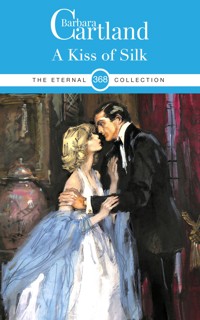
A collision with a handsome stranger makes Varia Milfield late for work. Summoned to see the boss, Sir Edward Blakewell, Varia braces for dismissal but instead is presented with a most unusual offer – to accompany Sir Edward’s son, Ian, on a business trip pretending to be his fiancée.
Though wary of Ian’s cool disdain, Varia cannot resist the generous offer and is soon swept off to France to help Ian seal the important deal within the silk trade. But what begins as a harmless charade quickly tangles into a web of deceit. Ian has promised to marry another and the dashing stranger, Pierre Chalayat, reappears to declare his love for Varia. Drawn by passion, Varia risks everything to meet Pierre in secret, but will her late-night assignations lead to her pretense being exposed? As Varia tries to understand the stirrings in her heart, is her future entwined with the Frenchman who professes love so boldly – or with the man she never expected to love at all? All is revealed in this story of discovery, transformation and true love.
Sie lesen das E-Book in den Legimi-Apps auf:
Seitenzahl: 352
Veröffentlichungsjahr: 2026
Das E-Book (TTS) können Sie hören im Abo „Legimi Premium” in Legimi-Apps auf:
Ähnliche




















Audiobooks
Listen to all your favourite Barbara Cartland Audio Books for free on Spotify, just scan this code or click here
Chapter One
“Come on, Fluff! We’ve got to hurry,” Varia spoke to the small white poodle, which was prancing about with so much excitement
that it was difficult to fasten the lead to his collar.
At last, however, she achieved it and then, running down the narrow mews, she reached the street and the traffic. It took only a few minutes to cross Kensington High Street and they were in the park, but they were minutes that Varia watched nervously because any delay meant that she would be late to the office.
She did not know how she had come to oversleep, because usually she awoke long before her alarm clock pealed out at half-past seven.
This morning everything had gone wrong. She had overslept, the alarm clock had not gone off, and these catastrophes were followed by others, all making her feel that she was racing against time, which was like an express train that could not help but overtake her.
Anyway, at last they were in the park and she was running, with Fluff bounding and barking beside her, as quickly as she could to where she could release him from the lead and let him have his morning gambol. There was a pale sunshine glinting over the trees and on the great beds of banked tulips, which were almost breathtaking in their colourful beauty.
And there was a wind which whipped Varia’s pale curls against her cheeks, bringing the colour into them and making her eyes shine as she called out in a panting voice,
“Not so quick, Fluff!”
The poodle was pulling her almost faster than her feet could carry her. Then, suddenly, it happened. A tall figure seemed to appear from nowhere. Varia tried to check herself, to pull Fluff to her, but he went one way and she another and with a sudden exclamation of surprise, the tall figure tripped over the lead.
There was a yelp of pain from Fluff before Varia let him go and he sped away across the grass, his lead trailing behind him, while she was left looking down at the figure of a man, sprawling on one knee, on the ground beside her.
“I am so sorry!” she said. “I do apologise. I can’t think how it happened. Are you hurt?”
A pair of twinkling, dark eyes looked up into hers.
“Do not apologise, ma’m’selle,” a deep voice with a faint foreign accent replied. “All is well, but I was, as you say, taken by surprise.”
“But I am so sorry about it,” Varia said. “We were hurrying and Fluff – that’s my dog – was pulling at his lead. I am afraid I wasn’t looking where we were going.”
The man got slowly to his feet. His trousers were dusty and there were some small spots of blood on his hand from the sharp stones on the pathway.
“Oh, you’re hurt!” Varia cried. “We must get something for your hand. Perhaps there is a chemist nearby.”
She looked round a little wildly as if she expected a chemist’s shop to spring up in the middle of Hyde Park. The stranger only laughed.
“It is nothing,” he said. “Please do not trouble yourself about it.”
“And your trousers!” Varia said. “They are so dusty.”
“Dust will brush off,” he answered reassuringly.
He smiled down at her and she realised how tall he was and, for that matter, how good-looking. But his dark sunburnt face, with high rather prominent cheekbones, deep-set dark eyes and a square forehead, all seemed somehow unimportant beside his smile. In fact, there was no doubt about it, his smile was irresistible.
“I can only say again how sorry I am,” Varia breathed.
“And dare I say that I am glad because it gives us an opportunity to introduce ourselves?” the stranger said. “We can consider this an introduction, can’t we? Even in England, where it is such an important preliminary to any conversation.”
Varia laughed – she could not help it – and he went on.
“As Fluff, who seems to have made up his mind to present us, has disappeared, may I tell you that I am Pierre de Chalayat, at your service?”
“You are French?” Varia asked.
“Didn’t you guess?” he replied. “I cannot believe that my English is so perfect that you thought me a fellow countryman.”
“No, I didn’t think that,” she said honestly. “But your English is very good.”
“That is because I love England and, of course, the English people,” he answered with an almost imperceptible little bow that somehow turned it into a very delicate compliment.
“My name is Varia Milfield,” Varia said. “And now, please, if you will accept my apologies again, I must catch Fluff.”
“Fluff is quite safe,” Pierre de Chalayat replied. “I can see him flirting quite outrageously over there with two very attractive lady dogs.”
Varia laughed again, not only at the way he said it, but because she suddenly felt carefree and light-hearted. Then, almost guiltily, she glanced at her watch and gave an exclamation.
“It’s ten minutes-to-nine,” she said. “I must go. I shall be late to the office. Please forgive me, and I do hope your hand will be all right.”
She turned as she spoke and ran away from him, hurrying to where Fluff was, in fact, behaving extremely badly with a whole circle of park dogs.
“Come along, Fluff!” Varia commanded. She picked up his lead and began running as swiftly as she could down Rotten Row with Fluff reluctantly following her.
She reached the offices where she worked at one second to nine o’clock. She was hot and breathless, but she had the satisfaction of knowing that it had not yet struck nine as she passed in through the imposing, porticoed front door in a street which opened just off Park Lane. She then hurried quickly down to the basement.
The caretaker’s wife, with a handkerchief round her head and a bucket in her hand, was just coming out of one of the rooms.
“I began to think you were going to be late this morning, Miss Milfield,” she smiled.
“So did I,” Varia replied.
“Ted was all of a fret in case the little dog didn’t come,” the woman said.
“How is Ted?” Varia enquired.
“He ’ad a better night, thank God,” the woman answered. “In fact, ’e seems to be picking up altogether. I can’t ’elp thinking that it’s that dog that’s done the trick. It seems to give ’im something to look forward to. I says to my husband, I says, only last night, ‘It seems to mean more to ’im than anything else’.”
“I’m so glad,” Varia said. “But I mustn’t stop here talking, Mrs. Huggins, I shall get the sack!”
“There was only one thing I was going to say to you, miss,” Mrs. Huggins said hastily. “You wouldn’t think of selling the dog, would you?”
“Oh, no! I’m afraid I couldn’t,” Varia said hastily. “Fluff isn’t mine. He belongs to my mother and she’s ill, very ill, and she loves Fluff. It’s only that it gives me a chance of giving him a walk when I come here and a walk when I go back at lunchtime that it makes it easy for Ted to have him. Oh, please, Mrs. Huggins, don’t set your heart on Fluff because I just couldn’t ask my mother to part with him.”
“I understands,” Mrs. Huggins answered. “It was only just an idea seeing as ’ow Ted ’as taken such a fancy to the little dog. But don’t worry your ’ead, Miss Milfield. You’ve been kind enough as it is. We’ll think of somethin’.”
“Yes, of course, we will,” Varia said. “You think, and I’ll think, and we’ll find something to keep Ted happy. I must go now.”
She sped up the stairs, through the hall, and taking the lift, pressed the button for the top floor. As she stepped out and opened the door of the big office, she saw at once that she was the last to arrive.
There was quite a chorus of, “You’re late again!”
“I know, I know,” she said. “Everything has gone wrong this morning.”
“Oh, don’t worry,” one of the girls said – a rather pretty redhead. “Old Cranky isn’t here.”
Varia let out a sigh of relief. She was terrified of Miss Crankshaft, the head secretary, who had served Blakewell & Co. for over thirty years and never forgot to let those under her know about it.
“You’d better tidy yourself, hadn’t you?” the redhead went on. “You look as if you’ve come through a haystack backwards!”
“That’s just about what I have done,” Varia laughed.
She slipped out of the office and went to the cloakroom at the end of the passage, and when she saw her reflection in the glass, she realised that it was about time she did tidy herself.
Her fair hair, blown by the wind, seemed to be standing up on end. Yet as she looked in the mirror her eyes, deep violet in colour, seemed to be alight with all the sunshine she had left outside in the park.
They were very large eyes, almost too large it seemed at times for the smallness of her little, pointed face. They were fringed with long, dark eyelashes, which curled upwards and gave her a slightly surprised, childlike expression as if she was always discovering something new and wonderful in the world on which she looked. Her mouth was full and there were two entrancing dimples in her cheeks when she laughed.
It was a happy, irresistible face. At the same time, it had a surprising, almost spiritual beauty about it, as if its owner had never come in contact with the harshness or ugliness of the world and saw only the beautiful side of everything.
Varia combed her hair, tidied her dress, washed her hands, powdered her small tip-tilted nose then, looking demure and, she hoped, efficient, she went back to the office. Her desk was next to the redhead’s.
“Is that better, Sarah?” she asked as she passed.
“Much better,” Sarah replied. “What have you been up to?”
“I had to run to get here,” Varia confessed. “I overslept and then I burned mummy’s breakfast, and I had to change her pillowcase, and the electric kettle wouldn’t work! Oh, just everything went wrong!”
“I know that sort of day,” Sarah sympathised.
“Then I ran into the park as I always do, and Fluff tripped up a stranger – that delayed me too.”
“That’s a new way of getting to know someone!” Sarah remarked. “Was he nice?”
“He was a Frenchman,” Varia said a little drily.
“You be careful,” Sarah admonished her. “You can’t trust Frenchmen. Was he an attractive one?”
“Very attractive,” Varia said.
“Worse and worse!” Sarah exclaimed. “It was quite obvious that Fluff didn’t trip him up, but he tripped Fluff.”
Varia laughed.
“Oh, no, it wasn’t like that at all, I promise you. And, anyway, I shall never see him again.”
“Don’t you be too sure,” Sarah said darkly. “These French have a way with them.”
“Oh, Sarah, you are absurd!” Varia smiled.
She set the paper in her typewriter and settled down to the copy work that had been given to her the day before. But all the same, she could not help thinking of the Frenchman and how his dark eyes had looked down into hers. Pierre de Chalayat! It was a nice name, a name she wouldn’t forget easily.
She wondered if he would remember hers.
“Daydreaming I suppose, Miss Milfield!” a voice snapped.
She looked up. Miss Crankshaft was standing there looking more formidable than usual.
“I’m sorry, Miss Crankshaft,” Varia said hastily. “I was just puzzling over what I had to do.”
“It’s not the first time I’ve had to speak to you, Miss Milfield,” Miss Crankshaft snorted. “And I don’t suppose it will be the last. You waste more time than any other girl in this office. Come along now, if you please.”
“Come along?” Varia questioned. “But where to?”
“Sir Edward wishes to see you.”
“Sir Edward!” Varia gasped. “Whatever for?”
“That you will doubtless learn in due course,” Miss Crankshaft replied impressively. “Sir Edward has asked to see you, and he does not like to be kept waiting.”
Varia got to her feet, feeling suddenly apprehensive. Was she to get the sack? She couldn’t think of any other reason why Sir Edward would wish to see her. And yet, she told herself reassuringly, it was not usual for him to dispense with the services of employees. That was usually left to the manager. It wasn’t even Friday, she thought. What could he want with her?
Her thoughts were racing, but automatically she followed Miss Crankshaft out through the office door and down the stairs to the first floor. Miss Crankshaft disdained to use the lift, thinking it was a new-fangled innovation that, as she put it, “spoiled the character of the offices.” She preferred them as they had always been.
It was as they nearly reached the doors of the directors’ offices that Varia said timidly,
“What do they want to see me about?”
“You’ll soon find out,” Miss Crankshaft said uncompromisingly. And then looking at Varia’s face, which had suddenly grown white, she added in a surprisingly kind tone, “I don’t know myself, as it happens. But don’t be frightened. Sir Edward’s bark is much worse than his bite.”
“But what can I have done?” Varia said.
“I don’t know,” Miss Crankshaft replied honestly. She gave Varia a quick look as if to reassure herself she was neat and tidy, and then she knocked on the door and opened it at the same time.
“Miss Milfield, Sir Edward,” she said, and ushered Varia into a large, imposing room that she had never entered before.
The walls were panelled and there were two large desks that seemed to take up an unconscionable amount of space. Seated at one of them was Sir Edward Blakewell – standing beside him was his son, Ian.
Varia knew Mr. Ian Blakewell well enough by sight. He came regularly every day to the office and was, she knew, about twenty-eight years of age, extremely clever and very unapproachable. He was not like his father, she had heard the older clerks say. Sir Edward bawled you out all right, but he always had a cheery word for everyone and knew more about his staff than they knew about themselves.
But since Varia had been working for Blakewell & Co., Sir Edward had come to the office very seldom. He had been abroad all the winter and she had, in fact, during the four months of her employment, only seen him two or three times in the distance.
Now, as she faced him across the desk, she saw that he was, in fact, not so frightening as she had anticipated. He was not a large man and was, in reality, rather thin and pale. Only his shrewd penetrating eyes gave her the impression that he missed nothing.
For a moment there was silence and both men – the older and the younger one – seemed to stare at Varia. Then, almost explosively, Mr. Ian Blakewell said,
“It’s impossible, Father! I tell you, it’s quite impossible!”
“And I tell you it’s the only thing we can do,” Sir Edward replied.
“I disagree,” his son retorted. “And, what is more, I wish to have no part in it.”
Sir Edward brought his fist down violently on the table and in that moment he became galvanised into a dynamic force. Varia could feel the strength of his determination vibrate across the room.
“What do you mean, you’ll have no part in it? You’ll do as I say. Am I the head of this firm or am I not? Am I thinking of our best interests, and also your future, or am I going to mess up what is one of the biggest things that has ever come our way in the whole lifetime of trading?”
“Yes, yes, I know, Father,” Ian Blakewell answered. “But there must be something else we can do, not this at any rate.”
“This is the only possible get out,” Sir Edward snapped.
Ian Blakewell shrugged his shoulders and, turning from the desk, walked almost petulantly towards the window.
‘What a disagreeable young man he is,’ Varia thought to herself.
She felt almost sympathetic to Sir Edward because it was obvious that whatever they were arguing about he was sincerely convinced that what he wanted to do was the right thing, while the younger man merely seemed obstructive.
“I must apologise, Miss Milfield,” Sir Edward said with a sudden, old-world courtesy. “My son and I are having a little argument, and we have been rude enough to ignore that you have joined us. Won’t you come and sit down?”
A little embarrassed, Varia seated herself on the chair he indicated on the other side of the desk. Sir Edward looked at her, and she looked at Sir Edward and she found, to her surprise, that they were both smiling.
“You are very like your mother, my dear,” Sir Edward said quietly.
“My mother!” Varia exclaimed.
She had expected, when she came to the office, to hear something unusual, but certainly not this.
“Yes, very like her,” Sir Edward said. “In fact, looking at you I might be stepping back twenty-five years into the past.”
“You knew my mother then?” Varia asked.
“Yes, indeed,” Sir Edward said. “I remember her very well indeed and I think perhaps she will remember me.”
“I must ask her,” Varia said. “She didn’t say when I told her where I was working, that she had ever met you.”
“As it happens, she would not know me by the name of Blakewell,” Sir Edward said. “My uncle on my mother’s side left me a considerable sum of money about five years after I knew your mother, on condition that I changed my name to his.”
“Oh, I see,” Varia said.
There was a sudden silence while Sir Edward stared at her, and yet she had a feeling that he was not seeing her but her mother.
‘What does all this mean?’ she wondered and almost ventured a question of her own when Ian Blakewell turned from the window.
“Really, Father! I think we should discuss this again without Miss Milfield being present.”
“What I have to say concerns Miss Milfield and therefore I wish her to be here,” Sir Edward replied.
Varia looked from one to the other, perplexed. Ian Blakewell was scowling and, as his eyes met hers, the frown between them grew even deeper.
‘I believe he dislikes me,’ Varia thought. ‘Why? Why?’
“Miss Milfield, I will come to the point,” Sir Edward said, “and that is that I have asked you here to know if you will do the firm a great service.”
“But, of course!” Varia replied. “If it is something I can do.”
“You can help us in an unusual and certainly, I think, unique way,” Sir Edward said.
“Father, I beg of you…” Ian Blakewell interjected.
“Will you be quiet!” Sir Edward said sharply. “Let me handle this in my own manner.”
“Very well then,” his son retorted. “But I wish to put on record that I disapprove utterly and completely of the whole scheme.”
“And now perhaps you will allow me to continue,” Sir Edward said sarcastically.
He turned again to Varia.
“I am going to explain to you very briefly,” he said, “the situation in which we find ourselves. You know, having worked here for some months, that we are the oldest and the largest importers of silk in this country. We do not manufacture but we have, in the last few years, set up a laboratory to make certain experiments in the treatment of silk and the preservation of it. It was a sideline in which I became interested, perhaps ten years ago, and was always considered a sheer waste of money by the rest of the directors and, in particular, by my son.”
He shot a glance at Ian who had seated himself now at the other desk and was obviously engaged in doodling on the blotting paper with a pencil. He did not look up, but Varia realised that he was listening tensely and, she was convinced, hating every word of what he heard.
“My investigations were, however, not as fruitless as might have been anticipated,” Sir Edward went on. “In fact, the scientists I engaged have discovered a new process that will, when put into use, completely revolutionise the silk trade. To put it briefly so that you can understand it, my dear, we have invented something that will not only preserve silk and prevent it from deteriorating or becoming discoloured but will also prevent it from creasing, however badly or roughly it is handled.”
“How wonderful!” Varia exclaimed.
“Yes, indeed, it is wonderful,” Sir Edward agreed. “And that is what all those who are anxious to buy our process apparently think.”
He shot another glance at his son and then went on,
“You will understand, Miss Milfield, that there is going to be very hot competition for this particular invention, but we are, in fact, morally bound to offer it first to the silk merchants from whom the great majority of our importations come – Duflot in Lyons.”
“Oh, yes! I’ve heard their name,” Varia said.
“If you worked here even for a day you would have heard it,” Sir Edward told her, “because we have worked very closely with this company ever since we ourselves started. Our businesses are, in fact, as closely linked as two businesses possibly could be. Monsieur François Duflot has been a faithful and loyal associate of ours and I have the greatest respect for his business ability.”
“Yes, of course,” Varia said, feeling that something was expected of her, but wondering where this story was leading.
“And now I come to the point,” Sir Edward said. “Monsieur Duflot has agreed to take over this process from us, to use it in his company’s factories and to let us have the exclusive right to import every piece of silk that they treat in this manner. Now you understand what that means?”
“Yes, I think so,” Varia said a little doubtfully.
“It means,” Sir Edward said impressively, “that as we shall be the sole importers, everyone in the British Isles will have to come to us if they wish to buy this particular sort of silk that has been treated by the Blakewell method. And they will want to buy it, because I assure you the silk has an immeasurably longer life, and also by the fact that it does not crease, it will appeal to everyone who wishes to wear silk in any shape or form.”
“But, how wonderful for you!” Varia smiled.
“Wonderful, indeed,” Sir Edward agreed. “But there is a snag.”
“Father! I beg of you…” Ian interrupted.
Sir Edward ignored him.
“The snag is that to be quite certain there is no question of us letting anyone but the Duflot Company have this clever invention, Monsieur Duflot has suggested an even closer alliance between our two families. He wishes, in fact, for my son to marry his daughter.”
“Oh!”
The reaction came spontaneously from Varia’s lips. She began to understand now what all the argument was about.
“You see, my dear,” Sir Edward went on, “on the Continent they do arrange these things. I know the French very well and although they have become slightly more emancipated in the past few years, in all the solid business families, as well as in many aristocratic circles, marriages de convenance are still arranged as a matter of course.
“It means that the dowry is properly apportioned, that each family gains something by the marriage, and it completely eliminates any of these mésalliances which happen so often amongst our friends and even in our own f…” Varia looked shocked.
“Love! That is the English point of view,” Sir Edward continued. “Love comes very often when two people are ably suited and when they have the same interests. And if it doesn’t, well the French expect both husband and wife to amuse themselves so long as there is no scandal.”
“It doesn’t sound to me a very happy idea,” Varia faltered.
“Perhaps you are right,” Sir Edward replied. “Anyway, such arrangements are obviously repugnant to English people. But here is the difficulty. I cannot offend my old friend, François Duflot, by telling him that my son will not – under any circumstances – contemplate marrying his daughter.”
“Would he be very offended?” Varia asked.
“He would not only be offended,” Sir Edward replied, “he would not understand.”
“Then you should make him,” Ian Blakewell interposed.
“My dear Ian, one cannot change a man. François has great points. Where business is concerned there is no-one shrewder, more intelligent or more progressive. But as a family man, as a middle-class Frenchman, that is a very different thing. He does not understand our customs and habits, and we do not understand his.”
Sir Edward sighed before he continued,
“I could not make him see that you do not wish to marry as a matter of principle. He would take it as a personal insult – so personal, indeed, that our business arrangement together would be affected.”
“It’s fantastical! Impossible!” Ian Blakewell exclaimed angrily.
“When you have seen François Duflot in his own home, then you will understand,” Sir Edward said coldly. “And now, Miss Milfield – or may I perhaps call you Varia because I knew your mother many years ago? – I will get down to business.”
“To business!” Varia echoed in a bewildered tone.
“Yes! This is where I want you to help us,” Sir Edward said. “My son has to go to France to arrange the contracts between Blakewell and Duflot. I want you to go with him.”
“But am I experienced enough?” Varia asked. “I’m not very good at shorthand.”
“I’m not asking you to go as a secretary,” Sir Edward replied. “I’m asking you to go as my son’s future wife!”
Varia opened her mouth to speak but no sound came. For a moment she just stared at Sir Edward, thinking he had taken leave of his senses. And then, as he saw her face, he exclaimed quickly,
“Unofficially, of course, and as far as we are concerned, this will be entirely a business arrangement. I have thought it all out. I am quite certain it would work admirably. You will go with my son to Lyons. I will write saying that he is bringing with him his future wife although the engagement is not yet announced publicly. You will spend a week there and then return to this country. Later, perhaps one month, perhaps two months later, I shall write to François Duflot and tell him that the engagement is unfortunately terminated as it is felt you are not temperamentally suited. What do you think of my idea?”
“But I-I don’t know what to say,” Varia answered a little helplessly, looking from Sir Edward to the scowling young man across the other side of the room.
“As far as I’m concerned you can tell my father it is quite ridiculous,” Ian Blakewell said in a hostile tone. “It is an insult to you, and to me. If François Duflot is so old fashioned and out of date that he doesn’t understand that a man wants to choose his own wife, then it’s about time he learned that other people in other countries have a more sensible outlook.”
“Ian! Ian! We have been over this before,” Sir Edward snapped. “I’ve told you François would not understand. You know what it means to us to have the biggest and most influential firm in France take up our invention. There is no-one else in the same category as Duflot, there is no-one we have dealt with who even begins to be as suitable. We cannot throw this away for the sake of some silly prejudice on your part.”
Ian Blakewell did not answer and Sir Edward turned to Varia.
“Will you do this for the firm?” he said. “Will you do it for me? And, most of all, will you do it for your mother?”
“For my mother?” Varia questioned.
Sir Edward looked down at his desk. For a moment she fancied he was embarrassed.
“I have taken the trouble to find out your position,” he said. “I knew soon after you came to work here who you are. I happened to pass you on the stairs and realised by your likeness to your mother. I have since learned of your father’s death and of your mother’s illness. I have found out, too, that she is not having all the comforts she needs.”
Varia flushed crimson.
“We cannot afford them,” she muttered.
“I know that,” Sir Edward answered, “and I know that your relations are too poor themselves to be able to help. That is why I was going to suggest that if you will do this for me, if you will go with my son to France, I will pay you for your services one thousand pounds!”
“As much as that!” Varia exclaimed.
“It is not very much for what we shall gain in return,” Sir Edward replied. “But I think you would be able to help your mother, perhaps, to better health.”
“She could go to Switzerland,” Varia said almost beneath her breath. “The doctor spoke of it. We all knew it was impossible.”
“Yes, she could go to Switzerland,” Sir Edward agreed.
Varia drew a deep breath and then she said suddenly,
“But I don’t think she would agree. I don’t think she would allow me to do this even if I were willing.”
“Must you tell her?” Sir Edward enquired.
“Really, Father!” Ian Blakewell interjected. “This sort of bribery and corruption should have been beneath your dignity, I should have thought.”
There was something in the way he said it, something in the angry tone of his voice, that aroused Varia’s antagonism. What right had he to be so against an arrangement in which the only person to suffer would be herself? It wouldn’t hurt a man to pretend to be engaged to a girl, but it was certainly damaging for a girl to have to pretend to be engaged to a man she didn’t know and had hardly seen before.
What was more, he seemed to dislike her, which in itself was an insult.
She felt her heart leap at the idea Sir Edward presented to her. Her mother could go to Switzerland. A month out there might make all the difference – the doctor had said so. Perhaps her mother need never know how she got there. Perhaps she could concoct some wonderful fund that had come forward to assist her. Her mother was so ill that she wouldn’t ask many questions.
A thousand pounds! It was a fortune!
She realised that Sir Edward was watching her face, and as she looked up and met his eyes he smiled at her, and she saw there an anxiety which made her suddenly warm towards him. This meant so much to him, and it meant a lot to her too.
“Perhaps you’ve guessed,” Sir Edward said quietly, “that once I loved your mother. She refused to marry me because she was already in love with your father and because, too, I was not worthy of her. But I have never forgotten her – never!”
He spoke in a low voice almost as if he wished his son not to hear.
Ian Blakewell was still drawing on the blotting paper. Quite suddenly he threw the pencil down with an irritated, angry gesture that sent it spinning across the polished surface of the desk and, ricocheting off the inkpot, it fell onto the floor.
Then he looked up and Varia met his eyes. She felt something disturbing and antagonistic pass between them. There was a hostility that was almost alive it was so violent. He was challenging her, she thought, and knew in that moment that she had made up her mind.
She turned defiantly towards Sir Edward.
“Thank you,” she said quietly. “I will accept your proposition, and I will go to France with your son.”
Chapter Two
Varia looked round the little mews flat that had been her home for nearly six years and thought how empty it seemed. Her mother had left by air that morning for Switzerland and Varia had watched the aeroplane out of sight with tears in her eyes. They had been tears of joy, the joy of knowing that she had been able to provide what the doctor had called “a quite reasonable chance of recovery” for her mother.
It was lucky that Mrs. Milfield had really been too ill to ask questions.
She had been only too ready to accept what the doctor and Varia had told her, and when they mumbled over their explanations and did not really answer her questions as to how the journey was to be paid for, she was too exhausted to question them further.
They talked vaguely of “a grant from a charity that provided for cases such as hers” but what it all came down to was that Mrs. Milfield was too ill either to listen or to argue. Varia, who had foreseen a thousand difficulties, found that everything proceeded far more smoothly than she had dared to hope.
“You’ll get well, darling,” she said to her mother. “That’s all that matters. Don’t worry about anything else. Just get well. I need you so much.”
Mrs. Milfield had tried to smile in response and then said weakly,
“Who will look after you when I am away?”
“I shall be all right,” Varia said. “I promise you.”
“You can’t stay here alone.”
“Not all the time,” Varia answered. “I’m going to stay with friends – friends of the Blakewells.”
She half expected her mother to protest, or at least to enquire why she should be on social terms with the Blakewells, but Mrs. Milfield was too ill.
“As long as you will be all right, darling,” she murmured, and closed her eyes as if even the effort of thinking was too much.
It was the doctor who decided that everything should be done quickly. He had telephoned the sanatorium in Lausanne, arranged for Mrs. Milfield’s passport and ticket, and ordered an ambulance to take her to the aerodrome. There was really nothing for Varia to do but to pack her mother’s few things in a suitcase and hand her over to the efficient young nurse who was to travel with her.
Never had she been so glad of anything as to have enough money to ensure that the journey itself was comfortable and that everything possible was provided. Only when she came back alone to the mews flat did she begin once again to think of herself, to remember that this had all got to be paid for by her journey to France with Ian Blakewell.
But she was too happy to feel depressed about it. A thousand pounds had changed her life overnight and even if it was going to be difficult, and perhaps embarrassing, to pretend to be Ian Blakewell’s fiancée, she had only to endure it for a short time and then she would be free again – free, if necessary, to find a new job.
All the same, she felt a sudden little sinking of the heart as she looked round the familiar flat and remembered that she had made an engagement to meet Sir Edward Blakewell at three o’clock. It was now half-past-two and feeling that it was a somewhat auspicious occasion she put on a small white hat and gave the grey coat and skirt she was wearing a brush, hoping that if it looked tidy he would not see how worn it was.
She had another job to perform this afternoon and that was to take Fluff to stay with Ted Huggins until her mother returned. She knew how excited the little boy would be, but it would be a perfect solution to the problem of what to do with Fluff while she was in France.
“Come on, Fluff,” she said as he sat watching her, his funny little white head cocked on one side as he tried to understand what she was saying to him. “You’re going to stay with Ted. You like Ted, don’t you? The only trouble is, I’m afraid they’ll kill you by kindness. You’ll get so fat that I shall have to take a fortnight’s holiday as soon as I get back to walk it off you. Come on, walkies!”
At the word ‘walkies’ Fluff started to bark with excitement and jump about in clearly expressed delight. Varia fixed the lead on his collar and then they walked downstairs together, Fluff pulling and tugging, as he always did, in his efforts to get into the park.
It was only as they crossed Kensington High Street that Varia found herself thinking of the Frenchman to whom Fluff had introduced her at the beginning of the week
‘Was it only four days ago?’ she wondered. It seemed impossible. So much had happened since then and she felt as if an aeon had passed since she last came this way into the park.
“Go home, make arrangements to get your mother to Switzerland, and then come back and see me on Thursday afternoon,” Sir Edward had commanded.
“Shall I say anything in the office?” Varia had queried, thinking of Miss Crankshaft’s disapproving face and of the girls’ curiosity.
“No nothing,” Sir Edward said. “We don’t want a lot of gossip.”
Varia thought there would be a tremendous amount of gossip if she just disappeared, but this was difficult to explain to Sir Edward and she just left it as it was. Now she wondered what she was to say to the girls. For one thing, they would never believe the truth, even if she were allowed to relate it.
They didn’t like Ian Blakewell very much. She remembered now lots of things they had said about him, calling him “stuck up”, a “stuffed shirt” and various other rude descriptions which all boiled down to the fact that they found him unapproachable as he didn’t seem interested in them.
“Mr. Shirty!” Sarah had called him, but then Sarah always had something impudent to say about everyone and Varia felt herself smiling now at the idea of Sarah’s astonishment if she knew that she, Varia, and “Mr. Shirty” were going to France together.
‘What a pity I can’t tell her,’ she thought. A joke lost half its flavour when there was no-one with whom to share it.
She was so deep in her thoughts that it was only Fluff’s yelping and barking and pulling at the lead which reminded her that she had reached the part of the park where he was allowed to go free. She bent down to undo his lead when a voice beside her said,
“At last, I’ve found you again.”
She looked up and saw, with a surprising lack of astonishment, that the Frenchman stood there – Pierre de Chalayat.
“Hello!” she said, and knew, as she said it, that some sixth sense within her had known that he would be there.
“Where have you been?” he demanded. “I have been here every morning. I have come here every afternoon. I began to think that I had just imagined you, that you never existed.”
“I have been busy,” Varia answered, but her eyes fell before his and she felt the colour rise just a little within her cheeks.
“But how could you be so cruel?” he asked. “Did you not know that I should want to see you again?”
“How could I know it?” she replied.
“You do not know what I have been through, thinking I had lost you,” he said. “When you ran away like that, without looking back, I was too bemused, too stupid for the moment to run after you. It was only when you had gone that I began to get frantic, and then I thought to myself, ‘She will come tomorrow. Of course, she will come tomorrow.’ Why? Why did you not come tomorrow?”
Varia laughed.
“I was too busy,” she answered.
“Too busy to think of me, obviously,” Pierre de Chalayat said almost in tones of despair.
“But why should I?” Varia enquired. “After all, we were just strangers who met by chance.”
“Do you really believe it was chance?” he asked. “Do you not think that it was planned since the very beginning of time that you and I should meet on just that spot?”
Varia found herself being hypnotised by the almost irresistible attraction of his voice. With an effort she forced herself to answer lightly,
“I think you are talking nonsense,” she said. “And really we ought not to be talking at all. It’s very unconventional!”
“Mon Dieu! You English! So respectable, so straightlaced where the conventions are concerned. Fluff introduced us, but Fluff, as you see, is a dog. What difference would it have made if we had met at a crowded cocktail party and the hostess had mumbled, ‘Mr. er um! Miss. er um? You would not have heard my name – I should not have heard yours. But, voila! We are introduced! It is respectable!”
Varia laughed again.
“When you put it like that, you make it sound so ridiculous that I have to agree with you. But you know quite well that all nice girls have been warned about picking up strange men in the park.”
“I know! I know!” he said. “But I am not a strange man anymore. I am Pierre! Do you remember? Pierre, who has been thinking about you, looking for you and longing for you for four days. But this time I feel I have known you since we were children together in our prams.”




