


Erhalten Sie Zugang zu diesem und mehr als 300000 Büchern ab EUR 5,99 monatlich.
- Herausgeber: Robert Hale Fiction
- Kategorie: Abenteuer, Thriller, Horror
- Sprache: Englisch
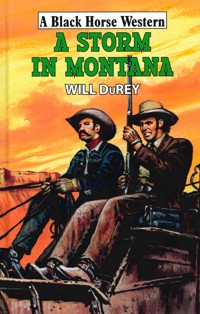
Clancy Jarrett possesses a quick and violent temper and the citizens of Brannigan are careful not to cross him. But when his stagecoach hold-up is thwarted by three trail-herders his rage cannot be contained and with revenge on his mind soon there are bodies piling up. For the cowboys, their status as heroes is short-lived and when Jarrett learns they are escorting Kate Jeavons, a dance-hall girl whose sister he has captive, to testify against him, they are firmly in his sights. Black clouds are forming overhead, but which storm will break first: the wild prairie rain, or the deadly guns of Jarrett and his crew?
Sie lesen das E-Book in den Legimi-Apps auf:
Seitenzahl: 215
Veröffentlichungsjahr: 2017
Das E-Book (TTS) können Sie hören im Abo „Legimi Premium” in Legimi-Apps auf:
Ähnliche













A Storm in Montana
Clancy Jarrett possesses a quick and violent temper and the citizens of Brannigan are careful not to cross him. But when his stagecoach hold-up is thwarted by three trail-herders his rage cannot be contained and with revenge on his mind soon there are bodies piling up. For the cowboys, their status as heroes is short-lived and when Jarrett learns they are escorting Kate Jeavons, a dance-hall girl whose sister he has captive, to testify against him, they are firmly in his sights.
Black clouds are forming overhead, but which storm will break first: the wild prairie rain, or the deadly guns of Jarrett and his crew?
By the same author
The Hanging of Charlie Darke
The Drummond Brand
In the High Bitterroots
Return to Tatanka Crossing
A Storm in Montana
Will DuRey
ROBERT HALE
© Will DuRey 2013
First published in Great Britain 2013
ISBN 978-0-7198-2326-8
The Crowood Press
The Stable Block
Crowood Lane
Ramsbury
Marlborough
Wiltshire SN8 2HR
www.bhwesterns.com
This e-book first published in 2017
Robert Hale is an imprint of The Crowood Press
The right of Will DuRey to be identified as author of this work has been asserted by him
in accordance with the Copyright, Designs and Patents Act 1988
For my friends, Pru, Deb and Helen, each a consistent source of encouragement.
Contents
Prologue
Chapter 1
Chapter 2
Chapter 3
Chapter 4
Chapter 5
Chapter 6
Chapter 7
Chapter 8
Chapter 9
Chapter 10
Chapter 11
PROLOGUE
It was dark when Jake Devane hitched the two horses in a stand of trees beyond the fence that surrounded Clancy Jarrett’s yard. He approached the cabin stealthily, the derringer gripped tightly in his hand. Jake wasn’t a gunman, the small, two-shot pistol being the only weapon he owned, but such was his confidence, his belief that he had the intelligence to outwit the men inside the shack, that no thought of failure entered his head. With luck, he wouldn’t need the gun. If Alice was alone in a separate part of the cabin, he believed he could rescue her without alerting her captors; they would be long gone before she was missed, and after a brief stopover in Brannigan to collect Kate and the bag he’d left with her, long before dawn they would be on the road to Cheyenne, to a new life in another town, in another State.
His first furtive glance through the window boded well for a secret rescue. Alice wasn’t in the room. Clancy was sitting at a table in the centre of the room, reading a newssheet and passing a comment about the editorial to Sepp Minto who sat opposite. Tulsa Jones, at the back of the room, was blowing softly into a harmonica, his big hands cupped around it so that it was almost completely hidden.
Jake half-rose from his crouched position, intending to make his way to the rear of the shack where he hoped to find Alice, but he paused at the realization that Ollie Dent, the fourth member of the gang, was missing. For a moment he pondered his next course of action and while he waited Alice came into the room. Despite the gloomy interior and the dirt-smudged window it was clear that she had suffered during the past days. Bruises discoloured her face, her hair was unkempt and she shuffled slightly as she walked, as though movement of her left leg caused her a great deal pain.
A rush of anger seared Jake’s brain and it was heightened as a disparaging remark was directed at Alice by Clancy Jarrett. Sepp laughed and Tulsa quit blowing into the harmonica so that he could supplement Clancy’s words with an insult of his own. Jake took a tighter grip on the derringer; even if it did hold only two shots he figured that a gun in the hand was better than three in their holsters.
But once again, as he prepared to move, stood upright to barge into the cabin and confront the men inside, his action was postponed. Tulsa had set aside his harmonica and was moving towards the door. For a moment Jake thought he’d been seen, but a wave of Tulsa’s arm indicated that he was heading for the privy. Jake slipped around the side of the building as the door opened and watched from the shadows as Clancy’s man sauntered past on his way to the wooden cubicle some twenty yards from the shack.
When he was inside and the door closed Jake crossed the yard and waited close by until Tulsa emerged once more into the night. Pressing the small pistol into the stagecoach robber’s back, Jake lifted the handgun from Tulsa’s cut-away holster.
‘Where’s Ollie?’ he whispered, his anger adding a rasping quality to his voice.
‘In town. He’ll be back soon.’
Jake wondered if the latter part of the answer was meant to make him believe he was in imminent danger. He pushed against Tulsa’s back with this pistol, motioning him towards the cabin. As they got nearer he sensed Tulsa tense his muscles, knew he was going to attempt to turn the tables or yell out a warning. He let him get his hand on the door latch; then, as he began to push it open, he cracked him over the head with his own six-shooter. Tulsa fell into the cabin, hitting the floor with a loud crash. The commotion brought reaction from the other men in the room. Both jumped to their feet, their right hands dropping automatically to the weapons at their sides.
Jake shouted, thumbing back the hammer of Tulsa’s gun to full cock so that Clancy and Sepp ceased in their efforts to arm themselves: ‘Get your hands high.’
Reluctantly, the occupants obeyed. Clancy’s expression signalled evil.
While Jake kept the men covered Alice took their guns and threw them outside. Then she found some rope and Jake trussed them tightly, talking as he did so, berating Clancy for his lack of trust.
‘I suppose you heard I was moving on,’ he said. ‘Well, I couldn’t stay with the mining company for ever. We’ve had a good run, Clancy, but they would have twigged before long that I was the source of your information. Sometimes the law acts slowly but usually they get there eventually. I always had plans to open my own casino, but I didn’t intend running off with your money. You should have waited until I got back from Missoula; we’d have sorted this out amicably. When I came here tonight I still intended sharing, but now that I’ve seen what you’ve done to Alice you’ve lost any right to that money.’
‘I have horses beyond the gate,’ he told Alice; then to Clancy he added, ‘We’ll be long gone before you’re free. No point trying to find us. Just accept that you and I are no longer partners.’
With his arms stretched behind him and then tied to the bindings around his ankles, it was awkward for Clancy to look up into Jake’s face, but he did it despite the discomfort. ‘You should kill me,’ he said, ‘cos I’ll kill you when I catch you.’
The snarl in Clancy’s voice unsettled Jake. For the first time that night a wedge of doubt lodged in his mind. He’d never killed a man before but at that moment, as he backed towards the door, he was overpowered with the thought that it was the right thing to do. The glare of hatred in Clancy’s eye convinced Jake that his former partner would not let the matter end here. Without Clancy, he knew that Tulsa and Sepp wouldn’t chase him, nor would Sheriff Oates. The people of Brannigan feared and hated Clancy. His death would be a cause for celebration, not revenge. Putting lead into Clancy was strong in his mind. Then, from outside, Alice called.
‘Hurry Jake. Someone’s coming.’ With a sense of incompletion, Jake hurried Alice to where the horses were tethered.
The rider was approaching from the direction of Brannigan, leaving little doubt as to his identity. Ollie Dent was the fourth member of the gang and Tulsa’s warning that he would be back soon hadn’t been a false prophecy. To avoid him, Jake and Alice rode up to the ridge behind the shack and headed east, away from town. As he spurred his mount on, panic gripped Jake. The realization that Clancy’s release was imminent brought beads of sweat to his forehead. He regretted not pulling the trigger when he’d had the opportunity. Judging by the look that had been in Clancy’s eyes he had no doubt that Jarrett would pursue him as soon as he got a saddle on a horse.
Jake’s fears were well founded. Ollie Dent, having witnessed their dash for the high ground, soon cut free his partners from their bindings. Within minutes, with the exception of Tulsa Jones who remained groggy from the blow on the head, they were mounted up and giving chase.
Clancy and his men were more accustomed to being astride a horse and rapidly closed the distance between themselves and their quarry. Jake’s increasing nervousness didn’t help his and Alice’s cause, nor did his indecisiveness. Heading east had not been his intention. He’d left his money in Brannigan and he was reluctant to stray too far from it. Perhaps if he had been thinking clearly he would have cared about it less, would have known that it could be retrieved by sending a telegram to Alice’s sister from any town in any state in the Union, but he wasn’t thinking clearly: fear had brought about confusion. Over and over Clancy’s threat resounded in his mind until the only clear thought in his head was that he didn’t know where he was going; he’d rescued Alice without any real plan for making good their escape.
Twice they stopped, Jake yanking his horse to a halt in the hope that being motionless would also still the vortex of thoughts in his head, but the first stop was short-lived. Alice added to the confusion of thoughts by asking if Clancy’s declaration was true: that Jake was the mastermind behind the local stagecoach robberies. Jake didn’t answer, the sound of pursuit was too close behind. They kicked on with nothing resolved. The second pause lasted moments longer. The trail at this point was forty feet above the river, which flowed parallel to the road. It was Alice, seeing the strain of panic written on Jake’s face, who urged them onwards. ‘We must move on,’ she cried. ‘We’ve got to get as far away as we can.’
Jake nodded and they put spur to horse once more. However they progressed no more than half a dozen strides. Clancy, Ollie and Sepp emerged from the trees, barging their horses into those of Alice and Jake, evoking yells from the riders and startled neighs and snorts from the surprised horses, which reared and stumbled in the face of the sudden onslaught.
Jake’s horse rose high on its hind legs as Clancy’s mount struck against it; then Clancy discharged his pistol in front of its face. Jake clung to the reins and tried to grip more tightly with his knees, but when the fore hoofs slammed down on the solid rock road with juddering force, Jake lost control and fell from the saddle.
Alice was even less lucky. Her mount was first checked at the front by Ollie’s horse; then, while unsettled and unbalanced, it was barged shoulder to shoulder by Sepp’s. The impact was so great that even a better rider would have struggled to keep the horse upright. It slithered, its forelegs crossed, then it toppled completely. Alice screamed as she tried to adjust her position in the saddle but at that narrow point of the trail her endeavour to stay upright was hopeless. With terrified cries, horse and rider slipped over the edge of the precipice. Amid the cruel noise of tumbling dislodged rubble the hideous sounds of the doomed horse arose to those on the trail as it slid into the fast-flowing water below.
For a moment there was silence from those who remained on the trail. Sepp Minto looked over the edge but in the darkness of the night there was nothing to see. He cupped a hand to an ear, exaggerating the fact that he was listening to the rush of water.
‘Gone,’ he said. ‘Water’s moving so fast they’ll be in the Dakotas by morning.’
Ollie Dent laughed. Clancy, who hadn’t taken his eyes from the spread-eagled Jake Devane, leant forward in the saddle. He waved the six-shooter he held. ‘Perhaps you should hand over that pop-gun you carry. Wouldn’t want you to get any ideas about pointing it at me again.’
Ollie Dent searched Jake and threw the pearl-handled derringer to Clancy.
‘No money in his pockets?’ asked Clancy.
Ollie shook his head.
Jake thought of the money he had in Brannigan. Even in this extreme moment when he knew his life hung in the balance, he contrived a plan that he hoped would give him the opportunity to get back to town.
‘My money was in the saddle-bags on the horse that went over,’ he said, pointing to the precipice that led down to the river.
‘Too bad,’ said Clancy, his finger tightening on his trigger.
‘But there’s another payroll due, Clancy. It’ll be on Friday’s stage.’ Jake spoke quickly, unable to hide his fear, trying to grin as though they were still friends. ‘Four days,’ he added. In his mind’s eye he envisaged himself making good his escape from Brannigan while these men held up the stagecoach somewhere south of town. They could have those takings, he thought: his war bag was full of everything he needed. Perhaps he’d forget about Cheyenne; Wyoming was too close to Clancy Jarrett for comfort.
‘Four days,’ repeated Clancy as though measuring how much living could be crammed into that time-scale.
‘Usual shares,’ said Jake, hoping his voice didn’t betray his attempted deception.
Clancy laughed. ‘I don’t think so, Jake. Like I told you back at the cabin, you should have killed me when you had the chance.’ His finger tightened against the trigger and the weapon spat out lead and flame. The bullet hit Jake between the eyes. Between them, Ollie and Sepp hurled the body over the precipice into the river below.
CHAPTER ONE
The chosen spot for the hold-up couldn’t be faulted. Following the natural contours of the land, the trail was a series of twists down to the valley floor, and it was at the crown of the final bend, with the outcrops and boulders behind them, that the stagecoach driver removed his foot from the brake bar and began thinking of cracking the whip over the heads of the lead horses, or throwing small pebbles at their rumps to encourage them to pick up the pace for the final seven miles to Brannigan. This day, however both options were denied the driver.
The road agent’s stone-coloured duster was buttoned high and hung low so that the only clothing visible to the two men riding high outside the coach were the wide-brimmed grey hat, the red-and-grey scarf that covered the lower half of his face and the dusty, unpolished foot of a brown right boot. He sat motionless on his dapple mare, straddling the trail, his head turned fully to the right to watch the approaching vehicle, the barrels of his shotgun pointed in the same direction. As the stagecoach hove into sight, he emptied one barrel into the air.
This wasn’t the first coach that Denny Harvey had driven to attract the attention of robbers. On previous occasions he had defied attempts to stop him and raced his horses for all they were worth. Today, too, such would have been his choice knowing that the closer they got to Brannigan the less likely any highwayman would be to continue the chase. But the matter was taken out of his hands.
First, the draught horses, surprised by the sudden noise in front, plunged and reared, each trying to change direction and each dragging the others off balance. Denny could see one of the middle pair slither, its fore legs buckle as though it might sink to its knees. If it went down, if any of them went down, it would be a catastrophe for the coach and its passengers. Unsettled and nervous, the horses’ neighing and whinnying added to their own confusion. Wary that thrashing limbs would become entangled with the leathers and chains of harness, Denny hauled on the reins in an effort to regain control of his team.
His second reason for not encouraging the horses into headlong flight was due to his partner, Bullwhip Saxon, a man with a querulous spirit and an inborn reluctance to comply with the wishes of strangers. Like Denny, when a highwayman wanted to stop a stagecoach his instinct was to make the horses run faster, but this time it was different. The spooked team had the coach lurching and swaying in such fashion that he wasn’t able to bring his rifle to bear on the rider ahead, and the angle at which that road agent’s gun and those of his companions who were now emerging from the roadside trees made it clear that any attempt to escape would result in someone’s death.
‘Haul ’em in, Denny,’ Bullwhip shouted. ‘Haul ’em in.’
One of the riders grabbed the bridle of a lead horse to bring the coach to an awkward halt. Swiftly he unhitched the six horses from the vehicle’s shafts then, with shouts and shots on the air, provoked the animals into headlong flight along the trail towards Brannigan.
Another of the robbers ordered Denny and Bullwhip to throw away their weapons then demanded the strongbox. It crossed Bullwhip’s mind to bluff it out, tell the robbers they weren’t carrying one this trip, but the masked man made it clear that he knew exactly what they had in the box.
‘You’re carrying the mineworker’s wages,’ he shouted. ‘The box is either under your feet or tied into the luggage hold behind.’
Lacking any alternative, Denny threw down the box.
Using an iron lever, the outlaw prised open the padlock and transferred the bundles of paper money into a canvas bag.
Meanwhile, the fourth member of the gang ordered the passengers out of the vehicle. They numbered four, three men and a lady. The married couple were the first to surrender what little wealth they carried with them: a slim wallet from him and some simple jewellery from her. Next was a fat man for whom the heat of the day seemed to be a greater enemy than the man with the gun. Incessantly, he dabbed at his face with a cotton square to soak up the beads of sweat that developed. He had a fatter wallet and a gold pocket-watch to donate. The last passenger was a slim young cleric, willing enough to contribute his mean pocket money to the collection but grimly determined to hang on to the envelope containing $500 destined for the church at Brannigan. When the struggle for the money became more than a matter of words, Bullwhip yelled in protest at the gunman’s violence. His shout was answered by a shot from the gunman’s revolver, the zing of the bullet passing his ear was warning enough to interfere no further.
Beyond the southern ridge that led to the open-range country of Montana, three cowboys had pulled rein. Al Dunnin, the eldest of the trio, spoke first.
‘Sounded like a shotgun,’ he declared. ‘The road to Brannigan is just beyond that rise.’
‘Should we take a look?’ young Walt Dickers asked, his voice betraying more than a hint of excitement.
‘A hunter.’ Bart Sween spoke slowly, attempting to dampen the lad’s eagerness. ‘Chasing rabbit, I suppose.’ The look he exchanged with Al, however, showed a lack of faith in his own explanation. There was rarely an innocent explanation for gunfire, and both he and Al had seen the far-off stagecoach descending the hill trail only a short while ago. He gave the lead rein of his pack horse to Walt and motioned for Al to do likewise. ‘Wait here with the animals,’ he told the youngster. ‘We’ll take a look.’
No sooner had Bart and Al put spur to horse than two more shots sounded from beyond the rise. Unwilling to miss out on any action, Walt dismounted, ground hitched the two pack animals left in his charge, then leapt back into the saddle and chased after his friends. A fourth gunshot reached their ears as they breasted the ridge and looked down on the action around the besieged stagecoach. ‘Come on,’ Bart said to Al and, drawing his revolver, plunged over the edge, taking the shortest route to the aid of the stricken passengers.
It was the outlaw on the dapple mare who first saw the approaching riders. ‘Hurry,’ he yelled at the man who was gathering in the booty from the passengers. ‘We’ve got company.’ He fired the second barrel of the shotgun as the newcomers reached the trail some 200 yards behind the stranded coach. The spread of shot over such a distance minimized its effectiveness but the blast spurred his partners to reach for their guns while simultaneously making for their horses.
The passengers inside the coach crouched low, reducing the risk of being hit if a gun battle developed. Bullwhip and Denny Harvey, unarmed and therefore unable to contribute to the plight of the robbers, sat atop the coach watching the approach of their would-be rescuers, remaining alert for any opportunity to assist.
‘Come on,’ the mounted outlaw yelled, urging the others to catch their horses and put distance between themselves and the oncoming cowboys, ‘we’ve got what we wanted.’ He had drawn his six-gun, but clutching the shotgun and the reins detracted from the accuracy of his shooting. With the money in the bag he saw no reason to tarry by the stagecoach and risk injury or capture.
Other than a couple of misdirected shots back along the trail, the outlaws were unable to muster a coordinated response to the unexpected attack. Their efforts were concentrated on catching and climbing on to their horses. The last man to do so was the one carrying a linen bag, which now contained the contents of the strongbox and those items taken from the passengers. The remainder of the gang was now in full flight and by the time he mounted he was twenty yards behind.
Once they’d gained the more level surface of the trail Al and Bart had begun to return the gunfire and, unhindered, their shooting was more accurate than that of the robbers. Even so, although he would never admit it, Al’s shot which hit the last outlaw was nothing more than luck. He was still fifty feet from the coach when he fired and he was well aware that the accuracy of any pistol over such a distance could not be guaranteed. But hit the fleeing outlaw he did, extracting from the man a pain-filled yell as he slumped forward on to his horse’s neck.
The impact of the bullet had shattered the outlaw’s shoulder blade; the resulting pain was so intense that only thoughts of self-preservation filled his mind. Although barely conscious, he hung on to his horse and followed the other members of the gang away from the scene of the hold-up; that he had dropped the linen bag he neither noticed nor cared about until there were many miles between himself and the stranded stagecoach.
When they reached the stagecoach, with the robbers in full retreat, Bart and Al reined in to enquire if anyone was hurt and were relieved to learn that, apart from the blow the churchman had taken, everyone was fine. Walt Dickers, still a few strides behind his friends and having adopted a different line of approach in an effort to catch up, didn’t stop. He had seen something that had escaped the notice of his friends. Walt had seen the wounded man drop the bag and was now going to retrieve it. When he returned to the coach with all the valuables intact he was hailed a hero by all the passengers. Walt was happy to bask in their praise and his older friends were content to let him do so.
Satisfied that the passengers were safe and that the outlaws had fled, Al Dunnin rode off in search of the scattered horses. Bullwhip saw to it that each passenger got back the money and valuables that had been taken from them and gave voice to his belief that the stageline or the mine-owners should reward the three cowboys who had come to their aid. Among the rescued passengers this was a popular suggestion and the fat man, Silas Wainwright, professing a degree of political influence, assured Bart and Walt that he would write letters to both Jeb Friar, the owner of the stageline, and the Minnesota Mining Company proposing that such courage should be marked by some financial reward. The churchman, Reverend Smallwood, echoed Silas Wainwright’s declaration, stating once again the importance of the money he was carrying for the church at Brannigan.
Young Walt Dickers swelled with pride as he listened to the many compliments that the travellers directed his way, and the promise of a reward brought a grin to his face that stretched from ear to ear. Bart Sween, on the other hand, put no trust in such blandishments. They would get to Brannigan, fill the order for supplies that old man Jefford, the ranch owner, had given him and, in the morning, at first light, they would be on the way back to the herd no richer than they were now. But he kept his own counsel, no need yet to end his young friend’s joy.




