


1,99 €
Niedrigster Preis in 30 Tagen: 1,99 €
Niedrigster Preis in 30 Tagen: 1,99 €
Mehr erfahren.
- Herausgeber: Booksell-Verlag
- Kategorie: Religion und Spiritualität
- Sprache: Englisch
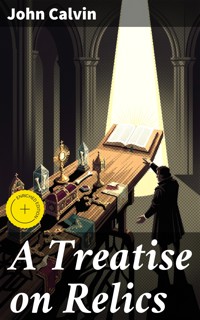
In "A Treatise on Relics," John Calvin delivers a compelling critique of the veneration of relics within the context of Reformation theology. Written with rigorous clarity and logical precision, this work explores not only the historical and cultural significance of relics but also their theological implications. Calvin meticulously dissects medieval practices surrounding relics, arguing that they stem from a misguidance that detracts from the central tenets of faith, primarily the sovereignty of God and the sufficiency of Scripture. The treatise serves as both a doctrinal exhortation and a theological exposition, underscoring the need for reforms in ecclesiastical practices that conflict with Protestant principles. Calvin, a seminal figure of the Protestant Reformation, was profoundly influenced by the need to restore biblical authority and purity to Christian practice. His commitment to Scripture as the ultimate source of truth shaped his arguments against the established Catholic traditions surrounding saints and their relics. Having experienced, firsthand, the fervor of religious disputes in Geneva, Calvin sought to clarify and reinforce the Reformed vision of faith, which is evident in this incisive text. For readers and scholars interested in the intersections of theology, history, and ecclesiology, "A Treatise on Relics" is an essential read. Calvin'Äôs articulate style and incisive reasoning challenge the mindset of relic veneration and encourage a deeper understanding of faith that relies solely on the grace of God and the teachings of Christ. This treatise remains a vital resource for those looking to engage with the core debates of the Reformation era. In this enriched edition, we have carefully created added value for your reading experience: - A succinct Introduction situates the work's timeless appeal and themes. - The Synopsis outlines the central plot, highlighting key developments without spoiling critical twists. - A detailed Historical Context immerses you in the era's events and influences that shaped the writing. - An Author Biography reveals milestones in the author's life, illuminating the personal insights behind the text. - A thorough Analysis dissects symbols, motifs, and character arcs to unearth underlying meanings. - Reflection questions prompt you to engage personally with the work's messages, connecting them to modern life. - Hand‐picked Memorable Quotes shine a spotlight on moments of literary brilliance. - Interactive footnotes clarify unusual references, historical allusions, and archaic phrases for an effortless, more informed read.
Das E-Book können Sie in Legimi-Apps oder einer beliebigen App lesen, die das folgende Format unterstützen:
Veröffentlichungsjahr: 2021
Ähnliche


A Treatise on Relics
Table of Contents
Introduction
Bones, splinters, and scraps become battlegrounds when devotion is measured against deception.
A Treatise on Relics endures as a classic because it captures, with disciplined force, a recurring tension in religious life: the pull between tangible objects and the claims of faith. Its pages helped fix in the public mind a model for polemical religious prose that is at once argumentative and culturally observant. The work’s lasting reputation rests not on antiquarian curiosity alone, but on the way it confronts authority, credibility, and the human need for certainty. Readers have returned to it for its sharp focus on how communities decide what to venerate and why.
The author of the treatise is John Calvin, one of the principal figures of the sixteenth-century Reformation. Written in that period of intense theological dispute and institutional change, the book is directed toward the Christian practice of venerating relics. Calvin examines the claims surrounding such objects and challenges the reasoning that supports their collection, display, and use in devotion. The treatise is not a narrative but a sustained argument, and its subject is the public religious culture of its time as much as any single institution or person.
This edition is associated with Walerian Krasiński, whose name appears with Calvin’s on the title. Krasiński is not the author of the original treatise, but his presence signals a later publication context in which Calvin’s work was presented to new readers. That reappearance matters: it shows that the questions raised in the sixteenth century were still considered urgent enough to warrant renewed circulation and framing. The combination of Calvin’s text and Krasiński’s editorial or translational role situates the book within a longer history of reading the Reformation, not merely as a past event, but as an ongoing conversation.
Calvin’s central premise is straightforward: the veneration of relics should be tested by clear standards of truth and responsible piety rather than by popularity, tradition, or the emotional power of physical objects. He approaches relics as claims that demand evidence, not as harmless decorations of belief. Without reducing religion to skepticism, he insists that faith and worship must be guarded against practices that can slide into credulity. The treatise therefore uses relics as a case study for a larger question: how religious authority is constructed and maintained in public life.
The book’s classic status also comes from its literary impact as a concise and pointed work of persuasion. Calvin writes with an economy that suits the topic: he aims to cut through accumulation—of objects, stories, and certificates of sanctity—and to return the reader to first principles. The treatise helped shape the style of later religious controversy by modeling how to argue against a practice while also criticizing the social mechanisms that allow it to flourish. Even readers who disagree with his conclusions can recognize the deliberate structure and the insistence on accountability.
Enduring themes run through the treatise: the vulnerability of conscience, the allure of visible tokens, and the temptation to replace inward devotion with outward assurances. Calvin’s critique turns repeatedly to the hazards of confusing possession with holiness, or spectacle with truth. In this way the book speaks not only about relics, but about how humans search for certainty in a world where claims are hard to verify. It is a meditation on discernment as much as an indictment, asking what kinds of proof should govern worship and what kinds of testimony deserve trust.
Because it emerged during the Reformation, the treatise also belongs to a broader conflict over what constitutes legitimate Christian practice. The period was marked by competing appeals to scripture, tradition, ecclesiastical authority, and popular devotion. Calvin’s work participates in that dispute by focusing on a practice that was widely visible and intensely meaningful. His choice of topic allows him to examine how religious economies form around revered objects and how institutional power can be reinforced by controlling access to them. The treatise thus offers a window into the contested public religion of its era.
The influence of the treatise is inseparable from the broader influence of Calvin’s writings: it contributed to a Protestant critique of certain devotional customs and to the shaping of Reformed attitudes toward religious images and material culture. Its arguments provided later writers with a vocabulary for challenging alleged sacred objects and for demanding clearer criteria of authenticity. At the same time, the book’s pointed attention to evidence and public claims anticipates modern habits of inquiry. It stands as an example of how theological controversy can function as cultural criticism, not merely doctrinal dispute.
Yet the work is not only historical; it is also a study in the psychology of belief. Calvin observes how desire, fear, hope, and communal pressure can magnify doubtful claims into certainties. His attention to these dynamics gives the treatise a durable edge: it can be read as a warning about how easily communities create sacred narratives around objects and how hard it is to retract them once established. The treatise’s power comes from its insistence that spiritual integrity requires vigilance, and that piety can be harmed by practices that exploit trust.
Krasiński’s association with the book underscores its later readership and the continuing interest in Reformation texts beyond their immediate controversies. Whatever the precise editorial circumstances of a given edition, the mere fact of republication signals that the work was read as more than a momentary pamphlet. It could be used for instruction, for historical understanding, or for renewed debate about devotion and authority. This extended reception contributes to its classic status: classics persist because they keep finding contexts in which their questions feel unsettled and their arguments demand engagement.
To approach A Treatise on Relics today is to enter a carefully argued confrontation with a practice that once shaped public worship across much of Europe. The book does not require specialized knowledge of particular relics to be understood, because its central interest lies in the standards by which claims are accepted. It invites the reader to consider how religious communities balance reverence with verification and how institutions respond when popular devotion outpaces careful judgment. The treatise’s refusal to treat the topic as trivial gives it a seriousness that modern readers can still respect, regardless of confessional standpoint, as an exercise in disciplined critique and moral responsibility.
Synopsis
A Treatise on Relics is presented as a work associated with John Calvin and published with material connected to Walerian Krasiński, situating the text in the context of Protestant critique of late-medieval and early-modern religious practices. The book proceeds as a focused examination of the Christian traffic in relics and the devotional culture surrounding them. Rather than offering a narrative story, it unfolds as an argument that asks how physical objects came to be treated as bearers of sacred power and how such practices should be measured against Christian teaching and ecclesiastical integrity.
paragraphs
The treatise opens by framing relic-veneration as a widespread and socially consequential phenomenon, touching not only private devotion but also public worship, pilgrimage, and the reputation of churches and shrines. It establishes the question that drives the work: whether the meanings assigned to relics are spiritually beneficial or spiritually hazardous. Calvin’s approach is to interrogate the grounds on which relics are authenticated, displayed, and used, and to consider how claims about holy objects function in the everyday life of believers and in the institutional life of the church.
paragraphs
From there the argument turns to the problem of verification and provenance. The book emphasizes the difficulty of confirming the origin of relics and the ease with which objects can be mislabeled, multiplied, or reinterpreted to fit local needs. It treats the circulation of relics as a system that can reward confident assertions and penalize careful doubt, creating conditions where questionable claims can thrive. The analysis stays oriented to the practical consequences: devotional trust is redirected toward material tokens whose history and identity are often uncertain.
paragraphs
The treatise then develops its critique of the mechanisms by which relics gain authority, including appeals to tradition, popular acclaim, and the prestige of particular religious sites. The work examines how stories, reputations, and institutional endorsements can substitute for evidence, and how this substitution shapes communal piety. The concern is not only intellectual error but the formation of habits of worship that may confuse sign and substance. In this sequence, the book portrays relic-culture as a complex mixture of sincere reverence and structural vulnerability to misrepresentation.
paragraphs




