


4,99 €
Mehr erfahren.
- Herausgeber: Spinning Door
- Kategorie: Abenteuer, Thriller, Horror
- Sprache: Englisch
When Ezra Quinn unexpectedly lands his dream job overseas, he soon finds himself living in luxury, but in an unstable country. Alif Zahir, the intelligent and passionate founder at Quinn’s new company, assures him that their initiatives are committed to using the latest technological advances to assist governments in keeping the peace.
He’s mesmerized by the exotic, silky-haired Leila. She whispers tales of a life different from his own, of the struggle of a people without freedom, of tragedy and hope.
Quinn digs further to uncover the truth. The vague answers and contradictions unsettle him. And so do the veiled threats. Then the betrayals, disappearances, and violence begin. The stakes are high for himself, his friends, and the people who cry out for peace.
The risk-averse Ezra Quinn has a decision to make. Which side truly offers freedom for the people? And is he willing to pay the price?
Sie lesen das E-Book in den Legimi-Apps auf:
Seitenzahl: 310
Veröffentlichungsjahr: 2019
Ähnliche



















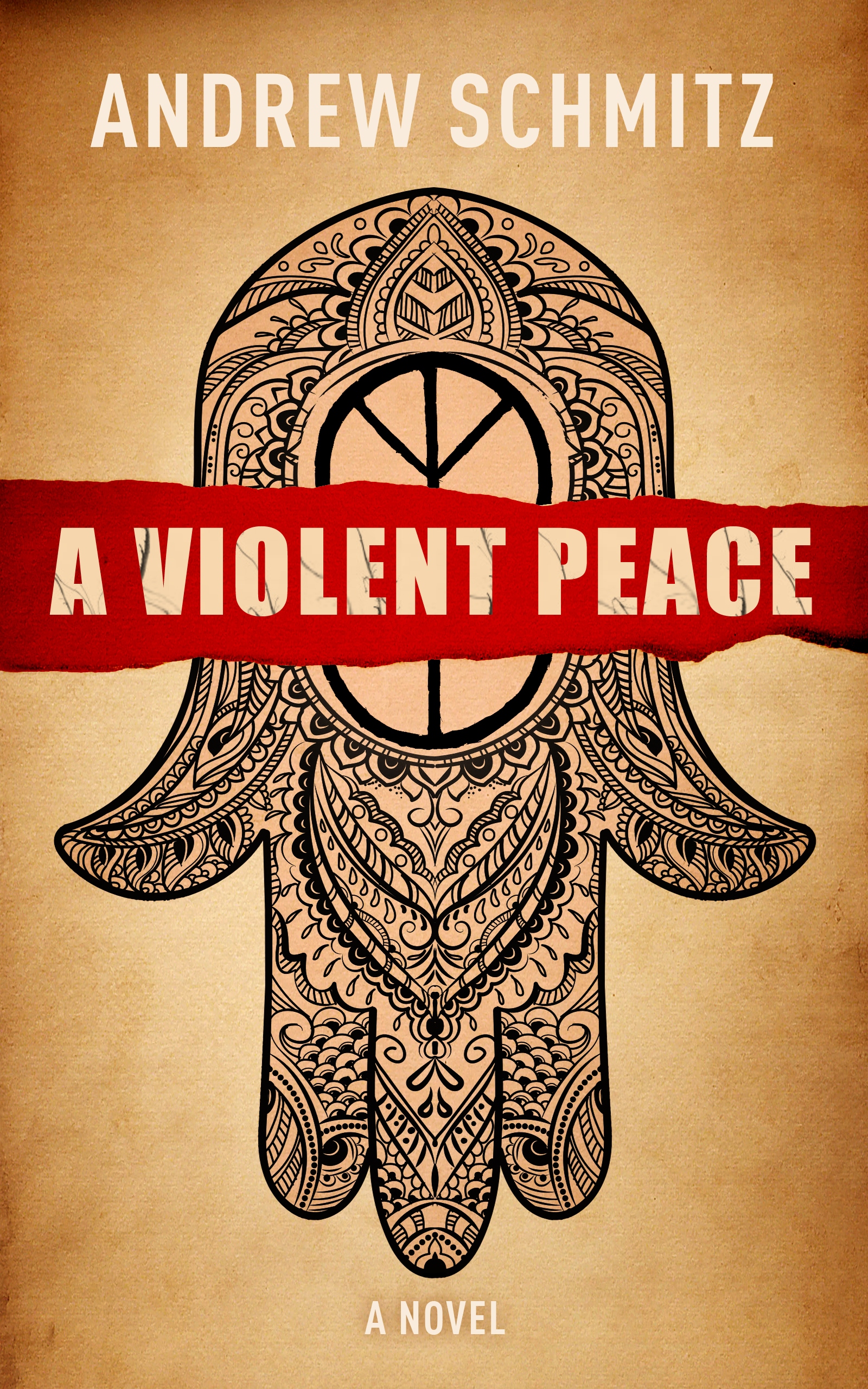
A Violent Peace
A Novel
Andrew Schmitz
Copyright © 2019 Creative Brand Ventures, LLC. All rights reserved.
This book is a work of fiction. The characters, incidents, organizations, and dialogue are drawn from the author’s imagination and are not to be construed as real. Any resemblance to actual events, organizations or persons, living or dead, is fictionalized or coincidental.
This book is a Spinning Door production. For inquiries regarding this book, please email [email protected].
No part of this book may be reproduced in any form or by any electronic or mechanical means, including information storage and retrieval systems, without written permission from the author or publisher, except for the use of brief quotations in a book review.
ISBN 978-1-950687-06-0 (ebook)
ISBN 978-1-950687-07-7 (paperback)
Contents
Chapter 1
Chapter 2
Chapter 3
Chapter 4
Chapter 5
Chapter 6
Chapter 7
Chapter 8
Chapter 9
Chapter 10
Chapter 11
Chapter 12
Chapter 13
Chapter 14
Chapter 15
Chapter 16
Chapter 17
Chapter 18
Chapter 19
Enjoyed The Story?
About The Author
1
The phone call dragged him out of a dream. In the hazy seconds while he lay suspended between dream and reality, he tried to cling to the dissolving fragments. He had been looking across a river. A river or an ocean, formed not of water but of hands, palms open and raised to the sky, waving.
The jangling ringtone chased the last of the waving hands into the gray ceiling, and he groaned and turned over and fumbled the phone off his bedside table.
“Yeah?”
“Is this Mr. Quinn?” A slight accent; not British, not Indian.
“This is Ezra Quinn, yes.”
“You do not know me, but I am a respected businessman. I am in San Francisco on a business trip, and I have a proposal to make to you.”
“Sorry?” Quinn scrubbed at his eyes with a fist and squinted at the clock. It was eight in the morning. Who would call at eight on a Saturday morning? “Uh… you’re here in San Francisco and you have a proposal? What sort of proposal?”
“I apologize, but I am unable to divulge this information over the telephone. You are free this morning, I believe. Please join me at the park of Potrero del Sol. Potrero Avenue. You know it?” He rolled the r’s, but it wasn’t a Spanish accent. Something from farther away.
“Yeah, I know Potrero.”
“Excellent. Near the southern entrance of the park, there is a bench. I will be sitting on this bench, wearing a red scarf around my neck so that you will know me.”
“I guess I’m not sure quite why…”
“Believe me, Mr. Quinn, the idea I will propose to you will be more than worth your time. Please join me at the park in one hour. Nine o’clock.”
And Quinn was left holding the humming phone to his ear. He put on his glasses and stared out the window. The fog clung to the top of the apartment building across the street, and he felt it was clinging to his skull as well: a curling, coiling mist that held his dream of the open hands and the man’s exotic accent and a sense that out of the uncertainty and melancholy of the last few months, something was emerging: something fresh, something strange.
It was chilly, and he buttoned a jacket over his sweatshirt and clutched his coffee in both hands as he walked. He could have taken the trolley, but he needed the movement and the bite of the morning air to clear his brain.
Potrero was seven blocks away. He turned in from San Bruno Ave. Already he could hear a few early-bird skaters grinding the concrete basins in the center of the park. Farther away, someone was playing Radiohead on a car stereo. Set back from the entrance was a painted labyrinth and beyond that, on a grassy slope, was a bench.
A man was sitting on the bench. He was wearing a dark suit, with a tasseled red scarf around his neck, and his hands lay on a briefcase across his knees. As Quinn approached, he unwound the scarf, folded it, placed it carefully in the briefcase, and then stood and extended his hand.
“Mr. Ezra Quinn. Thank you so much for agreeing to this meeting. My name is Mr. Mustafa Sufyan.” He was clean-shaven, with thick, trimmed eyebrows. “Now, did you bring with you your mobile phone?”
“Sure.”
“Forgive me, but you will please place the mobile into this device while we have our discussion. It is purely a muting device so that unwanted listeners cannot overhear.” Setting the briefcase on the bench, he took from it a small silver box, opened it, and handed it to Quinn. “You may hold the device so that you can be sure I will not steal your phone. Please have a seat.”
Somewhat bemused, and feeling he was taking part in a wacky foreign TV show where everybody else knew the script but him, Quinn set his phone in the box and pressed the lid shut.
“So what’s it all about?” he asked, sitting and holding the box on his lap. The slats of the bench were cold on his thighs.
“Ah, yes. So, let me first assure that you are Mr. Ezra Quinn, at present working as a computer scientist for the Orbotica Corporation of San Francisco?”
“That’s me.”
“And you have an advanced degree in robotics and computer engineering?”
Quinn nodded.
“Excellent. Now, my employer is a company similar to the one you work for. It is entitled Azure Oasis Technologies. You have heard of it?”
Quinn hesitated, shrugged. “Maybe. It’s a pretty crowded space.”
“No matter. We are one of the leading companies in the surveillance and robotics field in the Middle East. Our clients include royalty as well as five-star businesses.” He sounded as though he were reading off a brochure. “We have been growing at the rate of two hundred percent for the last four years, and expect that rate to escalate in the coming decade.”
“And you have an opening?”
“Yes. A leadership opening, and one that you are impeccably suited for. It is a position in wearable surveillance technology, just as you have been working on.”
“Okay.” Quinn stared at him. “But why the secrecy?” He tapped the silver box. “Why do we have to meet in a park? Why didn’t you just email?”
“These are the conditions of my employer. As you say, your area of expertise is a crowded space, and perhaps your company would not be happy if they know you are looking elsewhere.”
“All right.” Quinn nodded slowly, though he had half a mind to just get up and walk out of the park. “All right. And so… what’s your offer?”
“A one-year contract, up for renewal at the end of every year. Everything paid for: food, lodging, entertainment. You will have a driver at your disposal, as well as a personal manservant. A state-of-the-art laboratory, unlimited research and development funds, a crew of highly qualified technicians at your disposal. You will be doing work similar to that which you accomplish here, with certain modifications.” Again the man sounded as though he were reciting; as though the speech had been rehearsed.
“And the pay?”
“Twice what you make now, paid into a bank account of your choosing. Tax-free, obviously. In addition to this.” Mr. Sufyan opened his briefcase, took out an envelope, and handed it to Quinn. Inside was a check for a hundred thousand dollars.
“What the hell? What’s this?” Quinn asked, holding the check by one corner as if it might be poisonous.
“This is in appreciation of your time this morning, Mr. Quinn. A gift, you might say. But also, of course, an indication of our generosity.”
Quinn laid the check on the silver box and stared at it, rubbing his palm with a bitten thumbnail.
“So where would all this be? This laboratory, and…” He trailed off.
“Our office is based in Dubai. In the United Arab Emirates. A pleasant city, highly modern, far from the current strife in the region.”
Quinn looked up from the check with its alarming string of zeros. At the base of the knoll a couple of kids—third- or fourth-graders, he guessed—were trying to get to the center of the painted maze, twisting this way and that, losing their balance.
He shook his head slowly. “I don’t know if I… It all seems just…”
“It is sudden, I know. But believe me, Mr. Quinn, this is the opportunity you have been waiting for. I will give you five days to make your decision. Feel free to investigate Azure Oasis as you wish, but I ask you to keep your investigations confidential. Use an anonymous browser, so that your search items do not appear on your computer profile, and do not discuss our company with your companions. In five days, if you decide to accept our offer, be at San Francisco International Airport at nine fifty-five a.m.”
He reached into the briefcase once more and withdrew a second envelope. This one contained a first-class Emirates ticket to Dubai.
“Please remember to bring your passport to the airport. And also, please leave all your electronics behind: your computer, your mobile phone. You will receive new electronics when you land. The money is yours whether you decide to accept the offer or not. We hope you will choose the first option, of course.”
And suddenly the meeting was over. Mr. Safyan plucked the silver box from his lap and handed him his phone. Then he stood, shook Quinn’s hand with a little bow, and walked briskly down the path to the park entrance, a straight, dark figure. Quinn watched him till he rounded the corner of San Bruno. He didn’t look back.
The kids in the labyrinth were standing on opposite sides of the circle, arguing about whether it was okay to step over a line. Quinn watched them for a few minutes. From where he sat, the path to the center was obvious, but the kids weren’t going to get there anytime soon. They were still arguing when he got up, pocketed his phone, and walked slowly back to his apartment.
“Well, obviously it’s a no, right?” Quinn stroked the beads of sweat on his Icarus porter, drawing lines, watching the drops gather.
“What did you say the company was?” Joey asked. He was looking around, trying to flag a waiter.
“I’m not supposed to talk about them. They’re legit, though. I looked them up, and I’d heard of some of the customers. A couple of big oil companies. A cable company. As well as actual royalty. Princes and stuff.”
“But what about your idea, that glove idea… What was it?”
“Hands Across the Sky.”
“Hands Across the Sky. Bit of a mouthful, isn’t it? Do these waiters have invisibility cloaks? The dude was just here a second ago. Now, I thought… last time we had a beer, you were all gung-ho about quitting and starting this Hands thingy. You were going to start fundraising, you told me.”
“Yeah, but here’s the thing. I work at this place for a year or two and I’ve got the cash to start it up on my own.”
“Jeez. Seriously?” Joey stared at him.
“The dude handed me a check for a hundred thousand. Just for having the meeting. And when I start working it’s all take-home—everything’s paid for. Food, housing.”
“Um… so why are you saying it’s a no? Seems like a big juicy yes to me.”
Quinn sipped the porter and wiped the foam off his upper lip with the back of his hand. “Well, you know. I’ve got my dream job, right? I’m living the techie life in San Francisco, center of the world. And there’s Pam.”
Joey pursed his lips and breathed out slowly through his nose. “All right, Ezra—” he began, but the waiter had finally arrived, and they ordered: Barrelhead burgers and sweet-potato fries.
“And another Icarus for me,” Quinn called after him as he scurried off.
Joey held up a finger and tugged at it. “Listen,” he said. “First, you’ve been griping at me for months about the job: you can’t stand the hours, you can’t stand the whining, you’re so far down the chain you don’t even know what you’re working on anymore.” He seized another finger. “Second, you told me Pam was over. We were sitting right here last week, and you told me it was over.”
“I know, I know.” Quinn pushed at the bridge of his glasses. “But the job thing. I mean, everyone whines, don’t they? And Pam called on Tuesday and we went out. Had a pretty okay time.”
Joey shook his head. “Listen to you, man. ‘A pretty okay time.’ Is that what you want out of life? A pretty okay time?” He leaned across the table and smacked Quinn’s cheek, quite hard. “That’s life, okay? That’s life, reaching in and saying hi.”
What did he want out of life? It was a good question. As Quinn walked back to his apartment, slightly drunk, he knew that the ticket to Dubai was the smack on the face he needed. All his working life he’d taken the straight, safe path: computer science because he was good at it, job at Orbotica because it was in his field, dating Pam because she was in the next cubicle. Sometimes his life seemed so predictable he wanted to scream. He’d work his way up in Orbotica till he was a manager. He’d marry Pam, and they’d have two kids. Eventually they’d retire to SoCal, and he’d dye his hair and drive around in a refurbished 1967 Mustang. Then he’d die, probably of a heart attack while working on his golf swing.
The Hands Across the Sky notion was the closest he’d come to breaking out. The idea had arrived one day when he was so frustrated at work, he’d just walked out at two in the afternoon. They had been working on software for a glove that could read vital signs: heartbeat, breathing rate, blood pressure. But his manager was being exasperatingly coy about certain aspects of the product. She wouldn’t tell them who would be using it or why they needed certain modifications. Finally, a fellow worker figured out that it was a secret Department of Defense project and blurted out the information in a meeting. The worker was fired on the spot, and the rest of them were sworn to secrecy and had to sign ten pages of non-disclosure agreements.
Quinn had stalked out of the building, muttering that he’d never go back. He took the trolley down to the Wharf and walked over to Black Point and crouched on the slope, within earshot of the crowds and sea lions, but screened off by a stand of pines. Alcatraz stood half-veiled in mist, and the plaintive cries of the foghorns might have been the ghosts of its long-departed prisoners. And in that lonely moment, Quinn imagined a glove that would allow him to take someone else’s hand, somewhere else in the world—anywhere else in the world. That would allow him to feel that person’s heartbeat, or a squeeze, or a tap on the palm. That would allow him to twine his fingers through someone else’s or walk with joined hands swinging. The name of the device, Hands Across the Sky, was instantly on his tongue.
It was a ridiculous idea, he knew, and yet somehow wonderful. There were no obvious applications, no clear ways of making money off of the thing, but he knew there were people out there who, like him, desired to hold another person’s hand. To feel that connection. Crouching in the damp grass, he reached out and flickered his fingers at the fog, then looked around quickly, hoping no one had seen him.
Hands Across the Sky became a touchstone; an antidote to the drudgery. He’d bring it up over lunch at work, or over beers at the Barrelhead, and almost relished the scoffing. But there were always one or two listeners whose eyes went faraway and dreamy, whose hands drifted away from their bodies for a moment, fingers tapping the air.
“You could make the gloves in shimmery colors,” one said. “You could have it so you could write on someone else’s palm,” another said. “What if you could open your hand and just see the other person’s eyes there…” And he’d nod and they’d share a smile.
He knew he’d never make a go of Hands. It was just there to show that he had a different facet; that he could be creative as well. It was the flip side of whatever DoD horror they were facilitating. But now…
He reached his tiny apartment and let himself in. The familiar smell of stale laundry and desiccated pizza. Crumpled sheets on the bed, clothes strewn across the floor. He kicked the clothes into a pile and sat on the mattress looking out the window. The fog had rolled in again.
2
Five days later he was standing in line at the Emirates counter at the airport. He’d quit work two days before, and had had a little party at the Barrelhead last night, with Pam and Joey and a couple of the guys from work. He was pleased by the air of mystery he’d projected.
“No, I can’t say too much about it, I’m afraid; the project’s a complete secret.”
“No, even the location is secret. Somewhere in the Arabian Peninsula is all I can tell you.”
The secrecy had stemmed from necessity—he had no clue what he’d be doing—but Pam had looked at him with a curiosity and respect he relished, and he tried to keep his expression taut and world-weary.
Now, though, as he stood in line gripping the handle of his suitcase, he was terrified. At least the check had gone through, he told himself. He’d have padding and the means to survive for a year or so. He might do some traveling if things didn’t work out. Still, the images of violence on the news—the bombings, the beheadings, the massed hordes with raised weapons—flickered through his mind. Though he knew Dubai was nowhere near the battle zones, he had a sudden panicky notion that the plane would land amid lobbed mortars and black-veiled, Kalashnikov-toting militants. He pictured himself, in his Vans and gray hoodie, sprinting across the tarmac, chased by a blood-spattered ninja wielding a scimitar.…
The woman behind the counter called “Next, please,” and he shook his head slightly to clear it and stepped forward.
He’d flown on some fancy business trips to Europe for Orbotica, but he was unprepared for Emirates First Class on the A380. He had a tiny private suite on the upper deck, with a fold-out, full-length bed. He could order anything he wanted off of an extensive menu, and there was even a bar where a few business suits and bejeweled women sipped cocktails.
Soon he had plates of tidbits scattered around his mattress—coconut-crusted shrimp, skewers of spicy lamb, sushi, exotic fruits. He tried to watch a movie, but instead, spent most of his time staring out the window at the shifting cloudscape. In some places they seemed brushed in one direction, as if by a gigantic comb; in others they were stirred to a lather. He imagined he could read his future in their slow metamorphoses.
Toward the end of the fifteen-hour flight, he took a shower and put on a fresh uniform of jeans and a maroon T-shirt, and then waited in his suite, which felt now like a tiny jail cell. He hadn’t slept at all.
A blue-suited attendant pulled him out of the passport-control line. “Mr. Ezra Quinn? Marhaba. Welcome to Dubai. You will come with me, please.”
As the queuing passengers glared, he followed the attendant to an unmarked side door and entered a sumptuous little lounge. Coffee and croissants stood on a table to one side and soft jazz played on the speakers. The attendant took his passport and gestured at the coffee. He shook his head—despite his lack of sleep, his brain was buzzing and he didn’t need the caffeine.
Within a minute the attendant was back with his passport, and Quinn followed him through a hallway and out a door into the warm night, which was slightly scented with diesel fumes. Beneath a row of round lights, a woman stood beside a black stretch BMW with tinted windows. She was wearing a charcoal suit and red heels, and her hair was like a spill of oil, harboring rainbows. When she saw him, she smiled and swept her hair back with one hand and came toward him.
“Ezra Quinn,” she said, as if he were a long-lost friend from high school.
He took her proffered hand. Despite the warmth of the night, her fingers were cool. Her perfume enveloped him: something exotic and slightly smoky that seemed distilled from her dusky skin.
“I hope your journey was not too tiring?”
“It was fine,” he said, a little tongue-tied. He wasn’t used to talking to someone this elegant. Even in the highest-level meetings in San Francisco, you’d still find lugs in sweatshirts and sneakers, hair matted from the pillow.
“My name is Leila. Leila al-Seifi. I am the personnel manager for Azure Oasis, and I will be your hostess in Dubai for the next few days. We are so pleased that you have agreed to join us at Azure Oasis, Mr. Quinn. Now, if you will accompany me in the vehicle, we will go to your hotel.” Her accent was impeccably English, like that of a character in a Merchant Ivory film.
In the BMW, she sat across from him and clicked open the door of a small refrigerator to her left, revealing a row of bottles. “Would you care for a drink?”
He shook his head. “They gave me plenty on the flight. Too much, actually.”
He pressed a fist to his chest and grinned at her. She smiled back.
The car purred into traffic and he peered out beyond the passing neon toward the spires of Dubai, glittering on the horizon. The breathtaking spindle of the Burj Khalifa stretched over them like a rocket trail tapering into the stars.
“We will give you several days to get acclimated,” Leila said. “To get over jet lag and accustom yourself to the city. And please let us know your preferences. There is little that we cannot provide.”
Quinn glanced at her. At the moment, he thought, all he wanted was to drive around a new city in this sumptuous car and listen to her voice.
Only once as they drove into the city was the spell of spicy perfume and opulence and glitter broken. They were creeping along in traffic, passing a row of jewelers—watches and necklaces sparkling under pin lights—and in the shadow beneath the overhang of a shop window, he glimpsed a young girl and boy. They were sitting on a flattened carton, and had a small meal laid out before them on a handkerchief: a bruised banana, five dates, and a loaf of pita bread. As they passed, the girl took up the bread and broke it and handed the larger half to her brother. Then, abruptly, she raised her eyes, dark and luminous and intelligent, and seemed to look directly at him, though he knew she couldn’t see him behind the smoky glass. Why had she looked up? What was she thinking? He raised a hand to the glass for a moment, and then let it drop.
The Burj Al Arab lay on its own little peninsula in the Persian Gulf, its front a sail blown toward the land. The lobby, with its fountain like intricate basketry woven of water and its scalloped tiers of hallways, was filled with Chinese, turning in slow circles with their iPads held over their faces like rectangular masks. Quinn guessed a planeload had just come in.
He would have lingered, but Leila took his arm and walked him past the throngs and through the gleaming gold doors of an elevator. He could sense the men in the room swiveling to watch their passage. On the forty-seventh floor, the doors opened and she led him to a two-story suite at least four times the size of his San Francisco apartment. He went over to the window and looked down over the sea, so far below the breakers were thin, wavering chalk lines scrawled on the black, and he could have blotted out a liner with his thumb.
“Whoa!” he said, turning back into the room. “Pretty… massive,” and instantly told himself to shut up. His bags were being brought in by a porter, whom Leila dismissed with the back of her hand.
She took from her voluminous purse an iPhone and a svelte silver MacBook and laid them on a table.
“These are yours to keep,” she said. “You will find my number in the phone. Please call at any time. I will be waiting. Should you get hungry, there are nine restaurants in the hotel. I would note that some of them have a dress code. You will find a full complement of clothing and accouterments in your size in the wardrobe.” She extended a hand to lacquered doors. “Perhaps, once you have rested and eaten, you will give me a call and we can talk some more?”
He nodded mutely.
“All right then. Once again, welcome to Dubai, Mr. Quinn. I trust you will have a pleasant stay here.”
She turned on her red heels, her hair following more sluggishly. And then she was gone, though her perfume lingered on his palate like a drug.
3
He slept for eleven hours, and when he woke couldn’t tell if the dusky sky was daybreak or nightfall. He called reception, and they informed him that it was the morning of March 8 and asked if he would like breakfast.
“Sure,” he said and stumbled into the shower on the upper level of his suite.
When he got out, the breakfast was already laid on the table by the window: coffee, eggs, sausages, pastries, fruit. In a belted Hermès robe, he ate slowly, looking out at the wrinkling water where the sails crawled by like triangular motes. Then he opened up his new laptop and checked his email and the news. There were skirmishes in Syria, another explosion in Baghdad, but from this perch the Middle East seemed as placid as his hometown of Elkhart, Indiana. He chuckled as he remembered his moment of panic in the San Francisco airport.
In the wardrobe, he scavenged for jeans and a white button-down shirt, but eschewed the polished dress shoes in favor of his Vans. Then he called Leila. She picked up on the first ring, as though she’d been sitting with her hand hovering over the phone, waiting for his call.
Fifteen minutes later he was in the lobby. Leila was standing by a window. She was wearing a cream suit today, with a flimsy emerald scarf loosely draped around her neck, and looked as dewy fresh as a rose.
“I hope you passed a pleasant night, Mr. Quinn,” she said as he walked up.
“I don’t think I’ve slept that long since I was a kid,” he told her, grinning.
“And how did you enjoy your breakfast?”
“Delicious.” How did she know he’d had breakfast? He guessed she had an inside connection at the hotel and filed that thought away.
“Well, today is yours. You may pass the time at the hotel, or I could show you around the city. There are plenty of activities available: bungee jumping, ice skating, waterskiing, and of course shopping. People come from all over the world to shop in Dubai.”
“You know what I’d really like?” he said.
“Please tell me.”
“I’d like to know a bit more about what I’m doing here. All I got from Mr. Safi…”
“Mr. Sufyan.”
“Sufyan, yeah… all I got from him was that I’ll be doing something similar to what I was doing in San Francisco. But what is that exactly? I’d like background, a bit of orientation―this is only my fourth trip out of the States, and the others were to England and Germany.”
She nodded. “Of course. This is natural. Are you afraid of heights, Mr. Quinn?”
“Heights?” He was mystified. “Uh, not especially.”
“Come.” Walking to the doors ahead of him, she took out her phone and murmured something, then replaced it in her purse.
As they drove through the streets in the stretch BMW, he was surprised by the number of construction sites, some still mostly rubble, others spidery contraptions with yellow-helmeted workers crawling over them. The workers didn’t look like the Arabs in the streets, and he asked Leila about them.
“They are mostly from South Asia,” she said, glancing out the window. “India, Bangladesh, Thailand. The work here is difficult, especially in the heat of summer, but it pays well compared to what they can earn in their countries.”
The car pulled into a parking lot, but he didn’t realize where they were until he got out and looked up. The Burj Khalifa leaned into the blue like a sci-fi highway to the stars.
“Jesus,” he whispered. “That’s why you wanted to know if I was scared of heights.”
Once again, Leila seemed to have an inside connection. They walked past lines of tourists and entered doors that were unmarked or labeled “PRIVATE AREA.” She led him through a twisting hallway to an elevator that was like a cockpit from a Ridley Scott flick. As the doors closed, she took a packet of Wrigley’s spearmint out of her handbag and offered him a silver sliver. He shook his head, but she insisted, saying, “For your ears.”
When the elevator started rising, he realized what the gum was for: they sped skyward so rapidly that his ears popped. The numbers flickered on the black screen, faster and faster, soaring past a hundred, and only when they reached 140 did they start to slow. At floor 160 the elevator eased noiselessly to a standstill, and the doors opened. He gasped.
They stepped out onto a private platform, well above the tourist viewing deck—he could see them milling below with their cameras. Though he had said he wasn’t afraid of heights, he gripped the rails and swayed slightly as he looked down. They were so high up the entire city was spread below them like a schematic for a computer chip: overpasses and skyscrapers and gardens and artificial lakes, all etched in miniature. Against the horizon to his right, the gulf lay like a slab of chalcedony, with a palm-shaped artificial island jutting into it like a colossal deformed hand. To his left lay the desert. He’d imagined the desert to be all one shade of dun, and was surprised by the variety of its textures and colors, from plum to peach to palest apricot. Several oil fields tarnished the sands, a hydra of roads snaking from each.
He returned his gaze to the whorled streets. Where in that tangle, he wondered, were the girl and boy he had seen the night before?
Leila came up and stood beside him. “Dubai,” she said. “City of superlatives. We are standing on the greatest structure humans have ever built, nearly a kilometer above the desert floor.”
She pointed out several landmarks: a mosque, the museum of contemporary art, the camel market. Then she said, “But come. I will prepare coffee, and we can have our talk.”
He turned into the room and saw what he had not noticed when he’d stepped out of the elevator and been astounded by the view. The room was furnished like a tent, with striped woven wool draped from the ceiling. On a crimson carpet to his right lay a ring of embroidered cushions and in the center of the cushions, on an incongruous patch of sand, a brazier glowed.
Now Leila knelt in the sand before the brazier and set a brass coffeepot—the fancy Arab kind with the tall neck and curving spout—on the coals. She poured small coffee beans from a paper bag into a pan and set the pan on the coals as well, shimmying it from time to time. As the beans darkened, a wonderful aroma filled the air, and she wafted the fragrant smoke toward him with the side of her hand. When the beans were deep umber and glossy with oil, she poured them into a mortar and pestle and ground them to dust, then tipped the coffee into the pot. Now she became more attentive, tipping up the conical lid of the pot and peering in from time to time. As the coffee frothed up, she poured in water, keeping it at a gentle simmer for a minute or two. Finally, she spooned sugar into tiny handleless cups and poured the coffee, like a rivulet of tar.
The whole operation had been like an exotic dance. With a smile and the tiniest ceremonial flourish, she handed him a cup and nudged a platter of baklava trapezoids across the carpet to him.
Quinn took a sip, then held the cup out and looked at it. “Wow,” he said. The coffee was unlike anything he’d tasted: rich, smooth, chocolaty.
“Arabica beans from Ethiopia,” she told him. “The very finest. The coffee ceremony is normally performed on the sand in one’s tent, of course. It is my pleasure to perform it for you here, perched above the world. I should inform you that it is traditional to drink three cups.”
“It’s the best coffee I’ve ever had,” he said, absolutely sincerely.
“I’m delighted to hear that.” She sat back and adjusted her slim legs beneath her, smoothing her skirt with her palms. She looked up at him. “Now, you wanted to know what you will be doing here. But to answer that question fully, we have to go back several years. Have you heard the name Mohamed Bouazizi?” she inquired.
He shook his head.
“Not many Westerners have. But in the Arab world, everyone knows his name. He was a vendor in Sidi Bouzid, a small town in Tunisia. He sold fruit from his cart on the streets. A simple man; a nobody. Unmarried, twenty-seven years old. His father had died when he was young, and he supported his mother and siblings. Like many street vendors, he had often run into trouble with the authorities. Street vendors operate in a legal gray zone, and must often resort to bribes to survive.
One day in December 2010, an official tipped over Bouazizi’s cart. She threw his fruit away and confiscated his scales. He tried every avenue to get them back, but the officials ignored him. Finally, he went to the governor, but even there his efforts were futile. He was two hundred dollars in debt, because he’d had to take the fruit on commission, and saw no way out of his dilemma. So, with the last of his money, he bought a can of gasoline and stood in the street outside the governor’s office, in the middle of Sidi Bouzid. There Mohamed Bouazizi poured the gasoline over his body and set himself alight.”
She sat straight-backed, the coffee cup propped between her fingertips, and he had the sensation he was listening to an ancient storyteller relate something out of the Arabian Nights; but he was sitting above eagles in a modern iteration of the Tower of Babel. Leila looked down into the black circle of coffee in her cup and was silent for a moment. She looked up.
“Ordinarily, Mohamed Bouazizi would have been forgotten—just another tale of loss, misfortune, and heartbreak. There have been thousands of others like him through the years, who have started fires in their own ways. Those fires went out. But for some reason, the fire Bouazizi started did not go out. Perhaps because the pressures had grown too great. Perhaps because of the global economic recession. It is hard to know precisely why. At any rate, the story was picked up by the national media, and then the Arab media, and then the international media.
In a week, demonstrations were spreading throughout Tunisia. All of the working-class people had a story like his; a story of mistreatment at the hands of the authorities, of corruption, of unbridled greed. The government forces tried to suppress the demonstrations, but their efforts only fanned the flames. A month after Mohamed Bouazizi set himself alight, the Tunisian president Ben Ali fled to Saudi Arabia. A new regime came to power.”
She looked out of the window at the passing veils of cloud, and he thought the story was over. But after a moment, she returned her gaze to coals on the brazier and resumed her tale.
“Ben Ali had been in power for twenty-three years. Elsewhere in the Arab world, Mubarak of Egypt had ruled for thirty years, Gaddafi of Libya for forty years, and in Syria, the al-Assad clan had been in power for even longer. It was a similar tale in Bahrain, Algeria, Yemen, Jordan, Sudan, Morocco.… Soon, across the Middle East, the people began taking to the streets.
“Now, Tunisia is a relatively minor country in the region. The most prominent country in terms of population and influence is, of course, the ancient country of Egypt—Umm al-Dunia




