


1,99 €
Mehr erfahren.
- Herausgeber: Maria Peitcheva
- Kategorie: Geisteswissenschaft
- Sprache: Englisch
Adolph Friedrich Erdmann von Menzel (1815 – 1905) was a German artist noted for drawings, etchings, and paintings. Along with Caspar David Friedrich, he is considered one of the two most prominent German artists of the 19th century, and was the most successful artist of his era in Germany. His popularity in his native country, owing especially to History Painting, was such that few of his major paintings left Germany, as many were quickly acquired by museums in Berlin. Menzel's graphic works and drawings were more widely disseminated; these, along with informal paintings not initially intended for display, have largely accounted for his posthumous reputation. The paintings which were available to the public garnered recognition not only within Germany, but from the French avant-garde as well: Edgar Degas admired and copied his work, calling him "the greatest living master".
Das E-Book können Sie in Legimi-Apps oder einer beliebigen App lesen, die das folgende Format unterstützen:
Veröffentlichungsjahr: 2016
Ähnliche


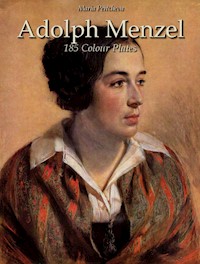
Adolph Menzel
185 Colour Plates
By Maria Peitcheva
First Edition
*****
Adolph Menzel: 185 Colour Plates
*****
Copyright © 2016 Maria Peitcheva
Foreword
Adolph Friedrich Erdmann von Menzel (1815 – 1905) was a German artist noted for drawings, etchings, and paintings. Along with Caspar David Friedrich, he is considered one of the two most prominent German artists of the 19th century, and was the most successful artist of his era in Germany. His popularity in his native country, owing especially to History Painting, was such that few of his major paintings left Germany, as many were quickly acquired by museums in Berlin. Menzel's graphic works and drawings were more widely disseminated; these, along with informal paintings not initially intended for display, have largely accounted for his posthumous reputation.
Although he traveled in order to find subjects for his art, to visit exhibitions, and to meet with other artists, Menzel spent most of his life in Berlin, and was, despite numerous friendships, by his own admission detached from others. It is likely that he felt socially estranged for physical reasons alone—Menzel had a large head, and stood about four foot six inches.
Menzel was born in Breslau, Silesia. His father was a lithographer and intended to educate his son as a professor; however, he would not thwart his taste for art. After resigning his teaching post, Menzel senior set up a lithographic workshop in 1818. In 1830 the family moved to Berlin, and in 1832 Adolph was forced to take over the lithographic business on the death of his father. In 1833, he studied briefly at the Berlin Academy of Art, where he drew from plaster casts and ancient sculptures; thereafter Menzel was self-taught. Louis Friedrich Sachse of Berlin published his first work in 1833, an album of pen-and-ink drawings reproduced on stone, to illustrate Goethe's little poem, Kunstlers Erdenwallen. He executed lithographs in the same manner to illustrate The Five Senses and The Prayer, as well as diplomas for various corporations and societies.
From 1839 to 1842, he produced 400 drawings, largely introducing to Germany the technique of wood engraving, to illustrate the History of Frederick the Great by Franz Kugler. He subsequently brought out The Uniforms of the Army under Frederick the Great, The Soldiers of Frederick the Great; and finally, by order of King Frederick William IV, he illustrated the works of Frederick the Great, (1843-1849). Through these works, Menzel established his claim to be considered one of the first, if not actually the first, of the illustrators of his day in his own line.
In the meantime, Menzel had also begun to study, unaided, the art of painting, and he soon produced a great number and variety of pictures. His paintings consistently demonstrated keen observation and honest workmanship in subjects dealing with the life and achievements of Frederick the Great, and scenes of everyday life, such as In the Tuileries, The Ball Supper, and At Confession. Among those considered most important of these works are Iron Rolling Mill (1872-1875) and The Market-place at Verona. When invited to paint The Coronation of William I at Koenigsberg, he produced an exact representation of the ceremony without regard to the traditions of official painting.
If these historical illustrations anticipated the literal qualities of early Impressionism,it is paintings such as The French Window and The Palace Garden of Prince Albert, both painted in the mid- 1840s, that now appeal as "among the most freely observed of mid-nineteenth century images." Such genre paintings evidence associations with French and English art. Private drawings and watercolors made of dead and dying soldiers in 1866 on the battlefields of the Austro-Prussian War are unsparing in their realism, and have been described by art historian Marie Ursula Riemann-Reyher as "unique in German art of the time."
The paintings which were available to the public garnered recognition not only within Germany, but from the French avant-garde as well: Edgar Degas admired and copied his work, calling him "the greatest living master". In Germany he received many honors, and in 1898 became the first painter to be admitted to the Order of the Black Eagle; by virtue of receiving the Order, Menzel was raised to the nobility, becoming "Adolph von Menzel". He was also made a member of the Académie des Beaux-Arts in Paris and the RoyalAcademy in London. After his death in 1905 in Berlin, his funeral arrangements were directed by the Kaiser, who walked behind his coffin.
Paintings
The Balcony Room, 1845
Detail
Building Site with Willows, 1846
Detail
The Berlin-Potsdam Railway, 1847
Detail
Studio Wall, 1852
Detail
Flute Concert with Frederick the Great in Sanssouci, 1850 – 1852
Detail
Detail
Detail
Half-length figure of an old man, 1855




