


16,99 €
Mehr erfahren.
- Herausgeber: John Wiley & Sons
- Kategorie: Wissenschaft und neue Technologien
- Sprache: Englisch
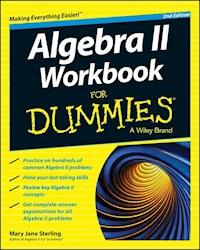
Algebra II For Dummies, 2nd Edition (9781119543145) was previously published as Algebra II For Dummies, 2nd Edition (9781119090625). While this version features a new Dummies cover and design, the content is the same as the prior release and should not be considered a new or updated product. Your complete guide to acing Algebra II Do quadratic equations make you queasy? Does the mere thought of logarithms make you feel lethargic? You're not alone! Algebra can induce anxiety in the best of us, especially for the masses that have never counted math as their forte. But here's the good news: you no longer have to suffer through statistics, sequences, and series alone. Algebra II For Dummies takes the fear out of this math course and gives you easy-to-follow, friendly guidance on everything you'll encounter in the classroom and arms you with the skills and confidence you need to score high at exam time. Gone are the days that Algebra II is a subject that only the serious 'math' students need to worry about. Now, as the concepts and material covered in a typical Algebra II course are consistently popping up on standardized tests like the SAT and ACT, the demand for advanced guidance on this subject has never been more urgent. Thankfully, this new edition of Algebra II For Dummies answers the call with a friendly and accessible approach to this often-intimidating subject, offering you a closer look at exponentials, graphing inequalities, and other topics in a way you can understand. * Examine exponentials like a pro * Find out how to graph inequalities * Go beyond your Algebra I knowledge * Ace your Algebra II exams with ease Whether you're looking to increase your score on a standardized test or simply succeed in your Algebra II course, this friendly guide makes it possible.
Sie lesen das E-Book in den Legimi-Apps auf:
Seitenzahl: 580
Veröffentlichungsjahr: 2018
Ähnliche








Algebra II For Dummies®, 2nd Edition
Published by: John Wiley & Sons, Inc., 111 River Street, Hoboken, NJ 07030-5774, www.wiley.com
Copyright © 2019 by John Wiley & Sons, Inc., Hoboken, New Jersey
Published simultaneously in Canada
No part of this publication may be reproduced, stored in a retrieval system or transmitted in any form or by any means, electronic, mechanical, photocopying, recording, scanning or otherwise, except as permitted under Sections 107 or 108 of the 1976 United States Copyright Act, without the prior written permission of the Publisher. Requests to the Publisher for permission should be addressed to the Permissions Department, John Wiley & Sons, Inc., 111 River Street, Hoboken, NJ 07030, (201) 748-6011, fax (201) 748-6008, or online at http://www.wiley.com/go/permissions.
Trademarks: Wiley, For Dummies, the Dummies Man logo, Dummies.com, Making Everything Easier, and related trade dress are trademarks or registered trademarks of John Wiley & Sons, Inc., and may not be used without written permission. All other trademarks are the property of their respective owners. John Wiley & Sons, Inc., is not associated with any product or vendor mentioned in this book.
LIMIT OF LIABILITY/DISCLAIMER OF WARRANTY: THE PUBLISHER AND THE AUTHOR MAKE NO REPRESENTATIONS OR WARRANTIES WITH RESPECT TO THE ACCURACY OR COMPLETENESS OF THE CONTENTS OF THIS WORK AND SPECIFICALLY DISCLAIM ALL WARRANTIES, INCLUDING WITHOUT LIMITATION WARRANTIES OF FITNESS FOR A PARTICULAR PURPOSE. NO WARRANTY MAY BE CREATED OR EXTENDED BY SALES OR PROMOTIONAL MATERIALS. THE ADVICE AND STRATEGIES CONTAINED HEREIN MAY NOT BE SUITABLE FOR EVERY SITUATION. THIS WORK IS SOLD WITH THE UNDERSTANDING THAT THE PUBLISHER IS NOT ENGAGED IN RENDERING LEGAL, ACCOUNTING, OR OTHER PROFESSIONAL SERVICES. IF PROFESSIONAL ASSISTANCE IS REQUIRED, THE SERVICES OF A COMPETENT PROFESSIONAL PERSON SHOULD BE SOUGHT. NEITHER THE PUBLISHER NOR THE AUTHOR SHALL BE LIABLE FOR DAMAGES ARISING HEREFROM. THE FACT THAT AN ORGANIZATION OR WEBSITE IS REFERRED TO IN THIS WORK AS A CITATION AND/OR A POTENTIAL SOURCE OF FURTHER INFORMATION DOES NOT MEAN THAT THE AUTHOR OR THE PUBLISHER ENDORSES THE INFORMATION THE ORGANIZATION OR WEBSITE MAY PROVIDE OR RECOMMENDATIONS IT MAY MAKE. FURTHER, READERS SHOULD BE AWARE THAT INTERNET WEBSITES LISTED IN THIS WORK MAY HAVE CHANGED OR DISAPPEARED BETWEEN WHEN THIS WORK WAS WRITTEN AND WHEN IT IS READ.
For general information on our other products and services, please contact our Customer Care Department within the U.S. at 877-762-2974, outside the U.S. at 317-572-3993, or fax 317-572-4002. For technical support, please visit https://hub.wiley.com/community/support/dummies.
Wiley publishes in a variety of print and electronic formats and by print-on-demand. Some material included with standard print versions of this book may not be included in e-books or in print-on-demand. If this book refers to media such as a CD or DVD that is not included in the version you purchased, you may download this material at http://booksupport.wiley.com. For more information about Wiley products, visit www.wiley.com.
Library of Congress Control Number: 2018956041
ISBN 978-1-119-54314-5 (pbk); ISBN 978-1-119-54317-6 (ebk); ISBN 978-1-119-54310-7 (ebk)
Algebra II For Dummies®
To view this book's Cheat Sheet, simply go to www.dummies.com and search for “Algebra II For Dummies Cheat Sheet” in the Search box.
Table of Contents
Cover
Introduction
About This Book
Foolish Assumptions
Icons Used in This Book
Beyond the Book
Where to Go from Here
Part 1: Homing in on Basic Solutions
Chapter 1: Going Beyond Beginning Algebra
Outlining Algebraic Properties
Ordering Your Operations
Zeroing in on the Multiplication Property of Zero
Expounding on Exponential Rules
Implementing Factoring Techniques
Chapter 2: Toeing the Straight Line: Linear Equations
Linear Equations: Handling the First Degree
Linear Inequalities: Algebraic Relationship Therapy
Absolute Value: Keeping Everything in Line
Chapter 3: Conquering Quadratic Equations
Implementing the Square Root Rule
Dismantling Quadratic Equations into Factors
Resorting to the Quadratic Formula
Completing the Square: Warming Up for Conics
Tackling Higher-Powered Polynomials
Solving Quadratic Inequalities
Chapter 4: Rooting Out the Rational, Radical, and Negative
Acting Rationally with Fraction-Filled Equations
Ridding Yourself of a Radical
Changing Negative Attitudes about Exponents
Fooling Around with Fractional Exponents
Chapter 5: Graphing Your Way to the Good Life
Coordinating Your Graphing Efforts
Streamlining the Graphing Process with Intercepts and Symmetry
Graphing Lines
Looking at 10 Basic Forms
Solving Problems with a Graphing Calculator
Part 2: Facing Off with Functions
Chapter 6: Formulating Function Facts
Defining Functions
Homing In on Domain and Range
Betting on Even or Odd Functions
Facing One-to-One Confrontations
Going to Pieces with Piecewise Functions
Composing Yourself and Functions
Singing Along with Inverse Functions
Chapter 7: Sketching and Interpreting Quadratic Functions
Interpreting the Standard Form of Quadratics
Investigating Intercepts in Quadratics
Going to the Extreme: Finding the Vertex
Lining Up along the Axis of Symmetry
Sketching a Graph from the Available Information
Applying Quadratics to the Real World
Chapter 8: Staying Ahead of the Curves: Polynomials
Taking a Look at the Standard Polynomial Form
Exploring Polynomial Intercepts and Turning Points
Determining Positive and Negative Intervals
Finding the Roots of a Polynomial
Synthesizing Root Findings
Chapter 9: Reasoning with Rational Functions
Exploring Rational Functions
Adding Asymptotes to the Rational Pot
Accounting for Removable Discontinuities
Pushing the Limits of Rational Functions
Putting It All Together: Sketching Rational Graphs from Clues
Chapter 10: Exposing Exponential and Logarithmic Functions
Evaluating Exponential Expressions
Exponential Functions: It’s All about the Base, Baby
Solving Exponential Equations
Showing an “Interest” in Exponential Functions
Logging On to Logarithmic Functions
Solving Logarithmic Equations
Graphing Exponential and Logarithmic Functions
Part 3: Conquering Conics and Systems of Equations
Chapter 11: Cutting Up Conic Sections
Cutting Up a Cone
Opening Every Which Way with Parabolas
Going Round and Round in Conic Circles
Preparing Your Eyes for Solar Ellipses
Feeling Hyper about Hyperbolas
Identifying Conics from Their Equations, Standard or Not
Chapter 12: Solving Systems of Linear Equations
Looking at the Standard Linear-Systems Form and Its Possible Solutions
Graphing Solutions of Linear Systems
Solving Systems of Two Linear Equations by Using Elimination
Making Substitution the Choice
Using Cramer’s Rule to Defeat Unwieldy Fractions
Tackling Linear Systems with Three Linear Equations
Upping the Ante with Larger Systems
Applying Linear Systems to Our 3-D World
Using Systems to Decompose Fractions
Chapter 13: Solving Systems of Nonlinear Equations and Inequalities
Crossing Parabolas with Lines
Intertwining Parabolas and Circles
Planning Your Attack on Other Systems of Equations
Playing Fair with Inequalities
Part 4: Shifting into High Gear with Advanced Concepts
Chapter 14: Simplifying Complex Numbers in a Complex World
Using Your Imagination to Simplify Powers of
i
Understanding the Complexity of Complex Numbers
Solving Quadratic Equations with Complex Solutions
Working Polynomials with Complex Solutions
Chapter 15: Making Moves with Matrices
Describing the Different Types of Matrices
Performing Operations on Matrices
Defining Row Operations
Finding Inverse Matrices
Dividing Matrices by Using Inverses
Using Matrices to Find Solutions for Systems of Equations
Chapter 16: Making a List: Sequences and Series
Understanding Sequence Terminology
Taking Note of Arithmetic and Geometric Sequences
Recursively Defining Functions
Making a Series of Moves
Applying Sums of Sequences to the Real World
Highlighting Special Formulas
Chapter 17: Everything You Wanted to Know about Sets
Revealing Set Notation
Operating on Sets
Drawing Venn You Feel Like It
Focusing on Factorials
How Do I Love Thee? Let Me Count Up the Ways
Branching Out with Tree Diagrams
Part 5: The Part of Tens
Chapter 18: Ten Multiplication Tricks
Squaring Numbers That End in 5
Finding the Next Perfect Square
Recognizing the Pattern in Multiples of 9 and 11
Casting Out 9s
Casting Out 9s: The Multiplication Moves
Multiplying by 11
Multiplying by 5
Finding Common Denominators
Determining Divisors
Multiplying Two-Digit Numbers
Chapter 19: Ten Special Types of Numbers
Triangular Numbers
Square Numbers
Hexagonal Numbers
Perfect Numbers
Amicable Numbers
Happy Numbers
Abundant Numbers
Deficient Numbers
Narcissistic Numbers
Prime Numbers
Index
About the Author
Connect with Dummies
End User License Agreement
List of Tables
Chapter 9
TABLE 9-1 Approaching from Both Sides in
TABLE 9-2 Approaching from Both Sides in
TABLE 9-3 Approaching from Both Sides in
TABLE 9-4 Approaching from Both Sides in
Chapter 10
TABLE 10-1 Compounding a Nominal 4 Percent Interest Rate
TABLE 10-2 Properties of Logarithms
TABLE 10-3 Properties of Natural Logarithms
List of Illustrations
Chapter 5
FIGURE 5-1: Identifying all the players in the coordinate plane.
FIGURE 5-2: Connecting the points in order creates a picture.
FIGURE 5-3: Creating a set of points to fit the graph of an equation.
FIGURE 5-4: Plotting the intercepts and calculated points on a graph to get the...
FIGURE 5-5: Symmetry in a graph makes for a pretty picture.
FIGURE 5-6: A graph’s reflection over a vertical line.
FIGURE 5-7: A graph’s reflection over a horizontal line.
FIGURE 5-8: A graph revolving 180 degrees about the origin of the coordinate pla...
FIGURE 5-9: Graphing , a line written in standard form, using its...
FIGURE 5-10: A line with a slope of 2 is fairly steep.
FIGURE 5-11: Parallel lines have equal slopes, and perpendicular lines have slop...
FIGURE 5-12: Graphs of a steep line and an upward-facing quadratic.
FIGURE 5-13: Graphs of an S-shaped cubic and a W-shaped quartic.
FIGURE 5-14: Graphs of radicals often have abrupt stops, and graphs of rationals...
FIGURE 5-15: The graph of the exponential faces upward, and the graph of the log...
FIGURE 5-16: Graphs of absolute values have distinctive V-shapes, and graphs of...
FIGURE 5-17: Equations entered in the
y
-menu of a graphing calculator.
FIGURE 5-18: Radicals can be represented by fractional exponents.
Chapter 6
FIGURE 6-1: Try graphing equations that don’t have an obvious range.
FIGURE 6-2: Graphs of an even and an odd function.
FIGURE 6-3: A function passes the vertical line test, but a non-function inevita...
FIGURE 6-4: The horizontal line test weeds out one-to-one functions from violato...
FIGURE 6-5: Graphing piecewise functions shows you both connections and gaps.
Chapter 7
FIGURE 7-1: Parabolas opening up and down, appearing steep and flat.
FIGURE 7-2: Graphs of and .
FIGURE 7-3: A company can determine its profit with a quadratic equation.
FIGURE 7-4: Parabolas can intercept the
x
-axis multiple times, a single time, or...
FIGURE 7-5: Points resting on the same horizontal line and equidistant from the...
FIGURE 7-6: Using the various pieces of a quadratic as steps for sketching a par...
FIGURE 7-7: Using intercepts and the vertex to sketch a parabola.
FIGURE 7-8: The downs and ups of shooting baskets.
FIGURE 7-9: Launching a water balloon over a tree requires more math than you th...
Chapter 8
FIGURE 8-1: Extreme points on a polynomial.
FIGURE 8-2: The intercept and turning point behavior of two polynomial functions...
FIGURE 8-3: A polynomial’s highest power provides information on the
most-possi
...
FIGURE 8-4: Comparing graphs of polynomials that have differing sign behaviors.
FIGURE 8-5: The powers of a polynomial determine whether the curve crosses the
x
...
Chapter 9
FIGURE 9-1: Rational functions approaching vertical and horizontal asymptotes.
FIGURE 9-2: Rational functions curving between vertical asymptotes.
FIGURE 9-3: Graphs between vertical and oblique asymptotes.
FIGURE 9-4: A removable discontinuity at the coordinate (3, 0.2).
FIGURE 9-5: Following the steps to graph a rational function.
FIGURE 9-6: Graphing a rational function with two vertical asymptotes.
Chapter 10
FIGURE 10-1: Exponential graphs rise away from the
x
-axis or fall toward the
x
-a...
FIGURE 10-2: The graph of the exponential function .
FIGURE 10-3: The graph of the exponential function .
FIGURE 10-4: Logarithmic functions rise or fall, breaking away from the asymptot...
FIGURE 10-5: With a log base of 2, the curve of the function rises.
FIGURE 10-6: Graphing inverse curves over the line .
FIGURE 10-7: Using an exponential function as an inverse to graph a log function...
Chapter 11
FIGURE 11-1: The four conic sections.
FIGURE 11-2: Points on a parabola are the same distance away from a fixed point...
FIGURE 11-3: The parabola with all its features on display.
FIGURE 11-4: A narrow parabola that opens downward.
FIGURE 11-5: A parabola sketched from points and lines deduced from the standard...
FIGURE 11-6: The suspended cable on this bridge resembles a parabola.
FIGURE 11-7: All the points in a circle are the same distance from
(h, k).
FIGURE 11-8: With the center, radius, and a compass, you too can sketch this cir...
FIGURE 11-9: The summed distances to the foci are equal for all points on an ell...
FIGURE 11-10: Ellipses with their axis properties identified.
FIGURE 11-11: The foci always lie on the major axis (in this case on the
x
-axis)...
FIGURE 11-12: A whispering gallery is long and narrow.
FIGURE 11-13: The curves of hyperbolas face away from one another.
FIGURE 11-14: The asymptotes help you sketch the hyperbola.
FIGURE 11-15: Drawing a rectangle before drawing the hyperbola is a sketching he...
FIGURE 11-16: The hyperbola takes its shape with the asymptotes in place.
Chapter 12
FIGURE 12-1: Two lines from a linear system crossing at a single point.
FIGURE 12-2: Parallel lines in a linear system of equations never intersect.
Chapter 13
FIGURE 13-1: A line and a parabola sharing space on a graph.
FIGURE 13-2: You find the two points of intersection with substitution.
FIGURE 13-3: The line touches the parabola in just one place — at their point of...
FIGURE 13-4: The algebra shows that ne’er the twain shall meet.
FIGURE 13-5: A parabola and circle intersecting at four points.
FIGURE 13-6: Parabolas and circles tangling, offering up different solutions.
FIGURE 13-7: This system has only two points of intersection.
FIGURE 13-8: A line crossing the curves of a polynomial.
FIGURE 13-9: Counting the intersections of quartic and cubic polynomials.
FIGURE 13-10: Graphing systems containing exponential equations.
FIGURE 13-11: Two exponential functions intersecting at (1, 4).
FIGURE 13-12: A line crossing a rational function, forming two solutions.
FIGURE 13-13: Two inverse rational functions reflected over the line .
FIGURE 13-14: Two inequalities intersecting to share a portion of the plane (the...
FIGURE 13-15: A parabola and line outline a solution wedge for the inequalities.
Chapter 14
FIGURE 14-1: A parabola with no real solutions for the
x
-intercepts never crosse...
FIGURE 14-2: The graph of a quadratic equation whose points stay left of the
y
-a...
FIGURE 14-3: A flattening curve indicates a complex root.
FIGURE 14-4: A polynomial with one real zero and several complex zeros.
Chapter 16
FIGURE 16-1: Adding terms in a geometric sequence.
FIGURE 16-2: The distance the ball rebounds after each drop stays the same on ea...
Chapter 17
FIGURE 17-1: A Venn diagram with two sets enclosed by the universal set.
FIGURE 17-2: Watch for the overlap created by combining two groups.
FIGURE 17-3: You find that 17 Chicagoans root for Da Bears.
FIGURE 17-4: Identifying the union (a) and the complement of the union (b).
FIGURE 17-5: The darker shading represents .
FIGURE 17-6: The eight district areas created by the intersection of three circl...
FIGURE 17-7: With a Venn diagram, you can tell how many people want a plain chee...
FIGURE 17-8: Creating two-letter words (permutations) from seat.
FIGURE 17-9: The branches of the tree diagram get smaller as you account for all
Guide
Cover
Table of Contents
Begin Reading
Pages
i
ii
1
2
3
4
5
6
7
8
9
10
11
12
13
14
15
16
17
18
19
21
22
23
24
25
26
27
28
29
30
31
32
33
34
35
36
37
38
39
40
41
42
43
44
45
46
47
48
49
50
51
52
53
54
55
56
57
58
59
60
61
62
63
64
65
66
67
68
69
70
71
72
73
74
75
76
77
78
79
80
81
82
83
84
85
86
87
88
89
90
91
92
93
95
96
97
98
99
100
101
102
103
104
105
106
107
108
109
110
111
112
113
114
115
116
117
118
119
120
121
122
123
124
125
126
127
128
129
130
131
133
134
135
136
137
138
139
140
141
142
143
144
145
146
147
148
149
150
151
152
153
154
155
157
158
159
160
161
162
163
164
165
166
167
168
169
170
171
172
173
174
175
177
178
179
180
181
182
183
184
185
186
187
188
189
190
191
192
193
194
195
196
197
198
199
200
201
203
204
205
206
207
208
209
210
211
212
213
214
215
216
217
218
219
220
221
222
223
224
225
226
227
228
229
230
231
232
233
234
235
236
237
238
239
240
241
242
243
244
245
246
247
248
249
250
251
252
253
254
255
256
257
258
259
260
261
262
263
264
265
266
267
268
269
270
271
272
273
274
275
276
277
278
279
280
281
282
283
284
285
287
288
289
290
291
292
293
294
295
296
297
298
299
300
301
302
303
304
305
306
307
308
309
310
311
312
313
314
315
316
317
318
319
320
321
322
323
324
325
326
327
329
330
331
332
333
334
335
336
337
338
339
340
341
342
343
344
345
346
347
348
349
350
351
352
353
354
355
356
357
358
359
360
361
362
363
365
366
367
368
369
371
372
373
374
375
376
377
378
379
380
381
382
383
384
385
386
387
Introduction
Here you are, contemplating reading a book on Algebra II. It isn’t a mystery novel, although you can find people who think mathematics in general is a mystery. It isn’t a historical account, even though you find some historical tidbits scattered here and there. Science fiction it isn’t; mathematics is a science, but you find more fact than fiction. As Joe Friday (star of the old Dragnet series) says, “The facts, ma’am, just the facts.” This book isn’t light reading, although I attempt to interject humor whenever possible. What you find in this book is a glimpse into the way I teach: uncovering mysteries, working in historical perspectives, providing information, and introducing the topic of Algebra II with good-natured humor. This book has the best of all literary types! Over the years, I’ve tried many approaches to teaching algebra, and I hope that with this book I’m helping you cope with and incorporate other teaching methods.
About This Book
Because you’re interested in this book, you probably fall into one of four categories:
You’re fresh off Algebra I and feel eager to start on this new venture.
You’ve been away from algebra for a while, but math has always been your main interest, so you don’t want to start too far back.
You’re a parent of a student embarking on or having some trouble with an Algebra II class and you want to help.
You’re just naturally curious about science and mathematics and you want to get to the good stuff that’s in Algebra II.
Whichever category you represent (and I may have missed one or two), you’ll find what you need in this book. You can find some advanced algebraic topics, but I also cover the necessary basics, too. You can also find plenty of connections — the ways different algebraic topics connect with each other and the ways the algebra connects with other areas of mathematics.
After all, the many other math areas drive Algebra II. Algebra is the passport to studying calculus, trigonometry, number theory, geometry, all sorts of good mathematics, and much of science. Algebra is basic, and the algebra you find here will help you grow your skills and knowledge so you can do well in math courses and possibly pursue other math topics.
To help you navigate this book, I use the following conventions:
I italicize special mathematical terms and define them right then and there so you don’t have to search around.
I use boldface text to indicate keywords in bulleted lists or the action parts of numbered steps. I describe many algebraic procedures in a step-by-step format and then use those steps in an example or two.
Sidebars are shaded boxes that contain text you may find interesting, but this text isn’t necessarily critical to your understanding of the chapter or topic.
Foolish Assumptions
Algebra II is essentially a continuation of Algebra I, so I have some assumptions I need to make about anyone who wants (or has) to take algebra one step further.
I assume that a person reading about Algebra II has a grasp of the arithmetic of signed numbers — how to combine positive and negative numbers and come out with the correct sign. Another assumption I make is that your order of operations is in order. Working your way through algebraic equations and expressions requires that you know the rules of order. Imagine yourself at a meeting or in a courtroom. You don’t want to be called out of order!
I assume that people who complete Algebra I successfully know how to solve equations and do basic graphs. Even though I lightly review these topics in this book, I assume that you have a general knowledge of the necessary procedures. I also assume that you have a handle on the basic terms you run across in Algebra I, such as
binomial: An expression with two terms
coefficient: The multiplier or factor of a variable
constant: A number that doesn’t change in value
expression: Combination of numbers and variables grouped together — not an equation or inequality
factor (n.): Something multiplying something else
factor (v.): To change the format of several terms added together into a product
linear: An expression in which the highest power of any variable term is one
monomial: An expression with only one term
polynomial: An expression with several terms
quadratic: An expression in which the highest power of any variable term is two
simplify: To change an expression into an equivalent form that you combined, reduced, factored, or otherwise made more useable
solve: To find the value or values of the variable that makes a statement true
term: A grouping of constants and variables connected by multiplication, division, or grouping symbols and separated from other constants and variables by addition or subtraction
trinomial: An expression with three terms
variable: Something that can have many values (usually represented by a letter to indicate that you have many choices for its value)
If you feel a bit over your head after reading through some chapters, you may want to refer to Algebra I For Dummies (Wiley) for a more complete explanation of the basics. My feelings won’t be hurt; I wrote that one, too!
Icons Used in This Book
The icons that appear in this book are great for calling attention to what you need to remember or what you need to avoid when doing algebra. Think of the icons as signs along the Algebra II Highway; you pay attention to signs — you don’t run them over!
This icon provides you with the rules of the road. You can’t go anywhere without road signs — and in algebra, you can’t get anywhere without following the rules that govern how you deal with operations. In place of “Don’t cross the solid yellow line,” you see “Reverse the sign when multiplying by a negative.” Not following the rules gets you into all sorts of predicaments with the Algebra Police (namely, your instructor).
This icon is like the sign alerting you to the presence of a sports arena, museum, or historical marker. Use this information to improve your mind, and put the information to work to improve your algebra problem-solving skills.
This icon lets you know when you’ve come to a point in the road where you should soak in the information before you proceed. Think of it as stopping to watch an informative sunset. Don’t forget that you have another 30 miles to Chicago. Remember to check your answers when working with rational equations.
This icon alerts you to common hazards and stumbling blocks that could trip you up — much like “Watch for Falling Rock” or “Railroad Crossing.” Those who have gone before you have found that these items can cause a huge failure in the future if you aren’t careful.
Yes, Algebra II does present some technical items that you may be interested to know. Think of the temperature or odometer gauges on your dashboard. The information they present is helpful, but you can drive without it, so you can simply glance at it and move on if everything is in order.
Beyond the Book
In addition to all the great content provided in this book, you can find even more of it online. Check out www.dummies.com/cheatsheet/algebraii for a free Cheat Sheet that provides you with a quick reference to some standard forms, such as special products and equations of conics; some formulas, such as those needed for counting techniques and sequences and series; and, yes, those ever-important laws of logarithms.
You can also find several bonus articles on topics such as just what a normal line is (as opposed to abnormal?) and how mathematics helped a young man become king at www.dummies.com/extras/algebraii.
Where to Go from Here
I’m so pleased that you’re willing, able, and ready to begin an investigation of Algebra II. If you’re so pumped up that you want to tackle the material cover to cover, great! But you don’t have to read the material from page 1 to page 2 and so on. You can go straight to the topic or topics you want or need and refer to earlier material if necessary. You can also jump ahead if so inclined. I include clear cross-references in chapters that point you to the chapter or section where you can find a particular topic — especially if it’s something you need for the material you’re looking at or if it extends or furthers the discussion at hand.
You can use the table of contents at the beginning of the book and the index in the back to navigate your way to the topic that you need to brush up on. Or, if you’re more of a freewheeling type of guy or gal, take your finger, flip open the book, and mark a spot. No matter your motivation or what technique you use to jump into the book, you won’t get lost because you can go in any direction from there.
Enjoy!
Part 1
Homing in on Basic Solutions
IN THIS PART …
Get a handle on the basics of simplifying and factoring.
Find out how to get in line with linear equations.
Queue up to quadratic equations.
Take on basic rational and radical equations.
Work through graphing on the coordinate system.
Chapter 1
Going Beyond Beginning Algebra
IN THIS CHAPTER
Abiding by (and using) the rules of algebra
Adding the multiplication property of zero to your repertoire
Raising your exponential power
Looking at special products and factoring
Algebra is a branch of mathematics that people study before they move on to other areas or branches in mathematics and science. For example, you use the processes and mechanics of algebra in calculus to complete the study of change; you use algebra in probability and statistics to study averages and expectations; and you use algebra in chemistry to work out the balance between chemicals. Algebra all by itself is esthetically pleasing, but it springs to life when used in other applications.
Any study of science or mathematics involves rules and patterns. You approach the subject with the rules and patterns you already know, and you build on those rules with further study. The reward is all the new horizons that open up to you.
Any discussion of algebra presumes that you’re using the correct notation and terminology. Algebra I (check out Algebra I For Dummies [Wiley]) begins with combining terms correctly, performing operations on signed numbers, and dealing with exponents in an orderly fashion. You also solve the basic types of linear and quadratic equations. Algebra II gets into more types of functions, such as exponential and logarithmic functions, and topics that serve as launching spots for other math courses.
Going into a bit more detail, the basics of algebra include rules for dealing with equations, rules for using and combining terms with exponents, patterns to use when factoring expressions, and a general order for combining all the above. In this chapter, I present these basics so you can further your study of algebra and feel confident in your algebraic ability. Refer to these rules whenever needed as you investigate the many advanced topics in algebra.
Outlining Algebraic Properties
Mathematicians developed the rules and properties you use in algebra so that every student, researcher, curious scholar, and bored geek working on the same problem would get the same answer — no matter the time or place. You don’t want the rules changing on you every day (and I don’t want to have to write a new book every year!); you want consistency and security, which you get from the strong algebra rules and properties that I present in this section.
Keeping order with the commutative property
The commutative property applies to the operations of addition and multiplication. It states that you can change the order of the values in a particular operation without changing the final result:
Commutative property of addition
Commutative property of multiplication
If you add 2 and 3, you get 5. If you add 3 and 2, you still get 5. If you multiply 2 times 3, you get 6. If you multiply 3 times 2, you still get 6.
Algebraic expressions usually appear in a particular order, which comes in handy when you have to deal with variables and coefficients (multipliers of variables). The number part comes first, followed by the letters, in alphabetical order. But the beauty of the commutative property is that 2xyz is the same as x2zy. You have no good reason to write the expression in that second, jumbled order, but it’s helpful to know that you can change the order around when you need to.
Maintaining group harmony with the associative property
Like the commutative property (see the previous section), the associative property applies only to the operations of addition and multiplication. The associative property states that you can change the grouping of operations without changing the result:
Associative property of addition
Associative property of multiplication
You can use the associative property of addition or multiplication to your advantage when simplifying expressions. And if you throw in the commutative property when necessary, you have a powerful combination. For instance, when simplifying , you can start by dropping the parentheses (thanks to the associative property). You then switch the middle two terms around, using the commutative property of addition. You finish by reassociating the terms with parentheses and combining the like terms:
The steps in the previous process involve a lot more detail than you really need. You probably did the problem, as I first stated it, in your head. I provide the steps to illustrate how the commutative and associative properties work together; now you can apply them to more complex situations.
Distributing a wealth of values
The distributive property states that you can multiply each term in an expression within parentheses by the multiplier outside the parentheses and not change the value of the expression. It takes one operation, multiplication, and spreads it out over terms that you add to and subtract from one another:
Distributing multiplication over addition
Distributing multiplication over subtraction
For instance, you can use the distributive property on the problem to make your life easier. You distribute the 12 over the fractions by multiplying each fraction by 12 and then combining the results:
Finding the answer with the distributive property is much easier than changing all the fractions to equivalent fractions with common denominators of 12, combining them, and then multiplying by 12.
You can use the distributive property to simplify equations — in other words, you can prepare them to be solved. You also do the opposite of the distributive property when you factor expressions; see the section “Implementing Factoring Techniques” later in this chapter.
Checking out an algebraic ID
The numbers zero and one have special roles in algebra — as identities. You use identities in algebra when solving equations and simplifying expressions. You need to keep an expression equal to the same value, but you want to change its format, so you use an identity in one way or another:
The additive identity is zero. Adding zero to a number doesn’t change that number; it keeps its identity.
The multiplicative identity is one. Multiplying a number by one doesn’t change that number; it keeps its identity.
Applying the additive identity
One situation that calls for the use of the additive identity is when you want to change the format of an expression so you can factor it. For instance, take the expression and add 0 to it. You get , which doesn’t do much for you (or me, for that matter). But how about replacing that 0 with both 9 and ? You now have , which you can write as and factor into . Why in the world do you want to do this? Go to Chapter 11 and read up on conic sections to see why. By both adding and subtracting 9, you add 0 — the additive identity.
Making multiple identity decisions
You use the multiplicative identity extensively when you work with fractions. Whenever you rewrite fractions with a common denominator, you actually multiply by one. If you want the fraction to have a denominator of 6x, for example, you multiply both the numerator and denominator by 3:
Now you’re ready to rock and roll with a fraction to your liking.
Singing along in-verses
You face two types of inverses in algebra: additive inverses and multiplicative inverses. The additive inverse matches up with the additive identity and the multiplicative inverse matches up with the multiplicative identity. The additive inverse is connected to zero, and the multiplicative inverse is connected to one.
A number and its additive inverse add up to zero. A number and its multiplicative inverse have a product of one. For example, and 3 are additive inverses; the multiplicative inverse of is . Inverses come into play big-time when you’re solving equations and want to isolate the variable. You use inverses by adding them to get zero next to the variable or by multiplying them to get one as a multiplier (or coefficient) of the variable.
Ordering Your Operations
When mathematicians switched from words to symbols to describe mathematical processes, their goal was to make dealing with problems as simple as possible; however, at the same time, they wanted everyone to know what was meant by an expression and for everyone to get the same answer to the same problem. Along with the special notation came a special set of rules on how to handle more than one operation in an expression. For instance, if you do the problem , you have to decide when to add, subtract, multiply, divide, take the root, and deal with the exponent.
The order of operations dictates that you follow this sequence:
Raise to powers or find roots.
Multiply or divide.
Add or subtract.
If you have to perform more than one operation from the same level, work those operations moving from left to right. If any grouping symbols appear, perform the operation inside the grouping symbols first.
So, to simplify , follow the order of operations:
The radical acts like a grouping symbol, so you subtract what’s in the radical first: .
Raise the power and find the root: .
Multiply and divide, working from left to right: .
Add and subtract, moving from left to right: .
Zeroing in on the Multiplication Property of Zero
You may be thinking that multiplying by zero is no big deal. After all, zero times anything is zero, right? Yes, and that’s the big deal. You can use the multiplication property of zero when solving equations. If you can factor an equation — in other words, write it as the product of two or more multipliers — you can apply the multiplication property of zero to solve the equation. The multiplication property of zero states that
If the product of , at least one of the factors has to represent the number 0.
The only way the product of two or more values can be zero is for at least one of the values to actually be zero. If you multiply (16)(467)(11)(9)(0), the result is 0. It doesn’t really matter what the other numbers are — the zero always wins.
The reason this property is so useful when solving equations is that if you want to solve the equation , for instance, you need the numbers that replace the x’s to make the equation a true statement. This particular equation factors into . The product of the four factors shown here is zero. The only way the product can be zero is if one or more of the factors is zero. For instance, if , the third factor is zero, and the whole product is zero. Also, if x is zero, the whole product is zero. (Head to Chapters 3 and 8 for more info on factoring and using the multiplication property of zero to solve equations.)
THE BIRTH OF NEGATIVE NUMBERS
In the early days of algebra, negative numbers weren’t an accepted entity. Mathematicians had a hard time explaining exactly what the numbers illustrated; it was too tough to come up with concrete examples. One of the first mathematicians to accept negative numbers was Fibonacci, an Italian mathematician. When he was working on a financial problem, he saw that he needed what amounted to a negative number to finish the problem. He described it as a loss and proclaimed, “I have shown this to be insoluble unless it is conceded that the man had a debt.”
Expounding on Exponential Rules
Several hundred years ago, mathematicians introduced powers of variables and numbers called exponents. The use of exponents wasn’t immediately popular, however. Scholars around the world had to be convinced; eventually, the quick, slick notation of exponents won over, and we benefit from the use today. Instead of writing xxxxxxxx, you use the exponent 8 by writing . This form is easier to read and much quicker.
The expression is an exponential expression with a base of a and an exponent of n. The n tells you how many times you multiply the a times itself.
You use radicals to show roots. When you see , you know that you’re looking for the number that multiplies itself to give you 16. The answer? Four, of course. If you put a small superscript in front of the radical, you denote a cube root, a fourth root, and so on. For instance, , because the number 3 multiplied by itself four times is 81. You can also replace radicals with fractional exponents — terms that make them easier to combine. This use of exponents is very systematic and workable — thanks to the mathematicians who came before us.
Multiplying and dividing exponents
When two numbers or variables have the same base, you can multiply or divide those numbers or variables by adding or subtracting their exponents:
: When multiplying numbers with the same base, you add the exponents.
: When dividing numbers with the same base, you subtract the exponents (numerator – denominator). And, in this case, .
Also, recall that . Again, . To multiply , for example, you add the exponents: . When dividing by , you subtract the exponents: . You must be sure that the bases of the expressions are the same. You can multiply and , but you can’t use the rule of exponents when multiplying and .
Getting to the roots of exponents
Radical expressions — such as square roots, cube roots, fourth roots, and so on — appear with a radical to show the root. Another way you can write these values is by using fractional exponents. You’ll have an easier time combining variables with the same base if they have fractional exponents in place of radical forms:
: The root goes in the denominator of the fractional exponent.
: The root goes in the denominator of the fractional exponent, and the power goes in the numerator.
So, you can say and so on, along with .
To simplify a radical expression such as , you change the radicals to exponents and apply the rules for multiplication and division of values with the same base (see the previous section):
Raising or lowering the roof with exponents
You can raise numbers or variables with exponents to higher powers or reduce them to lower powers by taking roots. When raising a power to a power, you multiply the exponents. When taking the root of a power, you divide the exponents:
: Raise a power to a power by multiplying the exponents.
: Reduce the power when taking a root by dividing the exponents.
The second rule may look familiar — it’s one of the rules that govern changing from radicals to fractional exponents (see Chapter 4 for more on dealing with radicals and fractional exponents).
Here’s an example of how you apply the two rules when simplifying an expression:
Making nice with negative exponents
You use negative exponents to indicate that a number or variable belongs in the denominator of the term:
Writing variables with negative exponents allows you to combine those variables with other factors that share the same base. For instance, if you have the expression , you can rewrite the fractions by using negative exponents and then simplify by using the rules for multiplying factors with the same base (see “Multiplying and dividing exponents”):
Implementing Factoring Techniques
When you factor an algebraic expression, you rewrite the sums and differences of the terms as a product. For instance, you write the three terms in factored form as . The expression changes from three terms to one big, multiplied-together term. You can factor two terms, three terms, four terms, and so on for many different purposes. The factorization comes in handy when you set the factored forms equal to zero to solve an equation. Factored numerators and denominators in fractions also make it possible to reduce the fractions.
You can think of factoring as the opposite of distributing. You have good reasons to distribute or multiply through by a value — the process allows you to combine like terms and simplify expressions. Factoring out a common factor also has its purposes for solving equations and combining fractions. The different formats are equivalent — they just have different uses.
Factoring two terms
When an algebraic expression has two terms, you have four different choices for its factorization — if you can factor the expression at all. If you try the following four methods and none of them work, you can stop your attempt; you just can’t factor the expression:
Greatest common factor
Difference of two perfect squares
Difference of two perfect cubes
Sum of two perfect cubes
In general, you check for a greatest common factor before attempting any of the other methods. By taking out the common factor, you often make the numbers smaller and more manageable, which helps you see clearly whether any other factoring is necessary.
To factor the expression , for example, you first factor out the common factor, 6x, and then you use the pattern for the difference of two perfect cubes:
A quadratic trinomial is a three-term polynomial with a term raised to the second power. When you see something like (as in this case), you immediately run through the possibilities of factoring it into the product of two binomials. In this case, you can just stop. These trinomials that crop up when factoring cubes just don’t cooperate.
Keeping in mind my tip to start a problem off by looking for the greatest common factor, look at the example expression . When you factor the expression, you first divide out the common factor, , to get . You then factor the difference of perfect squares in the parentheses: .
Here’s one more: The expression is the difference of two perfect squares. When you factor it, you get . Notice that the first factor is also the difference of two squares — you can factor again. The second term, however, is the sum of squares — you can’t factor it. With perfect cubes, you can factor both differences and sums, but not with the squares. So, the factorization of is .
Taking on three terms
When a quadratic expression has three terms, making it a trinomial, you have two different ways to factor it. One method is factoring out a greatest common factor, and the other is finding two binomials whose product is identical to those three terms:
Greatest common factor
Two binomials
You can often spot the greatest common factor with ease; you see a multiple of some number or variable in each term. With the product of two binomials, you either find the product or become satisfied that it doesn’t exist.
For example, you can perform the factorization of by dividing each term by the common factor, .
You want to look for the common factor first; it’s usually easier to factor expressions when the numbers are smaller. In the previous example, all you can do is pull out that common factor — the trinomial is prime (you can’t factor it any more).
Trinomials that factor into the product of two binomials have related powers on the variables in two of the terms. The relationship between the powers is that one is twice the other. When factoring a trinomial into the product of two binomials, you first look to see if you have a special product: a perfect square trinomial. If you don’t, you can proceed to unFOIL. The acronym FOIL helps you multiply two binomials (First, Outer, Inner, Last); unFOIL helps you factor the product of those binomials.
Finding perfect square trinomials
A perfect square trinomial is an expression of three terms that results from the squaring of a binomial — multiplying it times itself. Perfect square trinomials are fairly easy to spot — their first and last terms are perfect squares, and the middle term is twice the product of the roots of the first and last terms:
To factor , for example, you should first recognize that 20x is twice the product of the root of and the root of 100; therefore, the factorization is . An expression that isn’t quite as obvious is . You can see that the first and last terms are perfect squares. The root of is 5y, and the root of 9 is 3. The middle term, 30y, is twice the product of 5y and 3, so you have a perfect square trinomial that factors into .
Resorting to unFOIL
When you factor a trinomial that results from multiplying two binomials, you have to play detective and piece together the parts of the puzzle. Look at the following generalized product of binomials and the pattern that appears:
So, where does FOIL come in? You need to FOIL before you can unFOIL, don’t ya think?
The F in FOIL stands for “First.” In the previous problem, the First terms are the ax and cx. You multiply these terms together to get . The Outer terms are ax and d. Yes, you already used the ax, but each of the terms will have two different names. The Inner terms are b and cx; the Outer and Inner products are, respectively, adx and bcx. You add these two values. (Don’t worry; when you’re working with numbers, they combine nicely.) The Last terms, b and d, have a product of bd. Here’s an actual example that uses FOIL to multiply — working with numbers for the coefficients rather than letters:
Now, think of every quadratic trinomial as being of the form . The coefficient of the term, ac, is the product of the coefficients of the two x terms in the parentheses; the last term, bd, is the product of the two second terms in the parentheses; and the coefficient of the middle term is the sum of the outer and inner products. To factor these trinomials into the product of two binomials, you can use the opposite of the FOIL, which I call unFOIL.
Here are the basic steps you take to unFOIL the trinomial :
Determine all the ways you can multiply two numbers to get
ac
, the coefficient of the squared term.
Determine all the ways you can multiply two numbers to get
bd
, the constant term.
If the last term is positive, find the combination of factors from Steps 1 and 2 whose sum is that middle term; if the last term is negative, you want the combination of factors to be a difference.
Arrange your choices as binomials so that the factors line up correctly.
Insert the
and
signs to finish off the factoring and make the sign of the middle term come out right.
To factor , for example, you need to find two terms whose product is 20 and whose sum is 9. The coefficient of the squared term is 1, so you don’t have to take any other factors into consideration. You can produce the number 20 with , , or . The last pair is your choice, because . Arranging the factors and x’s into two binomials, you get .
Factoring four or more terms by grouping
When four or more terms come together to form an expression, you have bigger challenges in the factoring. You see factoring by grouping in the previous section as a method for factoring trinomials; the grouping is pretty obvious in this case. But what about when you’re starting from scratch? What happens with exponents greater than two? As with an expression with fewer terms, you always look for a greatest common factor first. If you can’t find a factor common to all the terms at the same time, your other option is grouping. To group, you take the terms two at a time and look for common factors for each of the pairs on an individual basis. After factoring, you see if the new groupings have a common factor. The best way to explain this is to demonstrate the factoring by grouping on and then on .
The four terms don’t have any common factor. However, the first two terms have a common factor of , and the last two terms have a common factor of 3:
Notice that you now have two terms, not four, and they both have the factor . Now, factoring out of each term, you have .
Factoring by grouping only works if a new common factor appears — the exact same one in each term.
The six terms don’t have a common factor, but, taking them two at a time, you can pull out the factors , , and . Factoring by grouping, you get the following:
The three new terms have a common factor of , so the factorization becomes . The trinomial that you create also factors (see the previous section):
Factored, and ready to go!
Chapter 2
Toeing the Straight Line: Linear Equations
IN THIS CHAPTER
Isolating values of x in linear equations
Comparing variable values by using inequalities
Assessing absolute value in equations and inequalities
The term linear has the word line buried in it, and the obvious connection is that you can graph many linear equations as lines. But linear expressions can come in many types of packages, not just equations of lines. Add an interesting operation or two, put several first-degree terms together, throw in a funny connective, and you can construct all sorts of creative mathematical challenges. In this chapter, you find out how to deal with linear equations, what to do with the answers in linear inequalities, and how to rewrite linear absolute value equations and inequalities so that you can solve them.
Linear Equations: Handling the First Degree
Linear equations feature variables that reach only the first degree, meaning that the highest power of any variable you solve for is one. The general form of a linear equation with one variable is
In this equation, the one variable is the x. The a, b, and c are coefficients and constants. (If you go to Chapter 12, you can see linear equations with two or three variables.) But, no matter how many variables you see, the common theme to linear equations is that each variable has only one solution or value that works in the equation.
The graph of the single solution of a linear equation, if you really want to graph it, is one point on the number line — the answer to the equation. When you up the ante to two variables in a linear equation, the graph of all the solutions (there are infinitely many) is a straight line. Any point on the line is a solution. Three variable solutions means you have a plane — a flat surface.
Generally, algebra uses the letters at the end of the alphabet for variables; the letters at the beginning of the alphabet are reserved for coefficients and constants.
Tackling basic linear equations
To solve a linear equation, you isolate the variable on one side of the equation. You do so by adding the same number to both sides — or you can subtract, multiply, or divide the same number on both sides.
For example, you solve the equation by adding 7 to each side of the equation, to isolate the variable and the multiplier, and then dividing each side by 4, to leave the variable on its own:
becomes
giving you .
When a linear equation has grouping symbols such as parentheses, brackets, or braces, you deal with any distributing across and simplifying within the grouping symbols before you isolate the variable. For instance, to solve the equation , you first distribute the 3 and –4 inside the brackets:
You then combine the terms that combine and distribute the negative sign in front of the bracket; it’s like multiplying through by :
Simplify again, and you can solve for x:
When distributing a number or negative sign over terms within a grouping symbol, make sure you multiply every term by that value or sign. If you don’t multiply each and every term, the new expression won’t be equivalent to the original.
To check your answer from the previous example problem, replace every x in the original equation with




