


13,99 €
Mehr erfahren.
- Herausgeber: The History Press
- Kategorie: Geisteswissenschaft
- Sprache: Englisch
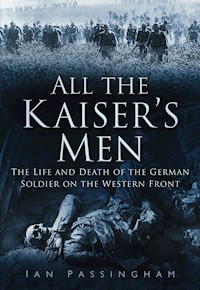
Convinced that both God and the Kaiser were on their side, the officers and men of the German Army went to war in 1914, confident that they were destined for a swift and crushing victory in the West. The vaunted Schlieffen Plan on which the anticipated German victory was based expected triumph in the West to be followed by an equally decisive success on the Eastern Front. It was not to be. From the winter of 1914 until the early months of 1918, the struggle on the Western Front was characterised by trench warfare. But our perception of the conflict takes little or no account of the realities of life 'across the wire' in the German trenches. This book redresses that imbalance and reminds us how similar these young German men were to our own Tommies. Drawing from diaries and letters, Ian Passingham charts the hopes and despair of the German soldiers, filling an important gap in the history of the Western Front.
Das E-Book können Sie in Legimi-Apps oder einer beliebigen App lesen, die das folgende Format unterstützen:
Veröffentlichungsjahr: 2011
Ähnliche



















ALLTHE
KAISER’S MEN
THE LIFE AND DEATH OF THE GERMAN SOLDIER ON THE WESTERN FRONT
IANPASSINGHAM
Deutschland
Und wenn uns nichts mehr übrig blieb,
So blieb uns doch ein Schwert,
Das zorngemut mit scharfem Hieb
Dem Trotz des Fremdlings wehrt.
So blieb die Schlacht als letzt Gericht
Auf Leben und auf Tod,
Und wenn die Not nicht Eisen* bricht,
Das Eisen bricht die Not.
Emanuel Geibel
Germany
And if nothing else to us be left,
There still remains the sword,
Which boldly wielded with fierce cleft
Defies the enemy horde.
Thus combat unto death we make,
Last arbiter indeed,
For if need will not iron* break,
Then iron shall break the need.
First published 2003
This edition published in 2011
The History Press
The Mill, Brimscombe Port
Stroud, Gloucestershire, GL5 2QG
www.thehistorypress.co.uk
This ebook edition first published in 2013
All rights reserved
© Ian Passingham, 2003, 2004, 2005, 2011, 2013
The right of Ian Passingham to be identified as the Author of this work has been asserted in accordance with the Copyright, Designs and Patents Act 1988.
This ebook is copyright material and must not be copied, reproduced, transferred, distributed, leased, licensed or publicly performed or used in any way except as specifically permitted in writing by the publishers, as allowed under the terms and conditions under which it was purchased or as strictly permitted by applicable copyright law. Any unauthorised distribution or use of this text may be a direct infringement of the author’s and publisher’s rights, and those responsible may be liable in law accordingly.
EPUB ISBN 978 0 7524 7258 4
Original typesetting by The History Press
CONTENTS
Acknowledgements
Preface
Introduction
1
Roots of Conflict: 1871–1914
2
The Scent of Victory, Disaster on the Marne: August–September 1914
3
Dance of Death, First Ypres and a Winter of Discontent: September–December 1914
4
1915: Deadlock, False Hopes and Promises
5
‘We shall bleed the French white at Verdun’: January–June 1916
6
Materialschlacht: The German Agony on the Somme: July–November 1916
7
A Terrible Turnip Winter: The German Home Front in 1916
8
New Plans for Old – Alberich and a Cunning Plan: January–March 1917
9
Amerika, Arras and l’Affaire Nivelle: April–June 1917
10
Catastrophe and the ‘Greatest Martyrdom of the War’: June–November 1917
11
Mons, Cambrai and News from the East: Novem-ber–December 1917
12
War at Home and Kaiserschlacht at the Front: January–March 1918
13
Friedenssturm – The Greatest Myth of the War: April–July 1918
14
Courage, Endurance, Defeat: August–November 1918
15
Dolchstoss: Versailles and the Diabolical Legacy
Appendices I–V
Glossary
Notes
Bibliography
To
John Terraine
for whom truth, context and balance
were the most effective items
in a military historian’s kitbag;
and to
All the Kaiser’s Men –
who lived, loved and died
in the same way as their enemies,
but whose courage, endurance and sacrifice
were betrayed by Germany’s
first great catastrophe.
To Germany (Autumn 1914)
You are blind like us. Your hurt no man designed,
And no man claimed the conquest of your land.
But gropers both through fields of thought confined
We stumble and we do not understand.
You only saw your future greatly planned,
And we, the tapering paths of our own mind,
And in each other’s dearest ways we stand,
And hiss and hate. And the blind fight the blind.
When it is peace, then we may view again
With new-won eyes each other’s truer form
And wonder. Grown more loving-kind and warm
We’ll grasp firm hands and laugh at the old pain,
When it is peace. But until peace, the storm,
The darkness and the thunder and the rain.
Charles Hamilton Sorley
ACKNOWLEDGEMENTS
My interest in the First World War did not begin formally at school, where the Tudor, Stuart and Georgian eras more occupied my history, but with a play, Journey’s End, by R.C. Sherriff. What captured my imagination more than any other part of this remarkable drama was that it was set on the eve of the great German offensive of 1918. My curiosity led me to read Erich Maria Remarque’s All Quiet on the Western Front and after that, the history books. Since then, I have been fortunate enough to serve in the Army myself and to understand that little bit more about the experience of military life in peace and war. Half of my career was spent in Germany/Berlin within the British Army on the Rhine (BAOR) as part of NATO, and in Berlin as a liaison officer to the former Soviet forces stationed in the German Democratic Republic (GDR). From these roots has grown an abiding interest in German history, culture and the German people, who have a great deal more in common with the British than we often acknowledge.
The First World War turned so many ‘certainties’ on their heads, not least of which was the dramatic reversal of alliances, especially those between Great Britain and France (traditional enemies), and that of Great Britain with Prussia/Germany as traditional allies. All this has led me to wonder precisely what the true experience of the German soldier was like between 1914 and 1918, and at the other end of the scale, whether German leadership was genuinely superior to that of the Allies during the First World War, for which much ‘testimony’ still exists.
I have been privileged to carry out research on this book in places far and wide and, as usual, sources range from individual testament or memory of loved ones through a considerable wealth of primary and secondary sources, many of which have been translated from the ‘notorious’ German Gothic script, and other excellent studies of all aspects of the battles, campaigns, strategy, doctrine, leadership and tactics of the First World War on the Western Front in particular. While every effort has been made to acknowledge copyright holders of the references and illustrative material used in All the Kaiser’s Men, should any copyright holders inadvertently have been omitted, I would urge them to contact the publishers directly.
I have received particular help from the Bundesarchiv, Imperial War Museum, Public Record Office, (now known as The National Archives), the Liddle Collection at the University of Leeds, Australian War Memorial and the German Historical Institute and hope that their advice, assistance and genuine interest in my efforts to realise my aim will be rewarded. The Imperial War Museum has provided continual support through its Department of Printed Books, Documents and Mapping Department, Photographic and Sound Archives, as well as the Reading Room and Library. I wish to extend my thanks to all the staff who have helped me to read and use extracts especially of captured letters, diaries, individual memoirs, and German regimental and other unit histories. My thanks go also to Renate and Oliver Farley, for their poignant family history of Renate’s father, Robert and his brothers Karl and Alois, as well as that of Valentine Kühns.
As ever, I am immensely grateful for the support and encouragement of members of the Western Front Association (WFA), British Commission for Military History (BCMH) and the many travellers with Holts’ Battlefields and History Tours who have shown a real desire to have a German version of the events of the First World War that they so diligently study and on which they spend time travelling to ‘see the ground’. Of a large cast of fellow enthusiasts, whose knowledge and passion for the subject will always continue across social as well as working hours, I wish to acknowledge the help of Peter Simkins, Michael Orr, Stuart Sampson, Kathy Stevenson, Jules Lyne, Bill Philpott, Isabel Swan, John Lee, Leslie Graham, David Filsell and Tony Cowan, among others. I would particularly acknowledge the assiduous and excellent efforts of Joy Thomas in bringing the British Official History to new life with extracts of the detailed German information held therein and which is so often missed or ignored. My special thanks go to Giles Allen for access to his outstanding collection of First World War memorabilia.
In general terms, studies of this great conflict have paid lip-service to the actual conditions for the troops on the other side of no-man’s-land while acknowledging the ‘mud, blood and horror’ of life for the Tommy or the Poilu (French soldier). This is by no means the full picture, for tremendous strides have been made in considering Germany and the Central Powers as part of the equation – and excellent studies are now available.
What I believe is still missing is a narrative account of all the Kaiser’s men, particularly in the main theatre of war between 1914 and 1918 – the Western Front. Though not claiming to be in any way a definitive academic analysis of the German Army in the First World War, I trust that All the Kaiser’s Men will give a wider readership an insight into the life and death of the German Army at that time to set against their knowledge of the British, Dominion or French experience.
Dr Correlli Barnett and John Terraine (who passed away on 28th December 2003, but whose legacy is a profound one), have been particular inspirations to me across the years, not least because of their outstanding contribution to the BBC’s ‘Great War’ television series and their unwavering determination to inject objectivity into such an emotive subject as the First World War.
My thanks go also to Jonathan Falconer, Nick Reynolds, Sarah Flight et al. for helping to take the manuscript, photographs, maps and diagrams and magically produce the book; a process that still fascinates me at every turn.
Last, but by no means least, I could not have even contemplated this work without the extraordinary forbearance and understanding of Sally, JJ and Eleanor. I hope they will consider the fact that the publisher has elected to release it in paperback worthwhile also.
PREFACE
Anyone who has ever looked into the glazed eyes of a soldier dying on the battlefield will think hard before starting a war.
Count Otto von Bismarck
(Speech to the Reichstag, Berlin, 1867)
The Great War, or First World War, gained such titles from the unprecedented scale on which it was fought from the outset. There had never been so great a concentration of armed force in world history as that which formed the respective blocs ranged against each other in August 1914. Each of the major continental armies, namely those of Germany, France, Austro-Hungary and Russia, had around one million men in the field and millions in reserve when the conflict began.
The only exception, as a key player on the Western Front, was Great Britain, with an Army of less than 500,000 and a mere 120,000 assigned to the British Expeditionary Force, or BEF. But Great Britain was not a continental, but a world power, with an empire that covered over a third of the globe. As an island-nation with imperial interests, its military strength relied on the then unchallenged supremacy of the Royal Navy, rather than a large standing Army.
Although Wellington and Napoleon and their generals had developed strategies and tactics based on the use of thousands of men almost a century before, in 1914 commanders such as Joffre and von Moltke were dealing daily with millions. Furthermore, these were millions armed with weapons more accurate, quick-firing and deadly than ever before. If the strategy and tactics were difficult enough, the logistical implications were a nightmare. But by 1914, the movement of men and matériel had also changed beyond all recognition since the last great European conflict of the Napoleonic era.
The sheer scale of the conflict determined the nature of the war itself. Plans drawn up by Germany, France and Russia prior to the hostilities envisaged rapid victory via swift mobilisation and the prompt despatch of the vast armies to the forward battle zone by train. In short, the nation’s rolling stock and railway timetables held the key to success. Once the armies were in place, it was believed that the offensive spirit, eloquently labelled by the French as l’attaque à l’outrance, would win the campaign – and the war – in weeks, rather than months or years.
The British provided the only coherent voice of reason at this stage, despite the popular enthusiasm for war that had gripped the people of all the nations that were then tumbling headlong towards Armageddon. Lord Kitchener, Secretary of State for War, warned his Cabinet colleagues that this would be no swift, victorious campaign. Rather, it would more likely stretch across a minimum of three years and with concomitant serious loss of life on both sides.
More poignantly, as war was officially announced in Great Britain and the crowds amassed in London and sang ‘God Save the King’, delighted at the great adventure on which they were about to embark, Foreign Secretary Sir Edward Grey had already seen the true apparition of the war about to unfold. Standing in a Foreign Office window with a colleague as the lamps were lit across St James’s Park, he remarked sorrowfully: ‘The lamps are going out all over Europe; we shall not see them lit again in our lifetime.’
On the other side, where we shall dwell in this book, the enthusiasm and arrogance of a nation that was more certain than any other of its destiny in this war, attitudes were very, very different. On 4 August, when Germany had declared war on Belgium and immediately violated her borders, Britain, under the terms of the Treaty of London of April 1839, ordered general mobilisation and issued an ultimatum. In Berlin, the British Ambassador, Sir Edward Groschen, presented the ultimatum papers to Chancellor Theobald von Bethman-Hollweg. The German Chancellor was incandescent over what he regarded was hypocritical harping on Belgium, which in his opinion was not the reason for Britain’s decision to go to war. He stated that:
England is doing an unthinkable thing in making war on a kindred nation . . . it was like striking a man from behind while he was fighting for his life against two assailants and as a result of this terrible step, England would be responsible for the dreadful events that might follow . . . [and this would be] all from just a word, ‘neutrality’. Just for a scrap of paper Great Britain is going to make war on a kindred nation!
The ultimatum was rejected and Britain and Germany were at war.
But this time, the historical precedent of English and Prussian alliance against France had been turned on its head. The spirit of Wellington and Blücher was forgotten and Britain and Germany were enemies that were by now politically polarised. By the end of August their young men, many of whom had family and friends in the other country and whose cultural heritages were so closely tied, would be fighting each other in the land that had been so often the land of their mutual enemy, France.
It was ironic that in his invective against ‘England’, Bethmann-Hollweg had unwittingly used the phrase, ‘like striking a man from behind while he was fighting for his life’. Four years later, German agitators would attempt to explain away Germany’s final defeat by accusing Socialist and Jewish politicians of ‘stabbing Germany in the back’ when she was fighting for her life. Neither accusation was true, of course, but each had a palliative effect for those who were leading Germany into a dark and terribly bloody place.
By 5 August, Britain was transformed into Germany’s most hated enemy. ‘Gott strafe England’ (‘God punish England’) was on the lips of almost every German soldier, woman and child, convinced that they had been betrayed by an old friend. Crowds pelted the British Embassy in Berlin with stones and enraged Berliners described this betrayal as ‘Rassen verrat’, or ‘racial treason’. Many Germans sincerely believed that they were about to fight a ‘defensive’ war, convinced that they were surrounded by hostile neighbours, all with evil intent.
Now even Britain had joined in the conspiracy as far as they were concerned. Many had not conceived such a thing, having witnessed a Britain in decline on their visits to friends and family there in recent years. They had believed that social unrest was rife, authority diminished and that with a small, though professional army, Britain would have no stomach for a fight against Germany as the great new military and industrial power in Europe. They were to be proved so wrong.
But as the drama over Britain’s entry into war and the reaction to it was played out, the Kaiser was predicting triumph, and quickly, to the delirious crowds in Berlin. Confident that his divine destiny was to lead Germany to the promised land of European – and then global – supremacy, he exhorted his troops as they departed for the front in early August with the imperial prophecy that:
You will be home before the [autumn] leaves have fallen . . . The only countries that have made progress and become great were warring nations; those which have not been ambitious and gone to war have amounted to nothing.
Sadly, the only German troops to return home before the leaves fell across Germany in the autumn of 1914 would be the thousands of wounded men who had become the first few of millions who would suffer the same fate – crippled, blinded or mentally afflicted by the horrors of a war that Germany had been so confident of winning at the outset.
As to being a successful warring nation, Germany would need two wars to finally come to terms with the fact that the noble Prussian military tradition on which she was founded as a nation state in 1871 was, for all its strengths, the very architect of its nemesis in both 1918 and 1945.
Let there be no further illusions about the whys and the wherefores, the point, pointlessness, or apparent futility of the First World War between 1914 and 1918. The why, the point and the justification for the conflict were, and remain, rooted in containing the over-weaning ambition of what was a militaristic Germany.
The nation state of Germany was the prize for crushing the French in the Franco-Prussian War of 1870–71. Otto von Bismarck, the ‘Iron Chancellor’, brilliantly, but all too briefly, guided this fledgling nation. But goodwill and good intentions were blatantly tossed aside under the misguided leadership of Kaiser Wilhelm II. Germany, the ‘new kid on the block’ in Europe, rapidly became the ‘new bully on the block’.
In August 1914, the US Ambassador to the Court of St James in London, Walter Hines Page, wrote: ‘German militarism, which is the crime of the last fifty years, has been working towards [war] for twenty-five years. It is the logical result of their spirit and enterprise and doctrine. It had to come.’
Page had summed it up perfectly; the First World War was the inevitable result of German economic and industrial progress, coupled with an avowed militarism.
It is no coincidence that the German term for the period 1914 to 1918 was always Weltkrieg, or ‘World War’, whereas in Britain it was principally known as the Great War, rather than the First World War or World War One and in France, La Grande Guerre was preferred to La Première Guerre Mondiale.
When Bismarck was forced out of office in 1890, his steady hand on the tiller was lost and the military leaders, enthusiastically encouraged by the ambitious Kaiser, gradually, yet inexorably, tore the fabric of democracy apart. Ultimately, the Kaiser saw the ‘Prussian military tradition’ as the one and only true symbol of Germany’s rise to European and global influence.
Coupled with this psychological export of Germany’s symbolic military power between 1871 and 1914, Germany’s industrial and technological progress in the same period was astonishing. Naturally, it suited the Kaiser and his generals that this progress was hitched strongly to the burgeoning power of the armed forces.
But with rapid industrial and technological advances came equally swift social change. An overwhelmingly rural population was transformed into an increasingly urban one, as well as a population that had expanded from 11 million in 1871 to almost 40 million by 1914.
Sweeping educational reforms, which emphasised higher and technical education, led to Germany’s claim on some of the most prominent and brilliant chemists, engineers and pioneers in the electrical and communications industries, as well as the ‘third dimension’ of aviation, in which Count Graf von Zeppelin led the world.
The rapid increase in the strength of the German Navy was more than matched by that of merchant shipping and German trade, which was becoming truly global by the turn of the century. Industrial expansion was underlined by the astounding increase in coal and steel production – the very foundation of the modern state at that time.
All in all, by 1914 Germany had come from nowhere as a nation and impressed the world. But this collective achievement in only four decades between 1871 and 1914 had sinister undertones. In the minds of the Kaiser and the military hierarchy, Germany’s social, industrial and economic evolution was not only proof-positive that Germany was becoming a great nation, but also that she now possessed the infrastructure, manpower and resources for a victorious and glorious war.
Lord Haldane, statesman and British Minister for War between 1906 and 1911, knew Germany well and understood the origin of the First World War more clearly than most. He wrote:
The reason [for war] appears to have been at some period in 1913 the German Government finally lost the reins on the necks of men whom up to then it had held in restraint. The decision appears to have been allowed at this point to pass from civilians to soldiers . . . It is not their business to have the last word in deciding between peace and war.
Germany was unquestionably at the heart of the bloody conflicts that marked the first half of the twentieth century. Therefore, Germany must be the place to go to fully understand the context, rather than the myth, of the First World War.
It is a journey worth taking.
INTRODUCTION
The reader will appreciate that All the Kaiser’s Men is a title that is not accurate for the ‘purist’, as the book deliberately concentrates on the German experience of the First World War on the Western Front, the main theatre of war throughout the momentous events of 1914 to 1918. Nevertheless, with the collapse of Russia in 1917 and the transfer of a million-or-so German troops from that theatre to the west and the German offensive/defensive campaigns on the Western Front throughout 1918, the vast majority of the troops of the German Army were fated to serve on the Western Front at one stage or another of the war. I hope that the book will be read with this in mind and that the narrative will be both accessible and fascinating.
References and research sources from German archives can be a mixed blessing, as much that was published from 1933 onwards would have had the ‘dead hand’ of the National Socialist regime’s Propaganda Ministry scrawled across it if it did not conform to the myths and blatant untruths that were peddled about the origins and conduct of the First World War. Nevertheless, providing the reader is reasonably well-versed in the history of that era and is prepared to keep an open mind, the sources dating from 1933 can, and should, still be regarded as important documents.
I have attempted to ensure that all abbreviations are used in full initially throughout the text and include most where appropriate in the glossary also. Where relevant, I have included translations of phrases and all of the poetry included in the book, and of many of the principal documents referred to either in the end notes or the bibliography.
Place names corrupted by soldiers on both sides, such as ‘Wipers’ for the Belgian town of Ypres, are included in their original and ‘corrupted’ manner and where German place names differ from either the French or Belgian original, e.g. Ypern for Ieper or Ypres, they are shown in italics.
The study has drawn heavily on both the German official history Weltkrieg (with the ‘Government Health Warning’ given in these notes), Ypern 1914 and the extraordinary alternative Weltkrieg by Rudolf Stratz, which reflects the true nature of ‘spin’ on behalf of the National Socialist regime, as well as diaries and memoirs that range widely from those of personalities such as von Falkenhagn, Ludendorff, von Hindenburg and Crown Prince Rupprecht of Bavaria to those of prominent soldiers like Ernst Jünger and ordinary men such as Edwin Valentine Kühns, Alois and Albert Mühmelt and Herbert Sulzbach. These have been an endless source of revelation and fascination in my research. I would also recommend the British Official History, which has a wealth of translated information on German actions, attitudes and leadership issues in its voluminous footnotes and special sections on the German experience of a particular battle or campaign throughout, much of which has not been tapped by readers hitherto. Naturally, many other primary and secondary sources were used, as the text and bibliography will reflect. Where possible, maps are of German origin also.
CHAPTER 1
ROOTSOF CONFLICT: 1871–1914
‘Where the army marches, all Germany marches too.’
In 1887, Friedrich Engels predicted that beyond the German victory in the Franco-Prussian war, the next major conflict, (namely the First World War) would be fought on a scale and in conditions without precedent. It would lead to nothing less than the destruction of empires, monarchies and the notion of divine right for hereditary rulers:
. . . [This fledgling state] – Prussia-Germany – can no longer fight any war but a world war; and a world war of hitherto unknown dimensions and ferocity. Eight to ten million soldiers will strangle each other and in the process decimate Europe . . . The ravages of the Thirty Years War telescoped into three or four years and extended to the entire European continent. It will lead to famine, pestilence and the general barbarization of both the armies and peoples of the competing nations. It will end in general bankruptcy and the collapse of the old state and traditional statecraft . . .1
But despite the huge political and social upheavals, as well as the enormous sacrifice for most of the nations embroiled in the First World War, the nature of the war’s end and of the Treaty of Versailles would sow the seeds of another even greater worldwide conflict a mere generation later.
For Germany, with almost two million dead and approximately seven and a half million wounded, maimed, crippled and destitute soldiers returning to a country half-starved by the Allied blockade and deliberated by woeful military and political mismanagement between 1914 and 1918, it looked as if it would be impossible for the German people to contemplate another major conflict.
And it seemed to be unthinkable that Germany would use military force again once it entered an era of democracy – the Weimar Republic – and despite the serious economic difficulties that were to beset it and the rest of the world in the 1920s and early 1930s.
But the impossible and the unthinkable happened. The real tragedy was that its roots were firmly embedded in Germany’s experience of the First World War and a national psyche that accepted authority and believed the notion that Germany was destined for greatness and the leading role on the world stage.
Germany’s fate throughout the first half of the twentieth century was fixed by her evolution as a nation state following the Franco-Prussian War of 1870–71. The fulcrum was the First World War – where German plans for European and global dominance, combined with military arrogance, dictatorship and a flawed strategy led only to political and military collapse in the summer and autumn of 1918. It is a historical fact that sadly, the German Army was not forced to surrender unconditionally and the hard-won Allied military victory was then undermined by the subsequent political failure of the Versailles Treaty. In short, the Allied Military success was undermined by political failure at Versailles.
In 1872 the German socialist Wilhelm Liebknecht had explained to a baffled British visitor: ‘[To understand] Germany, you must first grasp the fact that this new nation is like an inverted pyramid. Its apex, firmly embedded in the ground, is the spike on the top of the Prussian soldier’s helmet. Everything rests on that.’
The Army, principally represented and led by Prussian influence, was unencumbered by constitutional restraints. The Chancellor and mentor of a unified Germany and the ‘Second Reich’ was Count Otto von Bismarck, the Iron Chancellor. He set about making the newly ascendant and confident Germany the strongest economic power in Europe, granting generous concessions to industry and creating a stable currency.
For the years after 1871, Bismarck enjoyed the support of a compliant Kaiser, namely Wilhelm I. When he died in March 1888, he was succeeded by his 57-year-old son Friedrich III, the husband of Queen Victoria’s eldest and favourite daughter ‘Vicky’.
Friedrich was a great admirer of British parliamentary institutions and envisioned a democratic Germany. Indeed, during the Franco-Prussian War, he had noted in his diary:
I maintain even today that Germany could have conquered morally, without ‘blood and iron’ [in Bismarck’s phrase] . . . It will be our noble but immensely difficult task in the future to free the dear German Fatherland from the unfounded suspicions with which the World looks upon it today. We must show that our newly-acquired power is not a danger, but a boon to humanity.
But it was not to be. Friedrich was Kaiser for a mere 99 days and died of throat cancer on 15 June 1888.
His 29-year-old son became Kaiser Wilhelm II. The difference between ‘Kaiser Bill’ and his predecessors could not have been more stark, for he immediately set about dashing any hope of a benign democracy within Germany. He hated constitutionalism and the power of political parties and he despised his father’s ‘liberal’ thinking.
Above all, he resented Bismarck’s well-established authority and the personal respect that he enjoyed throughout Germany. Wilhelm refused to subordinate himself to the aging chancellor. Bismarck, on the other hand, remarked that: ‘The new Kaiser is like a balloon. If you don’t keep hold of the string, you will never know where he will be off to.’ It was the beginning of a stormy, brief and ultimately fatal power struggle between Bismarck and the Kaiser.
Matters came to a head in 1890 when Bismarck unearthed an old decree, signed by Wilhelm IV in 1852, obliging Prussian ministers to consult with the prime minister before approaching the king. The chancellor, in attempting to limit the younger Wilhelm’s exposure to the ideas of others, infuriated him. The Kaiser ordered Bismarck to repeal the decree or resign. Bismarck, embittered and totally frustrated by Wilhelm’s hubris, chose to resign.
As soon as he was unfettered by this political control, Wilhelm II swiftly shifted the focus of foreign policy and set course for confrontation rather than mediation with other nation states that would have dire consequences for the Hohenzollern dynasty and Germany. Not content with becoming a dominant force on the European continent, Wilhelm was determined to transform Germany into a global power with a colonial empire and a powerful Navy that would more than match that of Britain in particular.
In fact, this new emphasis did suit the muscle-flexing mood of the day. Germany was enjoying an era of unprecedented growth, and most Germans saw in the Kaiser’s Weltpolitik, or global policy, an outlet for their energy and desire to ensure Germany’s greatness as the ‘new kid on the block’ on the world stage. Coupled with the public support for the Kaiser’s initiative was the resurgence of a virulent form of racist nationalism, epitomised by the Alldeutsche Verband, or Pan-German League.
Founded in 1890, the league embraced the notion that pure-blooded Teutons were the creators and bearers of civilisation and thus responsible for all worldly progress. Jews and ‘socialists’, on the other hand, were a corrupting, negative force – a dogma popularised by Houston Stewart-Chamberlain, the Anglo-German author and son-in-law of the composer Richard Wagner. Beyond this extreme simplification of European affairs, the Pan-German League’s professed goal was to gather all the countries considered to be ‘German’ in origin, such as the Netherlands, Belgium, Luxembourg, Switzerland, Austro-Hungary, Poland, Rumania and Serbia. From this enlarged Reich, the pan-Germans intended nothing less than to rule the world.
This notion was fuelled by this diabolical theory and by the outpourings of such writers as Heinrich von Trietschke, who popularised the glorification of war as a means to achieve greatness, and predicted that a new German empire would replace the old British empire and utterly subjugate the Slavs of central Europe. Buoyed by these ideas, the Kaiser drove a wedge between moderation and extremist views in the Fatherland.
The conflict that was to actually erupt in 1914 was preordained. It is my view that the touch paper for a European conflagration had been lit in the 1890s. Trietschke, greatly admired by Wilhelm II, wrote in 1892: ‘Those who propose a foolish notion of peace show their ignorance of the international life of the Aryan race.’ Democracies were dismissed as corrupt and, beneath the surface, ripe for domination by the emergent militaristic nation of Germany, with the Kaiser at its head.
By the turn of the century, Wilhelm’s penchant for bombast and the radical views coming from Germany sharpened a growing worldwide fear of a policy that appeared to advocate German military aggression. The Kaiser peppered his speeches with phrases such as ‘a place in the sun’, Germany’s ‘mailed fist’ and a ‘glistening coat of [chain] mail’, to make this policy plain to all who cared to listen. When Herbert Asquith engaged Wilhelm in a discussion on the balance of power in Europe, he retorted: ‘There is no balance of power but me; me and my 25 [Army] Corps.’
Worse, the ship-building programme masterminded by Admiral Alfred von Tirpitz was designed to match the Royal Navy ship for ship – a red rag to the British bulldog. It engendered a rivalry that became a principal factor in Britain’s decision to seek an entente with her traditional enemy, France.
As a continental power, Germany’s great strength lay with its army. But circumstances and ambitions beyond the continent arguably weakened that might as a result of Wilhelm II’s desire for global influence and Tirpitz’s ambition to rule the waves in place of the Royal Navy. Tirpitz had unequivocal faith in sea power and was equally convinced that Britain was determined to prevent Germany from striving to become the world influence that he believed was her destiny. In 1897, he affirmed in a secret memorandum that England was Germany’s most dangerous naval enemy; and in that ‘enemy’s’ mind, the Tirpitz factor was one of profound menace too:
Sea-power played no part in the making of modern Germany, and that was irrelevant to Germany’s home defence. It was sought deliberately as an engine of conquest and as the only effective weapon with which Germany could win power abroad and above all dispute British supremacy.2
In 1898, Tirpitz introduced the Navy Law, which was explicit in confirming such British fears. The Imperial German Navy was to expand dramatically and become an instrument of challenge and coercion, rather than directly confront the Royal Navy, at least for a number of years. In 1900 Tirpitz put forward the infamous ‘Risk Theory’, a policy by which Germany could build a modern maritime force to match the Royal Navy and threaten Britain’s fleets protecting the empire abroad.
What’s more, the public demonstration of Germany’s naval expansion led to patriotic fervour and convinced the Kaiser that the Fatherland’s future lay ‘on the water’. By 1912, Chancellor Bethmann-Hollweg declared that: ‘The fleet was the favourite child of Germany.’3
Tirpitz’s aggressive policy led to inevitable reaction, not least by Britain. The First Sea Lord, Admiral Sir John Fisher, introduced the naval reforms as a direct response. Germany was careering towards isolation and enmity from the world’s greatest sea power in addition to the opposition she had already brought upon herself from Russia and France. In 1904, it was a significant factor in the bilateral agreeement that led to the ‘Entente Cordiale’ between Great Britain and France. By 1907, Britain, France and Russia had formed the Triple Entente. Germany had brought this upon herself, primarily because of Tirpitz, whose ‘Risk Theory’ had begun to turn towards a dark reality for Germany’s future.
One by one, Germany had forfeited friendships and old alliances. In 1909, German Chancellor Bethman-Hollweg summed up the Kaiser’s policy when he wrote: ‘Challenge everybody, get in everyone’s way and, in the course of it all, weaken nobody.’
The Bismarckian balance of power, based on firm government and a pragmatic foreign policy, was now a long-abandoned dream, for first Wilhelm II and then the military powers in Germany had torn it to shreds, strip by strip. Tirpitz and Count Alfred von Schlieffen had become the architects of Germany’s destiny. Schlieffen, as Chief of the Army General Staff, had drawn up a plan of ‘preventative war’ to preempt any growing threat of attacks by France on one side and Russia on the other. The threats were tenuous, but the perception in Germany held sway.
By 1914 the German Army’s thirst for war had gathered widespread support. By then, the control of economic and foreign policy had all but passed to the military General Staff anyway.
After the assassination of Austrian Archduke Ferdinand and his wife Sophie in Sarajevo on 28 June, Germany became engaged in a race that was wholly driven by the military hierarchy in order to conform with the Schlieffen Plan. When the Russians began to mobilise on 29 July and the French followed suit on 1 August, the pressure on the Kaiser to kowtow to the Army was overwhelming. Simply, if he failed to order general mobilisation, the Schlieffen Plan would be jeopardised. He had little choice but to acquiesce.
The very size of the German Army forced a decision. From some 250,000 men in 1870 it had grown to over two million strong – almost one million of whom had to be moved by a strict timetable immediately. Any delay was intolerable and could be fatal, according to the General Staff. The chickens were now flocking home to roost – the Kaiser’s arrogance and bombast since his accession had led Germany to the brink of war and he was now forced to make a decision by those to whom he had originally sought to give power without losing supreme control himself.
As the conflagration in Europe was about to ignite he realised too late that he had unwittingly handed over the reins of power – the conduct of the war and Germany’s leadership – to a military High Command that would ultimately bring Germany to ruin and the Kaiser to exile.
During the Franco-Prussian War of 1870–1 Prussia, allied with Bavaria and other German states, defeated the French. In January 1871 the North German Federation was dissolved, giving way to the German Empire or Reich, with King Wilhelm the First of Prussia as its first emperor.
The father of the new army was Helmuth von Moltke the Elder (1800–91). An avid student of the theories of Clausewitz and Gneisenau, he devoted himself to the formation, instruction, and evolution of the German General Staff and the Army, both of which were to become renowned for their skill and professionalism in the art of modern warfare.
When war came in August 1914, the German Army was under the command of General Helmuth von Moltke the Younger. His officers and the troops that they led were confident that the great German Army would sweep any opposition off the battlefield in the west before turning its attention in force to the Eastern front. After all, they were about to implement the indomitable Schlieffen Plan.
This strategic initiative, conceived by Moltke the Elder, and subsequently developed by Count Alfred von Schlieffen when he eventually succeeded Moltke as Chief of the German General Staff, envisaged a war on two fronts. But it would still win a war within months, not years. He declared that, ‘In a two-front war, the whole of Germany must throw itself upon one enemy; the strongest, most powerful, most dangerous enemy and that can only be France.’4
The main German force was to attack France, striking through Belgium, move quickly into the department of Champagne, smash the French in one great battle, isolate Paris, then roll the remains of the French Army up to the Swiss border. Schlieffen was adamant that the right wing of this vast sweeping movement must be strong and seamless, reaching as far west as Lille to make the envelopment of the French Army complete. Schlieffen wanted ‘the last man on the right of the right wing to brush the Channel with his sleeve’ when the Kaiser’s men marched stridently in to violate and conquer French territory.
Behind this massive advance by first-rate Active Army Corps through Belgium, reserve formations would rush to the Channel ports to cut off any British reinforcement of the French Army. This would leave one army, the Eighth, to secure East Prussia so as to contain any initial Russian advance and to cooperate with the Austrians, who were to attack Russian forces through Poland. Austria was to withdraw some troops from her front with Serbia to develop a strike at Russia through Galicia.
This was the plan, and it was accepted by the Kaiser, the government and the German High Command, as well as the General Staff. The power and influence of the German General Staff were so strong that the plan was endorsed without any debate on its moral or political implications. The violation of Belgian neutrality was hardly a major factor to most, for few influential German politicians or military men believed in its neutrality anyway. More dangerous, however, was the hubris and unquestioned authority of the General Staff and its head, Count Alfred von Schlieffen. The German foreign ministry was informed that:
If the Chief of the General Staff, particularly such a pre-eminent strategical authority as Schlieffen, considers such a measure [violating Belgium] is necessary, then it is the duty of diplomacy to concur in it and to facilitate it in every possible manner.5
The Schlieffen Plan apparently provided the template for guaranteed success. When the test came, its architect was already in Valhalla and his successor, Helmuth von Moltke, (‘the Younger’) was not cut of the same cloth as either his mentor or his renowned uncle. Moltke was a pessimist, who lacked Schlieffen’s drive and zeal for the concept of concentrating his forces and most of his strength in one bold manoeuvre. If Schlieffen’s motto was ‘Be bold, be bold’, then Moltke’s was ‘Be bold, but not too bold.’
He worried constantly about the weakness of his left wing, rather than the strength of his right wing, in the west; and he had nagging doubts about the capability of his Eighth Army in East Prussia to contain any Russian aggression. Schlieffen had estimated that the vast army that was known as the ‘Russian steamroller’, largely because of the sheer weight of its numbers, would be slow to mobilise and therefore the Eighth Army’s role would be merely to screen and contain the Eastern Front alongside its Austro-Hungarian allies while the war in the West was swiftly settled. Then, the concentration of force would be entirely at the East’s disposal.
But what if the momentum of the western offensive was stalled; and what if the ‘Russian steamroller’ moved forward more quickly than Schlieffen had predicted? Moltke wrestled with such ‘worst case scenarios’ and he made a few adjustments along the way, a little tinkering here and there, and hoped for the best. The test of Germany’s master strategy and the man who was fated to bear the responsibility for implementing it was looming. It would be quite a test.
Owing to the efficient system of universal conscription, Germany was able to field a large professionally-trained army within days of war being declared in July/August 1914. In peacetime, every German male from the age of seventeen to forty-five was liable for some form of military service.
Although not eligible for service in the Standing Army until his twentieth birthday, every man on reaching seventeen became automatically liable to serve with the Landsturm, or Home Guard. On his twentieth birthday, he began to serve a two-year period, or three years in the case of cavalry or artillery, with the Standing Army, followed by successive periods of seven years with reserve forces – the Landwehr – and then back to the Landsturm for the final seven years of service. This system meant that each year saw a constant entry from one form of service to another – up to age forty-five. This was the principal reason for the large pool of manpower at the onset of hostilities. In wartime men could be called up and sent to the front before reaching the age of twenty and were not automatically released from further service until their forty-fifth birthday.
There were three more categories: the Restanten Liste (reserved occupations, but eligible for military service in extremis), the Einjahrige Freiwilligen (one-year volunteers) and the Kriegsfreiwilligen (War Volunteers). The latter were men between 17 and 20 who were allowed to volunteer for active service before their official call-up date. Thousands of young men opted for this option in the heady days of July and August 1914.
Not surprisingly, the Reserve and Landsturm were practically all absorbed into the expansion of the Army in 1914. The Landsturm in particular was extensively drawn on to make up the huge losses of the autumn and winter campaigns of that year. By the end of 1915 this had exhausted most of these reinforcements. As a result, men training within the normal categories were called to the front earlier than planned.
Significantly, the situation became so dire by the beginning of 1917 that training drafts that expected to have been called to the colours in 1919 were drafted into service on the Eastern front two years early. This was to allow seasoned and experienced men to be transferred to the Western Front to replace the enormous losses there. It was abundantly clear from Germany’s manpower situation alone that by the beginning of 1917 her Army was on the ‘back foot’ on the Western Front. The roots of this crisis were to be firmly embedded in the twin German catastrophes at Verdun and especially on the Somme in the previous year, as we shall see.
Between 1914 and 1918, the German Army was to prove time and time again that it had the capacity to remain standing after what appeared to have been knockout blows. This endurance against extraordinary odds came from the resourcefulness and courage of the ordinary ‘Fritzie Schmidt’ (an allusion to ‘Tommy Atkins’ as the archetypal British soldier) and the leadership of junior officers and the stalwart senior and junior NCOs. On the face of it, these were similar characteristics of the Western allies. But there were marked differences, so often neglected by studies of the First World War.
Inevitably, the officer corps was modelled on Prussia, the dominant state prior to and after unification in 1871. Though only 30 per cent of the officers in the German Army of 1914 were aristocrats, they held most of the important command roles and staff appointments. This imbalance did not reflect German society, where the inspiration and drive of modernisation had been largely with the middle classes. This was demonstrated by the fact that in the more technical corps, such as the artillery and engineers, middle-class officers predominated. But few progressed to the higher levels of command.
Therefore, as Materialschlacht, or the ‘war of material’ dependent on modern technology, evolved between 1914 and 1918, the German High Command struggled to handle it. It was an inherent weakness, obvious not at regimental level and in the trenches where the day-to-day fighting went on, but at the senior levels where the fate of the German Army rested. It would lead to dogmatic, rather than pragmatic, doctrine and become a source of failure in 1918.
Halfway through the First World War, as the Somme campaign erupted, this weakness was explicitly identified by the Germans themselves. On 4 July 1916, Admiral Georg Müller, a senior aide to the Kaiser, discussed the state of German military leadership with General Ludwig von Lauter, the largely unheralded but crucially important Ordnance General for Heavy Artillery at OHL, the German Supreme HQ. Lauter was responsible for the logistical provision of this vital asset and understood the nature of modern warfare and the reality of Materialschlacht. Georg Müller recorded Lauter’s uncomplimentary comments about the German military leadership in his diary:
It was a war, he said, ‘of young leaders and junior officers on the General Staff and in the field, a war that was dangerously undermining the authority of the Army commanders . . . ’ Lauter warned the Staff [on this] emphatically in December before the Verdun offensive. When he expressed his opinion to von Falkenhayn later, the latter replied: ‘Well, the French are being bled white, too. Moreover, if things go badly, we can break off and say that we only intended taking the forward [French] positions.’ When I [Müller] asked von Lauter whether General Falkenhayn enjoyed great respect in the Army, he replied: ‘Certainly not, and if the war ever ends there will be some interesting literature on the subject of the [German] war leadership.’6
After Falkenhayn’s dismissal in August 1916, the ‘duumvirate’ leadership of Field Marshal Paul von Hindenburg and General Erich Ludendorff agreed that in the West they had succeeded to ‘an evil inheritance.’ In the context of the dreadful events unfolding for the German troops at Verdun and on the Somme, this view was entirely apposite. But it could just as easily have described the insidious inheritance that Germany had now chained herself to with a military dictatorship that was soon to become absolute. The worst part was that from August 1916 Hindenburg, the ‘Hero of Tannenberg’ and a military legend of the Franco-Prussian War to boot, gave Ludendorff a legitimacy and status that would prove fatal for the Fatherland. By early 1917, the Kaiser became a political and military irrelevance and Ludendorff had a free reign to lead the charge to Germany’s first twentieth-century nemesis.
The real strength of the German Army lay at the tactical level and rested on the shoulders of junior officers and the NCOs. The popular myth and tales of ‘Lions led by Donkeys’ in the British Army during the First World War could be more accurately applied to the German Army. German junior officers and NCOs were given more responsibility in their rank than their Allied equivalents, so that an Oberleutnant might well command an infantry company of 150 men and a sergeant or Feldwebel a platoon of around 40.
Germany’s modernisation since 1871, which included universal education and a high proportion of well-educated men and women, worked to her advantage in war. Senior and junior NCOs were generally better educated than their Allied equivalents and they were trusted to use their initiative and play more important roles at the tactical level. These ‘100,000 men’ were truly the backbone of the German Army, maintaining the highest standards of training and discipline, as well as inspiring their men to acts of courage and endurance that were the hallmark of the Kaiser’s men throughout this war and would be when their sons went to war twenty-one years later.
The German Army in 1914 had an active strength of eight armies, with one, the Eighth, in East Prussia. Within these armies were a total of 25 Corps, with 50 infantry and 11 cavalry divisions. Behind these came 32 Reserve divisions, 7 Ersatz (supplementary Reserve) divisions and 16 Landwehr Brigades. The field Army was around 850,000 and the High Command was determined to use maximum and concentrated force in the West.7
The railways were soon sending the vast majority of these men and their weapons and other matériel towards the West for death or glory, while the remainder headed for the borders of East Prussia.8
CHAPTER 2
THE SCENTOF VICTORY, DISASTERONTHE MARNE
AUGUST–SEPTEMBER 1914
Abschied
Vorm Sterben mache ich noch mein Gedicht.
Still, Kameraden, stört mich nicht.
Wir ziehn zum Krieg. Der Tod ist unser Kitt.
O, heulte mir doch die Geliebte nit.
Was liegt an mir? Ich gehe gerne ein.
Meine Mutter weint; Man muß aus Eisen sein.
Die Sonne fällt zum Horizont hinab.
Bald wirft man mich ins milde Massengrab.
Am Himmel brennt das brave Abendrot;
Vielleicht bin ich in dreizehn Tage tot.
Alfred Lichtenstein, 1889–1914
(Killed in action at Vermandovillers,
Somme, September 1914)
‘Departure’ or Leaving for the Front
Before dying I must write my poem.
Quiet, comrades, don’t disturb me.
We are off to war [and] death is our bond.
Oh, if only my girlfriend would stop howling!
What do I care? I am happy to go.
My mother’s crying; one needs to be made of iron.
The sun falls to the horizon;
Soon they’ll be throwing me into a nice mass-grave.
In the sky the good old sun is glowing red;
[And] in thirteen days I shall probably be dead.
At the beginning of August 1914 there was an unmistakable mood of optimism across Europe. Throughout the continent, peace gave way to an explosion of patriotic enthusiasm for war. The tensions within each country – unrest and fear of civil disobedience, civil war and social upheaval brought on by poverty and the sheer drabness of most people’s lives – were blown away like a cobweb on a fresh wind. The fresh wind was ‘the cause’ – a singular belief in each country of duty, honour, glory and victory in the name of the Kaiser, King, Tsar or Emperor.
Within weeks of Archduke Ferdinand’s assassination it was utterly irrelevant that it was Austria’s casus belli, for it was, in irredeemable fact, Germany’s war. The German Army attacked first – principally to knock out France in the west.
At 5 a.m. on 4 August, the German vanguard crossed the Belgian frontier. On the same day, the Kaiser, already more certain of victory than any other European leader at that time, addressed a packed Reichstag: ‘I no longer know of [political] parties. I know only Germans and therefore I ask all of you to give me your hands.’




