


0,99 €
Mehr erfahren.
- Herausgeber: Delos Digital
- Kategorie: Krimi
- Sprache: Englisch
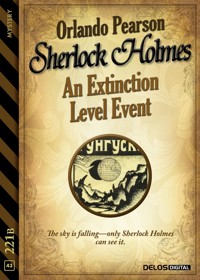
Giallo - short story (19 pagine) - The sky is falling—only Sherlock Holmes can see it.
In 1908, Sherlock Holmes is haunted not by a crime, but by a cosmic question: how did the mighty dinosaurs vanish from the Earth? When he begins scanning the heavens for answers, he witnesses something terrifying—a celestial projectile hurtling toward the planet. Racing to Siberia with Watson and Mycroft, they arrive just in time to witness the Tunguska Event firsthand. Now Holmes must not only solve a prehistoric mystery but prevent humanity from suffering the same fate.
London businessman, Orlando Pearson is the creator of The Redacted Sherlock Holmes series, which buries forever the idea that Sherlock Holmes might not have been a historical person.
Do you want to see Sherlock Holmes come to the rescue of Queen Victoria, arrange the borders of post-war Europe, clear Macbeth of murder, unravel King Oedipus’s complexities, or provide advice to the Almighty? Then you will find all this and more in the seven collections of short stories, two novels, and the six plays in the series.
When not communing with the spirits of 221b, Orlando enjoys sport, music, and browsing price comparison websites.
He has written Sherlock Holmes stories on all these topics.
Das E-Book können Sie in Legimi-Apps oder einer beliebigen App lesen, die das folgende Format unterstützen:
Veröffentlichungsjahr: 2026
Ähnliche

Cover
An Extinction Level Event
221B
43
Edited by Luigi Pachì
Orlando Pearson
An Extinction Level Event
short story
Delos Digital
This book
The sky is falling—only Sherlock Holmes can see it.
In 1908, Sherlock Holmes is haunted not by a crime, but by a cosmic question: how did the mighty dinosaurs vanish from the Earth? When he begins scanning the heavens for answers, he witnesses something terrifying—a celestial projectile hurtling toward the planet. Racing to Siberia with Watson and Mycroft, they arrive just in time to witness the Tunguska Event firsthand. Now Holmes must not only solve a prehistoric mystery but prevent humanity from suffering the same fate.
The Author
London businessman, Orlando Pearson is the creator of The Redacted Sherlock Holmes series, which buries forever the idea that Sherlock Holmes might not have been a historical person.
Do you want to see Sherlock Holmes come to the rescue of Queen Victoria, arrange the borders of post-war Europe, clear Macbeth of murder, unravel King Oedipus’s complexities, or provide advice to the Almighty? Then you will find all this and more in the seven collections of short stories, two novels, and the six plays in the series.
When not communing with the spirits of 221b, Orlando enjoys sport, music, and browsing price comparison websites.
He has written Sherlock Holmes stories on all these topics.
Contents
Cover
221B
Frontispiece
This book
The Author
Contents
An Extinction Level Event
(1)
(2)
(3)
Note by Henry Durham, historical advisor to The Redacted Sherlock Holmes series
From the same author
In the same collection
Did you liked this book?
Copyright
Cover
Frontispiece
Copyright
Book’s beginning
An Extinction Level Event
Contents
An Extinction Level Event
The titles of the works I have written about my friend, Mr Sherlock Holmes, can be variously described as romanticising, punning, referential, and narrowly descriptive of the work’s subject matter. A Study in Scarlet focuses on the spilling of blood rather than my friend’s incomparable logical processes and is an example of the first type while A Case of Identity, which uses the word “identity” in both its meanings at the same time, of the second. The Empty House referentially and, some might say reverently, links Holmes’s return from the apparent dead to the Biblical account of the Resurrection, and The Hound of the Baskervilles, which is about a demonic hound pursuing members of the Baskerville family, is as literal a description of what that work is about as can be conceived.
Readers may be started by the title of the present work, but it is an accurate description of its content, and it took my friend’s activities into realms well beyond anything I have covered elsewhere. There are many who find reading my works a comfort as they normally (though not always) provide a clear solution to a problem that is apparently intractable. The conclusion of this work merely offers suggestions as to where such a solution may be found and it will be for later generations to take up the search.
It was late one afternoon in the April of 1908 that I received a telegram at my practice in Queen Anne Street from Holmes which said, “Order emerges from chaos. Come at once.”
A summons as cryptic as the one which asked for a description of the left ear of the man who had been accompanying Lady Frances Carfax in the work of that title was an irresistible draw. I closed my practice at once and hastened to Baker Street where I found my friend in the best of spirits.
“1909 will be the centenary of the death of the composer Joseph Haydn,” he said, “but celebrations marking the great man’s anniversary have started already. In my view anything to do with Haydn cannot be celebrated early enough or often enough. My monograph on the polyphonic motets of Orlando de Lassus continues to open musical doors for me even more than twenty years after its publication, and I have received two complimentary ticket to a gala performance of Haydn’s late masterpiece, The Creation, at the Albert Hall tonight. Save for you, I have no friend to whom I might offer the second ticket, and you would do me a great service if you were to accompany me there.”
I was not sure whether to be amused or angered by this method of taking me away from my patients but in the end I agreed to accompany Holmes to hear the Austrian master’s mighty work.
The Creation, the concert program told us, begins with a single chord combining all twelve notes of the scale to depict chaos, and concludes with a harmonious hymn of the most radiant happiness in praise of the Almighty and his works. I was enraptured throughout but my attention was particularly caught by a number in the second part of the work which included the text, “By mighty beasts the ground is trod”. The whole number depicts the creation of the fauna of the earth. The word was “trod” was accompanied by thunderous base notes from an instrument or combination of instruments I did not recognise.
It was a fine evening and a pleasant walk back from the Albert Hall towards our respective quarters. Holmes also seemed taken by Haydn’s coup.
“Quite a masterstroke,” enthused my friend, “to have the last word of that text accompanied by fortissimo bottom notes on each of the bassoon, the rarely used contra bassoon, and the bass trombone.”
“It certainly made me start,” I replied.
“I wonder what mighty beasts it was referring to,” mused Holmes, for once at a loss. “The text Haydn set mentions the whale and the flexible tiger by name.”
“Not to mention the birds and the bees,” I replied, “and just about every other creature imaginable although not the elephant. Probably he meant the mythical Leviathan and the Behemoth. I do not imagine,” I went on, “that Haydn’s librettist was referring to the dinosaurs which though real had not been identified as a separate species when the text was written in the eighteenth century.”
“Dinosaurs?” said my friend sounding blank.




