


27,99 €
Mehr erfahren.
- Herausgeber: John Wiley & Sons
- Kategorie: Fachliteratur
- Sprache: Englisch
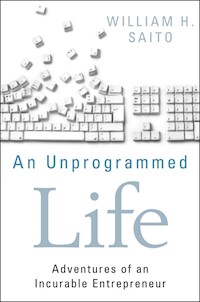
An Unprogrammed Life By the age of 10, William Saito was designing financial programs for Merrill Lynch. By the time he was in college, he was running his own business, creating software for corporate giants like NEC, Toshiba, and Sony. Soon afterwards, he was selling his work to Bill Gates. In An Unprogrammed Life: Adventures of an Incurable Entrepreneur, the child-prodigy-turned-star-businessman tells his story for the first time, providing business owners and budding entrepreneurs with an invaluable insight into a remarkable story of hard work and success. From volunteering to set up an automated filing system for his local library to helping the Japanese government respond to the 2011 tsunami, an unwavering commitment to putting his technical savvy at the disposal of those who need it most has defined Saito's career. As a result, he has become a preeminent authority on homeland security, as well as a friend to young start-ups around the globe. He has been a judge for Ernst & Young's "Entrepreneur of the Year" award as well as a winner of this prestigious prize. Saito knows exactly what makes a company a winner, and he can identify the little things that prevent promising new ventures from ever making it big. In An Unprogrammed Life, he takes a lifetime of wisdom public. Ending each chapter with actionable "takeaway" advice, this book is a must-read for anyone looking to succeed as an entrepreneur.
Sie lesen das E-Book in den Legimi-Apps auf:
Seitenzahl: 434
Veröffentlichungsjahr: 2011
Ähnliche



















Contents
Foreword by Carl Schramm
Preface: FBI at the Door
Acknowledgments
Chapter 1: Blame It on DNA
First Encounter
My Addiction Starts
Study, Study, Study
Chapter 2: Finding a Business Partner (Opposites Attract)
Shrink-Wrapped Success
High School Daze
Chapter 3: Learning to Juggle (Med School, Business, and More)
The Japan Connection Begins
Rain Bird
Chapter 4: Building a Real Company
NEC Comes Calling
Just an Ordinary College Student
Newspaper Publisher
Translating Success into Failure
Chapter 5: Learning from Failure
Drivers of Success
There’s a New Sheriff in Town. . . .
Chapter 6: Developing for Toshiba (Camera Obscura)
Could You Please Turn the Camera Off?
Chapter 7: Developing for Sony—Fingerprint ID
Puppy Chow
Puppy Love
To Clone or Not to Clone?
Chapter 8: Birth of BAPI
A Note on Biometrics
Standard Deviation
The 800-Pound Gorilla in the Room: Microsoft
The Shot Heard Round the World: Microsoft Licenses BAPI
Chapter 9: IPO: It’s All in the Timing
Chapter 10: Using My Japanese Connections to Fight Terrorism
Chapter 11: Last Exit: Microsoft Wants the Whole Thing
Selling the Company
Chapter 12: My Year of Retirement
Chapter 13: Back in the Game
Chapter 14: From Todai into AIST
Super Creators
Chapter 15: Starting My Own Company, Version 2.0
Framing for Softbank
Investing in the Future
Chapter 16: Consulting around the World
Chapter 17: Teaching (United States and Japan)
Chapter 18: Turning 40
Epilogue: The Perfect Storm Hits Japan
Appendix A: Famous Quotes and Helpful Advice
Appendix B: Creativity and Logical Assessment Test
About the Author
Index
Copyright © 2012 John Wiley & Sons Singapore Pte. Ltd.
Published in 2012 by John Wiley & Sons (Asia) Pte. Ltd., 1 Fusionopolis Walk, #07-01, Solaris South Tower, Singapore 138628
All rights reserved.
No part of this publication may be reproduced, stored in a retrieval system, or transmitted in any form or by any means, electronic, mechanical, photocopying, recording, scanning, or otherwise, except as expressly permitted by law, without either the prior written permission of the Publisher, or authorization through payment of the appropriate photocopy fee to the Copyright Clearance Center. Requests for permission should be addressed to the Publisher, John Wiley & Sons (Asia) Pte. Ltd., 1 Fusionopolis Walk, #07-01, Solaris South Tower, Singapore 138628, tel: 65-6643-8000, fax: 65-6643-8008, e-mail: [email protected].
This publication is designed to provide accurate and authoritative information in regard to the subject matter covered. It is sold with the understanding that the Publisher is not engaged in rendering professional services. If professional advice or other expert assistance is required, the services of a competent professional person should be sought. Neither the author nor the Publisher is liable for any actions prompted or caused by the information presented in this book. Any views expressed herein are those of the author and do not represent the views of the organizations he works for.
Other Wiley Editorial Offices
John Wiley & Sons, 111 River Street, Hoboken, NJ 07030, USA
John Wiley & Sons, The Atrium, Southern Gate, Chichester, West Sussex, P019 8SQ, United Kingdom
John Wiley & Sons (Canada) Ltd., 5353 Dundas Street West, Suite 400, Toronto, Ontario, M9B 6HB, Canada
John Wiley & Sons Australia Ltd., 42 McDougall Street, Milton, Queensland 4064, Australia
Wiley-VCH, Boschstrasse 12, D-69469 Weinheim, Germany
Library of Congress Cataloging-in-Publication Data
ISBN 978-1-118-07703-0 (Paperback)
ISBN 978-1-118-07742-9 (ePDF)
ISBN 978-1-118-07741-2 (Mobi)
ISBN 978-1-118-07727-6 (ePub)
For Hitomi and Lisa
Foreword
Entrepreneurs are often characterized as creative innovators with a higher propensity for risk-taking and achievement. They imagine solutions to problems by introducing new technologies, increasing efficiencies in productivity, or by generating new products or services. While certain entrepreneurial personality traits may be present from birth, research studies have revealed there is much more complexity in the interplay between entrepreneurial behaviors and environmental influences.
William Saito’s story is an ideal example of that dynamic interplay between nature versus nurture. From his first computer programming job at age 10 to the sale of his company, I/O Software, to Microsoft at age 34, William has shown that entrepreneurship is not some magic formula or the result of any particular personality trait. Much like the story of Ewing Kauffman—a poor Missouri farm boy who started a company in his basement, created the foundation I’m privileged to lead today, and died a billionaire—William illustrates that anyone can succeed on the entrepreneurial journey, particularly if one has a passion for his or her work and the determination to persevere even amid the inevitable trials and failures.
I first met William after he won the 1998 Ernst & Young Entrepreneur of the Year (EOY) award, which continues to be sponsored by the Kauffman Foundation. William went on to become one of the most active judges for EOY award competitions—at the local, national, and global levels. We have also shared the stage at many events, most recently as speakers at the Milken Global Institute conference.
After selling his company in the United States, William moved to Japan and took on the roles of both educator and government adviser. Notably, since November 2009, together with the Honda Foundation, he has been instrumental in the planning for the Kauffman Foundation’s Global Entrepreneurship Week (GEW) in Japan, a celebration of entrepreneurship that encourages people from across the world to follow the kind of example William sets in this book. GEW is now held in nearly 120 countries. At the Kauffman Foundation, our mission is to develop and fund programs to help entrepreneurs more easily start and grow their businesses; to contribute new research insights regarding the link between entrepreneurship and economic growth; and to help educate policymakers about how they can pave the way for a more entrepreneurial economy.
As an innovator, entrepreneur, venture capitalist, and educator, William Saito has been supporting startups in his business, in the classroom, in events organization, and now in the pages of this book. It is a worthy read, and offers encouragement for entrepreneurs everywhere.
—Carl Schramm
President and CEO, Ewing Marion
Kauffman Foundation
Founding board member, Startup America
Preface
FBI at the Door
I’ve always liked taking things apart. I’d see a gadget, a device, a new appliance in the family living room, and I’d start wondering how it worked. This might well be seen as an innate curiosity about the fundamental nature of things—not only how things worked but why they worked as they did. Sooner or later, I would grab a screwdriver and take my curiosity to the next level. This might be seen as a childlike death wish. You see, I was very good at taking things apart and finding out what made them run, but I was not very adept at putting them back together. Looking back, it certainly wasn’t because I couldn’t put them back together, but the thrill of discovery in deconstructing something was never matched by the tiresome process of trying to put it all back together. When I was very young I started with simple things like the family’s stereo system or Dad’s reel-to-reel tape deck, then it progressed to TVs, personal computers, and, finally, computer software. My parents got me a PC when I was very young, and I quickly learned to program on it. Within a short time I was actually making money from my programming ability (more on that later); that’s about the time I discovered that it’s even more fun to take software apart than to take a TV apart—and the great thing is that your parents don’t get upset if you’re not inclined to put it back together again.
When I was a kid, most software (especially programs that catered to teenagers) came with some level of copy protection. So one of the first real challenges—and by challenges I mean joys—in my life was figuring out how to break the copy protection. I think it’s important to point out that this had nothing to do with making illicit copies; I had no use for the software whose copy protection I was trying to crack. I just did it because it was a challenge. Some people enjoy crossword puzzles or brain twisters, and others, like me, enjoy getting inside software to see how it works. That’s all. Not to use it or resell it or damage it. Just to open it. To my 11-year-old mind, the newest corporate groupware program was just like a Rubik’s cube: a puzzle to be solved. I didn’t understand what something like Lotus 1-2-3 did or why anyone would want to use it, but I could see that someone had gone to a lot of trouble to lock the door, so to speak, and to me that was a challenge. A brain teaser. So I figured out how to pick the lock.
Over the years, software got bigger, more complex, and more expensive, and as you’d expect, the locks also became more sophisticated. Sometimes it was a complicated code, other times it was modification to the media itself, and eventually it became an external hardware device such as a USB-based key that acted as a lock to turn the program on. It’s as if someone was inventing an endless series of new Rubik’s cubes, each a little more difficult than the one before. I loved the challenge that each new program presented; something worthy of my time and effort (though in many cases it didn’t take very much time or effort). Through programming, I figured out how to crack all kinds of software copy protection, just as I’d done years earlier, and I never found a lock that I couldn’t pick one way or another. I could get into anything.
Eventually I created a small business with friends who shared my love for programming, and among various other projects, we decided to create our own security software. Of course, the only way to make bulletproof security software is to find out what’s wrong with all the products already on the market—in other words, test them for weaknesses, see how people like ourselves can pick the locks of these commercial data encryption programs. Once we saw what was wrong with other people’s security software, we could set about patching those holes to make something better.
So part of our work involved breaking all the security products on the market to discover their weaknesses, hunt for digital, or in some cases intentional, back doors left open when the house was supposed to be locked up tight. We naturally kept a big database with all our test results, showing exactly how to break any major security product on the planet. We’d improve on the best techniques we found, and then incorporate these innovative concepts into our own products. It was serious work, but I have to admit that it brought back lots of memories, and I was having a great time.
One afternoon in 1994 two big guys in suits came strolling into our reception area, and I mean big. One of them was a good 6′5″ and built like a tank. Neither of them looked like software engineers. Before our receptionist had a chance to ask what company they represented, the two pulled ominous-looking IDs and said in a booming voice that brought work in the office to a halt faster than a power blackout, “Federal Bureau of Investigation.”
The bigger of the two agents announced, “We’re looking for William Saito.”
I was 23. I’d been breaking copy protection on software since I was in the fifth grade. I knew that this was technically illegal, but so what? I wasn’t stealing the software or doing anything. . .you know. . .bad. I just wanted to test my skills against the team that made the software. No harm, no foul. Nothing I had done, nothing my company had done was going to come to the attention of the FBI.
Then I began to think about the dozens, no, hundreds of security programs we had successfully hacked into over the past couple of years. What if one of them was somehow tied to some government organization? What if purely by accident we’d got our hands on something we weren’t supposed to, what if we’d cracked something that we shouldn’t have touched? Maybe there was some government code out there masquerading as a commercial product, and. . . . For a fraction of a second I wondered if they had PCs in federal prisons.
Of course, all of that insanity came and went in a flash. I had done some routine work with our local city police department. Perhaps this visit had something to do with that. Or maybe my mom had figured out that going to medical school and running a software company were just clever ways to avoid those hated piano lessons, and she’d called the feds. Anything was possible.
I rose from my seat, I looked around the office. Of course, everyone was looking at each other, wanting to make some kind of hilarious joke, but no jokes were forthcoming. Was it my imagination or was one of our programmers eyeing the rear window that opened onto a fire escape out back?
Okay, that was enough. I faced the big fellow with the badge and said, “I’m William Saito. What can I do for you?”
His face showed not the slightest trace of emotion as he said in a practiced monotone, “Is there somewhere we could talk?”
I showed the two of them into the conference room right next to my office and closed the door. We talked for quite a while, but their whole discussion boiled down to something like this: “We’re with the research facilities from Quantico. We hear from friends in the Los Angeles area that you guys know all about computers, that you’re real good at solving ‘problems,’ and that you’ve been willing to help local law enforcement in the past. We’re wondering if you could help us, too.”
If it were 10 years later and we all had cell phones and instant messaging, I would have quickly typed, “Sorry, no one’s getting arrested today. Go back to work!” and sent it to all of our undoubtedly curious staff. Instead, I smiled and said, “Sure. Just tell me how I can help.”
Acknowledgments
Every successful entrepreneur stands on the shoulders of mentors, friends, family, role models, and business leaders who blazed their own paths to create standards and practices that others can follow. It would take too many pages to mention everyone who helped me along the way, but one mentor in particular walked through my door unexpectedly early in my career and that has made all the difference in the successes that followed.
In 1997, representatives from Ernst & Young came to my office and offered to help me apply for their Entrepreneur of the Year Awards Program, which I eventually won in 1998. I wrote about why I initially turned them down three times, and I remain grateful to this day for their persistence and determination. Because of that experience and the network it created early on, I was able to meet with start-up companies, CEOs, and venture businesses all over the world, but especially in the United States and Japan.
This book is written not only from my personal experience of running a venture business (lots of people have done that), but also from my many years of working with the Entrepreneur of the Year awards program. I am probably the only awardee who has been fortunate enough to judge all levels of the competition—local, national, Japan, and the world competition in Monte Carlo. I have personally reviewed thousands of business plans and proposals, talked to countless young company managers, and learned a great deal from them. I know what makes a company a winner, and I know what little things will hold back even a terrific company with a powerful technology from ever making it to the big time. This book is a thank you to all those shoulders I have stood on and all the entrepreneurs who shared their stories with me. I’d like to pass on some of what I’ve learned to any enterprising souls out there who are hoping their company will also hit it big someday.
While discussing the possibility of writing a book with my agent, Cindy Mullins, I wondered if I really had enough of a story to tell to warrant the time and effort required. I didn’t have to wonder long, because a contract from John Wiley & Sons was soon on my desk, and I knew there was no turning back at that point. I am grateful to Cindy and to David Russell, both of Safari Universal Relations, for helping me keep the time and research commitment to a manageable level, and to our editor at Wiley’s Singapore office, Nick Wallwork, for ushering the book through the publishing process. This has been a whole new challenge for me, but I’ve always liked to try new things at least once.
Chapter 1
Blame It on DNA
If I have ever seemed overly inquisitive, independently minded, impatient to see what comes next, and, yes, a bit headstrong, I came by it naturally. More than anyone else, I blame my grandmother. I sometimes say the real talent in my family came from her, and the rest of us have just been trying to catch up. Frankly, no matter what any of us achieves, I don’t think we’ll ever be as independent, strong-willed, and self-confident as she was way back when.
My grandparents were international travelers before World War II, a time when a majority of Japanese still lived and died within the small village where they were born. Almost nobody went overseas. But my grandmother was in motion from an early age. She came from a cold, northern prefecture called Yamagata, where farming has always been a major occupation. Women of her time had a pretty basic job description: keep your husband healthy, raise strong kids, and when you aren’t helping with the work in the fields, get back home to cook, clean, wash, and sew. It was a routine that did not allow for much variation, and it could easily last half a century or more.
But one young girl by the name of Kimiyo knew from an early age that this job description just wasn’t going to satisfy her. She wanted more, a lot more. The first step was education, and she threw herself into her studies. Many years later, a U.S. journalist would note matter-of-factly something that must have shocked her family and friends no end: “[Kimiyo] is one of the few women of her land who went on to study after high school.” In fact, she continued her studies until the age of 22, which was rare enough for men, but unheard of for a woman, and then left Yamagata entirely. She got a job teaching home economics (one of the few things women were allowed to teach)—and not even in Japan but in Seoul (the capital of what is now South Korea). She had received a scholarship to the prestigious Nara Women’s University, and a part of that scholarship included her teaching home economics abroad. Traveling as a single woman, she packed up and left her family and friends, boarded a ship, and traveled to another country and another culture. Looking at a map today, her journey might not appear very long, but in terms of the social norms she was tossing aside, she might as well have been going to the moon.
Lesen Sie weiter in der vollständigen Ausgabe!
Lesen Sie weiter in der vollständigen Ausgabe!
Lesen Sie weiter in der vollständigen Ausgabe!
Lesen Sie weiter in der vollständigen Ausgabe!
Lesen Sie weiter in der vollständigen Ausgabe!
Lesen Sie weiter in der vollständigen Ausgabe!
Lesen Sie weiter in der vollständigen Ausgabe!
Lesen Sie weiter in der vollständigen Ausgabe!
Lesen Sie weiter in der vollständigen Ausgabe!
Lesen Sie weiter in der vollständigen Ausgabe!
Lesen Sie weiter in der vollständigen Ausgabe!
Lesen Sie weiter in der vollständigen Ausgabe!
Lesen Sie weiter in der vollständigen Ausgabe!
Lesen Sie weiter in der vollständigen Ausgabe!
Lesen Sie weiter in der vollständigen Ausgabe!
Lesen Sie weiter in der vollständigen Ausgabe!
Lesen Sie weiter in der vollständigen Ausgabe!
Lesen Sie weiter in der vollständigen Ausgabe!
Lesen Sie weiter in der vollständigen Ausgabe!
Lesen Sie weiter in der vollständigen Ausgabe!
Lesen Sie weiter in der vollständigen Ausgabe!
Lesen Sie weiter in der vollständigen Ausgabe!




