


1,99 €
Mehr erfahren.
- Herausgeber: Maria Peitcheva
- Kategorie: Geisteswissenschaft
- Sprache: Englisch
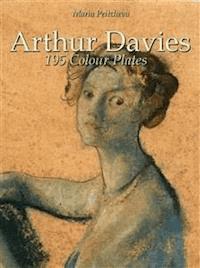
Arthur Bowen Davies (1862 – 1928) was an avant-garde American artist and influential advocate of modern art in the United States c. 1910–1928. He is an anomaly in American art history, an artist whose own lyrical work could be described as restrained and conservative but whose tastes were as advanced and open to experimentation as those of anyone of his time. He was completely eclectic," with influences that ranged from Hellenistic Greek art to Sandro Botticelli, the German painter Arnold Böcklin, and the English Pre-Raphaelites. A painter of dream-like maidens and "frieze-like idylls,"he was most often compared to the French artist Pierre Puvis de Chavannes. His involvement with the Armory Show and prolonged exposure to European Modernism, however, changed his outlook utterly. As art historian Sam Hunter wrote, " His subsequent work attempted to merge stronger color and a Cubist sense of structure and Cubist forms with his on-going preoccupation with the female body, delicate movement, and an essentially romantic outlook.”
Das E-Book können Sie in Legimi-Apps oder einer beliebigen App lesen, die das folgende Format unterstützen:
Veröffentlichungsjahr: 2016
Ähnliche


Arthur Davies
195 Colour Plates
By Maria Peitcheva
First Edition
*****
Arthur Davies: 195 Colour Plates
*****
Copyright © 2016 Maria Peitcheva
Foreword
Arthur Bowen Davies (1862 –1928) was an avant-garde American artist and influential advocate of modern art in the United States c. 1910–1928.
Davies was born in Utica, New York. He was keenly interested in drawing when he was young and, at fifteen, attended a large touring exhibition in his hometown of American landscape art, featuring works by George Inness and members of the Hudson RiverSchool. The show had a profound effect on him. He was especially impressed by Inness's tonalist landscapes. After his family relocated to Chicago, Davies studied at the Chicago Academy of Design from 1879 to 1882 and briefly attended the Art Institute of Chicago, before moving to New York City, where he studied at the Art Students League. He worked as a magazine illustrator before devoting himself to painting.
In 1892, Davies married Virginia Meriwether, one of New YorkState's first female physicians. They were anything but a conventional couple. An urbane man with a formal demeanor, Arthur B. Davies was "famously diffident and retiring". He would rarely invite anyone to his studio and, later in life, would go out of his way to avoid old friends and acquaintances. The reason for Davies' reticence became known after his sudden death while vacationing in Italy in 1928: he had two wives (one legal, one common-law) and children by each of them, a secret kept from Virginia for twenty-five years.
Davies is an anomaly in American art history, an artist whose own lyrical work could be described as restrained and conservative but whose tastes were as advanced and open to experimentation as those of anyone of his time. His personal art collection at the time of his death included works by Alfred Maurer, Marsden Hartley, and Joseph Stella as well as major European modernists like Cézanne and Brâncuși. As art historian Milton Brown wrote of Davies' early period, "A product of the Tonalist school and Whistler, he had developed a unique decorative style. He was completely eclectic," with influences that ranged from Hellenistic Greek art to Sandro Botticelli, the German painter Arnold Böcklin, and the English Pre-Raphaelites. A painter of dream-like maidens and "frieze-like idylls,"he was most often compared to the French artist Pierre Puvis de Chavannes. His involvement with the Armory Show and prolonged exposure to European Modernism, however, changed his outlook utterly. As art historian Sam Hunter wrote, " His subsequent work attempted to merge stronger color and a Cubist sense of structure and Cubist forms with his on-going preoccupation with the female body, delicate movement, and an essentially romantic outlook.”
By 1918, Davies returned to the style that was expected of him, the one that had brought him praise and prosperity. A traditionalist, a visionary, an Arcadian fantasist, an advocate for Modernism: varied and seemingly contradictory designations describe Arthur B. Davies.
Lesen Sie weiter in der vollständigen Ausgabe!
Lesen Sie weiter in der vollständigen Ausgabe!




