



Erhalten Sie Zugang zu diesem und mehr als 300000 Büchern ab EUR 5,99 monatlich.
- Herausgeber: Musaicum Books
- Kategorie: Religion und Spiritualität
- Sprache: Englisch
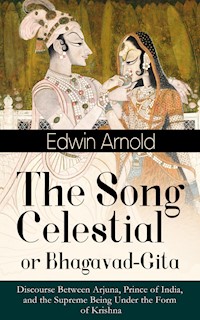
Edwin Arnold's 'Bhagavad-Gita: The Song Celestial' is a timeless classic that presents the sacred text of the Bhagavad Gita in a poetic and profound manner. The book beautifully captures the essence of the Gita as a spiritual dialogue between Arjuna and Krishna on the battlefield of Kurukshetra, addressing fundamental questions of duty, righteousness, and the nature of existence. Arnold's poetic style enhances the philosophical depth of the Gita, making it accessible and engaging for readers of all backgrounds. This literary masterpiece serves as a guide to inner peace and self-realization, offering timeless wisdom for navigating life's challenges. Arnold's elegant prose and vivid imagery bring the ancient teachings of the Gita to life, making it a must-read for spiritual seekers and lovers of poetry alike. In this enriched edition, we have carefully created added value for your reading experience: - A succinct Introduction situates the work's timeless appeal and themes. - The Synopsis outlines the central plot, highlighting key developments without spoiling critical twists. - A detailed Historical Context immerses you in the era's events and influences that shaped the writing. - A thorough Analysis dissects symbols, motifs, and character arcs to unearth underlying meanings. - Reflection questions prompt you to engage personally with the work's messages, connecting them to modern life. - Hand‐picked Memorable Quotes shine a spotlight on moments of literary brilliance. - Interactive footnotes clarify unusual references, historical allusions, and archaic phrases for an effortless, more informed read.
Sie lesen das E-Book in den Legimi-Apps auf:
Seitenzahl: 129
Veröffentlichungsjahr: 2017
Das E-Book (TTS) können Sie hören im Abo „Legimi Premium” in Legimi-Apps auf:
Ähnliche











Bhagavad-Gita: The Song Celestial
Published by
Books
Table of Contents
Introduction
Here a warrior’s crisis of conscience becomes the stage on which action and wisdom seek their rightful balance, drawing the reader into a dialogue that asks how to live, how to choose, and how to act without being consumed by the fruits of action, as duty presses from without and insight beckons from within, and as a human heart, standing at the edge of violence, searches for a way to honor both the call to serve and the summons to know, so that courage, clarity, and compassion might stand together when the world demands a decision.
Bhagavad-Gita: The Song Celestial is Edwin Arnold’s English verse rendering of a central episode from the epic Mahabharata, set on the plain of Kurukshetra in ancient India and framed by the imminence of battle. Produced for a broad readership in the Victorian period, it belongs to the genre of poetic translation and devotional-philosophical literature, reframing a Sanskrit discourse for English-language readers. Arnold, a British poet and journalist, sought to present the Gita’s teaching in graceful, accessible lines, and his version became one pathway through which many in the West first encountered Indian religious and philosophical thought.
At the narrative threshold, a royal champion falters, troubled by the ethical cost of what is about to unfold; his charioteer, revealed as a teacher, opens a sustained conversation about action, purpose, and the nature of the self. Arnold’s rendering preserves the dramatic frame while emphasizing continuity of voice, flowing in measured, musical cadences that tilt toward reverence without losing intellectual clarity. The poem reads as a dialogue yet feels like an address to the reader, alternating gentle counsel with energizing exhortation, and inviting reflection through recurring images and carefully poised contrasts, rather than through scholastic argument or technical commentary.
The Song Celestial turns on enduring questions of obligation and freedom: what one owes to kin and community, what one owes to conscience, and how to act when these allegiances seem to collide. It maps different disciplines of living—steadfast work, contemplative insight, devoted love—without forcing a single path, instead stressing the integrity of intention and the cultivation of balance. The poem probes identity and impermanence, the relation between the doer and the deed, and the steadying power of inward composure. It sketches an ethic in which clarity, humility, and perseverance allow difficult duties to be undertaken without spiritual corrosion.
Arnold’s choice to cast the discourse in flowing English verse reflects the conviction that philosophy can be sung as well as reasoned, and his idiom—shaped by the tastes of his time—seeks to marry accessibility with elevation. Readers will notice a ceremonial cadence, occasional archaisms, and a preference for luminous summaries over technical precision; these features both ease entry and inevitably interpret what they present. Yet the result invites openness: the poem frames doctrine as lived counsel, welcoming newcomers to an inner journey while gesturing toward the depth of the source. It is, at once, translation, adaptation, and homage.
Read today, The Song Celestial speaks to lives stretched between competing roles and relentless demands, offering a vision of purposeful action that does not depend on applause, fear, or fatigue. Its guidance on steadiness amid uncertainty resonates in public service, family life, and work, where decisions often carry moral cost. The call to align intention, attention, and deed has affinities with contemporary practices of reflection and disciplined care for others. Without prescribing a single theology or politics, the poem proposes habits of mind—clarity, restraint, devotion to the common good—that help readers navigate complexity without cynicism or paralysis.
Approached as poem, as philosophical guide, or as dramatic dialogue, this work rewards slow attention: the argument unfurls in concentric movements, and fresh turns often illuminate earlier lines. Arnold’s version remains a venerable gateway to a text that has nurtured thinkers, artists, and seekers across centuries, not because it replaces the original, but because it opens a door in a language and cadence many readers can enter. To read it is to test one’s own priorities against a calm yet demanding measure, and to find, in an ancient scene, resources for courage and compassion in the present.
Synopsis
Edwin Arnold’s Bhagavad-Gita: The Song Celestial (1885) is a Victorian-era English verse rendering of the Sanskrit Bhagavad Gita, a segment of the Mahabharata. The poem frames a dialogue between the warrior Arjuna and his charioteer, Krishna, on the eve of battle at Kurukshetra. Confronted by the prospect of fighting kinsmen, Arjuna falters, and the battlefield becomes the setting for a philosophical counsel on duty, selfhood, and liberation. Arnold preserves the dramatic scene and the alternation of speaker and respondent, rendering the eighteen chapters as a continuous meditation. The version employs elevated, rhythmic English to carry the argument for readers beyond the original tradition.
Arjuna’s crisis initiates the discourse. He questions the righteousness of war against relatives and revered teachers, fearing moral collapse and social disorder. His anguish becomes the first theme: how to act when obligations conflict. Krishna’s early response introduces the permanence of the self and the transience of the body, recasting death within a larger metaphysical frame. From this follows a call to perform one’s duty without attachment to outcomes. Arnold renders this exchange as a dignified, measured persuasion, keeping focus on the ethical perplexity and the counsel that action, rightly understood, need not bind, provided it is undertaken with steady intention.
Krishna elaborates a discipline of action that subordinates personal desire to a broader sacrificial order. Work is to be done as an offering, sustaining the world’s balance rather than feeding ambition. Equanimity in success and failure is urged, along with mastery of the senses and constancy in purpose. This practical path does not reject the world; it purifies participation in it. Arnold’s shaping emphasizes the harmonious cadence of these lessons, letting the precepts unfold as counsel for rulers, householders, and seekers alike. The battlefield, still present in the background, functions as a concrete test of whether such teaching can guide decisive conduct.
The discourse then turns to knowledge and contemplation. Distinguishing the enduring from the changeful, Krishna describes the true self as unaffected by the turmoil of nature. A path of inward steadiness is outlined: disciplined posture and breath, regulated living, and a mind trained to return from distraction. The goal is a clarity that neither elation nor despair can unsettle, enabling action that is lucid yet detached. Arnold’s verse balances instruction and imagery, presenting metaphysical claims as guidance for interior practice. The speaker’s role as charioteer and inner mentor merges, suggesting that wisdom is both heard in counsel and realized through inward attention.
As the teaching widens, devotion is affirmed as a direct route to the highest. The divine is portrayed as immanent in all beings yet beyond them, receiving any sincere offering of love. This culminates in a revelation granted to Arjuna, a vision that discloses an overwhelming, universal sovereignty and places the impending conflict within a cosmic scale. Arnold heightens the sense of awe while retaining the dialogue’s intimacy, allowing the spiritual assurance to address the original fear. The poem thus integrates love with knowledge and action, proposing that steadfast devotion can steady the will and illumine duty without erasing human compassion.
Further chapters analyze nature and conduct. The interplay of the three qualities—clarity, impulse, and inertia—explains how temperament and choice shape destiny. Distinctions are drawn between the field of matter and the knower of the field, preparing a perspective in which the self witnesses change without losing its identity. Practical signs of maturity are listed: humility, non-harming, truthfulness, steadiness, and freedom from vanity. Krishna contrasts luminous and destructive tendencies, and classifies knowledge, action, and resolve according to their guiding quality. Arnold maintains the didactic momentum, presenting these gradations as diagnostics that help a perplexed agent align behavior with an illumined purpose.
The closing counsel returns to the original dilemma, gathering the strands of action, knowledge, and devotion into a single orientation: act according to one’s rightful place, surrendering possessiveness and fear, and take refuge in the sustaining reality disclosed throughout the dialogue. The poem suggests that such alignment brings inner freedom even amid unavoidable conflict. Without detailing the outcome of the battle, Arnold ends with the sense of a conscience steadied and a path clarified. As a 19th‑century gateway to the Gita for English readers, The Song Celestial endures for its lucid synthesis, presenting a portable ethics of poise, responsibility, and inward release.
Historical Context
Bhagavad-Gita: The Song Celestial (1885) appeared in late-Victorian Britain, translating a Sanskrit scripture long central to Hindu thought. The Bhagavad Gita, a section of the Mahabharata traditionally located in the Bhishma Parva, had for centuries shaped debates on duty, devotion, and liberation in South Asia. Set on the field of Kurukshetra and cast as a dialogue, it circulated widely in manuscript and print within India by the nineteenth century. Edwin Arnold’s rendering brought this revered text to Anglophone readers amid expanding imperial connections between Britain and the Indian subcontinent, where universities, presses, and civil institutions linked scholarship to colonial governance.
The work emerged under the British Raj, established after the 1857 uprising transferred rule from the East India Company to the Crown in 1858. Orientalist scholarship had already introduced the Gita to European audiences: Charles Wilkins published the first English translation in 1785, sponsored by officials interested in India’s laws and literatures. By the 1870s–1880s, philology flourished at Oxford and elsewhere, notably through Max Müller’s Sacred Books of the East series (launched 1879), which included K. T. Telang’s scholarly translation of the Bhagavadgita in 1882. Arnold’s version entered a landscape where literal renderings coexisted with poetic and popular adaptations.
Edwin Arnold (1832–1904) was an Oxford-educated poet and journalist who spent formative years in western India as a government educator in Poona (Pune) in the late 1850s. Returning to London, he became a leading writer at the Daily Telegraph and a prominent interpreter of Asian traditions for Victorian readers. His earlier narrative poem The Light of Asia (1879), on the life of the Buddha, had been a publishing sensation, encouraging him to approach Hindu scripture in similar fashion. Drawing on Sanskrit scholarship and prior translations, he fashioned an English poem intended for general readers rather than specialists in Indian philology.
Published in London in 1885, The Song Celestial presents the Bhagavad Gita in fluid, rhythmic English verse, with simplified names and explanatory cues that fit Victorian taste for edifying literature. Rather than a literal line-by-line rendition, Arnold sought a readable, elevated idiom that conveyed perceived ethical and devotional cores. His effort coincided with a surge of cross-cultural spiritual interest: the Theosophical Society, founded in 1875 and headquartered at Adyar, Madras from 1882, popularized Indian scriptures in the Anglophone world. Periodicals, lecture circuits, and inexpensive editions enabled such works to circulate beyond academia to clergy, reformers, and general readers.
In India, the late nineteenth century saw vigorous religious and social reform alongside rising political organization. The Brahmo Samaj (founded 1828) and the Arya Samaj (founded 1875) promoted renewed engagement with Sanskrit scriptures and ethical monotheism or Vedic revival, respectively, prompting fresh readings of canonical texts. Debates over caste, education, and women’s roles animated print culture in major cities. In 1885—the year Arnold’s book appeared—the Indian National Congress held its first session in Bombay, signaling emergent national politics. The Gita figured in these discussions as an authoritative source on duty and discipline, even as interpreters disagreed on its emphasis.
Educational and media infrastructures tied Britain and India closely by the 1880s. After decades of state-supported English-language schooling—promoted since the 1830s—and the founding of universities at Calcutta, Bombay, and Madras in 1857, a bilingual elite engaged both Sanskrit sources and European scholarship. Railways and telegraphs facilitated national markets for periodicals and books; missionary, commercial, and government presses issued translations, primers, and religious tracts. Oxford and London publishers capitalized on this demand. Arnold’s compact, lyrical rendering fit the era’s appetite for portable moral texts, aligning with sermon literature and “world scripture” anthologies circulating in churches, reading clubs, and classrooms.
The Song Celestial quickly found readers across the British Empire and the United States, benefiting from Arnold’s celebrity after The Light of Asia. It also reached Indian audiences educated in English. M. K. Gandhi later recorded that Arnold’s version introduced him to the Gita and deeply influenced him. Scholars, however, noted the liberties of its Victorian diction and departures from literal sense when compared with Wilkins, Telang, or later critical editions. The book’s popularity lay in its accessible universalism: it framed the Gita as a guide to steadfast action and inward devotion without demanding specialist knowledge of Sanskrit or commentary traditions.
As a cultural artifact, Arnold’s translation reflects the contradictions of its age. It arose within imperial networks of power, education, and print, yet presented an Indian scripture to Anglophone audiences as a source of universal moral insight. Its polished English idiom, moral earnestness, and didactic framing exemplify Victorian strategies for mediating foreign texts. At the same time, by foregrounding themes of disciplined action and inward piety, it aligned with comparative religion and “world literature” projects that emphasized shared ethical ideals. The Song Celestial thus mirrors late-nineteenth-century fascination with “Eastern wisdom” while helping expand recognition of non-European intellectual authority.
Bhagavad-Gita: The Song Celestial
Dedication
TO INDIA
So have I read this wonderful and spirit-thrilling speech, By Krishna and Prince Arjun held, discoursing each with each; So have I writ its wisdom here,--its hidden mystery, For England; O our India! as dear to me as She! EDWIN ARNOLD




