


2,99 €
Mehr erfahren.
- Herausgeber: Robert Hale Fiction
- Kategorie: Abenteuer, Thriller, Horror
- Sprache: Englisch
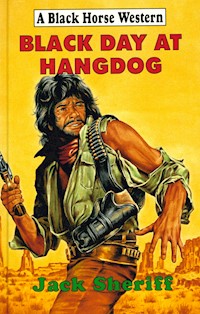
When exiled bank robber Moses Kane arrives in Haven''s Hangdog Saloon, he is with deadly gunslingers and wanting revenge. Old-timer Gannon smells trouble, Flint is concerned for Gannon, Baxter wants his money, and the Sioux Long Arrow wants Kane.'
Das E-Book können Sie in Legimi-Apps oder einer beliebigen App lesen, die das folgende Format unterstützen:
Veröffentlichungsjahr: 2017
Ähnliche



















Black Day at Hangdog
By the same author
Brazos Guns
Midnight Hawk
Bury Him Deep, in Tombstone
The Man From the Staked Plains
Incident at Powder River
Black Day at Hangdog
JACK SHERIFF
ROBERT HALE
© Jack Sheriff 1999
First published in Great Britain 1999
ISBN 978-0-7198-2269-8
The Crowood Press
The Stable Block
Crowood Lane
Ramsbury
Marlborough
Wiltshire SN8 2HR
www.bhwesterns.com
This e-book first published in 2017
Robert Hale is an imprint of The Crowood Press
The right of Jack Sheriff to be identified as author of this work has been asserted by him
in accordance with the copyright, Designs and Patents Act 1988.
Contents
Chapter 1
Chapter 2
Chapter 3
Chapter 4
Chapter 5
Chapter 6
Chapter 7
Chapter 8
Chapter 9
Chapter 10
Chapter 11
Chapter 12
Chapter 13
Chapter 14
Chapter 15
Chapter One
As far as old Wilf Gannon could work out on the chill night Ben Stone put the question to him in the Hangdog Saloon, Haven had begun to die round about the time Red Cloud rode his pony down to Fort Laramie and signed away his people’s future. The two events were in no way connected, but with Ben having been up the Bozeman around the treaty time Wilf knew the remark would jolt some memories and, maybe, put a spark into conversation that was about as lively as damp kindling.
‘End of ’68,’ Ben agreed now. ‘Close on fifteen years ago.’ He scratched his ragged thatch of grey hair and behind wire-framed spectacles his tired, watery-blue eyes stared into some far distance. Across the table from him, Hank Travis trickled smoke towards the old brass lamp that was flickering as it swung lazily above the table and nodded sagely.
‘Cruellest winter I ever saw,’ he said in his lazy Texan drawl, talking through teeth clamped on his thin cheroot and concentrating hard as he tipped the whiskey bottle over his glass with a big scarred hand that was pretty steady for almost midnight. Straggly grey hair flopped over his lined forehead as he went on, ‘I’d rode up from Amarillo with a rancher drivin’ a herd up to Montana and damn near froze to death. Vowed then I’d head back to the Nueces in the spring, but I never did get paid and one thing led to another . . . the way things do.’
‘If you put it that way,’ John Darling said, ‘this darned place has been dyin’ ever since folks was led to believe there was gold in these hills, realized they’d been fooled and ran that crazy Forty-niner out of town. In twelve months most of those chased him out had seen sense and hightailed after him – and the only place we’ve been led since then is downhill at a gallop.’
He collected the empty bottle off the table, stood up and stomped out of the shifting pool of light and round behind the bar, a portly man with bright red galluses stretched across the shoulders of his collarless white shirt, and thin strands of what had once been dark hair plastered across a pink scalp shiny with sweat.
When he returned, wiping dust and clogged spiders’ webs off a fresh bottle with the hem of the white apron that was stretched to bursting around his ample middle, he was met by a fierce gust of cold, damp air as Dan Ford stumbled in over the threshold and struggled to shut the door against the wind’s strength while slapping rain off his hat and blowing through his drooping white moustache like a riled old bronc.
‘I admire this man,’ Wilf Gannon said, keeping his seamed face straight as the others chuckled at the newcomer’s discomfort. ‘Lives in a goddamn ghost town, yet pins on his tarnished badge and does the rounds every night just to protect us from the hordes of outlaws waitin’ to pounce and rob us of our hard-earned dollars—’
‘Ain’t nobody doin’ any pouncin’ on a night like this,’ Dan Ford cut in, ‘ ’less it’s a half-drowned alley cat workin’ to reduce the rat population. Four-legged, that is. And,’ he continued, swinging his slicker off his bony shoulders to a raucous chorus of protests as icy rainwater showered the drinkers, ‘if you don’t break open that bottle, John, you’ll be lookin’ for a new town constable because the one you’ve got’ll’ve froze to death.’
‘Or been demoted clear out of sight,’ John Darling said, grinning. He splashed whiskey into a fresh glass, watched with satisfaction as Ford tossed it back with a grimace that could have been pleasure but was more likely the pain of a blistered gullet. ‘Dan, you’re the only man I ever met started off as US marshal and in the space of a town’s living and dying worked his way right back down to the bottom of the rubbish heap.’
‘Which remark paints a pretty grim picture of this settlement,’ Dan Ford said. ‘John, you and Bonnie scratch a living out of this excuse for a drinking den and the mercantile next door. Hank’s lucky to see half-a-dozen horses a week pass through his livery stable – and, yes, Ben, I know; you and Jenny ain’t seen that many people in your rooming-house in more’n a year.’ He shook his head, marvelling. ‘About the only one of us with any sense is Wilf. . . .’ And here he raised his glass in a mocking toast. ‘Old Wilf there, he passes every day without raisin’ a sweat because he knows—’
‘From long experience,’ Wilf said mildly.
‘Because he knows – from long experience – that in this purty little town called Haven, there ain’t a goddamn thing worth doing.’
‘I remember once,’ John Darling mused, ‘Haven was such a fine place to live some wag took a running iron, rode out a ways and inserted an E after the H on the town sign.’
‘Wasn’t more than a year after that he worked on it again,’ Ben Stone pointed out. ‘Crossed out that E, stuck on a final T and added two little words that neatly summed up our prospects.’
‘Haven’t A Hope,’ Wilf said. ‘It’s still there – and we still ain’t got one. And if I remember, Ben, that wag was you.’
Ben Stone nodded. ‘That hunk of wood’s the only thing I’ve put a brand on in more than ten years. Did it three months after I bust my leg ropin’ a steer. . . .’ He fumbled in his pocket for his tobacco sack, and in his face there was a despairing anger that settled over the table like a dusty shroud.
About then Wilf dragged out his silver turnip watch, saw it was gone midnight and climbed out of his chair to walk in the laboured way dictated by his game hip over to the window and peer out across the expanse of muddy street. He had to scrub the condensation with the edge of his hand to do it, winced as he saw the curtain of rain sweeping down the steep slope and across the single lantern swinging in front of Ben and Jenny’s rooming-house, and turned away from the window with a disgusted grunt.
Near to winter on the south side of the Bighorn, Wyoming Territory. A chill in the air hanging beneath ragged, wind-torn clouds leaking a steady rain. Sensible men would be at home in bed. The only ones caught out in this weather would be drifters with nowhere to go, or the hard, restless men who rode the wild trails one step ahead of the law.
Wilf’s boot heels clomped unevenly on the rough boards as he limped across to the old pot-bellied stove, tossed in a couple of resiny pine logs and slammed the door with a clang. Sparks hissed up the battered flue. A tendril of smoke curled, its tang catching Wilf’s nostrils, stinging his mild grey eyes.
He blinked, faced back down the room, eased his shoulders, then wandered reluctantly away from the stove’s warmth, thick fingers fumbling in his shirt pocket for his tobacco sack.
Over at the table, Dan Ford had finally got his slicker hooked over the back of his chair, doffed his Stetson to expose a shiny bald scalp, and sat down. John Darling tipped out the greasy pack of cards, and for several seconds the only sound to be heard above the moaning wind was the rhythmic snapping as Hank dealt the first hand of a poker game that would likely see them all the way through the next hour, and most of the way through the next bottle of whiskey.
With his colleagues’ warmth tended to, Wilf settled down on the long seat up against the window. He pushed aside an ashtray and tossed the makings onto the small table, took time fashioning a cigarette; snapped a match, applied it, watched the smoke spiral away in the cold, swirling draught.
Not a man among them wasn’t closer to sixty than fifty, he ruminated – and that included himself, only he was looking back over his shoulder from the increasingly lonely high ground he wryly talked of as being above the snow line. Most mornings it took any one of them ten minutes just to roll out of bed and stretch the kinks out of their joints. Each day crawled past without incident. Every night they ended up here; had done for . . . oh, more years than Wilf cared to count.
So John Darling was right: Haven had commenced dying before it was halfway built – a cluster of houses and false-fronted business establishments erected towards the top end of a deep canyon that was sheltered by tall pines clinging to its high steep slopes and damn near cut off from the outside world at its lower end by Twin Bluffs Pass, a couple of immense, sheer-sided cliffs flanking a wide, dry river-bed that allowed entry to the canyon for a man on horseback – maybe even a top-buggy at a pinch – but not a lot more.
In bad weather, a tough beaver would have trouble.
The town owed its existence to a crazy miner’s dream of finding gold, and the zealous newspaperman who had listened to his imaginings and spread the word. Before the ink was dry on his story, more than a thousand men had ridden in beneath the tall bluffs; hard men, desperate men, the weak and the curious, the speculators and gamblers. With them came honest businessmen, shrewd enough to recognize a need and figure, rightly, that there was more money to be made from meeting that need than ever came from digging holes in a barren hillside.
But even they recognized that the town was built on a dream. And when that dream died, the town of Haven – which had never aspired to anything grander than raw timber frames nailed into shape and covered with tar paper by greedy men going nowhere in a hurry – had nothing to sustain it. The small outlying ranches to the south – Adam Flint’s Circle F, Jade Winston’s Lazy J – took the bulk of their limited trade to the nearest big town and came to Haven for necessities – reluctantly, and not often enough. The loaded emigrant wagons lumbering towards California passed by further north along the Bozeman or the Oregon. Those that did stray south drove past with ragged kids hanging out the back and a scrawny man up on the seat with his tired eyes fixed on another distant dream.
Or did do, Wilf reminded himself wistfully; with the coming of the railroad those wagons had gone the way of the buffalo.
But all men have their dreams, Wilf thought, half listening to the murmur of conversation in the Hangdog and staring blind at the glowing tip of his cigarette. His own had been shattered when a two-year drought wiped out his small herd of milking cows. The sheer heartache of it killed his wife and the only thing left for him was to sell up and move into town.
That had been well before Haven lay down and turned up its toes; and for a long time, after the haunting loneliness of his deserted spread where the creaking windmill kept him awake nights cruelly reminding him of what he had lost, the warmth and gruff compassion he had discovered in this circle of fine friends had been his salvation.
Their compassion had come from long practice at healing raw wounds.
Even now there were gaps in what Wilf knew of the others. Ben Stone was a cowhand fallen on bad times who had teamed up with a pretty schoolmarm who had come West with ambitions and finished up running a rooming-house.
John Darling had built the saloon and adjoining mercantile with his own hands – the first businessman to arrive in Haven, and always the one most likely to succeed.
In the first place he had provided what every man who came to Haven needed: supplies of one kind or another to maintain their bid for the rich prizes they were convinced lay buried on the slopes, and the strong drink they would turn to either to celebrate a strike, or to drown their sorrows.
But John Darling was also backed by a strong woman. Bonnie Darling, daughter of an itinerant Bible puncher, had married the young businessman and settled easily into the rough life on the Great Plains. But she had been less happy about the move to Haven, and some friction had developed between her and John when he stubbornly refused to move from a town that had lost its way.
Wilf recalled how, in his own loneliness, he had from time to time allowed himself to read a deeper meaning into the warm glances the dissatisfied Bonnie Darling bestowed on him. But that was as far as it had gone, and that was the way it remained.
Dan Ford had wound up carrying a badge – but where he’d come from, nobody could say. Likewise it seemed pretty certain that Hank Travis had been a wrangler back in his home state and had come north with a cattle drive; but there were those who had witnessed his prowess with a six-gun, when Haven was awash with footloose drifters and salty hellions, who were apt to be sceptical and offer their own theories on his background – when he was well out of earshot!
But even a gunslinger – if that was what he had been – loses his edge, and maybe to a man with enemies lurking along his back-trail Haven had appeared like a godsend.
Well, no matter where they’d come from, they’d all stayed, scratching a living in one way or another and waiting . . . but if you were to grab hold of them and ask them what exactly they were waiting for, well. . . .
Wilf killed the cigarette, and grinned ruefully. He made enough money to see him through the winters by driving the chuck wagon for Adam Flint, and dishing up hot meals for the Circle F punchers. A long way down the trail from owning his own spread, but, hell, a man—
He blinked, jerked rudely out of his thoughts as the Hangdog’s doors burst open, banging back against the wall and letting in another icy blast of wind and rain. The lantern over the table swung wildly, playing cards lifted and flew in the crazily flickering light like frosted winter leaves – and Wilf always reckoned, when they looked back on it, that it was Hank Travis who yelled out, ‘Either come in or stay out, mister, but for Christ’s sake shut that goddamn door!’
Then, as the doors slammed to, shutting out the storm, they were all stunned into silence. Five elderly men turned blank faces to stare at the tall, gaunt man dressed in rain-soaked black clothing who stood dripping onto the sawdust-sprinkled boards.
The face was high of cheekbone, square of jaw; there was some Mex in there, maybe a lot more white man, but none of it any good.




