


Erhalten Sie Zugang zu diesem und mehr als 300000 Büchern ab EUR 5,99 monatlich.
- Herausgeber: The History Press
- Kategorie: Sachliteratur, Reportagen, Biografien
- Sprache: Englisch
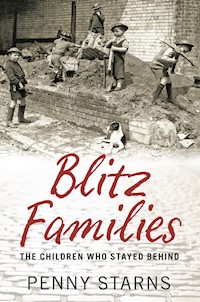
The mass evacuation of children and new and expectant mothers during the Second World War is well documented. But over fifty per cent of children were not evacuated during the War, and it is these young people who offer an unrivalled view of what life was like during the bombing raids in Britain's cities. In Blitz Families Penny Starns takes a new look at the children whose parents refused to bow to official pressure and kept their beloved children with them throughout the War. As she documents family after family which made this difficult decision, she uncovers tales of the deprivation, criminality and disease of life in the city and, conversely, the surprising relative emotional and physical wellbeing of those who lived through the Blitz compared to their evacuee counterparts. Because of their unique position at the heart of the action, these forgotten children offer us a priceless insight into the true grit and reality of the Blitz.
Sie lesen das E-Book in den Legimi-Apps auf:
Seitenzahl: 328
Veröffentlichungsjahr: 2011
Das E-Book (TTS) können Sie hören im Abo „Legimi Premium” in Legimi-Apps auf:
Ähnliche















For Paul
Acknowledgements
First and foremost I would like to thank my editor, Sophie Bradshaw, and Abbie Wood and the design, editorial and production staff at The History Press for their excellent work. In addition, there are a great number of people without whom this book would not have been written, and I extend special thanks to Dr Andrew Brindley and his team for all of their help and support. Grateful thanks are due to the Dean, the Very Rev. Dr David Hoyle MA and the Chapter of Bristol Cathedral for allowing the inclusion of pictures of their magnificent memorial windows. I also appreciate the help extended to me by Rachel Brain, Theresa Simeone and residents of Charlton Residential Care for their wartime recollections and pertinent comments. In particular, I thank Rhoda Edmonds and David Gay for giving me so much of their time and attention. The Rev. Canon Brian Arman, his ministerial team, members of the choir and congregation of St Peters Church, Filton, have also been invaluable. Members of the congregation have generously recounted their many memories of Bristol during the Blitz, especially Iris Williams, who prompted a number of thought-provoking discussions about children and war.
My father Edward Starns has contributed enormously to the book by recalling his experiences of the London Blitz and by offering his complete support. Teachers from Birmingham, Coventry, Sheffield, Manchester, Liverpool, Plymouth, Bristol and London have provided me with mounds of evidence gleaned from their own personal experiences of working with city children during the sustained bombing raids of the Second World War. Moreover, survivors from all of these blitzed cities have kindly entrusted me with their childhood stories, which collectively have added a richness and depth to the overall text.
My friends Paul Simeone, Catherine Nile and Jo Denman have provided practical support and encouragement. I am also grateful to my brother Christopher for his previous research assistance, and to my sister Barbara Starns whose co-authored book, Keeping Children Safe, provided me with some much-needed context in terms of government child protection policies. I thank my father Edward Starns and my sons James, Michael and Lewis for their love and humour; my grandchildren for their joy and enthusiasm for life; and their mothers for enabling me to share their lives.
Sources
Much of the primary source material for this book rests on the oral history testimonies of individuals who lived through the Blitz. Most of them were children living in cities during the Second World War but others were teachers, paediatricians, social workers or parents. Collectively they have created a remarkable picture of how city children spent their war years. Further information has been obtained from all volumes of the Journal of Education (1938–46), The Times, Hansard House of Commons and House of Lords Parliamentary Debates for the same period. Primary source material has also been gleaned from Ministry of Health files, Board of Education (Ministry of Education after 1944) documents, and Ministry of Labour records, all of which are held at The National Archives in Kew, London. In addition, numerous files have been consulted in a variety of county record offices across the country.
Secondary sources are listed in the select bibliography at the end of this book. The main secondary works consulted however, are Children and War by A. Freud (1943), The Blitz: The British Under Attack by J. Gardiner (2010) and We Are At War: The Diaries of Five Ordinary People in Extraordinary Times by S. Garfield (2005).
Contents
Title
Dedication
Acknowledgements
Introduction
1 Protecting the Nation
2 A Mother’s Dilemma
3 A New Generation of Artful Dodgers?
4 Education in the Rubble
5 Childhood Epidemics
6 Health and Welfare
7 Food, Glorious Food
8 Child Psychology
9 The Bristol Blitz
10 The Plymouth Blitz
11 The Birmingham and Coventry Blitz
12 The London Blitz
13 The Moral Crusade
14 The Legacy
Bibliography
Copyright
Introduction
M uch has been written in recent years about the children who were evacuated during the Second World War under the British government’s dispersal policy. Undoubtedly, this civilian evacuation constituted the biggest social upheaval in British history, and in England alone official figures record that 673,000 unaccompanied schoolchildren, 406,000 mothers and young children and 3,000 expectant mothers were moved during the course of three days. In Scotland evacuation figures were estimated as 175,000, of which 50,000 were unaccompanied children. Journalists of the period described the initial evacuation as an exodus of biblical proportions. Subsequent waves of evacuation were more ad hoc in nature but, nonetheless, had profound and long-lasting effects on British society. However, because the historical spotlight has lingered on the children that were evacuated, a larger and more significant group of children have been overlooked. In actual fact, official figures suggest that only 47 per cent of English schoolchildren were evacuated in the initial wave, and only 38 per cent of Scottish school children. The remainder stayed steadfastly in the cities with their parents. Surprisingly, historical literature and analysis of the Second World War period has hitherto and systematically ignored this fact.
Indeed, there were vast numbers of parents who chose to ignore the dire warnings of government ministers before the war and refused to heed the calls for evacuation. Instead, they kept their children with them in cities for the duration of the war. These children endured sustained bombing raids in addition to educational and welfare problems, but new research suggests that the city children who survived the Blitz emerged from the war years emotionally, mentally and physically far healthier than their counterparts who were evacuated to the country. In fact, the ways in which children developed during the war completely baffled government ministers and for the first time in British history local authorities were forced to take on board a whole host of new ideas pertaining to child welfare. Contrary to Ministry of Health expectations, throughout the war years children were growing taller and more robust in the cities than they were in the country areas. This situation did not make sense, either to government ministers or child welfare officers. Country areas were reasonably considered to be healthy environments, with children having access to clean, fresh air and an abundance of healthy fruit and vegetables. The popular image of hearty country children helping to work the land and enjoying the fruits of their labour was also encouraged by government ministers in an effort to underpin official evacuation schemes. But children defied all predictions in terms of child development. Even when nutritional improvements to children’s diets were on a par across the length and breadth of Britain, the anomaly remained. The Ministry of Health at one stage concluded that children in the country moved around too much and, therefore, became far too active to grow! They also surmised that city children, by comparison, sat and read comics, thereby reserving their energy for essential growth. All of this was nonsense of course, but it took some time to persuade officials otherwise.
It is also important to recognise that notions of childhood changed dramatically during the war; both in terms of public perceptions and in terms of government policy. At the outbreak of war in 1939 there was a concerted effort to protect children from all mention of war; yet by 1941 children became an integral part of the war effort and nearly every family had been touched by the conflict. Conflicting policies with regard to children became the norm. The Ministry of Labour, for instance, required children to work on the land and in factories as part of the overall war effort, whereas the Board of Education argued that children needed to remain in school and focus on learning. Ministry of Health officials were thus required to tread a delicate policy-making path between the two. In addition to this problem, the latter were also up against local authority opposition for the duration of the war. In the early stages of the war local authorities often ignored the policies which emanated from Whitehall, so very few were implemented. Central government had attempted to offload responsibility for children onto local authorities, but a mixture of obstinacy and lack of resources thwarted this move. By 1941 central government was firmly back in the child policy driving seat. Astonishingly, from this time on, the Ministry of Health managed to push through a number of barriers to reform and introduce significant public health measures. Understandably, the ministers who introduced such policies as improved nutrition, the relocation of many children into the countryside and vaccination programmes, were eager to find evidence of their efficacy. They were particularly keen to find evidence that children were healthier in the country because this would endorse the validity and rationale behind their evacuation policy. The fact that children appeared to be healthier in the cities rather than the countryside defied all explanation.
Eventually, it was a pioneering psychologist named Anna Freud who provided adequate explanations as to why city children, who were dwelling with family members, developed at a quicker rate than evacuees. Anna conducted extensive research into child development and children’s relationships throughout the war. In so doing, she proved beyond doubt that the emotional wellbeing of children was essential for their adequate physical and mental growth. Henceforth, there was a proliferation of child guidance clinics across the country and child welfare officers were educated about the emotional needs of the child for the first time. City children, who were virtually raised on bombsites, thus became the key to understanding family relationships and to what extent emotional ties dictated overall child development. By focussing on children who were not evacuated, Blitz Families sheds light on the importance of family unity and children’s emotional security. The book also reveals some surprising, uplifting and personal accounts of wartime history.
1
Protecting the Nation
One of the most pervading myths in British history is the notion that Britain was totally unprepared for the Second World War. Undoubtedly there were economic constraints during the inter-war period as the country struggled to recover from the debts it had incurred as a result of the First World War, and to some extent these constraints naturally underpinned the concerted efforts that were taken by Britain and France to avoid further conflict. Historical evidence also reveals that the appeasement policy pursued by British Conservative Prime Minister Neville Chamberlain towards Hitler in the late 1930s bought Britain some much-needed rearmament time. Aircraft production was increased dramatically from 1934 onwards, and between 1936 and 1939 numerous shadow factories were built. These latter constructions were industrial works that were built with military production in mind, alongside ordinary civilian factories.
During this period twenty-seven new ordnance works were established and, in terms of protecting the nation in readiness for a further war with Germany, British government ministers were far ahead of other European nations – beginning to plan civil defence strategies in 1922. They had realised that the main threat in any future war would come in the form of aerial bombardment, which was later confirmed by the unrelenting air raids experienced by Barcelona during the Spanish Civil War. It was therefore deemed pertinent to discuss the prospect of moving all non-essential persons away from potential danger areas into places of relative safety. Aside from the substantial risk of aerial bombing raids, military personnel pointed out that major cities could become actual fields of combat should an invasion occur, and civilians would impede the fighting forces. Worse still, there was a distinct possibility that they could be taken hostage by the enemy in an attempt to force a British surrender. It seemed sensible then, in the event of war, to remove all non-combatants, particularly vulnerable sections of the population to areas that were not obvious military targets.
There were a few alternatives to an evacuation scheme, and these were debated at length in the House of Commons, but none were considered feasible. A few ministers suggested the erection of specialised camps on the outskirts of major cities, but at this stage it was feared that such camps would look like military bases from the air and would thus become targets for enemy attack. In March 1938, Lord Haldane suggested that deep underground shelters were the way forward. The experience of the Spanish during the Civil War, which began in 1936, indicated that deep shelters were more useful in terms of civil defence and that evacuation was a somewhat flawed policy. Evidently the emotional ties that bound Spanish families together had resisted all attempts at separation and deep shelters were constructed in major cities in order to protect the population from aerial bombardment. Lord Haldane also advised that such shelters could later be used as underground car parks; this potential long-term use would offset the initial building costs.
But it was difficult for British ministers to second guess the enemy during civil defence planning stages. Debates played out in the House of Commons demonstrated considerable support for deep shelters – and nobody doubted the protection that such shelters could provide – but they were also very costly and time-consuming to erect. More importantly, it was thought by some military personnel that deep shelters could potentially become the target of gas attacks if the enemy decided to use chemical warfare. The provision of gas masks for the population and instructions on their use were already included within the overall civil defence strategy as a precaution. Chemical warfare had featured during the First World War and there was a strong possibility that the enemy would deploy chemical weapons again. Thus, while the merits and drawbacks of alternative schemes were highlighted in official circles, evacuation quickly emerged as the only sensible and feasible option for keeping non-combatant personnel safe. Crucially, the policy also received support from senior officers within the armed forces. Colonel Wedgwood, who was an avid protagonist for a civilian evacuation scheme, pointed out that the lack of such a scheme would severely undermine the efforts of fighting men. He argued on a number of occasions that civilian evacuation was essential in terms of maintaining military morale:
Imagine for one moment that this country is invaded. Every man worth his salt will be engaged either in the field, or in some munitions factory far from his family. All the time they will be desperately anxious about what is happening to their wives, and children and parents … Therefore, this problem of evacuation is a very real one and does not apply solely to children. It applies to all useless mouths in every country which is meeting this new form of gangster warfare.1
In order to devise an efficient and comprehensive civil defence programme a sub-committee of the Imperial Defence Committee was formed in 1932 and the Air Raid Precaution Bill was presented to Parliament in 1937. The Home Secretary subsequently introduced a clause in the bill which effectively called upon all local authorities in England to provide central government with the information it required to prepare a civilian evacuation scheme. The task of co-ordinating all civil defence planning was then given to Sir John Anderson, a senior civil servant with an astounding and excellent reputation for administration and attention to detail.
The Anderson Committee first convened in May 1938 and members began their work by dividing the British landscape into designated evacuation, reception and neutral areas. Senior military personnel from all branches of the armed forces were called upon to advise the committee. These officers duly outlined all military bases, industrial areas and cities that were likely to be attacked. On 28 June 1938 Wing Commander R.V. Goddard also strongly advised Anderson not to evacuate civilians to the east coast, since this stretch of land was nearest to Europe and would, therefore, be the most vulnerable to the threat of bombing and invasion. In addition to constructing and implementing plans for a civilian evacuation scheme, Anderson was also responsible for prioritising essential public services, maintaining public order and safety, controlling transport systems and billeting evacuees. He is best remembered, however, for the protective little tin air-raid shelter that bore his name, and which most people kept at the bottom of their gardens in preparation for the German Luftwaffe raids.
An example of an old Anderson shelter, currently on display outside the Bedford Museum, Bedford.
By 26 July 1938 the Anderson Committee had drafted a final report with regard to civilian evacuation and made several recommendations. Available accommodation in reception areas was to be provided by private householders; it would be compulsory for them to take in evacuees. The government would bear the brunt of evacuation costs but some families would be expected to contribute towards the upkeep of their offspring. In order to maintain industrial production non-essential personnel, such as the sick, would be evacuated in addition to children. It was also decided that civilian evacuation should be a voluntary process. This latter decision subsequently proved to be the most controversial of Anderson’s recommendations. Although historical records suggest that British government ministers were reluctant to adopt an overly authoritarian approach towards the issue of evacuation – for fear of being compared with the fascist dictators of Europe – the decision also reflected a genuine ministerial belief in the art of official persuasion.
Nevertheless, a central government policy that originated in Whitehall did not necessarily have widespread support within individual local authorities, many of which lacked the resources and administrative networks that would be required to cope with large numbers of evacuees. From a government standpoint the evacuation scheme was, to some extent, a straightforward exercise in military logistics, but as the social historian Richard Titmuss pointed out:
The Government were asking a great deal, it was asking parents to send their children for an indefinite period to an unknown destination, there to be committed to the care of strangers. In helping parents make up their minds, much depended, therefore, on the efficiency of local preparations in each evacuation area and particularly on the quality of the relationship between those responsible for the preparatory work – from councillors to teachers – and parents. The art of democratic persuasion, of making people feel confident in the Government’s plans, had to be practiced on a local level as well as a national level.2
Unfortunately local health and education authorities were none too keen on embracing the official evacuation scheme. They were not included in the government’s consultation process and though Anderson had devised an excellent system for transporting evacuees out of the cities, he had not given much thought to how essential services would sustain them in the rural areas. Much of the problem lay with the decision to make the hosting of evacuees compulsory, whilst making the evacuation a voluntary endeavour. As a consequence, a groundswell of resentment surfaced amongst those who would be forced to play host to evacuees against their will, and neither central government nor local authorities could predict the numbers of evacuees who would be involved in the scheme until the process of evacuation began. This situation was clearly a recipe for chaos; one that was not lost on the public as a whole. The problem was further compounded by the fact that evacuee billets were not assessed in terms of the suitability of hosts to look after children, but merely in terms of availability of accommodation. In theory, disabled people and the elderly were exempt from hosting evacuees, but guidelines were often ignored in this respect.
A survey of potential billets for evacuees was initiated by central government in January 1939 and, by this stage, official responsibility for the evacuation scheme had been transferred from the Home Office to the Ministry of Health – since the latter was viewed more favourably by the general public. An army of volunteer interviewers, who were referred to as ‘visitors’ in official circles, scoured the country and diligently collected information with regard to over 5 million properties. A deluge of Ministry of Health circulars to local councils outlined the role of these visitors and the precise information required. They were not allowed to enter private properties but they were expected to make extensive notes about each property, its location and its owners. The Minister of Health addressed the nation on the evening of 6 January 1939, outlining his proposals and appealing for national co-operation as follows:
There are many big tasks we want to forward in the coming year. We want to press on with housing, with health, to make sure that in the schools, in the homes, in the factories, in the shops, in the countryside, the possibilities which our times open out for a happier life for all are secured. But there are possibilities of an emergency ahead, as well as possibilities of peace. One of the biggest problems is, undoubtedly what is called evacuation, that is to say many people would leave and many people ought to leave crowded or dangerous areas in time of war. Who are they to be? Where are they to go?
Well, first, I do not want you to think that the policy is to empty our big cities. I mean nothing of the sort. Most people will and should stay where they are, carrying on with their ordinary duties; for most of us, in fact, are engaged in work of real service to our country. There will however, be many who should go to places where they will be relatively safer. Of these children must come first. There are many children in Great Britain, eight million of them. Many of them of course are in places of relative safety. But there are a million of these children in London alone. Without doubt there would be, in time of trouble, and even when trouble was feared, a widespread rush to get children away from dangerous areas. Unless that is organised beforehand there will not only be widespread distress amongst families in exposed areas, there will be enormous disorganisation in areas into which people might flock. Take shops in these areas for instance they would be sold out of supplies in twenty four hours if nothing was done. To organise this, it is clear that we have to look for homes for children mainly in houses where people already are. Empty houses and camps will be used as far as possible; but mere numbers make it impossible to rely on these alone. We cannot always rely on summer weather. We may have wintry weather like tonight. In the recent storms many camps where children were, had to be cleared into surrounding houses. What will the method be? Schools will be moved as units with their teachers who will continue with their education. These schoolchildren will need both board and lodging. But when children have their mother or someone else to look after them the householder will be asked to provide lodging only. But it is not only the householder; we have all got a part to play. The local authorities will arrange for reception. The government will provide transport, will put money in the householder’s purse, and will see that there is food in the shops at reasonable prices for that purse to buy.
I know that money does not settle everything; so the government and the local authorities are doing their best to make allowances for the thousand and one individual differences. We have to see not only that the houses for instance are suitable for children, but that the children are suitable for the homes. We want this to be a matter of real human relationship and affection, a willing host and a willing guest. The whole nation will have to feel itself as one if such a crisis really comes. And remember, no-one can say ‘My house will never be destroyed.’ It may be for any of us to ask as well as to give this national hospitality.
Is anything going to be done about it immediately? Yes. That is why I am talking to you tonight. Amongst other things, Mr Colville and I are asking local authorities in England Scotland and Wales to make a survey of housing accommodation by the end of next month. What do we want to know? We want information about the number of rooms and the people already in the house. We want to estimate how many people could be properly accommodated, for we don’t want either the guests or the hosts to be over crowded. We also want to know the existing responsibilities of the household, whether, for example, the householder is aged or infirm, out all day, or perhaps himself or her self expecting relatives. Whether a farmer for instance, needs his spare rooms for extra workers; or whether the householder needs extra bedding. Obviously the more information we can get the better it will be for everybody.
So householders will shortly be visited and asked for this information. It will be confidential, collected for this emergency purpose alone, and will be used for no other purpose. I hope therefore, that every householder, whatever his or her personal circumstances, will give all possible help to the visitors. Finally, this work differs from most of our work, the real tasks of which I spoke to you when I began. Here our great hope and prayer about this is that it may never be needed at all. But the foundations of our work must be sound if our life is to be happy; and one of the foundation stones of any nation is that it has thought of danger, faced danger, and decided upon action so that in danger it may be secure.3
Government guidelines stipulated that evacuees should not be housed in isolated properties, but when visitors toured the country the pressure to find billets often took precedence over location. Their official guidelines also relied heavily on the 1931 census and definitions of overcrowding as defined within the 1935 Housing Act. Accordingly, the billeting standard was founded on one adult person for each habitable room, children under the age of 10 were considered to be half an adult and under twelve months they did not count at all. On this basis the final survey reports indicated that there was enough habitable space for 6,050,000 people. However, there were gross inaccuracies and glaring mistakes within the pages of these final reports. For instance, they failed to take into account the number of houses that had already been requisitioned by other government departments and the workforce of private companies who were also planning to escape from the cities once war was declared. Some properties were also very close to military bases or installations, which made them likely target areas. Furthermore, according to the 1939 census at least 1,100,000 rooms had been allocated to private evacuees by February of that year. When all these anomalies were corrected the final government survey report indicated that there were enough billets for 4,800,000 people. Even these figures were flawed, since in some areas houses could not accommodate extra people because of water and sewage problems.
Nevertheless, central government had made concerted efforts to gain a comprehensive picture of available accommodation, and successfully devised a workable scheme for evacuating civilians in the event of war. The latter was henceforth referred to as the government’s dispersal policy. A public information leaflet was issued by the Lord Privy Seal in July 1939 that stated quite simply: ‘The purpose of evacuation is to remove from the crowded and vulnerable centres, if an emergency should arise, those, more particularly children, whose presence cannot be of any assistance.’4
Officials at Whitehall had reached a general consensus of opinion that in a country the size of Britain it was impossible to guarantee the total safety of civilians. Ministers were thus very careful to refer to reception areas as areas of ‘relative’ safety. In essence, the dispersal policy simply meant that less people were likely to be killed or injured in any one city or county because the population was dispersed over a wider geographical area. Newspaper articles and radio broadcasts reinforced this message by stating in no uncertain terms that population dispersal was merely designed to reduce the impact of aerial bombardment; the process of evacuation thus by no means offered complete protection from the enemy.
Individual British families received this message with a mixture of suspicion and doubt. Indeed, contemporary public opinion polls revealed a considerable level of distrust in government policy, but these public misgivings were also combined with an attitude of stoical resilience towards Germany. The Munich Agreement of 1938 had returned the Sudetenland to Hitler’s Germany, and British Prime Minister Neville Chamberlain had returned from Munich claiming that he had achieved ‘peace for our time’. Consequently, British people heaved an enormous sigh of relief and most believed that war had been averted. Yet five months after the Munich Agreement the German army marched into Czechoslovakia and Britain’s appeasement policy was officially dead. As European tension rapidly increased a disconcerted British public reluctantly accepted that war was probably unavoidable. The dramatic failure of appeasement however, had undermined confidence in government policy. There was also a corresponding tidal wave of public support for the Conservative MP Winston Churchill, who had warned unstintingly of the German threat long before it became apparent to others within the corridors of power.
In fairness to British government ministers of all parties, civil defence policies were established long before the outbreak of war. But although these policies were obviously designed to protect the nation from enemy attack and invasion, ministers faced an uphill struggle in terms of persuading the public of their merit. Certain measures, such as blocking out light from their homes after dark, practising gas mask drills and erecting Anderson shelters in their gardens, were adopted with little resistance or complaint. The initial closure of cinemas and curtailment of other public leisure facilities were also met with an air of tolerant resignation. Furthermore, there was no shortage of volunteers for air-raid protection wardens, voluntary aid detachment nurses, firewatchers and the Home Guard. But when it came to persuading the British public to part with their children it was quite a different matter, and official persuasion was simply not up to the task.
In an effort to gain parental support for the evacuation scheme the Anderson Committee decided that children needed to be evacuated with their teachers. Parents needed to be reassured that their children would be safe and teachers were in an ideal position to gain parental trust. Teachers had considerable experience in terms of crowd control and had accompanied their schoolchildren to a variety of state occasions such as the coronation. Sir John Anderson argued that children were more likely to heed the instructions of their teachers in the event of an emergency and he persuaded the National Union of Teachers (NUT) to co-operate with his plans.
Sir Frederick Mander, the general secretary of the NUT, agreed with Anderson that evacuation should be voluntary. He also successfully enlisted the support of his members. However, Sir Percival Sharp of the Association of Education Committees highlighted the confusion that reigned within the local education authorities in designated reception areas. Writing in the Journal of Education he outlined the potential problems:
The children are to be evacuated by schools, their teachers with them. But there is no definite understanding as to the relative financial liabilities of the sending authority as regards the cost of education and as regards other costs. More than one Air Raid Precautions Committee has declared that the safety of children actually attending school is no concern of theirs, and that the Education Committee or education authority should get busy in taking all the necessary steps to ensure the safety of children in school. Local education authorities are entirely without information as to what powers they may properly exercise in this connection. They do not know what classes of expenditure, lying outside the range of expenditure on education, they may properly undertake. They do not know what rates of grant will be paid; they do not even know what classes of expenditure will be recognised for grant purposes. In short, the position is wholly unsatisfactory. It is to be doubted whether the Air Raid Precautions Committee which seeks to unload its responsibilities as regards school children upon the local education authority will receive a merciful sentence at the bar of public opinion if and when children’s lives are sacrificed.5
In order to protect national security the Anderson Committee had conducted much of its work in secret. This process naturally hampered communication between Whitehall and the general media, thereby creating a level of public confusion. Local authorities were also, from necessity, kept in the dark. The situation did not bode well when it came to encouraging parental support of evacuation. Neither were Anderson’s colleagues in government particularly supportive of his efforts to protect the nation. Many of them argued that all of London’s Underground stations needed to be boarded up as soon as war was declared because British civilians would simply take to the Underground and live a subterranean existence for the duration of the war. Others maintained that everyone would simply leave the cities in total panic.
Debates about the merits and drawbacks of the government’s dispersal policy were played out in national and local newspapers on a daily basis, but many of the facts of the situation and of the threat that was facing the nation in early 1939 were unknown. Government estimates of the expected level of bombing and the time frame for the declaration of war were pure conjecture. The date and time for the proposed civilian evacuation was unknown. There was even some doubt as to whether or not the railway system could cope with the burden of transporting huge numbers to the myriad of reception areas. Transport officials had stated that they could move 100,000 civilians every hour using the London Underground system, but only under bank holiday conditions.6 When trying to persuade parents to part with their children it was not even possible for government officials to tell parents where their children would be living. Moreover, unbeknown to parents, when dividing Britain into evacuation, reception and neutral areas Anderson chose to ignore the advice of Wing Commander Goddard. Going against all logic and sound military advice the Anderson Committee had designated the east coast of Britain as a reception area.
There were other controversial decisions. The division of the country appeared to have no rhyme or reason. It was possible, for instance, for a person to walk from one part of Sheffield that was designated an evacuation area to another part of the city that was designated a reception area. To the inhabitants of Sheffield this seemed to be a preposterous situation. The Mayor of Hereford was equally confused when informed that the city was to become both a reception and an evacuation area. Generally however, large cities and towns were designated as evacuation areas and rural areas acted as the reception areas. Anderson had also ruled that some cities would act as neutral areas. In these areas civilians were not eligible to be evacuated under the government dispersal scheme, nor were they allowed to receive any evacuees.
Controversially, Bristol and Plymouth were both designated neutral areas and, not surprisingly, the council members of both cities questioned the wisdom of such a dubious decision. Bristol was a thriving port and centre for aircraft manufacture and Plymouth was a crucial naval base; as such they were both potential targets for enemy bombers. Official documents reveal that the rationale for such a decision rested on one basic and fundamentally flawed assumption. It seems that in his calculations and deliberations Anderson clearly assumed France to be a significant and strong military ally, one that would be able to resist and possibly defeat the German army. It did not occur to him for one moment that France would capitulate quickly and spectacularly under a German onslaught. His overall civil defence strategy, therefore, relied heavily on France as a stalwart ally that would ultimately withstand a German invasion. Thus, Anderson reasoned, he could ignore Wing Commander Goddard and evacuate civilians to the east coast of Britain, since France would, in theory, hold off the threat of a German invasion. Moreover he surmised that from a geographical standpoint, in terms of distance the cities of Bristol and Plymouth would be safely out of reach of German bombers. Although Anderson could not have predicted the rapid fall of France or its subsequent Vichy government, he was nevertheless foolish to rely on his own assumptions and ignore British military advice. Anderson’s remit was to protect the nation and provide an overall civil defence strategy that was based on a number of potential variables, and military personnel were better able to predict enemy threats to the nation.
Despite Anderson’s flawed assumptions, British civil defence strategy was firmly in place by the summer of 1939, but without public support key civil defence measures could not be implemented. In terms of protecting the nation, the government’s dispersal policy represented a vital cornerstone of civil defence, yet even on the brink of war it remained an unpopular and emotive bone of contention for the nation’s parents. In essence, the evacuation scheme would stand or fall on the government’s ability to persuade parents to part with their children for an indefinite period of time.
Notes
1 Hansard House of Commons Parliamentary Debates, 5th Series, 15 June 1940, col. 1411–1454.
2 Titmuss, R., The History of the Second World War: Problems of Social Policy (HMSO, 1950), p. 105.
3 BBC radio broadcast entitled The Transfer of Population in Time of War, by Mr Walter Elliot, Minister of Health, 6 January 1939.
4 ‘Evacuation Why and How?’ public information leaflet no.3, issued by the Lord Privy Seal’s Office, July 1939.
5 Sharp, P., ‘Week by Week’ in Journal of Education, vol. IXIII, no. 1881, 27 January 1939, p. 122.
6 For a detailed picture of the railway system planning for evacuation please see Parsons, M., I’ll Take That One (Peterborough, 1998), pp. 36–42.
2
A Mother’s Dilemma
Opinion polls conducted during the late 1930s confirmed that the majority of husbands deferred to their wives when the issue of child evacuation was discussed in homes across the country. Issues of childcare usually fell within mothers’ sphere of influence whilst issues of money and work dominated husbands’ concerns. In this sense, gender divisions within British society still complied largely with Victorian notions of separate spheres for men and women. Men were expected to find gainful employment to support their families and a legal marriage bar operated in most professional circles, which ensured that women gave up all notions of a career once they were married. Housewives devoted their time towards caring for husbands and children within a very traditional family framework. Older members of the family often lived nearby and very few people ventured further than their own immediate local area for work or leisure activities. Working-class families were particularly close knit and the prospect of sending children away to strange, potentially hostile environments for any length of time was a scenario that shook the very foundations of family life.




