


2,99 €
Mehr erfahren.
- Herausgeber: Robert Hale Fiction
- Kategorie: Abenteuer, Thriller, Horror
- Sprache: Englisch
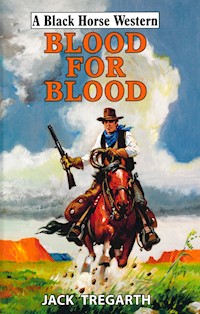
When Will Grafton's wife is gunned down in a bungled robbery, the middle-aged grocer vows to bring the killers to justice. Grafton hasn't always been a grocer and, as he pursues the ruthless Vallence Gang, it soon becomes clear that the odds are not as unevenly stacked as might at first have been thought. From the quiet California town of Alila, Grafton's quest leads him inexorably to a bloody showdown in Kansas – a fight from which only one man can emerge alive.
Das E-Book können Sie in Legimi-Apps oder einer beliebigen App lesen, die das folgende Format unterstützen:
Veröffentlichungsjahr: 2017
Ähnliche




















Blood for Blood
When Will Grafton’s wife is gunned down in a bungled robbery, the middle-aged grocer vows to bring the killers to justice. Grafton hasn’t always been a grocer and, as he pursues the ruthless Vallence Gang, it soon becomes clear that the odds are not as unevenly stacked as might at first have been thought.
From the quiet California town of Alila, Grafton’s quest leads him inexorably to a bloody showdown in Kansas – a fight from which only one man can emerge alive.
Blood for Blood
Jack Tregarth
ROBERT HALE
© Jack Tregarth 2014
First published in Great Britain 2014
ISBN 978-0-7198-2409-8
The Crowood Press
The Stable Block
Crowood Lane
Ramsbury
Marlborough
Wiltshire SN8 2HR
www.bhwesterns.com
This e-book first published in 2017
Robert Hale is an imprint of The Crowood Press
The right of Jack Tregarth to be identified as author of this work has been asserted by him
in accordance with the Copyright, Designs and Patents Act 1988
Contents
Chapter 1
Chapter 2
Chapter 3
Chapter 4
Chapter 5
Chapter 6
Chapter 7
Chapter 8
Chapter 9
Chapter 10
Chapter 11
Chapter 12
Chapter 1
Monday morning, and Will Grafton was where he was to be found every working day of the week, which is to say back of the counter in his grocery store. Grafton was like a fixed star in the firmament and you knew that Monday to Saturday, you would be sure to find the balding, spare-framed, bespectacled, middle-aged man in his store on Alila’s main street.
The little township of Alila was one of a straggling line of settlements strung out between San Francisco and Los Angeles. Few people came there unless they had special business in the town, although since the Southern Pacific Railroad line had been built through the place, it had become somewhat more lively.
On this particular day the Atlantic Flyer was due to stop over at the station and Grafton’s wife had taken their eldest son to watch the mighty locomotive haul the train up the slope from Tulare and into the town.
Twelve years ago Will Grafton, who was at that time a forty-year-old bachelor, had astonished everybody in town by marrying a girl half his age. It was the first and last time that this rather nondescript shopkeeper and elder of the Presbyterian church did anything liable to provoke the least remark from his neighbours. Against all expectations, the marriage had proved a glorious success and Grafton’s beautiful young wife had given him three children. If ever there was a man on this Earth who was truly contented with his lot in life, it was Alila’s grocer.
Although not in the slightest degree interested in railroad trains herself, Carrie Grafton enjoyed visiting the depot with her eleven-year-old son. Billy-Joe had a seemingly inexhaustible fund of knowledge about every aspect of locomotives, carriages, tracks, signals and everything else connected with trains, and it was pleasant to listen to his enthusiastic chatter.
She really didn’t know where he picked up all this information, and sometimes wished that he would put as much effort into learning about the arithmetic and history he was taught at school, as he did in memorizing the wheel configurations of the various classes of locomotives which passed through the town.
‘Look Mama, here it comes now,’ the boy cried, as the puffing locomotive hauled into the station. ‘Ain’t it a grand sight?’
‘Isn’t, darling,’ said his mother. ‘Ain’t is vulgar, you know.’
‘Can we go closer? I’d sure like to see the driver and fireman when they get down from the cab.’
‘Are they going to get out here?’
‘Of course,’ said the boy, scornful of his mother’s abysmal ignorance in matters relating to the railroad. ‘Why, they have to take on water. Please can we get closer?’
Mrs Grafton smiled down at the eager boy. ‘I don’t see why not.’ she said.
Neither she nor her son noticed the half-dozen men who were standing on the platform as the locomotive shuddered to a halt. There was nothing remarkable about their appearance and it wasn’t until they pulled their neckerchiefs up over their noses to cover half their faces, that there was anything to distinguish them from any of the other loafers hanging round the depot that morning.
Nobody knows why some children turn bad. Take George Vallence for instance: as sober, upright, respectable and God-fearing a man as was to be found anywhere in the state of Kansas. His first two sons had turned out just fine. The eldest, James, was a sheriff and his brother Peter a prosperous and well-to-do farmer.
The three younger boys, though, had never been anything but trouble to their father. They progressed in easy stages from playing hooky from school in order to poach fish, to stealing from neighbours and raising Cain in all manner of ways, until the three of them decided to move away from the district entirely.
Some said that the three young men took this step to spare their poor father the shame of having such a set of rogues blackening his family name in the town where he lived. Others though, said that Clay County was getting a little warm for the boys and that if they hung around much longer they were going on the right way to get themselves lynched. Whether or no, in the winter of 1889 Tom, Bob and Pat Vallence lit out of Kansas and headed West.
Over the course of several months, the Vallence brothers worked their way through Colorado, Utah and Nevada, raiding lonely farmhouses, holding up stages, robbing a gaming house and even stealing from lone travellers.
In the fullness of time they arrived in California, where they heard of the vast amounts of money supposedly being carried in the express cars of the railroad trains running along the Southern Pacific line. They picked up with one or two like-minded men and then laid plans for ambushing one of these trains as it stopped at a little town up in the hills called Alila.
The day the Vallences and their friends chose for this enterprise was Monday, 7 April 1890 and it was one of those glorious spring days when the sky is a deep, cerulean blue and completely cloudless. The aim was for two of the gang to hold the driver and fireman at gunpoint, to stop the train leaving the station until the robbery had been successfully accomplished, while the other four seized the express car and forced the guard to open the safe that it contained.
Billy-Joe was the first person at the station to notice that the men hanging round the locomotive had all pulled scarves or bandannas round their faces. He did not at first appreciate the significance of this, which was odd, because he had read any number of dime novels, acquired secretly from other boys at school, where behaviour of that sort was the invariable prelude to robbery and murder. Seeing it in real life in the prosaic surroundings of the local railroad station did not seem to bear any relation to the lurid line drawings of hold-ups on the covers of the trashy story books to which he and his friends were addicted.
He merely remarked to his mother casually, ‘Why d’you think those fellows are covering up their faces like that? Is it ’cause they don’t like the smoke and steam?’
Caroline Grafton grasped the situation almost immediately and grabbed her son’s hand, meaning to hustle him away as fast as she could. She was stopped in her tracks when one of the group of men drew a pistol and announced to all those on the platform:
‘Don’t nobody think o’ leavin’, leastways, not ’til we give you leave to go.’ It was clear that the men didn’t want anybody rushing off to raise the alarm.
Billy-Joe’s mother pulled him to her and held him tight, which proceeding caused the boy to try and wriggle free, protesting,
‘Mama, don’t cuddle me like that, some of the fellows from school might see me. I’ll look a right baby.’
‘Hush now,’ said his mother, keeping him enfolded in her arms. ‘You stay right where you are. These men are robbers.’
‘They are?’ cried the boy in excitement. ‘Hey, I never saw a robber before. Wait ’til I tell the boys at school.’
The driver and fireman showed no inclination towards bravery or defiance, throwing up their hands as soon as they were bidden to do so. While one of the bandits covered them, another watched the people on the platform. They too were all intent upon doing just exactly what they were told. So far, everything was proceeding smoothly for the gang.
It was when the four other masked men went along to the express car, back of the train, that the trouble started, because as soon as the guard sitting in the barred compartment of the car that contained the safe saw them, he began shooting. As the Vallences later observed to each other, it was perfectly stupid; it wasn’t, after all, his money that he was protecting so fiercely.
The guard exchanged shots with the four men who hoped to steal the contents of the safe and when the fireman, up by the locomotive, heard the sound of gunfire he made a bolt for it; whereupon one of the two men on the platform fired twice at him. Neither bullet hit the fleeing man, but the second, although missing its intended target, found a lodging place instead in the breast of Billy-Joe’s mother, who slumped to the ground.
There was pandemonium in the station, with women screaming and various other signs of disorder. The six robbers, who had not counted on any opposition, decided to give up their attempt as a bad job and leave empty-handed. They did so in a thunder of hoofbeats.
Billy-Joe Grafton, who was quite unharmed, did not at first appear to realize what had taken place. He knelt down and began shaking his mother urgently, trying to rouse her from what he took to be a fainting fit. It wasn’t until he saw the neat little hole in the front of her dress, surrounded by a slowly spreading crimson stain, that he knew she was dead. He started wailing in despair over the lifeless body of his mother: an unearthly, high, keening sound, imbued with absolute misery, which none of those present that day ever forgot, as long as they lived.
It didn’t take long for news of the tragedy to reach Will Grafton. His wife was a popular figure in the town. She taught Sunday School, went visiting the sick and always had time to listen to other folk’s troubles. Most of those on the platform knew her by sight. The first that Grafton knew of it was when two members of his church walked into the store. Their faces were sombre.
‘Well, friends,’ said Grafton, ‘what can I do for you today?’
‘Will,’ said one of the men, ‘There’s been some shooting up at the depot. A robbery went wrong.’
‘A robbery?’ exclaimed Grafton, horrified. ‘In our town? Lord, I don’t know what things are coming to.’ Then he suddenly remembered that Carrie and Billy-Joe were to have been up that way. ‘My, I hope my boy’s all right,’ he said. The look on the faces of his friends filled him with alarm.
‘Billy-Joe’s fine. My wife’s tending to him this minute. He’s not hurt.’
‘Your wife’s tending to him?’ said Grafton, bewildered. ‘I don’t rightly understand. Why isn’t his mother with him?’
‘We’re so sorry, Will,’ began one of the men and in that instant, everything was revealed to the grocer and he knew without a shadow of a doubt that his wife was dead. There was a strange humming in his ears, his mouth went dry and then his legs gave way. For the first time in the whole course of his life, Will Grafton fainted.
The funeral of Caroline Grafton took place eight days later in the little burying ground behind the Presbyterian church. Before that event though, came several sensational developments. The first of these was the capture of one of the robbers, whose horse broke a leg after setting foot in a hole, as he and his partners were fleeing Alila. An angry crowd seized the man and began roughing him up, the murder of a woman being regarded with the utmost loathing and detestation. It might have gone badly for the fellow had Sheriff Jackson not arrived on the scene and taken him into custody. Even so, there were murmurs about the desirability of executing summary justice upon this wretch and the sheriff, not wanting to see a lynching in the town, made arrangements to send his prisoner to the Kern County jail at Bakersfield, to await trial.
The 11 April 1890 edition of the Bakersfield Recorder, incorporating the Kern County Advertiser told the story of what happened next.
Amazing Escape of Suspected Killer
Those readers who, like us, were shocked and dismayed to hear of the brutal murder of Mrs Caroline Grafton in the course of a bungled robbery at the Alila railroad depot, will be astounded at the latest developments in the case; developments which do not redound to the credit of our law-enforcement agencies. It will be recalled that the captured man had on him letters and papers which identified him as one Thomas Vallence from Kansas. The telegraph wires between Kansas and our own fair state were fairly humming in no time at all and the intelligence was soon received that this man was one of a gang, consisting chiefly of he himself and his two brothers: namely Robert and Patrick Vallence. They are well known in their own neck of the woods as scallywags and rascals of the first water and it apparently surprises nobody in Clay County, from where they hail, to learn that they have now progressed to murder.
Following the sanguinary events in Alila, the sheriff of that town, Michael Jackson, thought it prudent to have his prisoner transported to the jail at Bakersfield until he was brought to trial. The fear was that some outraged local citizenry were planning to hold an impromptu ‘Necktie Party’, to which the afore mentioned Thomas Vallence would be invited.
Two young deputies, whose names we have been unable to ascertain, were assigned the job of escorting Vallence to Bakersfield. How shall we tell readers of the behaviour of these young men? One handcuffed himself to the suspected bandit and promptly fell asleep, the other engaged in such lively conversations with other passengers that he did not notice what his prisoner was about. It is believed that while one guard was enjoying his refreshing slumbers and the other behaving as though he were propping up the bar in a saloon, Vallence took the opportunity to abstract the key to the handcuffs from the pocket of his sleeping guardian and free himself from their restraint. When the train passed over the trestle-bridge which spans the Oshago river, the prisoner leaped through the window of the carriage into the water below. A later search failed to reveal any sign of the escaped man. We are reliably informed that the town of Alila is now seeking to engage two new deputies.
Will Grafton listened with only half his attention to the familiar words of the burial service as they were intoned at the graveside. I am the resurrection and the life. . . . Man that is born of woman has but a short time to live. . . . Odd how he had always found these same words so comforting and consoling when spoken at funerals he had previously attended. Maybe, he thought bitterly, that’s because none of those people I saw buried before really mattered all that much to me.
There was a very large turnout for Carrie’s funeral; the whole town seemed to be there. She had surely been a popular woman. Grafton looked down at his three children, who were standing at his side. Their faces were pale and pinched; the reality of their mother’s death was perhaps only now becoming plain to them as, one after another, the mourners filed past and cast clods of earth on to the coffin as it lay at the bottom of the freshly dug grave.
When he had shaken everybody’s hand and accepted their whispered condolences, Grafton asked his sister if she would take the children home and sit with them for a little, while he conducted some business in town. When they were gone he directed his steps towards Sheriff Jackson’s office.
In the first few days following his wife’s death, Will Grafton had considered all manner of wild schemes, which chiefly centred around getting hold of the men who had murdered his wife and subjecting them to the most vicious and ingenious tortures imaginable. Then he had turned to scripture for advice. Almost the first verse which leapt out at him when he reached down his Bible was that from chapter twelve of Romans: Vengeance is mine; I will repay, saith the Lord.
This was so wholly to the point that he read the entire passage: Dearly beloved, avenge not yourselves, but rather give place unto wrath: for it is written, Vengeance is mine; I will repay, saith the Lord.




