


0,49 €
Mehr erfahren.
- Herausgeber: Booksell-Verlag
- Kategorie: Gesellschafts- und Liebesromane
- Sprache: Englisch
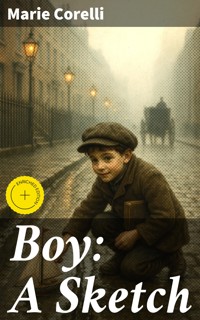
In "Boy: A Sketch," Marie Corelli presents a poignant exploration of innocence and the complexities of childhood against the backdrop of Victorian society. Through vivid prose and an intimate narrative style, Corelli captures the tumultuous yet carefree world of a young boy, portraying his adventures and misadventures with a blend of whimsy and earnest reflection. The book's themes of identity, societal expectations, and the unadulterated perspective of youth are elegantly woven, inviting readers to contemplate the bittersweet passage of time and the inherent wisdom borne from childhood experiences. Marie Corelli, a celebrated author of her time, often found herself at the crossroads of popular fiction and spiritual inquiry. Rising to literary prominence in the late 19th century, Corelli was a trailblazer for her emphasis on emotional depth and introspective characters, often captivating audiences with her explorations of moral and philosophical dilemmas. Her understanding of the societal constraints placed upon children may have stemmed from her own unconventional upbringing and keen observations of social dynamics during a period of significant cultural change. This delightful yet reflective sketch is highly recommended to readers seeking insight into the complexities of youth and the societal landscape of Corelli's time. Whether for its literary merit or its timeless themes, "Boy: A Sketch" offers a rich tapestry of emotion and thought, making it an essential addition to any literary collection. In this enriched edition, we have carefully created added value for your reading experience: - A succinct Introduction situates the work's timeless appeal and themes. - The Synopsis outlines the central plot, highlighting key developments without spoiling critical twists. - A detailed Historical Context immerses you in the era's events and influences that shaped the writing. - A thorough Analysis dissects symbols, motifs, and character arcs to unearth underlying meanings. - Reflection questions prompt you to engage personally with the work's messages, connecting them to modern life. - Hand‐picked Memorable Quotes shine a spotlight on moments of literary brilliance. - Interactive footnotes clarify unusual references, historical allusions, and archaic phrases for an effortless, more informed read.
Das E-Book können Sie in Legimi-Apps oder einer beliebigen App lesen, die das folgende Format unterstützen:
Veröffentlichungsjahr: 2022
Ähnliche



















Boy: A Sketch
Table of Contents
Introduction
At its heart, Boy: A Sketch explores how the vulnerable clarity of youth collides with the expectations, appetites, and judgments of an adult world determined to define what purity and worth should be.
Marie Corelli, one of the most widely read British novelists of the late Victorian era, wrote Boy: A Sketch as a concentrated work of fiction that sits comfortably within her blend of melodrama and moral reflection. Published in the 1890s, the book belongs to a period when Corelli’s popularity was at its height, and its compact form—announced by the word sketch—signals a focused portrait rather than a sprawling saga. Set within a recognizably Victorian social milieu, it offers an intimate lens on character and conscience, inviting readers to consider the pressures that shape a young life in a culture preoccupied with reputation and propriety.
Without revealing its later turns, the premise is straightforward and deliberately narrow: Corelli presents a youthful figure and traces the perceptions, attachments, and fraught sympathies that gather around that presence. The narrative’s compass is tight, the scenes domestic and social rather than panoramic, and the emphasis rests on feeling as much as on event. Readers encounter a work that is brisk in length but emotionally saturated, shaped by Corelli’s talent for intensifying everyday encounters until they bear moral consequence. The experience is immersive, sentimental, and at times austere, asking the audience to sit with discomfort as innocence meets the compromises demanded by adulthood.
The book’s themes are quintessentially Corellian: the testing of innocence by worldly ambition, the tension between material comfort and spiritual integrity, and the way admiration can slip into possession. Boy: A Sketch encourages reflection on how labels—especially those applied to the young—can constrain identity, turning a person into a symbol to be admired, debated, or saved. It probes the ethics of care and the costs of patronage, suggesting that benevolence can become a performance and that love, untethered from responsibility, risks becoming a beautiful but destabilizing force. The result is a moral inquiry conducted through feeling rather than doctrine.
Stylistically, the book bears Corelli’s signature: heightened emotion, a direct appeal to the reader’s conscience, and prose that lingers on moments of beauty even as it courts unease. The voice is assertive yet sympathetic, using a concentrated frame to examine motives and misreadings with almost theatrical clarity. Corelli’s dramatic instincts appear in her pacing—scenes quicken under pressure, then resolve into quieter passages of reflection. The sketch form sharpens the profile of each character interaction, so that gesture, tone, and setting carry moral weight. Readers familiar with her larger novels will recognize here a distilled rendition of her characteristic intensity.
Context matters to the book’s effect. Emerging from the late-Victorian climate of public virtue and private anxiety, Boy: A Sketch occupies the space where sentimental fiction meets social scrutiny. Corelli writes against a backdrop of debates about moral education, the responsibilities of wealth, and the spectacle of reputation, issues that pervaded the 1890s. Rather than mounting a polemic, she embeds these questions in a story that asks who gets to define goodness and to what ends. The tale’s compactness does not blunt its cultural resonance; it concentrates it, allowing the era’s concerns to surface through intimate circumstances.
For contemporary readers, the book offers more than a period curiosity. Its inquiry into how society projects meanings onto young people—often with the language of admiration, protection, or improvement—remains pointed. It challenges audiences to consider the distance between sentiment and justice, between the promise of care and the practice of it. As an entry point to Corelli’s oeuvre, Boy: A Sketch showcases her ability to fuse narrative urgency with ethical reflection, and its brevity makes that fusion accessible. It leaves readers with questions about power, compassion, and the stories we tell to make innocence legible—and how those stories shape a life.
Synopsis
Set in a small coastal town, the narrative opens with the discovery of a nameless child, taken in by a kindly fisherfolk couple. Known simply as "Boy," he grows up amid the tide, cliffs, and chapel bells, marked by an unusual gentleness and quick intelligence. The community regards him with curiosity and affection, noting his instinctive grace and keen ear for rhythm and words. Early scenes trace his daily tasks and quiet reflections, establishing a life shaped by poverty but steadied by affection. These chapters frame the boy's world as self-contained yet expectant, poised for change that will draw him beyond the shoreline.
Change arrives with the visit of a cultivated outsider, a distinguished traveler who pauses in the village for rest and reflection. Meeting the boy by chance, this observer recognizes a rare sensitivity and latent talent that simple surroundings cannot fully nourish. With tact toward the guardians who raised him, the visitor offers guidance, books, and introductions, fostering the child's taste for poetry and art without dislodging him from his home. Their conversations, often about nature, faith, and duty, establish a bond of trust. Through this mentorship, the boy's inner poise strengthens, and the possibility of a broader future, once vague, begins to take shape.
As the seasons turn, the story lingers over village rhythms that refine the boy's character. He works, studies, and practices, earning small opportunities to perform at local gatherings and to read before sympathetic neighbors. The narrative emphasizes observation rather than spectacle: sea-mists, garden paths, and the hush of evening prayers are presented as the boy's first classroom. He learns to distinguish admiration from flattery, and friendship from dependence. A sense of spiritual responsibility accompanies his growing skills, strengthened by simple rituals of kindness. These chapters deepen the portrait of a youth who is responsive to beauty yet wary of attention, prepared for harder tests ahead.
An invitation to the city brings the first decisive turn. Encouraged by the mentor, the boy travels to London to study more seriously and to be presented, cautiously, to a small circle of artists and patrons. The change of scene showcases contrasts: silence of the shore versus the din of streets; sincerity of village praise versus the quick judgments of salons. Initial experiences are modest but promising—less triumph than credible introduction. The boy returns periodically to the coast, maintaining ties with his guardians and mentor, while slowly learning the language and customs of an unfamiliar world that both entices and unsettles him.
Society's attention gathers, uneven and sometimes intrusive. A well-connected benefactor offers to advance the boy's prospects, arranging presentations, meetings, and notices. Alongside encouragement, veiled references to his origin appear, hinting at a lineage that, if proven, could alter his position. The boy's sense of self is tested by expectations that measure worth by background and acclaim. Scenes of drawing rooms and rehearsal halls alternate with private moments of doubt. The mentor urges patience and discretion, cautioning that opportunity can be as dangerous as neglect. The narrative marks this phase as a crossing point, where promise becomes pressure and identity becomes a public question.
Amid growing notice, an affectionate friendship develops between the boy and a young woman he meets through the mentor's circle. Their conversations are quiet and sincere, framed by shared interests more than declarations. Yet differences of class and obligation shadow their meetings, and the rhythms of public life intrude on private hopes. Invitations, appearances, and professional advice begin to shape the boy's schedule, while unspoken expectations complicate simple companionship. The relationship functions as a touchstone in the plot, turning admiration into responsibility and testing whether the qualities that first distinguished the boy—kindness, candor, and restraint—can withstand the demands of success.
A long-held secret about the boy's birth moves toward disclosure, precipitated by the benefactor's ambitions and the curiosity of acquaintances. Documents and confidences surface; hints become assertions. The mentor, protective yet principled, tries to manage revelations without spectacle, but rumor outruns prudence. The boy confronts conflicting counsel: accept a new identity with its privileges, or reject it to preserve peace and privacy. The village guardians are drawn into a conversation they never sought. Public notices amplify everything, and the humane scale of earlier chapters narrows into legalities, titles, and inheritances. The narrative presents this tension without melodrama, keeping motives clear and choices difficult.
Pressure culminates in a crisis that demands an irrevocable decision. The boy weighs loyalty against ambition, gratitude against opportunity, and personal truth against public advantage. Friendships are strained; the benefactor's role is clarified; the mentor offers steady support without dictating the outcome. Events move quickly—journeys, interviews, and announcements—yet the storytelling remains focused on the inward process rather than outward spectacle. The resolution is poignant and restrained, bringing the strands of origin, vocation, and affection to a close consistent with the character drawn from the first pages. The specifics are carefully withheld, but the turning point is decisive and clean.
In its closing chapters, the book gathers its meanings without lengthy exposition. The seaside scenes return as a measure of what has changed and what remains constant. Art is treated as service before display; birth as circumstance rather than destiny; and fame as a test rather than a prize. The guardian couple, the mentor, and the friends embody different forms of care, each with limits. By concluding with quiet images rather than declarations, the narrative underscores its central message: the enduring worth of integrity and compassion. "Boy: A Sketch" thus offers a compact portrait of promise shaped by choice within a watchful society.
Historical Context
Marie Corelli’s Boy: A Sketch is situated in late Victorian England, at the cusp of the Edwardian era (c. 1880s–early 1900s), a time marked by rapid industrial expansion, expanding railways, and stark contrasts between wealth and poverty. The narrative milieu evokes a small English community—semi-rural or coastal—where parish, school, and local notables shape everyday life. Britain’s imperial confidence coexisted with social anxiety about slums, child welfare, and moral decay. The period’s institutions—the Anglican Church, boards of guardians administering the Poor Law, voluntary charities, and newly consolidated school boards—frame the world through which a vulnerable “boy” navigates, allowing Corelli to foreground the ethical tests of class hierarchy, philanthropy, and duty to the young.
Child welfare reform formed a powerful backdrop. Parliament’s Elementary Education Act 1870 (Forster Act) created school boards; the 1880 Act made attendance compulsory; the 1891 Elementary Education Act effectively made elementary schooling free; and the 1899 Board of Education Act centralized policy. Parallel legal protections arrived with the Prevention of Cruelty to, and Protection of, Children Act 1889 (often called a Children’s Charter), expanded in the 1894 Act, and later consolidated in the Children Act 1908. The National Society for the Prevention of Cruelty to Children (founded 1884; granted royal charter 1895) professionalized interventions. Corelli’s focus on a precarious child mirrors this reforming climate—her sketch dramatizes the gap between statute and practice when poverty, neglect, and local prejudice impede protection and schooling.
Debate over the Poor Law (rooted in the 1834 Poor Law Amendment Act) shaped local responses to destitution. Boards of guardians controlled outdoor relief and workhouse admission; the regime emphasized deterrence over care, with notorious abuses from earlier decades still casting a shadow. The Local Government Act 1894 reorganized parish and district governance, yet relief remained moralized and uneven. Mounting criticism culminated in the Royal Commission on the Poor Laws (1905–1909), whose Majority and Minority Reports exposed systemic failure. Corelli’s portrayal of the boy’s vulnerability aligns with contemporary indignation at bureaucratic indifference: village respectability and the ledger of the guardians may matter more than a child’s welfare, revealing the punitive logic embedded in Victorian relief.
Economic stress from the Great Agricultural Depression (c. 1873–1896) transformed provincial life. Falling grain prices driven by imports from the United States and the Russian Empire depressed rural wages and accelerated migration to cities; the 1891 census confirmed Britain’s profound urbanization. The 1893 Royal Commission on Agriculture investigated farm insolvency and tenancy insecurity, while coastal and small-town economies struggled with seasonal labor and limited prospects. In such places, children often contributed to family survival, blurring lines between schooling and work. By situating a boy in a modest community, Corelli’s sketch echoes the lived effects of this downturn—the fragility of livelihoods, the pressure to conform to local patrons, and the moral judgments that accompanied economic distress.
Religious and philanthropic activism provided both solace and controversy. The Salvation Army, founded by William and Catherine Booth in 1865, expanded into Britain’s poorest districts by the 1880s and 1890s, promoting rescue work for children and the destitute. Within Anglicanism, conflicts over ritual and authority (e.g., the Public Worship Regulation Act 1874) reflected broader tensions about moral leadership and social mission. Parochial charities, Sunday schools, and missions filled gaps left by public authorities. Corelli’s tale echoes this milieu: clerical figures and lay philanthropists claim moral stewardship over the young, yet the narrative probes how charity can shade into control, and how spiritual rhetoric may fail when confronted with hunger, stigma, or abuse.
Imperial war and the the “national efficiency” debate amplified concern for child health. The Second Boer War (1899–1902) revealed high rejection rates of British recruits due to poor physique, prompting the Inter-Departmental Committee on Physical Deterioration (1904). Its findings helped justify early Liberal welfare reforms—School Meals (Provision of Meals) Act 1906 and school medical inspections (1907)—to improve children’s nutrition and health. Although Corelli’s sketch is domestic in scale, its attention to frailty, nourishment, and care resonates with this national reckoning: a nation’s future strength, the story implies, depends on safeguarding the poorest children long before they reach military age or the factory floor.
Women-led social activism reshaped child protection and moral reform. Josephine Butler’s campaign secured repeal of the Contagious Diseases Acts in 1886, reframing the state’s duty to the vulnerable. Housing reformers like Octavia Hill (active from the 1860s to early 1900s) advanced paternalistic yet rigorous models of urban management; the settlement movement—Toynbee Hall founded 1884 in Whitechapel—cultivated research-based charity. The National Union of Women Workers (1895) coordinated local efforts on child rescue and welfare. Corelli’s narrative, though fictional, channels this civic maternalism: benevolent women often perceive dangers dismissed by male authorities, illuminating how gendered compassion challenged the complacency of parishes, landlords, and magistrates.
As social and political critique, Boy: A Sketch exposes how class deference, moralism, and administrative rigidity endanger children. The book indicts a culture that treats poverty as delinquency, charity as favor, and education as conditional upon respectability. By staging conflicts among parish elites, minor officials, and would-be benefactors, Corelli dramatizes the distance between progressive law and lived reality. The vulnerable boy becomes an ethical touchstone: his hunger, schooling, housing, and safety test the credibility of church, state, and “good society.” In unveiling cruelty masked as discipline and kindness tinged with control, the work urges a reordering of duty—placing the child’s welfare before custom, doctrine, or class pride.




