


0,99 €
Niedrigster Preis in 30 Tagen: 1,99 €
Niedrigster Preis in 30 Tagen: 1,99 €
Mehr erfahren.
- Herausgeber: Booksell-Verlag
- Kategorie: Abenteuer, Thriller, Horror
- Sprache: Englisch
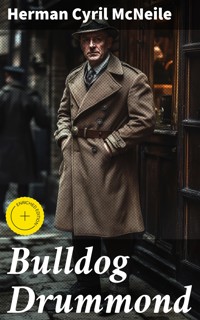
Set against the backdrop of the post-World War I era, "Bulldog Drummond" by Herman Cyril McNeile embodies the spirit of British adventure fiction, merging elements of detective narrative and espionage thriller. The novel follows Captain Hugh Drummond, a World War I veteran disillusioned by the mundane, who delights in embarking on dangerous escapades. McNeile's prose is characterized by its vivid descriptions and an engaging, fast-paced style that captures the reader's imagination. The narrative reflects the zeitgeist of the 1920s, illustrating the post-war disillusionment while romanticizing the archetype of the intrepid hero engaged in a battle against nefarious forces. Herman Cyril McNeile, a British soldier and author, drew upon his own military experiences as a Royal Field Artillery officer during the Great War to inform his writing. His military background, combined with his penchant for storytelling, provided McNeile with insights into the psychological nuances of his characters, making Drummond a credible yet larger-than-life figure representing resilience and bravery. "Bulldog Drummond" is highly recommended for readers seeking a thrilling escapade infused with humor and a touch of nostalgia. McNeile's work not only entertains but also invites reflection on the complexities of heroism in a changing world, making it a must-read for aficionados of classic adventure literature. In this enriched edition, we have carefully created added value for your reading experience: - A succinct Introduction situates the work's timeless appeal and themes. - The Synopsis outlines the central plot, highlighting key developments without spoiling critical twists. - A detailed Historical Context immerses you in the era's events and influences that shaped the writing. - An Author Biography reveals milestones in the author's life, illuminating the personal insights behind the text. - A thorough Analysis dissects symbols, motifs, and character arcs to unearth underlying meanings. - Reflection questions prompt you to engage personally with the work's messages, connecting them to modern life. - Hand‐picked Memorable Quotes shine a spotlight on moments of literary brilliance. - Interactive footnotes clarify unusual references, historical allusions, and archaic phrases for an effortless, more informed read.
Das E-Book können Sie in Legimi-Apps oder einer beliebigen App lesen, die das folgende Format unterstützen:
Veröffentlichungsjahr: 2020
Ähnliche

















Bulldog Drummond
Table of Contents
Introduction
Out of the uneasy peace that follows war, a restless ex-officer turns his hunger for action into a crusade against shadowed threats at home, pitting audacity, camaraderie, and an almost reckless sense of honor against schemes that test England’s security, and discovering that the battlefield has shifted from trenches to drawing rooms, warehouses, and midnight roads where wit, nerve, and physical dash decide whether a single determined individual can matter when institutions seem too slow, too constrained, or too compromised to act, and when loyalty itself becomes both weapon and question.
Bulldog Drummond, a thriller by Herman Cyril McNeile, appeared in 1920 and is set in post–First World War Britain. McNeile, also known as Sapper, launched here the figure who would anchor a popular series of adventures. The novel participates in the interwar blend of crime, espionage, and high-stakes intrigue, with a distinctly domestic focus. Its backdrop of demobilization, shifting class dynamics, and public unease provides both texture and motive, framing a world eager for stability yet haunted by the skills, habits, and suspicions that conflict has left behind.
The premise is direct and engaging. A former infantry officer, bored by peacetime routine, advertises for adventure and soon receives an appeal that leads him into danger. He moves from comfortable clubs and quiet lanes into a web of intimidation, clandestine meetings, and calculated violence whose scale suggests more than ordinary criminality. Calling on a few trusted comrades from wartime, he counters pressure with bluff good humor and decisive action. Each step exposes deeper layers of organization and intent, drawing him further into a contest where nerve, resourcefulness, and timing may be the only reliable advantages.
As a reading experience, the book is brisk and buoyant, alternating sardonic banter with sudden bursts of peril. Scenes unfold with cinematic clarity: convivial dinners give way to tailing cars at night, urbane conversation turns into improvised stratagems, and elegance masks menace. The voice favors clipped exchanges and a confident narrative stride, balancing melodrama with a light touch. Settings span London’s respectable facades and its shadowed corners, along with country houses whose calm conceals intrigue. The emphasis is on personality and momentum rather than elaborate technology, yielding action that feels immediate, physical, and slyly playful.
Thematically, Bulldog Drummond probes the tensions of reintegration after war. It asks what becomes of courage, initiative, and loyalty when official duties end yet danger seems newly domestic. The book explores the appeal and hazards of vigilant action, setting individual conscience against procedural caution. Ideas of class codes and national pride shape the hero’s choices, while anxiety about hidden subversion and economic uncertainty raises the stakes. The narrative also considers the charisma of organization and money, questioning how charm and coordination can move public sentiment, and how friendship, humor, and audacity might counter more calculated forms of power.
As the inaugural Drummond story, the novel established a template that later installments would revisit and vary: the gentleman amateur confronting formidable antagonists with wit, bravado, and a tight-knit cadre of allies. Its success secured the character’s longevity in print, and adaptations in film and other media followed, extending his reach to broader audiences. Within the evolving British thriller, the book channels wartime experience into peacetime anxieties, emphasizing domestic peril rather than distant battlefields and helping to define a strain of adventure in which private initiative races official response.
For contemporary readers, Bulldog Drummond offers both kinetic entertainment and a sharply dated window onto the concerns of its time. Its pace, clarity of motive, and relish for risk remain compelling, while its preoccupations with security, duty, and personal responsibility invite reflection. The novel also contains attitudes and stereotypes that many will find outmoded, making context an important companion to enjoyment. Approached with that awareness, it raises enduring questions about how societies valorize certain kinds of courage, the costs of acting outside formal authority, and the ways fiction converts public unease into urgent narrative.
Synopsis
After the Great War, Hugh "Bulldog" Drummond, a decorated British officer, returns to civilian life bored, craving excitement. He advertises for adventure, receives a flood of replies. Among them, a letter from a young woman, Phyllis, hints at a dangerous scheme ensnaring her family and influential businessmen. Drummond meets her and learns of a suave, enigmatic figure orchestrating coercion and financial pressure. The opening establishes Drummond’s restless energy, the unsettled mood of postwar Britain, and the book’s blend of urbane menace and high-spirited action, setting in motion his decision to intervene as an amateur but resourceful defender against a shadowy conspiracy.
Drummond’s initial inquiries draw him into fashionable London circles where he encounters Carl Peterson, an elegant cosmopolitan whose charm masks ruthless intent, and Irma, a striking associate whose loyalties remain elusive. Their polite conversations carry veiled threats, giving Drummond his first glimpse of an organization operating behind respectable fronts. Phyllis’s concerns center on the manipulation of a vulnerable relative and the systematic targeting of industrial interests. Drummond perceives a plot that reaches beyond a single household, touching national stability. The narrative frames this as a duel of wits, with social gatherings and private meetings doubling as battlegrounds for influence and information.
Recognizing he cannot work alone, Drummond summons a circle of wartime friends—cheerful, capable men accustomed to risk. Their camaraderie introduces levity while reinforcing his tactical advantage. They divide tasks: surveillance of suspects, reconnaissance of suspicious addresses, and discreet interviews with intermediaries who have been bribed or bullied. Early probes yield partial clues: peculiar financial transfers, coded messages, and evidence of planned strikes. The opposition responds with intimidation, and Drummond experiences the first of several physical confrontations. These encounters demonstrate the gang’s willingness to use abduction and violence, while also showcasing Drummond’s resilience and improvisational escape tactics that keep the investigation alive.
The inquiry leads from city apartments to suburban residences and guarded country houses where meetings occur under the guise of social weekends. Drummond and his allies infiltrate these spaces through disguises, servants’ entrances, and invitations engineered via bluff. Inside, they observe a hierarchy: Peterson’s smooth authority, Irma’s enigmatic poise, and the cold efficiency of a brutal lieutenant. Documents are coerced from targeted businessmen, and signatures are extracted under pressure. Drummond narrowly thwarts one such transaction without exposing his hand, but his interference alerts the conspirators. The stakes escalate; surveillance tightens, and the adversaries plant traps designed to isolate him from his team.
As pressure mounts, the plot’s scope becomes clearer. The conspirators aim to exploit postwar discontent—labor unrest, inflation, and political agitation—by triggering panic in markets and supply chains. Through blackmail and strategic leaks, they seek to topple confidence, gaining both profit and leverage over policy. Drummond pieces together this design from scattered hints, while keeping Phyllis safe and reassured. Official channels prove slow or compromised, compelling him to rely on informal networks and quick strikes. The narrative balances legwork with bursts of action, showing how small victories force the cabal to adjust, and how public calm masks an intensifying private struggle.
A pivotal setback occurs when Drummond follows what seems a promising lead into an ambush. Cut off from his comrades, he endures a coercive interrogation intended to break his resolve or recruit him. The episode reveals the opposition’s clinical methods—drugs, threats, and psychological pressure—while underlining their respect for his resourcefulness. A hidden message allows his friends to reorient, and their parallel efforts keep the trail from going cold. Drummond re-emerges, battered but steadfast, with renewed clarity about the conspiracy’s timetable. Meanwhile, tensions sharpen between duty to the broader cause and his growing attachment to Phyllis, complicating his calculations.
The middle act pivots to pursuit and counter-pursuit. Drummond engineers decoys, sabotages transport, and intercepts communications, forcing the conspirators to compress their schedule. Car chases, nocturnal stakeouts, and skirmishes along riverside warehouses push the conflict into open movement. Irma’s appearances continue to sow uncertainty; her interventions alternately assist and hinder, suggesting independent motives within the organization. A fierce confrontation with the gang’s most ruthless enforcer narrows Drummond’s list of immediate threats. At the same time, key financial instruments and dossiers change hands at critical moments, making possession of paper just as decisive as control of men.
The climax gathers at a fortified stronghold where the scheme is to be finalized. Drummond coordinates a dispersed assault with his friends, synchronizing distractions and breaches to overwhelm guards and reach the inner rooms. Negotiations and gunfire mix with calculated bravado, as each side seeks leverage without precipitating catastrophe. The resolution unfolds briskly, restoring a measure of security while leaving certain figures unaccounted for, suggesting a continuing game beyond the present victory. Personal matters advance in parallel: trust is affirmed between Drummond and Phyllis, and the experience defines his appetite for future operations, bridging this adventure to subsequent exploits.
The novel’s arc underscores a central message: in unsettled times, individual initiative and teamwork can counter organized subversion when institutions lag. It presents a hero who channels wartime skills into civilian defense, honoring loyalty, ingenuity, and direct action. The tone blends lighthearted camaraderie with high-stakes intrigue, offering brisk set pieces and clear motives. Without resolving every thread, it concludes on stability reclaimed for the moment and on the promise of further challenges. As the first entry in a series, it establishes recurring adversaries and alliances, defines Drummond’s code, and frames a continuing contest between open society and covert manipulation.
Historical Context
Bulldog Drummond is set in Britain in the immediate aftermath of the First World War, chiefly in London’s clubland and the Home Counties between 1919 and 1920. Its milieus—Piccadilly, Mayfair, the gentlemen’s clubs of Pall Mall, suburban villas, and country houses—reflect a society adjusting to peace amid persistent anxiety. Demobilized officers navigate a shifting economy and unsettled streets where labor unrest, political agitation, and fears of foreign subversion churn. Telephones, motorcars, and urban expansion frame a modernizing metropolis alongside traditional rural estates. The novel’s action, moving from London drawing rooms to secluded estates, situates private intrigue within a national atmosphere of surveillance, suspicion, and the struggle to restore postwar normalcy.
The First World War (1914–1918) is the single most formative context for Bulldog Drummond. Britain entered the war on 4 August 1914; the British Expeditionary Force fought at Mons and Ypres (1914–1915), and the nation endured catastrophic losses on the Somme in 1916 (over 420,000 British casualties) and at Passchendaele in 1917. Conscription began in 1916; millions served. Demobilization in 1918–1919 released a vast cohort of veterans into a strained economy, using age-and-service schemes that provoked unrest when delayed. Herman Cyril McNeile served as an officer in the Royal Engineers, was awarded the Military Cross in 1916, and wrote wartime stories as “Sapper,” experience that shaped his understanding of discipline, camaraderie, and the psychology of veterans. The novel’s protagonist, Captain Hugh “Bulldog” Drummond, is an archetype of the decorated ex-officer estranged from peacetime routine, seeking purpose beyond civilian employment. His language, tactics, and reliance on former comrades reproduce trench-bred improvisation—raids, reconnaissance, and small-unit cohesion translated into peacetime counter-conspiracy. Scenes of house assaults, nocturnal pursuits by motorcar, and quick improvisation of weapons echo wartime commando practice. The social presence of clubs, regimental ties, and quiet networks between officers and officials mirrors how wartime service bled into postwar security habits. The novel captures veterans’ restlessness, physical courage, and a belief in direct action, while revealing public anxieties over whether the nation could hold together after four years of attrition. In emphasizing a patriotic amateur who acts where bureaucracy hesitates, Bulldog Drummond channels the war’s legacy into a narrative of vigilant peacetime defense.
The Bolshevik Revolution of October 1917 and the Russian Civil War (1917–1922) triggered a Europe-wide fear of revolutionary contagion. The Comintern, founded in Moscow in 1919, pledged to support international upheaval. In Britain, the “Red Scare” crystallized with industrial militancy and the 31 January 1919 confrontation in Glasgow’s George Square, where troops and tanks were deployed to quell mass protests. The Communist Party of Great Britain formed in 1920 amid heightened surveillance. Bulldog Drummond mirrors these anxieties through villains who harness the rhetoric of radicalism to mask criminal conspiracy, portraying attempts to incite strikes and disorder as fronts for foreign-backed subversion that Drummond exposes and disrupts.
Postwar economic turbulence culminated in the sharp recession of 1920–1921. Wartime inflation peaked in 1920 before a deflationary contraction sent unemployment above 2 million in 1921. The Lloyd George coalition struggled with strikes by miners (1919), railway workers (1919), and dockers, while slogans such as “Homes for Heroes” (advanced by Christopher Addison’s 1919 housing program) contended with fiscal limits. Speculation, profiteering, and currency instability fed public resentment. The novel reflects this climate by casting its antagonist, Carl Peterson, as a cosmopolitan manipulator who exploits financial anxieties and industrial unrest to destabilize Britain, linking high finance to covert agitation and giving narrative shape to fears of economic sabotage.
The Treaty of Versailles (28 June 1919) reshaped Europe and imposed reparations on Germany, formalized in 1921 at 132 billion gold marks, while Allied troops occupied the Rhineland. War-bred spy fever persisted; Britain’s domestic and foreign intelligence services, MI5 and MI6, had been established in 1909 under Captain Vernon Kell and Mansfield Cumming, respectively. The Defence of the Realm Act and the Aliens Restriction Acts (1914; extended in 1919) regulated security and foreigners. Bulldog Drummond situates its plots within this apparatus: foreign agents, émigrés, and opaque cartels operate across borders, while Drummond liaises with senior figures at Scotland Yard and the War Office, embodying the era’s mix of official surveillance and patriotic amateur intervention.
The Irish War of Independence (1919–1921) intensified British fears of domestic insurgency. Beginning with the Soloheadbeg ambush on 21 January 1919, the IRA targeted the Royal Irish Constabulary; British responses included deploying the Black and Tans in 1920. On 21 November 1920, Dublin’s “Bloody Sunday” saw the assassination of British intelligence officers in the morning and shootings at Croke Park later that day. IRA operations extended to arson and sabotage in Britain. Although not a central topic of the novel, this conflict’s atmosphere of clandestine violence and counter-measures informs its focus on internal security, covert cells, and vigilant citizens stepping into perceived gaps in official control.
Postwar policing and regulation shaped everyday life and crime. The Firearms Act 1920 restricted civilian gun ownership; the Special Constabulary was revitalized from 1919 to bolster public order; and the Aliens Restriction (Amendment) Act 1919 tightened controls on foreign nationals. Motorcars and telephones transformed pursuit and escape, while London absorbed waves of refugees, including White Russian émigrés after 1917. Bulldog Drummond draws on these realities: it features armed confrontations, high-speed chases, and scrutiny of shadowy “aliens,” mapping new technologies and immigration patterns onto national-security concerns and framing Drummond’s readiness to act as both a product of regulation and a response to its perceived inadequacies.
As social and political critique, Bulldog Drummond exposes postwar Britain’s vulnerabilities: dislocation among veterans, industrial unrest, and fears of revolutionary infiltration. It castigates profiteers and cosmopolitan schemers who leverage economic pain, suggesting that governmental caution and bureaucratic delay leave spaces for private initiative. The novel endorses a muscular, class-inflected patriotism centered on ex-officers, thereby critiquing elite complacency while also revealing class anxieties and suspicion toward organized labor and foreigners. By dramatizing conspiracies that prey on unemployment and political agitation, it interrogates the fragility of public order and argues—problematically yet revealingly—for vigilant, extra-bureaucratic action as a remedy to the era’s social and political strains.
Bulldog Drummond
PROLOGUE
In the month of December 1918, and on the very day that a British Cavalry Division marched into Cologne, with flags flying and bands playing as the conquerors of a beaten nation, the manager of the Hôtel Nationale[1] in Berne received a letter. Its contents appeared to puzzle him somewhat, for having read it twice he rang the bell on his desk to summon his secretary. Almost immediately the door opened, and a young French girl came into the room.
"Monsieur rang?" She stood in front of the manager's desk, awaiting instructions.
"Have we ever had staying in the hotel a man called le Comte de Guy[2]?" He leaned back in his chair and looked at her through his pince-nez.
The secretary thought for a moment and then shook her head.
"Not as far as I can remember," she said.
"Do we know anything about him? Has he ever fed here, or taken a private room?
Again the secretary shook her head.
"Not that I know of."
The manager handed her the letter, and waited in silence until she had read it.
"It seems on the face of it a peculiar request from an unknown man," he remarked as she laid it down. "A dinner of four covers; no expense to be spared. Wines specified and if not in hotel to be obtained. A private room at half-past seven sharp. Guests to ask for room X."
The secretary nodded in agreement.
"It can hardly be a hoax," she remarked after a short silence.
"No." The manager tapped his teeth with his pen thoughtfully. "But if by any chance it was, it would prove an expensive one for us. I wish I could think who this Comte de Guy is."
"He sounds like a Frenchman," she answered.
Then after a pause: "I suppose you'll have to take it seriously?"
"I must." He took off his pince-nez and laid them on the desk in front of him. "Would you send the maître d'hôtel[3] to me at once."
Whatever may have been the manager's misgivings, they were certainly not shared by the head waiter as he left the office after receiving his instructions. War and short rations had not been conducive to any particularly lucrative business in his sphere; and the whole sound of the proposed entertainment seemed to him to contain considerable promise. Moreover, he was a man who loved his work, and a free hand over preparing a dinner was a joy in itself. Undoubtedly he personally would meet the three guests and the mysterious Comte de Guy; he personally would see that they had nothing to complain of in the matter of the service at dinner…
And so at about twenty minutes past seven the maître d'hôtel was hovering round the hall-porter, the manager was hovering round the maître d'hôtel, and the secretary was hovering round both. At five-and-twenty minutes past the first guest arrived…
He was a peculiar-looking man, in a big fur coat, reminding one irresistibly of a cod-fish.
"I wish to be taken to Room X." The French secretary stiffened involuntarily as the maître d'hôtel stepped obsequiously forward. Cosmopolitan as the hotel was, even now she could never hear German spoken without an inward shudder of disgust.
"A Boche," she murmured in disgust to the manager as the first arrival disappeared through the swing doors at the end of the lounge. It is to be regretted that that worthy man was more occupied in shaking himself by the hand, at the proof that the letter was bona fide, than in any meditation on the guest's nationality.
Almost immediately afterwards the second and third members of the party arrived. They did not come together, and what seemed peculiar to the manager was that they were evidently strangers to one another.
The leading one—a tall gaunt man with a ragged beard and a pair of piercing eyes—asked in a nasal and by no means an inaudible tone for Room X. As he spoke a little fat man who was standing just behind him started perceptibly, and shot a bird-like glance at the speaker.
Then in execrable French he too asked for Room X.
"He's not French," said the secretary excitedly to the manager as the ill-assorted pair were led out of the lounge by the head waiter. "That last one was another Boche."
The manager thoughtfully twirled his pince-nez between his fingers.
"Two Germans and an American." He looked a little apprehensive. "Let us hope the dinner will appease everybody. Otherwise——"
But whatever fears he might have entertained with regard to the furniture in Room X, they were not destined to be uttered. Even as he spoke the door again swang open, and a man with a thick white scarf around his neck, so pulled up as almost completely to cover his face, came in. A soft hat was pulled down well over his ears, and all that the manager could swear to as regards the newcomer's appearance was a pair of deep-set, steel-grey eyes which seemed to bore through him.
"You got my letter this morning?"
"M'sieur le Comte de Guy?" The manager bowed deferentially and rubbed his hands together. "Everything is ready, and your three guests have arrived."
"Good. I will go to the room at once."
The maître d'hôtel stepped forward to relieve him of his coat, but the Count waved him away.
"I will remove it later," he remarked shortly. "Take me to the room."
As he followed his guide his eyes swept round the lounge. Save for two or three elderly women of doubtful nationality, and a man in the American Red Cross, the place was deserted; and as he passed through the swing doors he turned to the head waiter.
"Business good?" he asked.
No—business decidedly was not good. The waiter was voluble. Business had never been so poor in the memory of man… But it was to be hoped that the dinner would be to Monsieur le Comte' s liking… He personally had superintended it… Also the wines.
"If everything is to my satisfaction you will not regret it," said the Count tersely. "But remember one thing. After the coffee has been brought in, I do not wish to be disturbed under any circumstances whatever." The head waiter paused as he came to a door, and the Count repeated the last few words. "Under no circumstances whatever."
"Mais certainement, Monsieur le Comte.… I, personally, will see to it.…"
As he spoke he flung open the door and the Count entered. It cannot be said that the atmosphere of the room was congenial. The three occupants were regarding one another in hostile silence, and as the Count entered they, with one accord, transferred their suspicious glances to him.
For a moment he stood motionless, while he looked at each one in turn. Then he stepped forward…
"Good evening, gentlemen"—he still spoke in French—"I am honoured at your presence." He turned to the head waiter. "Let dinner be served in five minutes exactly."
With a bow the man left the room, and the door closed.
"During that five minutes, gentlemen, I propose to introduce myself to you, and you to one another." As he spoke he divested himself of his coat and hat. "The business which I wish to discuss we will postpone, with your permission, till after the coffee, when we shall be undisturbed."
In silence the three guests waited while he unwound the thick white muffler; then, with undisguised curiosity, they studied their host. In appearance he was striking. He had a short dark beard, and in profile his face was aquiline and stern. The eyes, which had so impressed the manager, seemed now to be a cold grey-blue; the thick brown hair, flecked slightly with grey, was brushed back from a broad forehead. His hands were large and white; not effeminate, but capable and determined: the hands of a man who knew what he wanted, knew how to get it, and got it. To even the most superficial observer the giver of the feast was a man of power: a man capable of forming instant decisions and of carrying them through.…
And if so much was obvious to the superficial observer, it was more than obvious to the three men who stood by the fire watching him. They were what they were simply owing to the fact that they were not superficial observers of humanity; and each one of them, as he watched his host, realised that he was in the presence of a great man. It was enough: great men do not send fool invitations to dinner to men of international repute. It mattered not what form his greatness took—there was money in greatness, big money. And money was their life…
The Count advanced first to the American.
"Mr. Hocking, I believe," he remarked in English, holding out his hand. "I am glad you managed to come."
The American shook the proffered hand, while the two Germans looked at him with sudden interest. As the man at the head of the great American cotton trust, worth more in millions than he could count, he was entitled to their respect…
"That's me, Count," returned the millionaire in his nasal twang. "I am interested to know to what I am indebted for this invitation."
"All in good time, Mr. Hocking," smiled the host. "I have hopes that the dinner will fill in that time satisfactorily."
He turned to the taller of the two Germans, who without his coat seemed more like a cod-fish than ever.
"Herr Steinemann, is it not?" This time he spoke in German.
The man whose interest in German coal was hardly less well known than Hocking's in cotton, bowed stiffly.
"And Herr von Gratz?" The Count turned to the last member of the party and shook hands. Though less well known than either of the other two in the realms of international finance, von Gratz's name in the steel trade of Central Europe was one to conjure with.
"Well, gentlemen," said the Count, "before we sit down to dinner, I may perhaps be permitted to say a few words of introduction. The nations of the world have recently been engaged in a performance of unrivalled stupidity. As far as one can tell that performance is now over. The last thing I wish to do is to discuss the war—except in so far as it concerns our meeting here to-night. Mr. Hocking is an American, you two gentlemen are Germans. I"—the Count smiled slightly—"have no nationality. Or rather, shall I say, I have every nationality. Completely cosmopolitan.… Gentlemen, the war was waged by idiots[1q], and when idiots get busy on a large scale, it is time for clever men to step in … That is the raison d'être for this little dinner.… I claim that we four men are sufficiently international to be able to disregard any stupid and petty feelings about this country and that country, and to regard the world outlook at the present moment from one point of view and one point of view only—our own."
The gaunt American gave a hoarse chuckle.
"It will be my object after dinner," continued the Count, "to try and prove to you that we have a common point of view. Until then—shall we merely concentrate on a pious hope that the Hôtel Nationale will not poison us with their food?"
"I guess," remarked the American, "that you've got a pretty healthy command of languages, Count."
"I speak four fluently—French, German, English, and Spanish," returned the other. "In addition, I can make myself understood in Russia, Japan, China, the Balkan States, and—America."
His smile, as he spoke, robbed the words of any suspicion of offence. The next moment the head waiter opened the door, and the four men sat down to dine.
It must be admitted that the average hostess, desirous of making a dinner a success, would have been filled with secret dismay at the general atmosphere in the room. The American, in accumulating his millions, had also accumulated a digestion of such an exotic and tender character that dry rusks and Vichy water were the limit of his capacity.
Herr Steinemann was of the common order of German, to whom food is sacred. He ate and drank enormously, and evidently considered that nothing further was required of him.
Von Gratz did his best to keep his end up, but a she was apparently in a chronic condition of fear that the gaunt American would assault him with violence, he cannot be said to have contributed much to the gaiety of the meal.
And so to the host must be given the credit that the dinner was a success. Without appearing to monopolise the conversation he talked ceaselessly and well. More—he talked brilliantly. There seemed to be no corner of the globe with which he had not a nodding acquaintance at least; while with most places he was as familiar as a Londoner with Piccadilly Circus. But to even the most brilliant of conversationalists the strain of talking to a hypochondriacal American and two Germans—one greedy and the other frightened—is considerable; and the Count heaved an inward sigh of relief when the coffee had been handed round and the door closed behind the waiter. From now on the topic was an easy one—one where no effort on his part would be necessary to hold his audience. It was the topic of money—the common bond of his three guests. And yet, as he carefully cut the end of his cigar, and realised that the eyes of the other three were fixed on him expectantly, he knew that the hardest part of the evening was in front of him. Big financiers, in common with all other people, are fonder of having money put into their pockets than of taking it out. And that was the very thing the Count proposed they should do—in large quantities.…
"Gentlemen," he remarked, when his cigar was going to his satisfaction, "we are all men of business. I do not propose therefore to beat about the bush over the matter which I have to put before you, but to come to the point at once. I said before dinner that I considered we were sufficiently big to exclude any small arbitrary national distinctions from our minds. As men whose interests are international, such things are beneath us. I wish now to slightly qualify that remark." He turned to the American on his right, who with his eyes half closed was thoughtfully picking his teeth. "At this stage, sir, I address myself particularly to you."
"Go right ahead," drawled Mr. Hocking.
"I do not wish to touch on the war—or its result; but though the Central Powers have been beaten by America and France and England, I think I can speak for you two gentlemen"—he bowed to the two Germans—"when I say that it is neither France nor America with whom they desire another round. England is German's main enemy; she always has been, she always will be."
Both Germans grunted assent, and the American's eyes closed a little more.
"I have reason to believe, Mr. Hocking, that you personally do not love the English?"
"I guess I don't see what my private feelings have got to do with it. But if it's of any interest to the company you are correct in your belief."
"Good." The Count nodded his head as if satisfied. "I take it then that you would not be averse to seeing England down and out."
"Wal," remarked the American, "you can assume anything you feel like. Let's get to the show-down."
Once again the Count nodded his head; then he turned to the two Germans.
"Now you two gentlemen must admit that your plans have miscarried somewhat. It was no part of your original programme that a British Army should occupy Cologne.…"
"The war was the act of a fool," snarled Herr Steinemann. "In a few years more of peace, we should have beaten those swine.…"
"And now—they have beaten you." The Count smiled slightly. "Let us admit that the war was the act of a fool if you like, but as men of business we can only deal with the result … the result, gentlemen, as it concerns us. Both you gentlemen are sufficiently patriotic to resent the presence of that army at Cologne I have no doubt. And you, Mr. Hocking, have no love on personal grounds for the English.… But I am not proposing to appeal to financiers of your reputation on such grounds as those to support my scheme.… It is enough that your personal predilections run with and not against what I am about to put before you—the defeat of England … a defeat more utter and complete than if she had lost the war.…"
His voice sank a little, and instinctively his three listeners drew closer.
"Don't think that I am proposing this through motives of revenge merely. We are business men, and revenge is only worth our while if it pays. This will pay. I can give you no figures, but we are not of the type who deal in thousands, or even hundreds of thousands. There is a force in England which, if it be harnessed and led properly, will result in millions coming to you.… It is present now in every nation—fettered, inarticulate, unco-ordinated.… It is partly the result of the war—the war that the idiots have waged.… Harness that force, gentlemen, co-ordinate it, and use it for your own ends.… That is my proposal. Not only will you humble that cursed country to the dirt, but you will taste of power such as few men have tasted before.…" The Count stood up, his eyes blazing. "And I—I will do it for you."
He resumed his seat, and his left hand, slipping off the table, beat a tattoo on his knee.
"This is our opportunity—the opportunity of clever men. I have not got the money necessary: you have.…" He leaned forward in his chair, and glanced at the intent faces of his audience. Then he began to speak …
Ten minutes later he pushed back his chair.
"There is my proposal, gentlemen, in a nutshell. Unforeseen developments will doubtless occur; I have spent my life overcoming the unexpected. What is your answer?"
He rose and stood with his back to them by the fire, and for several minutes no one spoke. Each man was busy with his own thoughts, and showed it in his own particular way. The American, his eyes shut, rolled his toothpick backwards and forwards in his mouth slowly and methodically; Steinemann stared at the fire, breathing heavily after the exertions of dinner: von Gratz walked up and down—his hands behind his back—whistling under his breath. Only the Comte de Guy stared unconcernedly at the fire, as if indifferent to the result of their thoughts. In his attitude at that moment he gave a true expression to his attitude on life. Accustomed to play with great stakes, he had just dealt the cards for the most gigantic gamble of his life.… What matter to the three men, who were looking at the hands he had given them, that only a master criminal could have conceived such a game? The only question which occupied their minds was whether he could carry it through. And on that point they had only their judgment of his personality to rely on.
Suddenly the American removed the toothpick from his mouth, and stretched out his legs.
"There is a question which occurs to me, Count, before I make up my mind on the matter. I guess you've got us sized up to the last button; you know who we are, what we're worth, and all about us. Are you disposed to be a little more communicative about yourself? If we agree to come in on this hand, it's going to cost big money. The handling of that money is with you. Wal—who are you?"
Von Gratz paused in his restless pacing and nodded his head in agreement; even Steinemann, with a great effort, raised his eyes to the Count's face as he turned and faced them.…
"A very fair question, gentlemen, and yet one which I regret I am unable to answer. I would not insult your intelligence by giving you the fictitious address of—a fictitious Count. Enough that I am a man whose livelihood lies in other people's pockets. As you say, Mr. Hocking, it is going to cost big money; but compared to the results the costs will be a flea-bite.… Do I look—and you are all of you used to judging men—do I look the type who would steal the baby's money-box which lay on the mantelpiece, when the pearls could be had for opening the safe.… You will have to trust me, even as I shall have to trust you.… You will have to trust me not to divert the money which you give me as working expenses into my own pocket.… I shall have to trust you to pay me when the job is finished.…
"And that payment will be—how much?" Steinemann's guttural voice broke the silence.
"One million pounds sterling—to be split up between you in any proportion you may decide, and to be paid within one month of the completion of my work. After that the matter will pass into your hands… and may you leave that cursed country grovelling in the dirty …" His eyes glowed with a fierce, vindictive fury; and then, as if replacing a mask which had slipped for a moment, the Count was once again the suave, courteous host. He had stated his terms frankly and without haggling: stated them as one big man states them to another of the same kidney, to whom time is money and indecision or beating about the bush anathema.
"Take them or leave them." So much had he said in effect, if not in actual words, and not one of his audience but was far too used to men and matters to have dreamed of suggesting any compromise. All or nothing: and no doctrine could have appealed more to the three men in whose hands lay the decision.…
"Perhaps, Count, you would be good enough to leave us for a few minutes." Von Gratz was speaking. "The decision is a big one, and …"
"Why, certainly, gentlemen." The Count moved towards the door. "I will return in ten minutes. By that time you will have decided—one way or the other."
Once in the lounge he sat down and lit a cigarette. The hotel was deserted save for one fat woman asleep in a chair opposite, and the Count gave himself up to thought. Genius that he was in the reading of men's minds, he felt that he knew the result of that ten minutes' deliberation.… And then … What then? … In his imagination he saw his plans growing and spreading, his tentacles reaching into every corner of a great people—until, at last, everything was ready. He saw himself supreme in power, glutted with it—a king, an autocrat, who had only to lift his finger to plunge his kingdom into destruction and annihilation.… And when he had done it, and the country he hated was in ruins, then he would claim his million and enjoy it as a great man should enjoy a great reward.… Thus for the space of ten minutes did the Count see visions and dream dreams. That the force he proposed to tamper with was a dangerous force disturbed him not at all: he was a dangerous man. That his scheme would bring ruin, perhaps death, to thousands of innocent men and women, caused him no qualm: he was a supreme egoist. All that appealed to him was that he had seen the opportunity that existed, and that he had the nerve and the brain to turn that opportunity to his own advantage. Only the necessary money was lacking … and … With a quick movement he pulled out his watch. They had had their ten minutes … the matter was settled, the die was cast.…
He rose and walked across the lounge. At the swing doors was the head waiter, bowing obsequiously.…
It was to be hoped that the dinner had been to the liking of Monsieur le Comte … the wines all that he could wish … that he had been comfortable and would return again.…
"That is improbable." The Count took out his pocket-book. "But one never knows; perhaps I shall." He gave the waiter a note. "Let my bill be prepared at once, and given to me as I pass through the hall."
Apparently without a care in the world the Count passed down the passage to his private room, while the head waiter regarded complacently the unusual appearance of an English five-pound note.
For an appreciable moment the Count paused by the door, and a faint smile came to his lips. Then he opened it, and passed into the room.…
The American was still chewing his toothpick; Steinemann was still breathing hard. Only von Gratz had changed his occupation, and he was sitting at the table smoking a long thin cigar. The Count closed the door, and walked over to the fireplace.…
"Well, gentlemen," he said quietly, "what have you decided?"
It was the American who answered.
"It goes. With one amendment. The money is too big for three of us: there must be a fourth. That will be a quarter of a million each."
The Count bowed.
"Have you any suggestions as to who the fourth should be?"
"Yep," said the American shortly. "These two gentlemen agree with me that it should be another of my countrymen—so that we get equal numbers. The man we have decided on is coming to England in a few weeks—Hiram C. Potts. If you get him in, you can count us in too. If not, the deal's off."
The Count nodded, and if he felt any annoyance at this unexpected development he showed no sign of it on his face.
"I know of Mr. Potts," he answered quietly. "Your big shipping man, isn't he? I agree to your reservation."
"Good," said the American. "Let's discuss some details."
Without a trace of emotion on his face the Count drew up a chair to the table. It was only when he sat down that he started to play a tattoo on his knee with his left hand.…
Half an hour later he entered his luxurious suite of rooms at the Hôtel Magnificent.
A girl, who had been lying by the fire reading a French novel, looked up at the sound of the door. She did not speak, for the look on his face told her all she wanted to know.
He crossed to the sofa and smiled down at her.
"Successful … on our own terms. To-morrow, Irma, the Comte de Guy dies, and Carl Peterson and his daughter leave for England. A country gentleman, I think, is Carl Peterson. He might keep hens, and possibly pigs."
The girl on the sofa rose, yawning.
"Mon Dieu! What a prospect! Pigs and hens—and in England! How long is it going to take?"
The Count looked thoughtfully into the fire.
"Perhaps a year—perhaps six months… It is on the lap of the gods.…"
CHAPTER I
IN WHICH HE TAKES TEA AT THE CARLTON AND IS SURPRISED
I
Captain Hugh Drummond, D.S.O., M.C.[4], late of His Majesty's Royal Loamshires, was whistling in his morning bath. Being by nature of a cheerful disposition, the symptom did not surprise his servant, late private of the same famous regiment, who was laying breakfast in an adjoining room.
After a while the whistling ceased, and the musical gurgle of escaping water announced that the concert was over. It was the signal for James Denny—the square-jawed ex-batman[5]—to disappear into the back regions and get from his wife the kidneys and bacon which that most excellent woman had grilled to a turn. But on this particular morning the invariable routine was broken. James Denny seemed preoccupied, distrait.
Once or twice he scratched his head, and stared out of the window with a puzzled frown. And each time, after a brief survey of the other side of Half Moon Street, he turned back again to the breakfast table with a grin.
"What's you looking for, James Denny?" The irate voice of his wife at the door made him turn round guiltily. "Them kidneys is ready and waiting these five minutes."
Her eyes fell on the table, and she advanced into the room wiping her hands on her apron.
"Did you ever see such a bunch of letters?" she said.
"Forty-five," returned her husband grimly, "and more to come." He picked up the newspaper lying beside the chair and opened it out.




