


5,00 €
Mehr erfahren.
- Herausgeber: Daniel B. Smith
- Kategorie: Fachliteratur
- Sprache: Englisch
The world we live in changes dramatically every second. Globalization, terrorism, social inequities and all other problems have a huge impact on our economy and security. For the next period, these two main domains of study will be predominant because nowadays, the world faces multiple risks and challenges.
If you wanted to succeed in growing your business and reaching new markets, you would need to develop new skills.
By this book you will find easy-to-understand useful information on:
*How to manage a project and take the best decisions during its implementation
*Latest trends in international project management
*How to consider your business taking into consideration operational risks
*How to act in a global environment and take proper decisions when it comes to business taxation
*Key points of business taxation (tax engineering) to enhance your margins
*Key concepts of managerial finance and how you can use them to foster your business
Das E-Book können Sie in Legimi-Apps oder einer beliebigen App lesen, die das folgende Format unterstützen:
Veröffentlichungsjahr: 2022
Ähnliche
















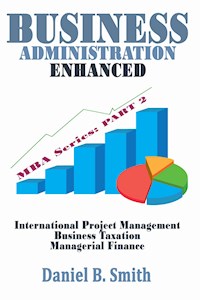
Business Administration Enhanced: Part 2
Daniel B. Smith
Daniel B. Smith Copyright © 2020
All rights reserved. No part of this publication may be reproduced, distributed or transmitted in any form or by any means, including photocopying, recording, or other electronic or mechanical methods, without the prior written permission of the author, excepting the case of brief quotations embodied in critical reviews and certain other noncommercial uses permitted by copyright law.
Table of contents
Introduction
Chapter 1: International Project Management
1. Projects: types and purpose
2. Choosing the project
3. Project management
4. Project planning
5. Project leadership
6. Project teams
7. Cost estimation and project budgeting
8. Projects and change
9. Problems related to project - Conflict resolution
10. Project monitoring and control. Project completion.
Chapter 2: Business Taxation
1. Introduction to taxation
2. Business structures and tax return
3. Corporate income tax
4. Value added tax (VAT)
5. Employees’ salaries and enterprises’ fiscal responsibilities
6. Excises and custom duties
7. Enterprises and fiscal autonomy of local authorities
8. Tax audit
9. Basic concepts on tax avoidance, tax evasion and tax engineering
Chapter 3: Managerial Finance
1. Financing and company lifecycle. Initial public offering (IPO) and the role of underwriters
2. Security valuation
3. Market efficiency
4. Portfolio theory and the CAPM model. Risk and return.
5. Capital structure: theory and practice
6. Dividend policy
7. Leasing
Conclusion
Introduction
The world we live in changes dramatically every second. Globalization, terrorism, social inequities and all other problems have a huge impact on our economy and security. For the next period, these two main domains of study will be predominant because nowadays, the world faces multiple risks and challenges.
If you want to succeed in growing your business and reaching new markets, you will need to develop new skills. By reading this book you will find easy-to-understand useful information on:
1.How to manage a project and take the best decisions during its implementation;
2.Latest trends in international project management;
3.How to consider your business taking into consideration operational risks;
4.How to act in a global environment and take proper decisions when it comes to business taxation;
5.Key points of business taxation (tax engineering) to enhance your margins;
6.Key concepts of managerial finance and how you can use them to foster your business.
Chapter 1: International Project Management
1. Projects: types and purpose
Change has become an ordinary feature of life. Many of these changes take the form of “project” and are often driven and controlled by managers whose experience and dexterity were acquired on daily basis operations. As every project is unique, there are a few conditions that need to be accomplished so as to reach an accurate and properly finalized project, together with a series of abilities and competencies, which are mostly different than the ones required in routine management activities.
During the 90’s projects have become more frequent, especially inside organizations, for at least two reasons:
1.The increasing awareness of the fact that a project can be a powerful tool for management – in that it can increase the manager’s ability to plan, conduct and effectively use the organization’s resources.
2.Within the operational environment of every company there has been an increase in competition and volatility. In order to survive and maybe the luckiest ones to thrive in this hostile and demanding environment, the organizations need to use and develop the ability to react promptly to their customer’s needs.
Despite a large usage of projects, it is obvious that some of them are extremely expensive and they expect important outcomes. Not all projects are as massive and expensive as “The man on the moon” (for example). They also do not need billions, decades and high technologies in order to be finished. The corporation projects are often shorter and they aim less expensive activities, such as launching a new product or redecorating a store.
Projects do not necessarily end in tangible results; there are also projects that require collecting data, changing the organization structures or influencing others’ behaviour or opinions (e.g. promotional campaigns which are meant to convince us to buy a certain product or a certain diet which may prevent heart diseases). The purpose of these project is often to change the way we behave in certain situation. For example, the key process in increasing effectiveness is seen by many companies as a continuous process which requires many little steps. Sometimes there are situations when a big step is necessary. These steps are often referred to as projects and they vary considerably when it comes to size, cost or duration.
Here are several characteristics of projects, as they are not used only inside organizational structures. Projects may:
-have any size, from small to big;
-take days or decades to be finished;
-involve cost;
-have a certain goal;
-reach a different number of participants, from individual to national level.
Despite the obvious diversity regarding results, size, cost or duration of projects, there are a series of common characteristics among all of them:
1.Every project involves people: projects require regardless of duration or results human skills so as to create, plan and manage the processes and activities involved, thus allowing the flow and content of the projects to adapt and change depending on the real world requirements.
2.Every project is unique: each project has at its core individual distinct features.
3.Every project exists for a limited and defined period of time: this means that the project has a limited period (it cannot be endless) and will sooner or later reach a point in time when it is considered to be finished.
4.Every project has to face change: while current operations are mainly defined by continual flow, predictability and stability, the activities of a project have to deal almost exclusively with changes – throw what is old and replace it with what is new.
5.Every project requires clearly defined outcomes/goals: each project has goals, targets, objectives and/or a desired set of results (according to its type), which can be further divided into sub-objectives so as to ease planning, control and management of the project.
6.Every project needs a variety of resources: a project for crime reductions requires information on the type and location of past offenses, offenders and victims, as well as the ability to analyze that information. These pieces of information may be obtained from various sources and are required at different times during the project.
Taking into consideration these common characteristics, the projects should be organized, planned and conducted in ways that differ from those commonly used in everyday work-related tasks.
What is a project? A project is a series of connected activities undertaken for a limited time, aiming to generate a unique and well designed result. Therefore, we can use a project for:
-reorganizing the organization of one of its departments;-increasing the company’s performances;
-introducing new procedures and removing the old ones;-influencing how people think of feel about something.
The project is only one of many other tools that leaders can use. They must understand not only when to use it but, perhaps more importantly, how to use it. Every project manager should know that there are four phases which compose project’s lifecycle:
1.Conception: in this phase, the project is identified, its feasibility is analyzed and the initial cost estimations are done. The final goal and the necessary time are also predefined in this phase. At the end of this step, along which the project is compared with other projects or performance standards, a decision is made whether to implement the project or not. The decision of implementing the project will lead to the next phase of development, while the opposite decision leads to the end of the project.
2.Initiation and development: along this phase the project is developed in detail and certain things must be known: “who”, “what’ and “when” will have to realize the proposed tasks and activities. Cost estimation and required time to complete the project will also be redefined.
3.Maturity: this is the phase when the most intense work is done and it required careful monitoring, controlling and forecasting. The project manager should know at this stage what was made and what not, how much was spent or not, what should or should not have been done. At the end of this phase the project will reach its end and the result will be delivered.
4.Aging and finalization: this phase implies a low rate of activity such as the audit of the final project and dissolving the project team.
Keep in mind that the manager struggles to maintain a balance between the contradictory needs of the organization, customers, team members etc. A good manager will daily mitigate the 4 dimensions (time, performance, quality and cost) in order to satisfy different needs.
Is there a general recipe for project management? Well, not an obvious one. The project management process is obtained using a variety of inputs: information (about time, cost, performance, quality, client), people (their perception, abilities, needs, experiences) and resources (materials, time, money).
The project manager’s role is essential in the process, as he has to maintain a balance between the customer’s needs, the project itself and his own team. The manager has to assure the integrity of the project by decreasing the risk of conflict and rivalries that may lead to altering the initial definition of the proposed result, costs and durations of the project, as well as solving possible problems as they might arise. As a project team leader, he needs to lead and motivate his team members, which will participate in the project just until the final result and which are often “borrowed” from other functional departments of the organization.
In selecting the winning team, the project manager has to assure that all members have the necessary skills and at the end of the project they will be transferred to other roles.
2. Choosing the project
All projects involve change and the change process has an ambivalent action: as an opportunity for success as well as a risk of failure. Successful projects are not only lead, planned and carefully monitored, but also chosen with cleverness and with a better understanding of the risk involved. Uncertainty can occur due to a lack of information regarding duration, incidence or the impact of the future events.
Projects are deliberate and committed changes regarding the actions we take and the way we take them. Consequently, risk levels will follow similar steps to those of change. One of the key actions in successful project management is to ensure that the changes that may occur are manageable and tolerable. In order to achieve this key action it is necessary to rigorously evaluate them.
Since we can not eradicate risk and uncertainty from projects, what we should do if we want to achieve success is to limit their impact on projects. To do this one needs to:
-identify the type, level, and source of the risk;
-follow the necessary steps to reduce or eliminate (if possible) that risk;
-decide whether to accept that risk or not.
This 3-phase sequence is part of an important process of project evaluation, often used to examine a number of alternative projects, process which also allows us to choose which one we want to implement. The first step in reducing the level of risk is to identify the nature and source of it. You can assess it by yourself using the risk matrix:
After we identify the cause and the risk level associated to the project, we will have to determine its consequences. Therefore, we will have to check the likelihood of the considered risk to occur and the risk’s potential consequences.
For example, a risk with a higher likelihood to occur needs more attention, for the simple reason that is has higher chances to appear while a risk with a lower probability needs less information for analysis purposes.
Thus, this can change radically when we consider the risk consequences.
For example, a risk that might occur every 100 years will be a risk that should not get too much attention. Although, if that risk does occur and it results with the death of 10 million people, then that risk should get more consideration.
This connections between the risk’s likelihood and its potential consequences, if they take place, is very important. This provides, although we might have to guess or estimate the consequences or the frequency, a base for trying to reduce the risk.
For example, if the result of multiplying the risk’s probability of occurrence and its consequence is high, then we need additional data in order to limit the risk. If the result is small, then we have two options:
-we will decide on a strategy based on the data we hold;
-we ignore the risk until its likelihood or its consequences would increase.
The next step in the process of choosing a project is trying to reduce the involved risk. One way we can alleviate the impact of risks in the project is the use of feasibility studies – which usually involves the participation of interdisciplinary teams consisting of 3-5 people that are aimed to address questions such as: “How much will the project actually last?” or “Is it possible?” or “How much it will cost?”.
A good feasibility study will remove misconceptions or false ideas, identify “no exit” paths, clearly highlighting the risks and benefits along with recommendations for the next step. This step includes an additional assessment of the risks involved and can be done with prototypes and/or tests. A prototype is usually a first attempt to produce the intended result, while trying prototype consists of exposing the result to a limited number of users. These actions will give us more information on the project’s risks and the opportunity to reduce these risks. Although both prototypes and tests entail costs, they may be less than those that would be caused by failure of the project – in the absence of prototypes and tests.
The techniques used for choosing and evaluating a project can be numeric and non-numeric. No matter what type ones chooses, the technique must be:
-easy to use;
-inexpensive compared to the project cost;
-flexible and pro-change;
-compatible with modus-operandi;
-capable to generate easy to understand results.
For companies or firms, the techniques will be based on the following indicators: profitability, competitive positioning and productive resource usage.
When it comes to NGOs, successful projects are measured based on resource allocation – limited and expensive – such as funds and human resources; making sure that all resources are effectively and efficiently used.
Whatever the project’s objectives might be, in order for them to be successful they must be compatible with the company’s goals, which are often included in the company’s strategy. These refer to the company’s future and they refer to organization itself and have a long term approach.
If the projects do not prove to be compatible with these strategic organizational objectives, they will only lead to failure and rejection. A way to avoid these situations is to create and use trees and hierarchies of their objectives.
These tactics consist in some structured diagram linking the organization’s objectives to be achieved and the project’s objectives. Another way to ensure this compatibility is to use the checklist for project’s objectives, which provides the project creator a way to check the project and its consistency with the goals that the firm has set.
Choosing a project to implement calls for a conscious, formal decision, as its consequences involve costs and risks. This decision is often made by a senior manager or a group of superior managers. In large firms, these groups are often called “committees for capital investment” due to their role in controlling and allocating capital – often limited – needed for projects. In small companies or large companies departments, the choice can be made by individuals, CEO or department head.
Almost always those who take the decision find themselves ahead of capital requirements that are higher than what is available and based on that, they must choose which project to implement. This choice can be made in different ways, but whatever the choice, it should ensure the guarantee that whatever project is chosen to be implemented, it has to:
-contribute to the well-being of the company;
-not involve major foreseeable risks;
-be consistent with the company objectives.
Some problems may arise when projects are not accompanied with sufficient information. For example, when rapid response is required in certain circumstances or when the necessary information is not available or obtaining it would be too expensive. Keep in mind the following indicators when it comes to non-numerical decision:
1.Operational crises – this type of situation often occurs when we become aware of imminent events such as storms, floods, earthquakes and when, for example, we need to build a dike to protect the company from the flooding.
2.Legal requirements – laws and regulations that tell us what we can and what we cannot do in our organization. They are subject to change and/or reinterpretation and therefore will change the way our organization operates.
3.Competitive advantage – in the highly competitive business environment and volatile times, the ability of a firm to maintain a competitive advantage over its rivals can make a major contribution in terms of profitability. In this context, a company may apply to a project without following the standard evaluation procedures to save time, to be the first in a particular market or to lower the risk that the inside information leak to rivals.
4.Ordering/Positioning – is a technique often used to order a group of similar projects. It is based on projects evaluation after a series of major indicators. The project with the best score is then chosen to be implemented.
For many projects, the type and size of the implications and risks require much more attention:
Payback period – for example, a project whose implementation cost is $ 20,000 may generate annual profits of $ 5,000. The payback period will be 4 years (cost of implementation/annual profit). When comparing the projects, the one which is going to be chosen is the one with the lowest payback period. There are some disadvantages of this method. They are based on the assumptions that:
-no interest in cash flows occurs after payback period;
-the money value doesn’t change over time.
Payback index – it is calculated by dividing the annual profit to the cost of project implementation. In the given example, the payback rate will be 25%. When using this method one will choose the project with the highest rate of return on investment. Although the method is simple and easy to use, it has some limitations:
-it disregards the change of the money value in time;
-it calculates only an average index on return of investment for the considered period;
-can ignore that the equipment will have split values, increased operating and maintenance costs. This drawback can be overcome by using methods for estimating changes in the value of the equipment followed by recalculation of capital and income values for each year.
Net present value – is a method that take into account that the money value changes over time by reporting all project future earnings to present value:
With an estimated interest rate of 10%, a project whose implementation cost is $400 and estimated profits are as follows:
Net present values will be as follows:
This process converts all cash flows projected in their value at the time of the decision. If the sum is less than the cost of implementation and the value of the company is increasing, then the project is successful and it brings more funds. The higher the difference, the more profitable the project is.
3. Project management
Successful projects should contribute to the well-being of the organization which demanded the project. In addition, projects must be organized and managed so as to meet the needs of: the client-organization, the project itself and the team that has been called on to implement it.
Generally, the customer wants:
-a strong involvement and influence on all decisions relating to the project;
-freedom to change or modify the project objectives as and when required to do so;
-a team made up of his obedient people.
In contrast to this, the project team wants the following:
-the presence of a project manager with a clear and unconditional authority in respect to all matters related to the project;
-members who are directly responsible only in front of the project manager;
-the freedom to make decisions without being constrained by interference from outside;
-a clear, separate identity from that of the client company.




