


0,99 €
Mehr erfahren.
- Herausgeber: Maria Peitcheva
- Kategorie: Geisteswissenschaft
- Sprache: Englisch
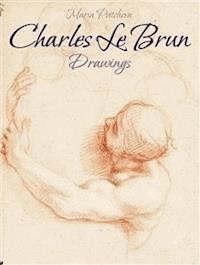
Charles Le Brun (1619 – 1690) was a French painter and art theorist. Declared by Louis XIV "the greatest French artist of all time", he was a dominant figure in 17th-century French art and much influenced by Nicolas Poussin.Le Brun primarily worked for King Louis XIV, for whom he executed large altarpieces and battle pieces. His most important paintings are at Versailles. Besides his gigantic labors at Versailles and the Louvre, the number of his works for religious corporations and private patrons is enormous. Le Brun was also a fine portraitist and an excellent draughtsman, but he was not fond of portrait or landscape painting, which he felt to be a mere exercise in developing technical prowess. What mattered was scholarly composition, whose ultimate goal was to nourish the spirit. The fundamental basis on which the director of the Academy based his art was unquestionably to make his paintings speak, through a series of symbols, costumes and gestures that allowed him to select for his composition the narrative elements that gave his works a particular depth. For Le Brun, a painting represented a story one could read. Nearly all his compositions have been reproduced by celebrated engravers.In his posthumously published treatise, Méthode pour apprendre à dessiner les passions (1698) he promoted the expression of the emotions in painting. It had much influence on art theory for the next two centuries.Many of his drawings are in the Louvre and the Monaco Royal Collection. He was also the teacher of painter Ludovico Dorigny.
Das E-Book können Sie in Legimi-Apps oder einer beliebigen App lesen, die das folgende Format unterstützen:
Veröffentlichungsjahr: 2015
Ähnliche


Charles Le Brun: Drawings
By Maria Peitcheva
First Edition
*****
Charles Le Brun: Drawings
*****
Copyright © 2015 by Maria Peitcheva
Foreword
Charles Le Brun (1619 –1690) was a French painter and art theorist. Declared by Louis XIV "the greatest French artist of all time", he was a dominant figure in 17th-century French art and much influenced by Nicolas Poussin.
Le Brun primarily worked for King Louis XIV, for whom he executed large altarpieces and battle pieces. His most important paintings are at Versailles. Besides his gigantic labors at Versailles and the Louvre, the number of his works for religious corporations and private patrons is enormous. Le Brun was also a fine portraitist and an excellent draughtsman, but he was not fond of portrait or landscape painting, which he felt to be a mere exercise in developing technical prowess. What mattered was scholarly composition, whose ultimate goal was to nourish the spirit. The fundamental basis on which the director of the Academy based his art was unquestionably to make his paintings speak, through a series of symbols, costumes and gestures that allowed him to select for his composition the narrative elements that gave his works a particular depth. For Le Brun, a painting represented a story one could read. Nearly all his compositions have been reproduced by celebrated engravers.
In his posthumously published treatise, Méthode pour apprendre à dessiner les passions (1698) he promoted the expression of the emotions in painting. It had much influence on art theory for the next two centuries.
Many of his drawings are in the Louvre and the Monaco Royal Collection. He was also the teacher of painter Ludovico Dorigny.
Drawings
A Caryatid
Black chalk and black wash on paper; incised for transfer with stylus
Detail
Acquisition of Dunkerque
Pen and ink over black chalk and gray wash on paper
Detail
Detail
Ceres and Cybele: Study for the Ceiling of the Galerie Lambert, Paris
Red and white chalk on light brown paper
Detail
Study for a male figure
Red chalk heightened with white




