


1,99 €
Mehr erfahren.
- Herausgeber: Booksell-Verlag
- Kategorie: Poesie und Drama
- Sprache: Englisch
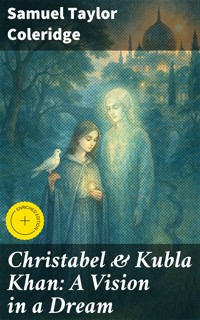
In "Christabel" and "Kubla Khan: A Vision in a Dream," Samuel Taylor Coleridge intricately weaves themes of fantasy, the supernatural, and the exploration of the human psyche. Characterized by its lush imagery and lyrical quality, the collections showcase Coleridge's profound engagement with Romanticism, seeking to evoke emotion through vivid and surreal landscapes. "Christabel" intricately delves into the dichotomy of innocence and seduction, while "Kubla Khan" presents a dreamlike vision of an opulent and enigmatic ruler, reflecting the interplay between creativity and the subconscious mind amidst the backdrop of opium-induced inspiration. Together, these poems encapsulate Coleridge's artistry and philosophical inquiries into the nature of existence and experience. Samuel Taylor Coleridge, one of the central figures of the Romantic movement, was greatly influenced by his own tumultuous life experiences, including struggles with addiction and a deep-seated sense of spirituality. His intellectual partnership with contemporaries such as William Wordsworth and his quest for artistic authenticity motivated him to explore the boundaries of perception through poetic forms. Coleridge's own mystical experiences often informed his writing, enabling him to craft works that evoke wonder and contemplation in readers. "Christabel & Kubla Khan" invites readers to traverse the depths of Coleridge's imaginative landscapes and psychological intricacies, making it an essential study for those interested in Romantic literature and the exploration of the human condition. This collection not only showcases the beauty of Coleridge's language but also reveals the timeless truths and mysteries of life that continue to resonate with readers today. In this enriched edition, we have carefully created added value for your reading experience: - A comprehensive Introduction outlines these selected works' unifying features, themes, or stylistic evolutions. - The Author Biography highlights personal milestones and literary influences that shape the entire body of writing. - A Historical Context section situates the works in their broader era—social currents, cultural trends, and key events that underpin their creation. - A concise Synopsis (Selection) offers an accessible overview of the included texts, helping readers navigate plotlines and main ideas without revealing critical twists. - A unified Analysis examines recurring motifs and stylistic hallmarks across the collection, tying the stories together while spotlighting the different work's strengths. - Reflection questions inspire deeper contemplation of the author's overarching message, inviting readers to draw connections among different texts and relate them to modern contexts. - Lastly, our hand‐picked Memorable Quotes distill pivotal lines and turning points, serving as touchstones for the collection's central themes.
Das E-Book können Sie in Legimi-Apps oder einer beliebigen App lesen, die das folgende Format unterstützen:
Veröffentlichungsjahr: 2024
Ähnliche


Christabel & Kubla Khan: A Vision in a Dream
Table of Contents
Introduction
This collection brings together two celebrated poems by Samuel Taylor Coleridge—Christabel and Kubla Khan; or, A Vision in a Dream: A Fragment—in order to present a concentrated encounter with his most distinctive Romantic preoccupations. Rather than attempting a comprehensive survey of his writings, the volume offers a focused pairing that highlights Coleridge’s interplay of narrative, vision, and musical language. Read together, these works illuminate how he tests the boundaries of poetic form and of consciousness itself, inviting readers into spaces where story, dream, and reverie meet. The selection’s purpose is to showcase Coleridge’s art at its most atmospheric, suggestive, and formally innovative.
The texts included here are poems. Christabel is an unfinished narrative poem, often aligned with the Romantic reinvention of the ballad and the Gothic romance. Kubla Khan; or, A Vision in a Dream: A Fragment is a visionary lyric, explicitly presented as a fragment and celebrated for its imagistic intensity. No novels, plays, essays, letters, or diaries are included; the present volume maintains a strict focus on verse. The juxtaposition underscores two complementary poetic modes: one narrative and dramatic in movement, the other rapt and incantatory, each revealing different capacities of Romantic poetry for evoking memory, sensation, and states of heightened imagination.
Both poems belong to the high Romantic period and are closely linked in their publication history. Although composed earlier, they first appeared in print together in 1816, when Christabel and Kubla Khan were published in the same volume alongside another poem by Coleridge. Their pairing, therefore, has historical precedent as well as thematic coherence. The 1816 presentation of Kubla Khan as a fragment arising from a dream, and the unfinished state of Christabel, shaped early responses and have continued to guide interpretation. This context provides a frame for understanding how Coleridge positioned each work in relation to authorship, imagination, and form.
A unifying feature of the collection is its sustained attention to vision and the liminal states that surround it. Both poems invite readers to inhabit thresholds between waking and dreaming, certainty and suggestiveness, revelation and secrecy. The fragmentary nature of Kubla Khan and the incompletion of Christabel are not merely biographical accidents; they operate within the poems as aesthetic principles. In them, Coleridge explores how the partial and the withheld generate their own power—how a vision glimpsed but not fully secured may still alter the imaginative landscape. As a pair, the poems model Romanticism’s fascination with the promise and peril of visionary experience.
Coleridge’s stylistic hallmarks are everywhere evident. Christabel is renowned for its flexible accentual verse, which privileges stress and musical cadence over fixed syllable counts, producing an intimate, swaying rhythm that suits its nocturnal atmosphere. Kubla Khan, by contrast, achieves its force through dense sonic patterning, richly textured imagery, and a fluid movement that mimics the flux of dream. In both, sound shapes sense: alliteration, assonance, and subtle repetition establish a hypnotic current. The poems’ lexicon is precise yet evocative, cultivating moods of wonder, unease, and transport. Their enduring appeal stems in part from this fusion of metrical experiment and sensuous verbal music.
Christabel situates its narrative within a medievalized setting that draws upon Gothic conventions of secrecy, ritual, and inherited memory. The poem’s premise—an encounter at night between a young woman and a mysterious stranger—unfolds less as linear plot than as a patterned sequence of revelations and reticences, sustained by atmosphere and cadence. Kubla Khan, while not narrative in the same sense, composes an opulent vision of place and power, where natural energies and human artifice intersect. Each poem builds a world by implication, relying on emblematic scenes, symbolic contrasts, and the suggestion of deep forces at work beneath the surface of the text.
Together, the poems probe the uncertain border between the natural and the supernatural. They are not allegories with fixed keys; instead, they create charged zones of ambiguity where ethical, psychological, and aesthetic questions overlap. Christabel foregrounds innocence, influence, and the unsettling pull of fascination. Kubla Khan contemplates creative potency and loss, the relation of vision to making, and the unstable majesty of imagined spaces. In both, Coleridge treats mystery not as a puzzle to be solved but as a condition to be experienced. The result is poetry that engages the senses while continually pointing beyond the reach of literal statement.
In the context of English Romanticism, these works exemplify a shift toward inwardness, experiment, and the primacy of imagination. Coleridge’s emphasis on visionary states aligns with the period’s interest in subjectivity and the sublime, while his formal innovations demonstrate a willingness to bend inherited structures to new purposes. Christabel reimagines ballad and romance materials with psychological nuance; Kubla Khan condenses an entire poetics of inspiration into concentrated lyric form. The collection therefore serves as a compact record of Romantic aims: to test the capacities of language, to render states of consciousness, and to ask what poetry can know and make.




