


1,99 €
Mehr erfahren.
- Herausgeber: Quickie Classics
- Kategorie: Religion und Spiritualität
- Sprache: Englisch
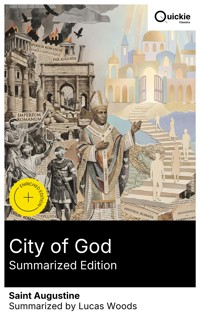
City of God, in twenty-two books, answers pagan indictments after the sack of Rome and builds a theology of history. Augustine opposes the earthly city, driven by libido dominandi, to the City of God, ordered by charity. Blending Scripture, Roman historiography, and Platonizing philosophy, he critiques civil religion and divination, treats providence and freedom, and narrates creation to consummation in a style at once polemical, pastoral, and encyclopedic. Augustine, bishop of Hippo in North Africa, brought the craft of a former rhetor, the conscience of a convert, and the learning of a reader of Cicero and Plotinus. Written between 413 and 426 and addressed in part to the official Marcellinus, the treatise arose from pastoral necessity: to steady a shaken Roman elite, answer pagan critics, and clarify for Christians the mixed condition of the saeculum. Students of theology, philosophy, and political thought will find a bracing account of the limits of politics and the ordering of loves. City of God rewards patient study for its diagnosis of idolatry, its account of virtue under grace, and its eschatological hope, an indispensable guide beyond the illusions of empire. Quickie Classics summarizes timeless works with precision, preserving the author's voice and keeping the prose clear, fast, and readable—distilled, never diluted. Enriched Edition extras: Introduction · Synopsis · Historical Context · Author Biography · Brief Analysis · 4 Reflection Q&As · Editorial Footnotes.
Das E-Book können Sie in Legimi-Apps oder einer beliebigen App lesen, die das folgende Format unterstützen:
Veröffentlichungsjahr: 2026
Ähnliche















City of God (Summarized Edition)
Table of Contents
Introduction
Between the glittering allure of power that erects earthly cities and the patient longing of a pilgrim people for a commonwealth shaped by the love of God, Augustine stages a sweeping drama of rival loyalties, testing whether any empire’s promises can satisfy the human desire for justice, meaning, and peace, and inviting readers to consider how daily choices about worship, allegiance, and love quietly build a destiny larger than politics, reputation, or conquest, even as history’s triumphs and catastrophes—so vivid in his age and ours—press upon the conscience and demand a judgment about what ultimately deserves our hope.
City of God is a monumental work of Christian apologetics and political theology composed by Augustine of Hippo in Roman North Africa between 413 and 426 CE, in the aftermath of the 410 sack of Rome. Written in Latin and organized into twenty-two books, it addresses the intellectual and civic anxieties of late antiquity by defending the Christian faith and reframing the meaning of Rome’s decline. As bishop of Hippo Regius, Augustine writes from a pastoral and philosophical vantage, combining scriptural interpretation with engagement in the broader Greco-Roman conversation that shaped the moral and civic imagination of his readers.
The project begins by confronting the charge that Christianity weakened Rome, a claim circulating among pagan critics who sought explanations for imperial fragility. Augustine responds not with denunciation alone but with a patient, cumulative argument that blends pastoral concern and rigorous analysis. The reading experience is expansive and layered: he moves from case-by-case refutations to broad meditations on happiness, virtue, and the ends of political life. His voice is learned, often combative but ultimately consoling, seeking to steady communities shaken by loss. Modern translations render the Latin with varying textures, yet the tone consistently marries urgency with contemplative breadth.
At the heart of the work is Augustine’s distinction between two communities ordered by different loves: one oriented toward God, the other toward self and domination. This contrast is not a map of institutions but a moral and spiritual diagnosis that runs through households, laws, and hearts. By tracing how these orders of love generate rival understandings of justice and peace, Augustine recasts history as more than the story of regimes; it becomes a theater of desire and worship. The argument reshapes civic identity, encouraging engagement in public life while relocating ultimate allegiance in a transcendent horizon.
Augustine prosecutes his case with an education steeped in classical learning, often measuring Roman religion and civic virtue against philosophical insights and scriptural claims. The architecture of the book is deliberate: an initial movement dismantles the credibility of pagan cults and their public myths, while a second develops a providential account of the origin, progress, and end of the two cities. Along the way he cites history, interprets Scripture, and pauses for probing reflections on freedom, evil, and happiness. The style alternates between forensic precision and sweeping narrative, rewarding patient readers with clarity about how beliefs shape cultures and policies.
Because it unites a sober assessment of politics with a searching account of human desire, City of God retains urgent relevance. Augustine raises questions that resonate in debates about nationalism, secularism, and the place of religion in public life: What sustains civic peace when institutions shake, what counts as genuine justice, and how should citizens order their loves amid competing loyalties? He also speaks to communities recovering from catastrophe, insisting that meaning is not exhausted by loss. His vision encourages responsible participation in temporal affairs without surrendering hope to them, offering a framework for humility, patience, and resilient solidarity.
For contemporary readers, the book serves less as a manual than as a school of attention, training the imagination to weigh ultimate ends alongside immediate needs. Augustine’s steady voice models how to argue without despair, to love a city without idolizing it, and to seek common goods without confusing them with final blessedness. The result is an intellectual pilgrimage through grief, criticism, and hope that reframes personal and political life. Entering City of God is to enter a conversation that stretches beyond crisis, inviting a recalibration of loyalties that can sustain integrity, generosity, and courage in unsettled times.
Synopsis
City of God, written in Latin by Augustine of Hippo after the sack of Rome in 410, addresses accusations that Christianity weakened the empire. Composed between the 410s and 420s and structured in twenty-two books, it has a twofold aim: to refute pagan religious and philosophical claims and to set forth a Christian interpretation of history and destiny. Augustine contrasts transient earthly achievements with an ultimate good not subject to fortune. He gradually unfolds a comprehensive vision in which worship, morality, and political life are evaluated by their orientation to God, establishing the framework for his famous distinction between two cities defined by their loves.
In the opening books, Augustine counters the charge that the Christian faith brought public calamity. He argues that prosperity and disaster befall peoples irrespective of their cults and that classical Rome enjoyed successes through natural virtues and providential arrangements rather than divine favor from its pantheon. He examines the limits of worldly happiness, insisting that virtue seeking human praise cannot secure lasting beatitude. Augustine emphasizes the fragility of temporal goods, the inevitability of suffering, and the inability of civic greatness to deliver the ultimate end of humanity. This prepares his broader claim that true security cannot be grounded in political fortune or ancestral rites.
Augustine then critiques Roman religion by engaging its own authorities. Drawing on Varro’s taxonomy of the mythical, natural, and civil theologies, he contends that public cults were socially expedient but morally corrupting and intellectually incoherent. The proliferation of deities tied to functions of nature and civic life, he argues, failed to disclose the one creator God and did not transform character toward genuine blessedness. He challenges the idea that demons mediating between gods and humans are trustworthy guardians of worship. For Augustine, civic rituals may stabilize communities, but without truth and moral renewal they cannot heal the human condition.
Turning to philosophy, Augustine acknowledges the insight of Platonists who affirm an immaterial, supreme principle and recognize the soul’s ascent beyond material goods. Yet he faults them for misdirected worship and for proposing angelic or daemonic intermediaries or theurgic practices as salvific means. He insists that only a mediator who is both divine and truly human can reconcile humanity to God, evaluating rival accounts of purification and liberation accordingly. Augustine integrates this critique with a theological account of sacrifice and worship, arguing that right worship orders the soul and society, while all substitutes, however refined, leave the deepest wound unhealed.
Having cleared ground, Augustine introduces the two cities: communities formed by two fundamental loves—of God to the contempt of self, and of self to the neglect of God. He situates this within a biblical narrative of creation, angelic obedience and defection, and the origin of evil as a privation caused by a creaturely will turning from the highest good. Time itself, he argues, is created; creation is ex nihilo and wholly dependent on God. The human fall yields disordered desires and mortality, shaping social life. The earthly and heavenly orientations thus diverge in purpose and end, even as their members intermingle in history.
Augustine traces these two lines through sacred history, reading genealogies, episodes, and institutions as manifestations of the divergent loves. From Cain and Abel through the patriarchs, the people of Israel, and the prophetic tradition, he follows how promises and figures prefigure a universal community oriented to God. In parallel, he interprets the rise of empires—Babylon serving as a representative image—as expressions of earthly ambition. Augustine correlates scriptural events with world history to show a providential pattern without denying human agency. His method weaves literal and figurative readings to disclose a coherent story that culminates beyond merely national or imperial projects.
In his sustained analysis of the human good, Augustine critiques classical schools on happiness and civic virtue. He argues that peace is the tranquility of order, present in varying degrees across households, cities, and empires. The earthly city seeks temporal peace and goods legitimately, but cannot attain the highest good without rightly ordered love and true worship. Christians, as pilgrims, use earthly peace for a higher end, cooperating in public life while maintaining ultimate allegiance to God. Augustine assesses justice, laws, and warfare within this framework, measuring political excellence by its service to genuine peace rather than glory, domination, or cultural achievement.
Augustine concludes with an account of the last things, interpreting prophetic and apocalyptic texts to depict a final judgment that discloses the true character of both cities. He defends the resurrection of the body and explores the integrity, identity, and transformed qualities of resurrected life. He considers the destiny of rational creatures, articulates the permanence of their ends, and reflects on the fullness of beatitude. Augustine also recounts signs and testimonies he regards as credible supports for hope. Throughout, he keeps distinct what belongs to temporal pilgrimage and what pertains to the consummation God effects.
The work’s enduring significance lies in its reorientation of historical and political imagination. By measuring cultures, institutions, and personal aspirations against the highest end, Augustine challenges triumphalism and despair alike. His two-cities framework helps readers discern how shared temporal goods can be pursued without confusing them with ultimate fulfillment. The book offers a vision of history governed by providence yet attentive to human action, encouraging engagement in civic life while relativizing its claims. Its steady, expansive argument continues to shape debates about religion, culture, and the state, inviting reflection on what constitutes true peace and lasting happiness.
Historical Context
The City of God emerged in the early fifth century, when the Western Roman Empire struggled to preserve order amid political fragmentation and military shocks. Augustine wrote from Hippo Regius in Roman North Africa, a region tied by trade and law to Italy yet distant from imperial courts. Institutions shaping daily life included the imperial bureaucracy, municipal councils, senatorial patronage networks, and a rapidly consolidating Catholic Church. Latin education in rhetoric and law remained the path to status, while bishops increasingly mediated civic disputes. This setting framed debates about Rome’s past glory, present insecurity, and the moral sources of public cohesion.
Augustine was born in 354 at Tagaste (Numidia), educated in grammar and rhetoric at Madauros and Carthage, and taught in Thagaste, Carthage, Rome, and Milan. Influenced by Latin Platonism and the preaching of Bishop Ambrose, he converted to Christianity, was baptized at Easter 387, and returned to Africa. Ordained presbyter in 391 and bishop of Hippo by 395/396, he led a busy episcopal community that combined pastoral care, doctrinal controversy, and literary production. His training in classical letters, experience in imperial cities, and immersion in scripture equipped him to address Rome’s crisis with arguments engaging both educated pagans and baptized elites.
From Constantine’s Edict of Milan in 313, Christianity gained legal standing in the empire; by the Edict of Thessalonica in 380, Nicene Christianity became the official religion. Emperors curtailed public pagan sacrifices and redirected resources to churches. Debates over the Altar of Victory in the Roman Senate epitomized conflict between traditional civic cults and Christian claims; the altar, removed under Gratian in 382, was not restored despite senatorial petitions supported by Symmachus and opposed by Ambrose. Augustine’s North Africa manifested this transition: basilicas dominated urban centers, episcopal courts arbitrated disputes, and catechumenate instruction prepared converts drawn from all social ranks.
In 410, Visigothic forces under Alaric sacked Rome, shocking contemporaries who viewed the city as the axis of order. Pagan critics charged that neglect of ancestral gods invited disaster, and refugees carried their grievances to North African ports. The imperial tribune Marcellinus, active in Carthage, urged Augustine to reply. Augustine began De Civitate Dei around 413 and completed its twenty-two books by 426. Composed amid correspondence and sermons, the project answered public accusations, surveyed Roman history, and situated recent calamity within a larger moral and providential account, while avoiding immediate political pamphleteering or narrowly local issues.
Augustine drew on scriptures alongside classical authorities to engage Rome’s self-understanding. He cites Varro’s theological classifications, confronts Cicero’s definitions of a commonwealth, and measures Roman virtues celebrated by Livy against Christian charity and humility. His engagement with Platonist metaphysics helped frame arguments about the hierarchy of goods, the origin of evil as privation, and the restless will. Rhetorical training shaped the book’s disputational structure, while biblical exegesis supplied a narrative of creation, fall, and pilgrimage. By juxtaposing revered Roman exempla with Christian claims, Augustine addressed educated audiences without conceding the sufficiency of civic religion or philosophical moralism.
North Africa’s church controversies sharpened Augustine’s themes about community and grace. The Donatist schism, rooted in disputes over the treatment of traditores and the validity of sacraments, divided congregations for decades. At the Conference of Carthage in 411, imperial officials adjudicated and upheld the Catholic position that sacramental efficacy did not depend on a minister’s moral purity. Soon after, debates with Pelagius and his followers about original sin and human ability culminated in African synods and the Council of Carthage in 418 condemning Pelagian teachings. These conflicts reinforced Augustine’s insistence on divine aid, humility, and the mixed character of Christian society.
Structural shifts in the empire formed the work’s background. After Theodosius I’s death in 395, the empire was ruled by Arcadius in the East and Honorius in the West, with the Western court moving to Ravenna by 402. Reliance on federate armies, fiscal strains, and contested successions limited imperial reach. Rome’s senatorial aristocracy retained prestige but saw diminished power as provincial strongmen and bishops gained influence. Earlier traumas—the third-century crises, Gothic migrations, and frontier losses—had already exposed vulnerabilities. Augustine wrote to reframe such instability, not by promising imperial recovery, but by evaluating political goods within a broader moral and ultimate horizon.
The City of God reflects its age by addressing Roman memory, civic pride, and fear of decline, while critiquing the idea that prosperity flows from ritual piety toward traditional gods. It contrasts temporal achievements with enduring goods, evaluates virtues prized by statesmen, and reassesses the ends of law and empire. Augustine neither rejects political order nor equates it with ultimate hope; instead he tests Rome’s narratives against a providential history claimed by the church. In doing so, the book offered late antique readers a framework for loyalty, patience, and responsibility amid uncertainty, shaping medieval and early modern Christian political thought.
Author Biography
Saint Augustine of Hippo (354–430) was a North African bishop, theologian, and philosopher whose writings mark a decisive moment in late antique Christianity and Western thought. Living through the transition from the Roman Empire’s classical order to its Christianized aftermath, he produced a vast corpus of sermons, letters, and treatises that shaped doctrine, spirituality, and intellectual vocabulary for centuries. His Confessions pioneered introspective autobiography; City of God offered a sweeping philosophy of history; and On the Trinity explored the mystery of God in dialogue with Scripture and philosophy. Across genres, Augustine’s work wrestles with desire, memory, time, language, and the dynamics of grace.
Augustine was born in Thagaste, in Roman North Africa, and educated in grammar and rhetoric in nearby towns before advanced study at Carthage. Trained for a career in eloquence, he first encountered philosophy through Cicero’s Hortensius, which awakened a desire for wisdom. For several years he adhered to Manichaeism, a dualist movement promising rational religion, while continuing rhetorical studies and teaching. His mother, later venerated as Monica, persistently encouraged him toward Christianity, though he hesitated. The intellectual climate of the African and Mediterranean schools—rhetorical competition, philosophical debate, and religious pluralism—formed the crucible of his early development as teacher, seeker, and controversialist.
Seeking better prospects, Augustine left Africa to teach in Rome and then secured a prestigious appointment in Milan. There he encountered the sermons of Bishop Ambrose, whose biblical exegesis and rhetorical skill impressed him, and he read Latin translations of Neoplatonist authors that reframed his understanding of God and the soul. These influences eroded his Manichaean commitments and his flirtation with skeptical thought. After an intense period of moral and intellectual struggle, he embraced Christianity and was baptized by Ambrose at Easter 387. Renouncing ambitions at the imperial court, he prepared to return to North Africa and pursue a more ascetic, communal life.
Back in Thagaste, Augustine founded a small community devoted to prayer, study, and common life, before visiting Hippo Regius, where he was reluctantly ordained a priest in 391 and later made bishop around 395–396. Pastoral responsibilities shaped his literary output: he preached regularly, responded to letters from across the Mediterranean, and composed treatises for clergy and laity. In this period he wrote Confessions (late 390s), On Christian Doctrine (developed over decades), and began On the Trinity (c. 399–419). The sack of Rome in 410 prompted City of God, completed in the 420s, which reinterpreted history and civic life in light of the gospel.
Augustine’s episcopate engaged major controversies. Against the Donatists in North Africa, he argued that the church’s unity and the efficacy of sacraments rest on Christ, not the moral purity of ministers. Against Manichaeans, he defended the goodness of creation and articulated a privation account of evil with a robust doctrine of free will ordered by grace. The Pelagian debates pressed him to clarify original sin and the necessity of divine grace for conversion and perseverance. Through sermons, letters, and treatises, he contended that human salvation begins and ends in God’s gratuitous initiative, a judgment received warmly by some and contested by others.
Augustine was an inventive reader of Scripture and theorist of interpretation. On Christian Doctrine presents a pedagogy of signs, teaching how to discern literal and figurative senses and to order learning to charity. His Confessions probes memory, time, and selfhood; Book XI’s reflections on time influenced later philosophy. In On the Trinity he wrestled with speaking about God while guarding divine mystery. City of God contrasted earthly ambitions with a pilgrim people oriented to eternal peace, offering themes that later informed political theology, including subsequent just war reflection. Throughout, he integrated classical learning with biblical faith in a disciplined, prayerful inquiry.
In his later years Augustine reviewed his writings in Retractions, clarifying positions and acknowledging developments in his thought, an unusual act of intellectual self-scrutiny. He continued corresponding with allies and opponents, supervising clergy, and writing on Scripture and doctrine. He died in 430 during the Vandal siege of Hippo. His Rule influenced later communal religious life, and his works shaped medieval theology, Renaissance humanism, and the Reformation, with readers as diverse as Anselm, Aquinas, Luther, and Calvin. Modern philosophy and theology still engage his accounts of desire, grace, history, and interiority. Augustine endures as a central voice in debates about faith, reason, and the human heart.
City of God (Summarized Edition)
VOLUME I.
“Rome having been stormed and sacked by the Goths under Alaric[1] their king, the worshippers of false gods began to blaspheme the true God,” Augustine declares, “and my zeal for His house drove me to defend the city of God.” He explains that twenty-two books emerged after years of interruption: “The first five disprove the notion that polytheism secures earthly prosperity; the next five reply to those who seek pagan help for the life to come. In the remaining twelve I trace the origin, progress, and destiny of the two cities.” Therefore he names the whole work “The City of God.
Urgent persuasion came from the imperial tribune Marcellinus[2]. Sent to Africa to settle the Donatist[3] dispute, he befriended Augustine and the pagan proconsul Volusian[4]. Hoping to convert his courtly colleague, Marcellinus pressed the bishop to answer every scruple. Augustine offered plainly, “Read the Scriptures, and I will meet any difficulty,” and so the two statesmen relayed objections ranging from the mystery of the Incarnation to fears that Christian ethics might ruin Rome’s rule. Letters proved too small; at Marcellinus’ insistence the defence swelled into a book begun in 413, issued in parts, and finished in 426.
The sack of Rome after eleven centuries shook the world. Even Jerome[5] sobbed, “A terrible rumour reaches me from the West… my voice falters, for she is captive, that city which enthralled the world.” Augustine deplores the disaster, scolding Roman pride yet hoping virtue may restore her strength. Gazing on toppled walls, he beholds “the city of God coming down out of heaven, adorned as a bride for her husband”; the unseen commonwealth “crescit occulto velut arbor ævo.” His masterpiece contrasts that pure kingdom with disjointed pagan theories and corrupted morals, traces their conflict from fallen angels to final judgment, and offers history’s first philosophy.
Critics struggle to gauge the influence of Augustine’s massive opus. Beugnot insists any impact was slight, because serial publication dulled its force, yet others weigh its intrinsic worth. Dupin calls it delightful for its colourful digressions, though filled with futile debates; Huet sees ‘un amas confus d’excellents materiaux’, while Flottes repeats Pressensé’s unreserved praise. The public rendered final judgment: from 1467 to 1500 twenty editions appeared, and Vives begged Erasmus for a stand-alone printing, noting it was almost the only patristic volume scholars read. Its encyclopedic sweep preserves lost Latin lore, displays courteous criticism, and proves Augustine’s deep but exclusively Latin learning.
Beyond historical riches, the book captivates through energetic exposition of Augustine’s theology. Lofty abstractions break into popular speech; he wields Plato’s ease, Cicero’s exactness, and deeper insight, discrediting Neoplatonism and wedding faith to reason. Though tedious refutations, repetitions, and arguments ‘plus ingénieux que solides’ intrude, and Erasmus sighs at his ‘obscuræ subtilitatis et parum amœnæ prolixitatis’, perseverance uncovers treasure. Readers join him in the ‘immemorial quest’, hearing verses where ‘The fourteen centuries fall away, Between us and the Afric saint’. His dialectic cuts like Socrates’, his charity glows through every page, lending life to the most abstract disputation.
In four centuries France produced eight translations, Saisset’s masterly version leading; England offered one, so inept it chilled interest. The Glasgow editor, 1871, now presents a loving corrective, aided by Benedictine and Vives notes, and opens Book I. The table proclaims: pagans blame Rome’s fall on Christ; good and bad share fortunes; soldiers’ violation of Christian women is denounced. Augustine writes to Marcellinus: ‘The glorious city of God is my theme… God resisteth the proud, but giveth grace unto the humble. Show pity to the humbled soul, And crush the sons of pride.’ He trusts God to oppose the earthly city’s lust for rule.
Against the city of God stand citizens of earth; some reclaimed, others burn with hatred. They forget that, when steel filled the streets, only the churches and martyr shrines preserved the breath they now use to mock their Redeemer. The raging swords halted at those thresholds; even cruel foes led captives inside lest harsher hands strike. Multitudes escaped, yet accuse Christ for Rome’s woes and credit mere luck for their own survival. They should read chastisement as providence, mercy as the temper of Christian times, thank God, and take the name they once feigned lest they suffer everlasting fire.
Search every chronicle: when did conquerors ever spare enemies for the sake of their gods? Troy offers the blunt reply. Priam[8] dies beside the altar—“Dying Priam at the shrine”—while Diomede[9] and Ulysses[10] seize the blood-stained image of Minerva: “Drag with red hands… the virgin coronal.” Fortune did not turn; the Greeks burned the city and beheaded the king. The goddess could not defend even her guards, and had to be carried off like booty. Yet Rome entrusted itself to such conquered powers. Virgil[7]’s Juno sneers, “A race I hate… home-gods conquered,” and pious Æneas[6] bears “his conquered gods” for safety.
Contrast that asylum with Christ’s houses. In Juno’s court the victors stacked plunder and herded trembling women and boys; walls meant for worship became a pen of bondage. In Rome the basilicas of the apostles stood open sanctuaries: murderers sheathed swords, guided prisoners within, returned seized goods, and withdrew. There liberty lived, slavery barred. The gentle Greeks turned a shrine to greed; fierce barbarians chose churches for humility and pity. Yet those whom the name of Christ shielded now emerge to spit curses, risk endless darkness, and forget how war’s ancient custom—Cæsar himself attests it—was overturned solely for His sake.
Caesar himself, speaking against Catiline, cries, 'Virgins and boys are violated, children torn from their parents, matrons forced, temples and homes plundered; everywhere arms, corpses, blood, lamentation.' Even Rome’s own nobility threatened her shrines. Nor, when Romans made foreign war, did they differ. They boasted 'to spare the vanquished and subdue the proud,' and 'rather to forgive than to revenge an injury,' yet no historian recalls a sanctuary declared inviolable. Marcellus, weeping for doomed Syracuse, ordered chastity spared before the assault, but the sack followed. Fabius, looting Tarentum, laughed, 'Let us leave the Tarentines their angry gods,' yet carried off all else.
Thus the recent storming of Rome displayed the usual horrors of war—slaughter, fire, and plunder—yet something unheard-of shone through. Brutal Goths set apart the largest churches, packed fugitives within them, slew none, dragged none away, even escorted captives inside so they might be freed, and never led a soul from the altars to bondage. This mercy springs from Christ’s name alone. Whoever fails to see it is blind; whoever forbids praise is mad. The same Lord who foretold, 'I will visit their transgression with the rod, yet my loving-kindness I will not remove,' bridled those fierce hearts.
Yet compassion touched villains as well as saints, for the One who 'makes his sun rise on evil and good, and sends rain on just and unjust' still invites repentance. Some scorn that richness and heap wrath, but patience guides the faithful. Because rewards and troubles are shared now, none may cling to earthly gifts or despair at earthly blows. Fire brightens gold and blackens chaff; the same flail shatters straw and cleans grain. Under equal calamities the wicked blaspheme while the righteous pray. Christians, conscious of lesser sins and timid silence toward great sinners, rightly taste that scourge together.
Some good people keep silence when wrongdoers act, hoping for a gentler moment, fearing the rebuke may harden sinners or unsettle the weak; such restraint is charitable. Yet blame clings to those who, though living differently, spare vices they ought to cure because offense might cost them money, comfort, or respect. Married believers, servants and masters, gladly gain and grudgingly lose temporal things; even stricter souls who fast and remain single sometimes protect their own safety and name. They refuse neither sin nor rebuke, but choose non-interference lest danger, slander, pain, or death disturb the selfish relish they still feel.
Because of this lingering love of earthly life, the righteous are scourged beside the wicked when God chastises a corrupt society; they suffer not for equal crimes, but for sharing, though less greedily, the same attachment that ought to be despised so the ungodly might glimpse eternal hope. If the wicked still refuse fellowship, they must be loved as enemies and borne with patiently, for they may yet awaken. Watchmen set over the churches must rebuke without sparing, or the blood will be required at their hand. Even private men incur guilt by silent fear. Trials like Job’s prove unmercenary devotion.
When Rome was sacked, many lost everything, yet their true riches—faith, godliness, “the hidden man of the heart”—remained. Those who had used the world as not using it echoed Job: “Naked came I… the Lord gave, and the Lord has taken away; blessed be the name of the Lord.” Others, wounded by loss, discovered how deeply they loved what perishes; they had “pierced themselves through with many sorrows.” Scripture had warned, “Lay not up treasures on earth… for where your treasure is, there will your heart be.” Bishop Paulinus, who had stored his wealth in heaven, prayed, “Lord, Thou knowest my treasure,” and rejoiced unharmed.
Good Christians were stretched on racks so enemies could wrench treasure from them, yet the grace that made them good could not be stripped away. If they clung to gold rather than Christ, they erred; torment should have schooled them to prize Him who bestows endless riches, not the mammon of iniquity. Under questioning no one forfeited Christ by confessing Him, while wealth survived only through lying denial. Thus the lash taught hearts to cling to an unfailing possession. Even poor captives, suspected of hidden coin, learned that hunger for money, not merely hoarding it, merited agonizing cords.
The long famine felled many believers; for the slain it kindly ended earthly ills, and for the gaunt it drilled stricter temperance. Soon blades replaced hunger: Christians were butchered in ghastly fashions, yet all who breathe are born to die, and the last breath levels the short span with the longest. Better to face one appointed death than quake before a thousand imagined ends. Flesh may quail, but reason declares death harmless when it closes a good life; evil stems from what follows. The pauper licked by dogs fared better beyond the grave than the purple-clad miser.
Even amid unburied heaps faithful hearts kept calm. Christ said, 'Fear not them which kill the body but are not able to kill the soul.' No beast, bird, or flame blocks rising. The Psalm sighs, 'The dead bodies of Thy servants have they given to the fowls,' yet sings, 'Precious is the death of His saints.' Poets boast, 'He who has no tomb has the sky for his vault.' Still friends honor remains, for God remembers dust; Tobit, the ointment, and those who laid Jesus in the grave prove it. If war forbade these rites, the living were guiltless and the blessed dead unharmed.
Many believers were dragged away, a misery only if exile could rob them of God. Scripture proves otherwise: the three young men, Daniel, and other prophets flourished in chains, while Jonah found deliverance even inside a sea-monster. The Comforter who stood with them has stood likewise with captives of a nation barbarous yet still human. Scoffers laugh at these wonders, yet they swallow without hesitation the tale of Arion of Methymna, hurled from a ship and ferried ashore on a dolphin’s back. Our account of Jonah seems impossible only because it displays an even mightier power.
Among their own heroes shines Marcus Attilius Regulus. Captured by Carthage, he was dispatched to Rome under oath to urge a prisoner exchange, promising, if he failed, to return. He advised the senate to refuse, judging the bargain harmful to the republic, then freely went back to his enemies. The Carthaginians locked him upright inside a cramped chest studded with razor nails and tortured him to death by sleepless agony. They praise his courage, yet his devoted gods granted neither victory, safety, nor earthly joy. If one worshipper suffered thus, a whole city may suffer likewise.
They charge our faith with disgrace because soldiers raped wives, maidens, even consecrated virgins. Yet virtue sits enthroned in the soul. While the will stands unshaken, no outrage forced upon flesh tarnishes the victim. Some virgins chose death rather than shame; pity excuses them, but self-murder remains a deeper wrong, as Judas proved when despair added one crime to another. Better to endure injury than to kill the innocent self. Another’s lust cannot soil the chaste mind; purity is not a bodily ornament like beauty or strength, but a spiritual power that survives even when bodies are overpowered.
Limbs may be wounded, handled, even cut by doctors, yet sanctity endures, for it resides not in untouched flesh but in a steadfast soul. A midwife might tear a girl’s hymen while testing her; no sane person says the maiden loses purity. Conversely, a vowed virgin who hurries to her seducer is already defiled, though her body is still whole, because her will has yielded. Hence, when another’s lust invades a woman against her consent, her bodily sanctity remains, and she must not slay herself—much less anticipate uncertain outrage by certain self-murder, or deem herself stained.
Rome’s celebrated matron Lucretia[12] proves the point. Sextus Tarquinius[13] forced her; she summoned her husband Collatinus[14] and kinsman Brutus[15], bound them by oath to vengeance, then, heartsick, stabbed herself. Spectators exclaimed, “Here was a marvel: there were two, and only one committed adultery,” and again, “There were two, but the adultery was the crime of only one.” Yet the innocent suffered death while the guilty merely fled. She, not her ravisher, murdered the chaste Lucretia. If she secretly consented, adultery damns her; if she refused, homicide condemns her. Christian women, similarly outraged, live on, preferring conscience to vainglorious shame.
Scripture nowhere grants leave to end our own lives. The command, “Thou shalt not kill,” lacks the limiting words “thy neighbour,” showing that self-slaying also violates it, just as lying against oneself still breaks “Thou shalt not bear false witness.” If the precept covered every living thing we would dread plucking flowers; rather, beasts and plants lie beneath us and may be used, whereas man alone is protected. Therefore no one may kill another or himself; suicide is murder unfailingly, and must never be chosen for promised immortality or to escape present or future suffering.
Divine authority allows two narrow exceptions to the law, 'Thou shalt not kill.' One is a standing statute empowering public justice; the other is a temporary mandate delivered to a chosen person. In such moments the delegate is only a sword wielded by the true Judge and bears no guilt for the deaths inflicted. Soldiers who fight by heavenly order, magistrates who execute criminals, Abraham lifting the knife over Isaac, Samson pulling the pillars down, all act within this sanction; Jephthah’s grim vow is debated. Beyond these two channels—just law or explicit command—whoever takes human life commits murder.
Some hail self-slaying as heroic, yet closer scrutiny finds no grandeur in surrendering to pain, servitude, or popular scorn. The sturdier soul endures hardship, esteems a clean conscience above the crowd’s cloudy verdict, and waits for release appointed by God. If suicide were true greatness, Cleombrotus would reign supreme: untroubled by disaster or accusation, he read Plato on the soul’s immortality, leapt from a wall, and fled the sweetness of life. Plato’s own insight would have rebuked him, forbidding a man to grasp immortality by violence. Even Christ, urging His friends to flee persecutors, never counseled self-murder.
Cato’s death at Utica is paraded as the noble precedent, yet his learned companions begged him to live, judging the act a retreat, not a triumph. He spared his son for Caesar’s mercy, proving he did not deem survival under Caesar disgraceful; envy, not honour, drew the blade. Compare Regulus: once victor over Carthage, later captive, he chose chains instead of suicide, kept faith with Rome, and returned to torment rather than break his oath. Pagans who worshipped false gods thus condemned self-killing; how much more must Christians, heirs of heaven, refuse to escape an enemy’s sin by their own.
People warn that when the body is seized by an enemy’s lust, sensual pleasure may seduce the soul, so they propose suicide to block both crimes. Yet a soul guided by God, not concupiscence, never assents; and if “Let us sin now, that we may obviate a possible future sin; let us now commit murder, lest we perhaps afterwards should commit adultery?” sounds insane, the scheme is damned. Better risk an uncertain adultery than commit certain slaughter; better survive for penitent healing than die without it. Trusting Christ, refuse shameful consent, and count involuntary stirrings no guiltier than those that visit sleepers.
In persecution, certain holy women flung themselves into rivers, drowned, and are honored as martyrs; Augustine will not condemn, for perhaps divine evidence sanctioned them, as with Samson. When God plainly commands, obedience cannot be criminal, just as a soldier kills lawfully by his general’s order. However, without such mandate, self-slaughter is forbidden. “No one knoweth the things of a man, save the spirit of man which is in him,” yet we boldly affirm: no one may end his own life to escape temporal misery, another’s guilt, past sins, or to grasp a better life, for self-murder loses that hope.
If suicide could rightly avoid future sin, we would urge the newly baptized to die at once, cleansed and safe; “He who loveth danger shall fall into it,” yet such counsel is madness. Since even this case fails, no reason remains. Therefore, faithful servants whose chastity was violated must not find life burdensome: they did not consent, and “unsearchable are His judgments, and His ways past finding out.” Examine hearts for secret pride; praise may have swelled or threatened to swell. God allowed humiliation to save humility: some were cured of existing pride, others protected from coming pride, preserving chastity with grace.
Some wounded souls once thought continence a bodily treasure lost with violated flesh; now they grasp that chastity, planted by grace, lives in a will no foe can seize. Consoled, the family of God accepts discipline like pilgrims, using earth’s goods lightly and letting trials purify them. When mockers jeer, “Where is your God?” the faithful answer: our God fills every place yet moves nowhere; He appears or withdraws to test us or cure our flaws, and in return for endurance He keeps reward. “He is to be feared above all gods; for all nations’ gods are idols, but the Lord made the heavens.”.
Yet many who howl against Christ really crave license. They beg for peace, plenty, and unchecked pleasure, not for moderation, temperance, or piety. Scipio Nasica[16], once your unanimous pontiff, foresaw this rot. He opposed Cato’s cry to raze Carthage, fearing prosperity would unbridle lust, breed luxury, feed avarice, and shatter liberty. His warning proved true: once the rival city fell, concord crumbled, seditions flared, civil blood soaked Rome, and the raging thirst for power dragged all beneath a few tyrants. The same Nasica doused plans for permanent theatre seats, lest Greek softness melt Roman manhood.




