


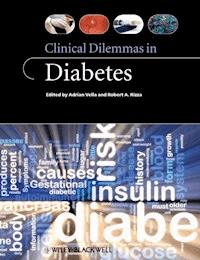
Clinical Dilemmas in Diabetes E-Book
48,99 €
Mehr erfahren.
- Herausgeber: John Wiley & Sons
- Kategorie: Fachliteratur
- Serie: Clinical Dilemmas
- Sprache: Englisch
Clinical Dilemmas in Diabetes provides evidence-based clinical guidance on the most common and problematic areas of concern encountered in diagnosing, treating and managing patients with diabetes. Each chapter is highly topical and has been selected due to current interest, specific recent developments, and areas of controversy. This valuable guide provides assistance in managing the life-long treatment of diabetes and the complications that often develop in patients. Clinical Dilemmas in Diabetes guides the medical team in their decision-making, particularly when there are conflicts in the treatment for the disease and the complications. Part of the Clinical Dilemmas series, the well-focused chapter structure allows for quick retrieval of information, and each opens with a "Learning Points" box to aid easy assimilation of the main issues. With a leading team of contributors and editors, Professor Robert A. Rizza is the immediate Past-President of the American Diabetes Association. This book is perfect for use on the wards and clinics as well as for self-study by diabetologists, diabetes specialist nurses, endocrinologists, GPs and cardiologists.
Sie lesen das E-Book in den Legimi-Apps auf:
Seitenzahl: 463
Veröffentlichungsjahr: 2011
Ähnliche




















Contents
Cover
Title Page
Copyright
Contributors
Preface
PART I: Prediabetes and the Diagnosis of Diabetes
1: Is prediabetes a risk factor or is it a disease?
Prediabetes, diabetes, micro- and macrovascular disease
Prediabetes and atherosclerosis: Why do they associate and how to best predict the risk?
Is there a role for OGTT in clinical practice?
What is the underlying pathogenesis and natural history of IGT and IFG?
Management of prediabetes
2: Early diagnosis of type 1 diabetes: Useful or a phyrrhic victory?
Introduction
Pathogenesis of T1D: an update in view of defining preventive tools
Prediction of T1D as the basis for disease prevention
Prevention of T1D: current status
Conclusions
Acknowledgments
3: How should secondary causes of diabetes be excluded?
Introduction
Hereditary hemochromatosis
Cystic fibrosis-related diabetes
Pancreatic-cancer-associated diabetes
Diabetes due to hormone excess
Post-transplant diabetes mellitus
Diabetes associated with atypical antipsychotic drug use
Diabetes associated with HIV infection and its treatment
Genetic forms of diabetes
4: Screening patients with prediabetes and diabetes for cardiovascular disease
Introduction
Current screening guidelines in asymptomatic patients with diabetes
Hyperglycemia and the risk of cardiovascular disease
What are other risk factors for cardiovascular disease? How should they be managed?
How do we “risk stratify” patients?
Traditional risk factors
Nontraditional risk factors
Highly sensitive C-reactive protein (hsCRP)
Coronary Artery Calcium Scoring (CAC)
Summary
PART II: Initial Evaluation and Management of Diabetes
5: What is the role of self-monitoring in diabetes? Is there a role for postprandial glucose monitoring? How does continuous glucose monitoring integrate into clinical practice?
Self-monitoring of blood glucose
Continuous glucose monitoring systems
6: The optimal diet for diabetes is?
Starting with the basics: Calories
Breaking down calories: Macronutrients
Alcohol
Sweeteners
Hypoglycemia
Special considerations
Weight management
Implementation
Carbohydrate counting
Glycemic index
Summary
7: How to determine when to pursue lifestyle change alone versus pharmacotherapy at diagnosis?
8: Insulin sensitizers versus secretagogues as first-line therapy for diabetes: Rationale for clinical choice
Introduction
Glucose control
Effect on body weight
Lipid effects
Risk of hypoglycemia
Risk of bone disease
Risk of developing cancer
Cardiovascular disease
Other risks and benefits
Conclusions
9: Are insulin sensitizers useful additions to insulin therapy?
Insulin sensitizers
Discussion
10: Is there a role for incretin-based therapy in combination with insulin?
11: HbA1c: Is it the most important therapeutic target in outpatient management of diabetes?
Is HbA1c the best measure for glycemic exposure, glucose control, and risk?
Why HbA1c is the best measure for glycemic exposure, glucose control, and risk?
What is the evidence for glucose control in managing the risks of complications of diabetes?
Efficacy: What are the plausible arguments that glucose control can reduce risk?
Effectiveness: What is the evidence that glucose control is effective in reducing risk and adds value?
What is the Evidence for Glucose Control in Managing the Risks of Complications of Diabetes?
What can we conclude? Is HbA1c the most important therapeutic target in outpatient management of diabetes?
PART III: Management of Associated Risk Factors and Disease
12: Primary therapy for obesity as the treatment of type 2 diabetes
13: Are statins the optimal therapy for cardiovascular risk in patients with diabetes? Are triglycerides an important independent risk factor for diabetes?
Dyslipidemia in type 2 diabetes
Treatment of dyslipidemia in patients with diabetes mellitus
Evidence linking hypertriglyceridemia to CHD risk in diabetes mellitus
Evidence that treating hypertriglyceridemia will reduce CV risk in DM
Discussion
14: The role of bariatric surgery in obese patients with diabetes: Primary or rescue therapy?
Introduction
Possible mechanisms by which bariatric surgery improves T2DM
Role of bariatric surgery in T2DM: First-line therapy or rescue therapy when medical options fail?
Gastric banding or gastric bypass?
Role of weight loss surgery in the treatment of patients with T2DM and BMI < 35 kg/m2
New techniques that can be an option in the future
15: Hyperglycemia should be avoided in critical illness and the postoperative period
Introduction
Large intervention studies
Acknowledgments
16: Is there an optimal revascularization strategy in diabetic patients with ischemic heart disease?
Introduction
Coronary revascularization
Risk factor modification
Conclusions
Index
This edition first published 2011, © 2011 by Blackwell Publishing Ltd
Blackwell Publishing was acquired by John Wiley & Sons in February 2007. Blackwell's publishing program has been merged with Wiley's global Scientific, Technical and Medical business to form Wiley-Blackwell.
Registered office: John Wiley & Sons Ltd, The Atrium, Southern Gate, Chichester, West Sussex, PO19 8SQ, UK
Editorial offices: 9600 Garsington Road, Oxford, OX4 2DQ, UK The Atrium, Southern Gate, Chichester, West Sussex, PO19 8SQ, UK 111 River Street, Hoboken, NJ 07030-5774, USA
For details of our global editorial offices, for customer services and for information about how to apply for permission to reuse the copyright material in this book please see our website at www.wiley.com/wiley-blackwell
The right of the author to be identified as the author of this work has been asserted in accordance with the UK Copyright, Designs and Patents Act 1988.
All rights reserved. No part of this publication may be reproduced, stored in a retrieval system, or transmitted, in any form or by any means, electronic, mechanical, photocopying, recording or otherwise, except as permitted by the UK Copyright, Designs and Patents Act 1988, without the prior permission of the publisher.
Designations used by companies to distinguish their products are often claimed as trademarks. All brand names and product names used in this book are trade names, service marks, trademarks or registered trademarks of their respective owners. The publisher is not associated with any product or vendor mentioned in this book. This publication is designed to provide accurate and authoritative information in regard to the subject matter covered. It is sold on the understanding that the publisher is not engaged in rendering professional services. If professional advice or other expert assistance is required, the services of a competent professional should be sought.
The contents of this work are intended to further general scientific research, understanding, and discussion only and are not intended and should not be relied upon as recommending or promoting a specific method, diagnosis, or treatment by physicians for any particular patient. The publisher and the author make no representations or warranties with respect to the accuracy or completeness of the contents of this work and specifically disclaim all warranties, including without limitation any implied warranties of fitness for a particular purpose. In view of ongoing research, equipment modifications, changes in governmental regulations, and the constant flow of information relating to the use of medicines, equipment, and devices, the reader is urged to review and evaluate the information provided in the package insert or instructions for each medicine, equipment, or device for, among other things, any changes in the instructions or indication of usage and for added warnings and precautions. Readers should consult with a specialist where appropriate. The fact that an organization or Website is referred to in this work as a citation and/or a potential source of further information does not mean that the author or the publisher endorses the information the organization or Website may provide or recommendations it may make. Further, readers should be aware that Internet Websites listed in this work may have changed or disappeared between when this work was written and when it is read. No warranty may be created or extended by any promotional statements for this work. Neither the publisher nor the author shall be liable for any damages arising herefrom.
Library of Congress Cataloging-in-Publication Data
Clinical dilemmas in diabetes / Edited by Adrian Vella, MD, Associate Professor of Medicine, Department of Endocrinology, Mayo Clinic, Rochester, MN, USA, Robert A. Rizza, MD, Professor of Medicine, Department of Endocrinology, Mayo Clinic, Rochester, MN, USA. p. ; cm. Includes bibliographical references and index. ISBN 978-1-4051-6928-8 (pbk. : alk. paper) 1. Diabetes. 2. Evidence-based medicine. I. Vella, Adrian, editor. II. Rizza, Robert A., editor. [DNLM: 1. Diabetes Mellitus–therapy. 2. Diabetes Mellitus–diagnosis. 3. Evidence-Based Medicine–methods. WK 810] RC660.C4635 2011 616.4′62–dc22 2010052327
A catalogue record for this book is available from the British Library.
This book is published in the following electronic formats: ePDF 9781444340266; Wiley Online Library 9781444340280; ePub 9781444340273
Contributors
Rami Almokayyad, MD Endocrine Fellow Division of Endocrinology, Department of Medicine, University of Minnesota Medical School University of Minnesota Minneapolis, MN, USA
Morgan L. Brown, MD, PhD Resident University of Alberta Edmonton, AB, Canada
William T. Cefalu, MD Douglas L. Manship, Sr. Professor of Diabetes Chief, Joint Program on Diabetes, Endocrinology and Metabolism Pennington Biomedical Research Center & LSUHSC School of Medicine New Orleans, LA and Baton Rouge, LA, USA
Maria L. Collazo-Clavell, MD Associate Professor of Medicine Division of Endocrinology, Diabetes, Metabolism & Nutrition Mayo Clinic Rochester, MN, USA
Robert M. Cuddihy, MD Medical Director International Diabetes Center World Health Organization Collaborating Center for Diabetes Education, Translation and Computer Technology Minneapolis, MN, USA
Sean F. Dinneen, MD, FRCPI Senior Lecturer in Medicine Department of Medicine Clinical Science Institute NUI Galway Galway, Ireland
Vivian Fonseca, MD Professor of Medicine and Pharmacology Tullis Tulane Alumni Chair in Diabetes Chief, Section of Endocrinology Tulane University Health Sciences Center New Orleans, LA, USA
Robert L. Frye, MD Professor of Medicine Division of Cardiovascular Diseases Mayo Clinic Rochester, MN, USA
Praveena Gandikota, MD Endocrine Fellow Endocrine, Diabetes and Nutrition Division Department of Medicine St Luke's Roosevelt Hospital New York, NY, USA
Chiara Guglielmi, MD, PhD PostDoc Fellow Department of Endocrinology & Diabetes University Campus Bio-Medico Rome, Italy
Michael D. Jensen, MD Tomas J. Watson, Jr. Professor in Honor of Dr. Robert L. Frye Mayo Foundation Rochester, MN, USA
Blandine Laferrère, MD Assistant Professor of Medicine Division of Endocrinology Diabetes and Nutrition Obesity Research Center Department of Medicine St Luke's Roosevelt Hospital Center Columbia University College of Physicians and Surgeons New York, NY, USA
Stephen H. McKellar, MD, MSc Resident Division of Cardiovascular Surgery Mayo Clinic Rochester, MN, USA
L. Yvonne Melendez- Ramirez, MD Assistant Professor of Medicine Joint Program on Diabetes, Endocrinology and Metabolism Pennington Biomedical Research Center & LSUHSC School of Medicine New Orleans, LA & Baton Rouge, LA, USA
John M. Miles, MD Professor of Medicine Endocrine Research Unit Mayo Clinic Rochester, MN, USA
Manpreet S. Mundi, MD Senior Associate Consultant Division of Endocrinology Mayo Clinic Rochester, MN, USA
Kalpana Muthusamy, MD Clinical Fellow Division of Endocrinology Mayo Clinic Rochester, MN, USA
Timothy O'Brien, MD, PhD Professor of Medicine, Consultant Endocrinologist/Director of REMEDI Department of Medicine and Endocrinology/Diabetes Mellitus University College Hospital/National University of Ireland Galway Galway, Ireland
Aonghus O'Loughlin, MB, MRCPI Specialist Registrar in Endocrinology/Diabetes Mellitus Department of Medicine and Endocrinology/Diabetes Mellitus University College Hospital/National University of Ireland Galway, Ireland
Michael O'Reilly, MB, BCh, BAO, MRCPI Specialist Registrar in Endocrinology/Diabetes Mellitus Department of Medicine and Endocrinology/Diabetes Mellitus University College Hospital/National University of Ireland Galway, Ireland
Paolo Pozzilli, MD Professor of Endocrinology Head of Department of Endocrinology & Diabetes University Campus Bio-Medico, Rome, Italy; Professor of Diabetes Research Barts & the London School of Medicine & Dentistry London, UK
Philip Raskin, MD Professor of Medicine Clifton and Betsy Robinson Chair in Biomedical Research University of Texas Southwestern Medical Center at Dallas Dallas, TX, USA
Deepika S. Reddy, MD Assistant Professor Department of Endocrinology Scott & White Clinic Temple, TX, USA
John W. Richard III, MD Endocrinology Fellow Division of Endocrinology, Diabetes, Nutrition and Metabolism University of Texas Southwestern Medical Center at Dallas Dallas, TX, USA
Robert J. Richards MD Associate Professor of Medicine Joint Program on Diabetes, Endocrinology and Metabolism Pennington Biomedical Research Center & LSUHSC School of Medicine New Orleans, LA and Baton Rouge, LA, USA
Matheni Sathananthan, MD Endocrinology Fellow Division of Endocrinology, Diabetes, Nutrition and Metabolism Mayo Clinic Rochester, MN, USA
F. John Service MD, PhD Professor of Medicine Mayo Clinic College of Medicine Rochester, MN, USA
Steven A. Smith, MD Associate Professor of Medicine Medical Director, Mayo Patient Education Consultant in Endocrinology, Diabetes Nutrition and Metabolism Health Care Policy & Research Mayo Clinic Rochester, MN, USA
Galina Smushkin, MD Fellow Mayo Clinic Division of Endocrinology Rochester, MN, USA
Preface
Clinical Dilemmas in Diabetes is a book that arose out of several different motivations. The primary motivator may have been a desire to shed some light onto how to translate results of clinical trials to individual patient care. Indeed, the passage of time continues to demonstrate that “common sense” is still (unfortunately) an uncommon commodity, but one which is necessary for the optimal management of Diabetes.
Another potential motivator is the realization that blind adherence to algorithm-based approaches to clinical care is a poor substitute for informed decision making in the clinic. With this in mind, we chose several subjects of relevance to diabetes that deserve discussion and debate. We hope this will be the first iteration of a book that will develop and grow over time – assimilating new chapters and topics for debate – in much the same way that diabetes care continues to develop.
Adrian Vella Robert A. Rizza February 2011
PART I
Prediabetes and the Diagnosis of Diabetes
1
Is prediabetes a risk factor or is it a disease?
Kalpana Muthusamy1 and Adrian Vella2
1Clinical Fellow, Division of Endocrinology, Mayo Clinic Rochester, MN, USA
2Associate Professor of Medicine, Department of Endocrinology, Mayo Clinic, Rochester, MN, USA
LEARNING POINTS
The diagnostic criteria for prediabetes and diabetes are based on the relationship of hyperglycemia with microvascular disease.Defects in insulin secretion and action occur in people with impaired fasting glucose and impaired glucose tolerance.An oral glucose tolerance test may help to better characterize patients at higher risk of progression to type 2 diabetes.Intervention may delay the progression to diabetes.Prediabetes, as previously defined by the American Diabetes Association (ADA), includes subjects with fasting plasma glucose (FPG) >100 mg/dl and <126 mg/dl and/or 2-hour plasma glucose following a 75-g oral glucose load >140 mg/dl and <200 mg/dl. The rate of progression to diabetes without any intervention is about 28.9% over a 3-year period as seen in the placebo arm of the Diabetes Prevention Program [1]. A 9-year longitudinal study from Olmsted County, Minnesota, reported a similar rate of diabetes progression of 34% [2]. The prevalence rate of prediabetes in the American adult population, as reported by CDC from 2003 to 2006, was 25.9% [3]. This represents 57 million American adults, a significant number of whom are predisposed to developing diabetes if adequate intervention is not undertaken. Therefore, understanding the definition of prediabetes, its implications, pathogenesis, and appropriate management becomes critical to any clinician.
Prediabetes includes two categories, impaired fasting glucose (IFG) and impaired glucose tolerance (IGT). Examining the evolution of these criteria will help us understand not only the basis of the current definitions, but also provide us guidance for the necessary evaluation and management.
Prediabetes, diabetes, micro- and macrovascular disease
Impaired glucose tolerance (IGT) is defined by a plasma glucose 2 hours after a 75-g oral glucose load >140 mg/dl and <200 mg/dl, while impaired fasting glucose (IFG) is defined by a fasting plasma glucose >100 mg/dl and <126 mg/dl.
IGT is a terminology that has been long known and has been a part of the ADA classification since 1979 [4]. IFG as a separate entity was established in an ADA report published in 1997 [5] and was later adopted by an expert WHO panel in 1999 [6]. These categories were intended to be seen as risk factors for future diabetes and cardiovascular disease rather than distinct clinical groups. The definition for IGT has undergone little change since its inception. IFG was initially defined as fasting plasma glucose >110 mg/dl and <126 mg/dl. This classification was rather arbitrary and reflected the then available evidence suggesting an insulin secretory defect and an increased risk of cardiovascular disease.
Lesen Sie weiter in der vollständigen Ausgabe!
Lesen Sie weiter in der vollständigen Ausgabe!
Lesen Sie weiter in der vollständigen Ausgabe!
Lesen Sie weiter in der vollständigen Ausgabe!
Lesen Sie weiter in der vollständigen Ausgabe!
Lesen Sie weiter in der vollständigen Ausgabe!
Lesen Sie weiter in der vollständigen Ausgabe!
Lesen Sie weiter in der vollständigen Ausgabe!
Lesen Sie weiter in der vollständigen Ausgabe!
Lesen Sie weiter in der vollständigen Ausgabe!
Lesen Sie weiter in der vollständigen Ausgabe!
Lesen Sie weiter in der vollständigen Ausgabe!
Lesen Sie weiter in der vollständigen Ausgabe!
Lesen Sie weiter in der vollständigen Ausgabe!
Lesen Sie weiter in der vollständigen Ausgabe!
Lesen Sie weiter in der vollständigen Ausgabe!
Lesen Sie weiter in der vollständigen Ausgabe!
Lesen Sie weiter in der vollständigen Ausgabe!




