12,99 €
Mehr erfahren.
- Herausgeber: GRIN Verlag
- Sprache: Englisch
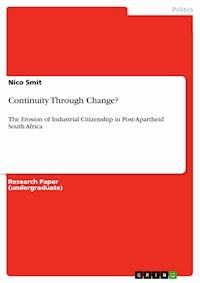
Research Paper (undergraduate) from the year 2010 in the subject Politics - Region: Africa, grade: 70, University of Cape Town (Department of Political Science), course: Third World Politics, language: English, abstract: Any discussion of industrial citizenship in South Africa is one which requires not only a focus on the current labour relations dispensation, but which tracks the development of labour relations in South Africa as it progressed along a winding path, beginning with the import of trade unionism from Britain in the latter stages of the nineteenth century.1 From the outset industrial citizenship was not extended to all workers, with race providing the basis for inclusion and exclusion, and the dual labour relations system was formally crystallized in 1953.2 Under the apartheid regime, labour relations created pattern of inclusion and exclusion on a racial basis which was swept away in 1979 with the state’s acceptance and implementation of the recommendations made by the Wiehahn Commission.3 South Africa’s triple transition has been “accompanied by a process of corporate and workplace restructuring,”4 engendering new patterns of inclusion and exclusion as South Africa has entered a globally integrated economy where exclusion is justified on the grounds of cost reduction and increasing competitiveness.5 This essay aims to make the argument that a large (and growing) portion of the South African workforce has roughly gone full circle in terms of industrial citizenship – where under apartheid they were denied labour rights and access to the industrial relations machinery, they are currently in a situation where the gains won throughout the liberation struggle and cemented in post-apartheid labour legislation are increasingly being eroded as they are shifted to a section of the workforce which finds itself beyond the scope of labour legislation. This paper is divided into four sections, the first providing a discussion of the dualistic labour relations system. The second section discusses the immediate legislative reforms effected in the wake of the 1973 Durban strikes, the establishment of the Wiehahn Commission, its recommendations and the effect thereof on labour relations in South Africa. The third section focuses on the post-apartheid era, and the final section concludes.
Das E-Book können Sie in einer beliebigen App lesen, die das folgende Format unterstützt:
Veröffentlichungsjahr: 2013