


29,99 €
Mehr erfahren.
- Herausgeber: GRIN Verlag
- Sprache: Englisch
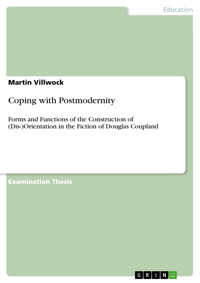
Examination Thesis from the year 2008 in the subject Didactics for the subject English - Pedagogy, Literature Studies, grade: 1,3, University of Cologne (Englisches Seminar), language: English, abstract: In the following chapter of this paper, an outline of the present ontological crisis in terms of Lyotard’s ‘postmodern condition’ will be given. Throughout the discussion of Coupland’s fiction, this concept will be relevant for its influence on the characters’ thoughts and emotions. Furthermore, the chapter will analyze the importance and self-referentiality of narrative structures in Coupland’s work. The characters in Coupland’s novels often come up with a plentitude of more or less successful strategies in order to deal with the semantic void they experience. For this chapter, material will be presented predominantly from the novels All Families are Psychotic, Generation X and Microserfs. The third chapter will focus on the presentation of working life in Coupland’s prose. His novels reveal that work today has lost its former function as a source of orientation. In this analysis, the concept of alienation as introduced by Karl Marx will be used in order to grasp the nature of the conflict that the characters experience in their working lives in Coupland’s novels. The chapter will focus on the presentation of working life in Generation X, Microserfs and Shampoo Planet. A fourth chapter will introduce yet a further source of disorientation – the hyperreality constituted by the media. Here, Baudrillard’s observations (1983 and 1994) will serve as a starting point in a discussion of the experience of the ‘hyperreal’ and the possibility of contact with the ‘real’ in Coupland’s work. Again, material will be presented from the novels Generation X, Microserfs and Shampoo Planet. The subsequent chapter will consider the important role that irony plays in several of the analyzed novels. Douglas Coupland, particularly in his first novels, impresses his readers with a smart and thoroughly ironic tone. In his later novels, however, he is deliberately trying to establish a more sincere language, mirrored by his characters’ desire to embark on a sincere quest for meaning. The functions of the presentation of the different forms of disorientation and re-orientation will be at the center of my discussion of Coupland’s fiction.
Das E-Book können Sie in Legimi-Apps oder einer beliebigen App lesen, die das folgende Format unterstützen:
Veröffentlichungsjahr: 2011
Ähnliche


















Page 1
Coping with Postmodernity:Forms and Functions of the Construction of (Dis-)Orientation in the Fiction of Douglas Coupland
Schriftliche Hausarbeit im Rahmen der ersten Staatsprüfung, dem Landesprüfungsamt für Erste Staatsprüfungen für Lehrämter an
Page 2
1 Introduction
Das Unbehagen in der Postmoderne- the discontents, pains and anxieties typical of the postmodern world - arise from the kind of society which offers ever more individual freedom at the price of ever less security. Postmodern discontents are born of freedom rather than of oppression. (Bauman 1997: 124)In the above quote, Bauman makes an allusion to Freud’sDas Unbehagen in der Kultur.In his influential work, Freud describes how the individual is oppressed by society at the beginning of the 20thcentury. The modern1society asked its members to sacrifice a large part of their individual freedom, their urges, desires and drives, for the best of the community. This led to oppression on the one hand, but a relative stability and security, a sense of orientation for the individual on the other hand.
Bauman suggests that the so-calledpostmodernperiod is experiencing a reverse of this phenomenon. In contemporary society, “individual freedom rules supreme; it is the value by which all other values came to be evaluated” (1997: 3). Freedom of the individual is no longer seen as the major problem for an ordered society, it is a goal that is to be achieved. In the developed Western countries it is apparent that individuals have never before been as free in their choice of beliefs and actions. This relatively large group, the comparatively well-to-do majority of the Western population,2however, is feeling a sense of disorientation. Freedom can be seen as bliss, a pre-condition for happiness, but it can also appear to be a threat.3When freedom is gained, something is lost at the same time. Thus, Bauman claims that “postmodernmen and women exchanged a portion of their possibilities of security for a portion of happiness”(1997: 3, italics in the original). In this sense, too much security has been given away and a lack of it
1As opposed topostmodern.
2Douglas Coupland deliberately chooses characters from this group for all of his novels. His first novel,Generation X,achieves its effect precisely because it takes aim “at concerns close to the heart of middle-class, North-American life, an intention dismissed by contemporary critics obsessed with the appeal of the marginal, the ethic, the oppressed […]” (Lainsbury 1996: 229).
3Hence, Liz Dunn in Coupland’s novelEleanor Rigbyremarks that being in prison is “the opposite of freedom, and, as such, […] almost as liberating” (2004: 182).
Page 3
could threaten the happiness possibly gained from freedom. If themodernsociety allowed for too little freedom to pursue one’s happiness, thepostmodernsociety perhaps provides too little orientation for the individual to achieve happiness.
Freedom in itself is not necessarily problematic. If the individual had a set of values, an idea of the sense of its freedom that it could regard as legitimate, atelos,it would not feel discontents, pains and anxieties as a result of its situation. Human beings need a guideline, a ‘meta-narrative’ to have a sense of orientation in their contingent world. However, the meta-narratives, the ideational frameworks of the pastno matter whether they helped or suppressed individuals then - seem to have lost their legitimation. The modern hope of finding a final truth that will explain the universe has been abandoned. The postmodern unease arises from a life without the certainties that a ‘grand narrative’ might provide. To Lyotard, this situation is what defines the ‘postmodern condition’ (1984: xxiv).
Prior to the postmodern period, structural factors of an individual life, such as the vocation that one pursues or the family one belongs to, generally had an immense influence on the individual. These elements provided orientation and coherence. A crisis of any kind seems to appear more manageable to the individual when it is experienced in a close group such as the family. Apart from the abandonment of the belief of the existence of a universal truth, the postmodern era has seen a fragmentization of society as a whole and the family in particular. Bauman remarks that “the harness by which collectivities tie their members to a joint history, custom, language or schooling is getting more threadbare by the year” (2000: 169). Again, being free from a harness can be seen as positive as well as negative. In the case of the family unit, the question of the necessity of a harness becomes even more controversial. On the whole, it is apparent that there is a “gradual, yet seemingly relentless disintegration […] of the once sacrosanct and imperturbable ‘family nest’” (Bauman 1997: 146). A similar development is taking place in the field of work. In the past, people generally did not changejobsa number of times during the
Page 4
course of their life but rather followed only onevocation.As the termvocationorcallingsuggests, the work that one performs used to have a strong correlation with one’s identity. The fulfilling of one’s calling could constitute the structure of a whole life. Today, it is becoming increasingly difficult to derive a similar structural momentum from one’s profession.4
How do postmodern men and women deal with this complex situation? Which factors contribute to make the individual feel its impact? What effects does the disorientation have on an individual and what can be done to regain orientation? The Canadian author Douglas Coupland in a large number of his fictional writings has made an attempt to address these fundamental issues. Coupland was born in 1961 on a Canadian Air Force Base in Germany. His family moved back to Canada in 1965 where Coupland has lived ever since, leaving Canada only temporarily for studies in Japan and Italy. He has published nine novels which are available in 35 languages and several non-fiction books. Coupland considers himself a visual artist who then turned to prose and drama (Coupland 2008). Coupland has been highly acclaimed for his sharp analyses of contemporary culture. In his books, he “has been exploring the textures and traumas of an era that, superficially at least, appears hostile to conviction, community, connection and continuity” (Tate 2007: 1). Coupland’s fiction is always set in the time period from 1970 to the present. This focus on contemporary life makes Coupland’s discussion of the postmodern condition less abstract and emphasizes its everyday effects on inhabitants of the Western world. What Linus, a character inGirlfriend in A Coma,remarks about himself and his group of friends seems to hold true for most of the characters Coupland creates in his novels: “We really don’t seem to have any values, any absolutes. We’ve maneuvered our values to suit our immediate purposes. There’s nothing large in our lives” (Girlfriend:
4In addition to recent problematic developments in the field of work, a number of the factors that lead to what Marx calledalienationstill persist and have possibly increased. For a closer analysis, see Barry Padgett’sMarx and Alienation in Contemporary Societyand chapter 3 of this paper.
Page 5
255). Lost between an aggressive, banal consumerism and the lack of a valid alternative narrative, jaded by media saturation, the characters are on a quest for meaning and reality. It has been argued by Katerberg that, whereas the classic frontier character sought liberation from an oppressive society, “the characters in Coupland’s stories seek liberation from their rootless individuality. They search for communities and connections to something larger than themselves” (2005: 287). Coupland does not only display the distress of postmodern life for the individual, but his writings also present the characters’ endeavors to orient themselves without the help of a single valid meta-narrative. It is the aim of this paper to show how Coupland constructs his characters’ disorientation as a particularly postmodern phenomenon. This paper will present the different levels on which disorientation arises, as well as the various strategies the characters employ to cope with their precarious situation. A number of essays have been published on Coupland’s work;5a recently published monograph (Tate 2007) presents a first full-scale analysis of his fiction. This paper will discuss the construction of postmodern disorientation in Coupland’s novels, a central aspect that has not yet been analyzed explicitly. The analysis will include material from all novels; however, depending on the focus of the respective chapter, examples will be given only from selected novels.
In the following chapter of this paper, an outline of the present ontological crisis in terms of Lyotard’s ‘postmodern condition’ will be given. Throughout the discussion of Coupland’s fiction, this concept will be relevant for its influence on the characters’ thoughts and emotions. Furthermore, the chapter will analyze the importance and selfreferentiality of narrative structures in Coupland’s work. The characters in Coupland’s novels often come up with a plentitude of more or less successful strategies in order to deal with the semantic void they experience. For this chapter, material will be presented predominantly from the novelsAll Families are Psychotic, Generation XandMicroserfs.
5See for example Katerberg 2005, Lainsbury 1996 and Tate 2002.
Page 6
The third chapter will focus on the presentation of working life in Coupland’s prose. His novels reveal that work today has lost its former function as a source of orientation. In this analysis, the concept of alienation as introduced by Karl Marx will be used in order to grasp the nature of the conflict that the characters experience in their working lives in Coupland’s novels. The chapter will focus on the presentation of working life inGeneration X, MicroserfsandShampoo Planet.A fourth chapter will introduce yet a further source of disorientation - the hyperreality constituted by the media. Here, Baudrillard’s observations (1983 and 1994) will serve as a starting point in a discussion of the experience of the ‘hyperreal’ and the possibility of contact with the ‘real’ in Coupland’s work. Again, material will be presented from the novelsGeneration X, MicroserfsandShampoo Planet.The subsequent chapter will consider the important role that irony plays in several of the analyzed novels. Douglas Coupland, particularly in his first novels, impresses his readers with a smart and thoroughly ironic tone. In his later novels, however, he is deliberately trying to establish a more sincere language, mirrored by his characters’ desire to embark on a sincere quest for meaning. The functions of the presentation of the different forms of disorientation and re-orientation will be at the center of my discussion of Coupland’s fiction.
2 Postmodern Life as De-Narration
In order to asses to what extent the crises and struggles, the disorientation of the characters in Coupland’s books can be described as a result of the ‘postmodern condition’, a more exact definition of this term is necessary. As is symptomatic for postmodern culture, it would be exceedingly difficult to give a universally accepted account of the concept of the postmodern.6Moreover, there is not even an agreement of whether the term ‘postmodernity’ in itself is adequate to describe the epoch from roughly the 1960s up to the present. For example, it has
6As Docherty remarks in his introduction to hisPostmodernism: A Reader:“The term hovers uncertainly in most current writings between - on the one hand - extremely complex and difficult philosophical senses, and - on the other - an extremely simplistic mediation as a nihilistic, cynical tendency in contemporary culture” (1993: 1).




