


1,99 €
Mehr erfahren.
- Herausgeber: Maria Peitcheva
- Kategorie: Geisteswissenschaft
- Sprache: Englisch
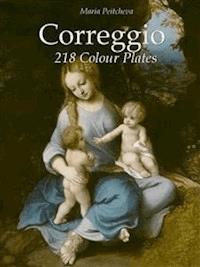
Antonio Allegri da Correggio was the foremost painter of the Parma school of the Italian Renaissance, who was responsible for some of the most forceful and sensuous works of the 16th century. In his use of dynamic composition, perspective and dramatic foreshortening, Correggio prefigured the Rococo art of the 18th century. He had little immediate influence in terms of apprenticed successors, but his works are now considered to have been revolutionary and influential on subsequent artists. A half-century after his death Correggio's work was well known to Vasari. In the 18th and 19th centuries, his works were often noted in the diaries of foreign visitors to Italy, which led to a re-evaluation of his art during the period of Romanticism. Corregio had no direct disciples outside of Parma, where he was influential on the work of Giovanni Maria Francesco Rondani, Parmigianino, Bernardo Gatti, Francesco Madonnina, and Giorgio Gandini del Grano.
Das E-Book können Sie in Legimi-Apps oder einer beliebigen App lesen, die das folgende Format unterstützen:
Veröffentlichungsjahr: 2016
Ähnliche
Correggio
218 Colour Plates
By Maria Peitcheva
First Edition
*****
Correggio: 218 Colour Plates
*****
Copyright © 2016 by Maria Peitcheva
Foreword
Antonio Allegri da Correggio (1489 –1534), known as Correggio, was the foremost painter of the Parma school of the Italian Renaissance, who was responsible for some of the most forceful and sensuous works of the 16th century. In his use of dynamic composition, perspective and dramatic foreshortening, Correggio prefigured the Rococo art of the 18th century.
He was born in Correggio, Italy, a small town near Reggio Emilia. His father was a merchant. Otherwise little is known about Correggio's early life or training. It is, however, often assumed that he had his first artistic education from his father's brother, the painter Lorenzo Allegri.
In 1503-5 he was apprenticed to Francesco Bianchi Ferrara in Modena, where he probably became familiar with the classicism of artists like Lorenzo Costa and Francesco Francia, evidence of which can be found in his first works. After a trip to Mantua in 1506, he returned to Correggio, where he stayed until 1510. To this period is assigned the Adoration of the Child with St. Elizabeth and John, which shows clear influences from Costa and Mantegna. In 1514 he probably finished three tondos for the entrance of the church of Sant'Andrea in Mantua, and then returned to Correggio, where, as an independent and increasingly renowned artist, he signed a contract for the Madonna altarpiece in the local monastery of St. Francis.
Correggio was remembered by his contemporaries as a shadowy, melancholic and introverted character. An enigmatic and eclectic artist, he appears to have emerged from no major apprenticeship. In addition to the influence of Costa, there are echoes of Mantegna's style in his work, and a response to Leonardo da Vinci, as well. Correggio had little immediate influence in terms of apprenticed successors, but his works are now considered to have been revolutionary and influential on subsequent artists. A half-century after his death Correggio's work was well known to Vasari, who felt that he had not had enough "Roman" exposure to make him a better painter. In the 18th and 19th centuries, his works were often noted in the diaries of foreign visitors to Italy, which led to a re-evaluation of his art during the period of Romanticism. The flight of the Madonna in the vault of the cupola of the Cathedral of Parma inspired many decorations in lay and religious palaces during those centuries.
Corregio's experiments, in which imaginary spaces replace the natural reality, seem to prefigure many elements of Mannerist and Baroque stylistic approaches. He appears to have fostered artistic grandchildren, for example, Giovannino di Pomponio Allegri (1521-1593).Corregio had no direct disciples outside of Parma, where he was influential on the work of Giovanni Maria Francesco Rondani, Parmigianino, Bernardo Gatti, Francesco Madonnina, and Giorgio Gandini del Grano.
Lesen Sie weiter in der vollständigen Ausgabe!
Lesen Sie weiter in der vollständigen Ausgabe!




