


1,99 €
Niedrigster Preis in 30 Tagen: 1,99 €
Niedrigster Preis in 30 Tagen: 1,99 €
Mehr erfahren.
- Herausgeber: Booksell-Verlag
- Kategorie: Bildung
- Sprache: Englisch
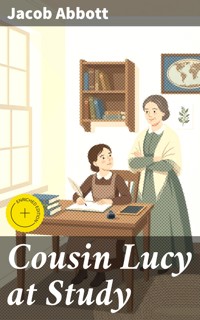
In "Cousin Lucy at Study," Jacob Abbott crafts an engaging narrative that blends educational themes with the delightful adventures of childhood. Set against the backdrop of an idyllic yet intellectually stimulating environment, the story follows Lucy as she navigates her studies and the complexities of familial relationships. Abbott'Äôs literary style is characterized by accessible prose and lively dialogue, making it suitable for young readers while gently instilling the values of diligence and curiosity in the pursuit of knowledge. Jacob Abbott, a prominent figure in 19th-century American literature, was dedicated to creating didactic works for children that prioritized moral and intellectual development. His extensive background in teaching and profound understanding of child psychology informed his writing process, leading him to construct relatable characters like Lucy, who embodies the struggles and triumphs of academic life. Abbott'Äôs intent to inspire young minds was rooted in the belief that literature could serve as both an educational tool and a source of enjoyment. I highly recommend "Cousin Lucy at Study" to parents and educators seeking a charming yet instructive book for their children. Through Lucy'Äôs experiences, readers will not only be entertained but also encouraged to embrace learning with enthusiasm and resilience. In this enriched edition, we have carefully created added value for your reading experience: - A succinct Introduction situates the work's timeless appeal and themes. - The Synopsis outlines the central plot, highlighting key developments without spoiling critical twists. - A detailed Historical Context immerses you in the era's events and influences that shaped the writing. - A thorough Analysis dissects symbols, motifs, and character arcs to unearth underlying meanings. - Reflection questions prompt you to engage personally with the work's messages, connecting them to modern life. - Hand‐picked Memorable Quotes shine a spotlight on moments of literary brilliance. - Interactive footnotes clarify unusual references, historical allusions, and archaic phrases for an effortless, more informed read.
Das E-Book können Sie in Legimi-Apps oder einer beliebigen App lesen, die das folgende Format unterstützen:
Veröffentlichungsjahr: 2022
Ähnliche
![Rollo's Philosophy. [Air] - Jacob Abbott - E-Book](https://legimifiles.blob.core.windows.net/images/e4d572daebda1da11211356848c48438/w200_u90.jpg)














Cousin Lucy at Study
Table of Contents
Introduction
Learning is rarely just the accumulation of facts; it is a test of character, attention, and the habits that shape a young life.
Cousin Lucy at Study is a short, didactic children’s story by Jacob Abbott, a nineteenth-century American writer known for moral and educational tales written for young readers. The book belongs to the tradition of domestic juvenile fiction that links everyday family scenes with instruction, placing lessons about conduct and self-government inside familiar routines. Its world is intentionally small and recognizable, built from household spaces, kinship ties, and the ordinary demands of schooling. Abbott’s approach reflects an era when stories for children commonly aimed to guide manners, discipline, and conscience as explicitly as they entertained.
The premise centers on a child named Lucy, introduced in the context of study and the expectations that surround it. Rather than relying on adventure or external danger, the narrative focuses on the inward difficulties of concentrating, persisting, and responding well to correction. The action unfolds through small incidents that illuminate how a child thinks and feels while trying to learn. Readers are invited to observe Lucy’s choices and their immediate consequences, not as sensational turns, but as moments that reveal what it means to take responsibility for one’s work and one’s temper.
Abbott’s narrative voice is calm, explanatory, and close to the reader, often pausing to clarify motives or draw out the lesson implicit in a scene. The style favors plain diction and clear cause-and-effect, making the reading experience swift and accessible while still attentive to the moral weight of minor decisions. The tone is earnest and guiding rather than ironic, aiming to persuade through gentle reasoning and example. Even when the book depicts frustration or missteps, it typically maintains a controlled, instructive atmosphere that assumes improvement is possible through reflection and practice.
At its core, the book explores the formation of habits: diligence, patience, honesty in acknowledging one’s errors, and respect for the time and efforts of others. It also examines the relationship between external guidance and internal self-control, showing how adults’ expectations intersect with a child’s developing independence. Education appears not only as schooling but as a moral process in which attention, perseverance, and humility become virtues. Underneath the immediate question of how to study lies a broader inquiry into how character is shaped in the ordinary, repeated moments of daily life.
The book still matters because its central concerns mirror enduring challenges in childhood learning, even when modern classrooms and technologies look very different. Contemporary readers will recognize the pressures of performance, the temptations of distraction, and the emotional swings that accompany difficult tasks. Abbott’s emphasis on steady effort and the incremental building of self-discipline speaks to current conversations about executive function, resilience, and the social dimensions of learning. While its moral framework reflects its time, its focus on practical self-management remains intelligible and relevant.
For today’s readers, Cousin Lucy at Study can be approached both as a story and as a historical artifact of children’s literature shaped by educational purpose. It offers a compact portrait of how a previous century imagined childhood, instruction, and the household as a training ground for citizenship and virtue. Read with attentiveness, it provides an opportunity to compare past and present assumptions about motivation, authority, and the aims of schooling. Its lasting value lies in the clarity with which it treats study as a human struggle, one that begins early and continues in new forms throughout life.
Synopsis
Cousin Lucy at Study is a short, didactic children’s book by Jacob Abbott, an American author known for moral and instructional stories written for young readers in the nineteenth century. The narrative centers on Lucy, a girl whose daily life is shaped by lessons about learning, conduct, and the practical habits that support steady progress. Rather than presenting a single dramatic adventure, the book follows ordinary moments and conversations that turn into guidance on how a child might approach study. The tone remains domestic and instructional, emphasizing gradual improvement over sudden change.
paragraphs.1
Lucy’s situation is framed through family interaction, where adults and older companions provide examples and gentle correction. Study is treated not as an abstract duty but as a set of choices made in the home: when to begin, how to persist, and how to respond to distractions. The story foregrounds the small conflicts that arise from childish reluctance, wandering attention, or impatience with difficult tasks. Lucy’s character is shown in action as she reacts to advice, tests her own resolutions, and learns how behavior and outcomes connect in everyday routines.
paragraphs.2
As the episodes unfold, Abbott uses Lucy’s experiences to explore what it means to learn effectively and responsibly. The book presents study as a moral practice as well as an intellectual one, linking diligence to honesty about one’s work and fairness toward others who share time and space. Lucy is encouraged to think about the reasons behind rules rather than following them mechanically, and to notice how order and preparation reduce frustration. The narrative remains focused on methods and attitudes—attention, perseverance, and self-command—rather than on academic content.
paragraphs.3
A continuing source of tension comes from the gap between good intentions and consistent performance. Lucy’s efforts are periodically complicated by attractive alternatives to study, by the temptation to cut corners, or by the desire for immediate comfort instead of delayed reward. Abbott stages these problems in ways that are recognizable to children, then traces how adults guide Lucy to reflect on consequences without harshness. The book’s movement is incremental: each scene adds a small clarification about what makes study easier or harder and why a child might choose better habits over time.
Historical Context
Jacob Abbott’s Cousin Lucy at Study appeared in the United States during the 1840s, when inexpensive children’s books and periodicals expanded rapidly alongside rising literacy. Abbott, a New England author and educator, wrote for middle-class families shaped by Protestant moral instruction and a strong print culture. His “Rollo Books” and related series were marketed through urban publishers and circulating libraries, bringing didactic fiction into many homes. The story’s everyday domestic setting and emphasis on ordered habits reflect a society that increasingly treated childhood as a distinct stage requiring purposeful training.
paragraphs
In the early nineteenth century, New England and the Mid-Atlantic states built a dense network of common schools, academies, and Sunday schools. Massachusetts, Abbott’s home state, enacted major public-school reforms in the late 1830s under Horace Mann, promoting trained teachers, graded instruction, and standardized materials. Textbooks, primers, and juvenile narratives became tools for shaping conduct as well as teaching reading. Cousin Lucy at Study fits this institutional landscape by presenting study routines and classroom-like expectations within family life, echoing the era’s belief that education advanced both individual character and civic stability.
paragraphs
Female education was also changing. While most colleges remained male-only, girls’ academies and seminaries expanded from the 1820s through the 1840s, influenced by educators such as Emma Willard and Mary Lyon. These institutions promoted rigorous study for young women, often framed as preparation for teaching and for moral leadership in the home. Abbott’s young female characters and the attention to conscientious learning correspond to this wider movement, in which disciplined study was encouraged as compatible with femininity and piety rather than a challenge to social norms.
paragraphs
Abbott wrote in the intellectual climate of the Second Great Awakening, a powerful wave of Protestant revival that intensified from the 1790s through the 1830s and continued to shape culture afterward. Evangelical organizations promoted Bible reading, temperance, and missionary work, and they produced a vast literature for youth. Children’s books commonly used everyday incidents to illustrate conscience, self-control, and responsibility. The moral tone of Cousin Lucy at Study aligns with this tradition, using familiar domestic scenes to reinforce virtues that evangelical reformers considered foundational to personal salvation and social order.
paragraphs,
Cousin Lucy at Study
PREFACE.
Two volumes of a series of little books, corresponding, in their general style and characteristics, with the Rollo Books for boys, but designed more particularly for the other sex, have already been published, under the names of Cousin Lucy’s Conversations, and Cousin Lucy’s Stories. This, and its companion, Cousin Lucy at Play, are now offered to the public, in the hope that the little readers, into whose hands they may fall, may be interested, and, in some degree at least, profited, by the perusal of them.




