


0,49 €
Mehr erfahren.
- Herausgeber: e-artnow Collections
- Kategorie: Gesellschafts- und Liebesromane
- Sprache: Englisch
Crime & Conscience – 3 Classic Russian Fiction Novels brings together masterpieces that delve into the nuances of morality, redemption, and the human psyche. This anthology presents a rich tapestry of existential dilemmas captured through a range of styles—from Dostoevsky's psychological probing to Tolstoy's sweeping narratives. The works in this collection are tied together by their exploration of timeless themes, utilizing diverse literary techniques that have shaped the canon of Russian literature. Each novel challenges the boundaries between crime, justice, and inner conflict, offering a profound investigation into what it means to be human. Within the pages of this anthology, the significant contributions of Fyodor Dostoevsky and Leo Tolstoy are on full display. Their explorations into the philosophical and ethical capacities of the individual align with the 19th-century Russian literary movement, characterized by its commitment to psychological and moral inquiry. This collection benefits from the depth and breadth of these literary giants, whose works have not only captured the spirit of their time but have spoken to subsequent generations about the complexities of conscience and societal norms. Crime & Conscience offers readers an invaluable glimpse into the minds of two of Russia's greatest novelists. This anthology is an enriching journey through a multitude of literary perspectives, inviting readers to immerse themselves in the contemplation of ethical dilemmas and the human condition. Perfect for scholars, students, and enthusiasts of classical literature, the collection serves as an educational tool and a foundation for meaningful discussions on the dualities present in everyday life and literature alike. In this enriched edition, we have carefully created added value for your reading experience: - An Introduction draws the threads together, discussing why these diverse authors and texts belong in one collection. - Historical Context explores the cultural and intellectual currents that shaped these works, offering insight into the shared (or contrasting) eras that influenced each writer. - A collective Analysis highlights common themes, stylistic variations, and significant crossovers in tone and technique, tying together writers from different backgrounds. - Reflection questions encourage readers to compare the different voices and perspectives within the collection, fostering a richer understanding of the overarching conversation.
Das E-Book können Sie in Legimi-Apps oder einer beliebigen App lesen, die das folgende Format unterstützen:
Veröffentlichungsjahr: 2026
Ähnliche







Crime & Conscience – 3 Classic Russian Fiction Novels
Table of Contents
Introduction
Curatorial Vision
This collection brings together Crime and Punishment, Notes from Underground, and The Death of Ivan Ilych to frame a sustained inquiry into moral consciousness under pressure. Read side by side, these works reveal how Russian fiction made inward life a decisive arena of drama, judgment, and self-deception. Fyodor Dostoevsky and Leo Tolstoy approach conscience through different narrative scales, yet both treat ethical experience as inseparable from ordinary habits, social expectations, and private speech. The guiding aim of the collection is to illuminate a shared terrain where guilt, rationalization, suffering, and the search for truthful self-knowledge become the central subjects of literary art.
The selection traces an arc from rebellion and alienation to accountability and mortality. Notes from Underground offers a compressed, combative voice that turns consciousness into a chamber of contradiction. Crime and Punishment expands those tensions into a larger moral and social field, showing thought tested by action and consequence. The Death of Ivan Ilych shifts the emphasis toward the approaching end of life, where accepted standards of success are measured against an inner reckoning. Together, the three works map a progression in which intellect, feeling, and ethical awareness are forced into confrontation with what can no longer be evaded.
Presented together, these texts define crime in a wider sense than legal violation and conscience in a wider sense than simple remorse. Each work studies forms of estrangement from others and from the self, asking how individuals justify injury, evade sympathy, or cling to false ideas of freedom and dignity. The collection therefore highlights not only transgression but also the inner languages that defend it. By uniting a philosophical confession, a psychological novel, and a concentrated meditation on dying, it emphasizes the range of forms through which Russian fiction investigated the burdens of moral freedom.
The distinctiveness of this gathering lies in its deliberate juxtaposition of two Dostoevsky works with Tolstoy’s shorter masterpiece, allowing readers to perceive a concentrated conversation rather than encounter each title in isolation. The collection does not merely assemble celebrated works; it organizes them around a coherent problem: how human beings live with consciousness once it becomes acute enough to expose vanity, cruelty, fear, and longing for redemption. In that framework, the books clarify one another. Dostoevsky’s fevered interiority and Tolstoy’s severe lucidity emerge as contrasting but related methods for examining the claims of truth upon a human life.
Thematic & Aesthetic Interplay
These works speak to one another through recurring scenes of inward division. In each, consciousness is both instrument and affliction: it sharpens perception while intensifying paralysis, pride, and shame. Notes from Underground presents thought as incessant self-argument, a voice trapped in its own negations. Crime and Punishment transforms similar instability into a wider drama of motive, punishment, and moral exposure. The Death of Ivan Ilych narrows the focus into relentless clarity, showing how social routine and personal denial can conceal spiritual crisis until suffering strips them away. Across all three, self-awareness is never merely reflective; it is active, punitive, and ethically consequential.
Several motifs echo insistently across the collection: isolation in crowded social worlds, the inadequacy of respectable language, the body as a site of truth, and suffering as an unwelcome teacher. Rooms, interiors, and confined spaces often mirror mental enclosure, while conversation repeatedly fails to secure genuine contact. The characters’ speech tends to reveal disguise as much as disclosure, exposing the gap between public decorum and inward reality. Even when the settings and situations differ, each work returns to the problem of what remains when customary explanations collapse. Conscience appears not as stable certainty but as a painful pressure that breaks through evasion.
The tonal contrasts among the texts generate much of their force as a set. Notes from Underground is abrasive, ironic, and deliberately unstable, refusing the consolations of coherence. Crime and Punishment is broader and more dramatic, bringing moral argument into collision with social circumstance and intense emotional experience. The Death of Ivan Ilych is cooler in surface manner yet devastating in effect, attaining severity through compression and restraint. These differences in tone and scale create a productive dialogue. What one work stages through defiant monologue, another explores through sustained narrative movement, and the third judges through a nearly clinical concentration on mortality and truth.
The relation between Dostoevsky and Tolstoy here is not one of sameness but of strong contrast around common moral concerns. Dostoevsky presses toward extremity, contradiction, and the exposed nerve of consciousness, while Tolstoy often reaches moral illumination through simplification and the stripping away of convention. Yet both insist that inward life cannot be separated from ethical reality. The Death of Ivan Ilych can be read beside Crime and Punishment as a distinct answer to the question of what suffering reveals, and beside Notes from Underground as a corrective to self-enclosed consciousness. Their juxtaposition sharpens affinities without erasing deep differences.
Subtle lines of influence and resonance are most visible at the level of shared problems rather than direct borrowing. Dostoevsky’s probing of divided motive and Tolstoy’s scrutiny of socially sanctioned illusion belong to the same broad cultural struggle over reason, ego, responsibility, and authentic living. Notes from Underground anticipates later forms of antiheroic inward narration that make moral discomfort central to style itself. Crime and Punishment extends that inwardness into a fuller social and ethical design. The Death of Ivan Ilych answers with a grave concentration on dying that throws every prior self-justification into question, making mortality the final critic of bad faith.
Enduring Impact & Critical Reception
The continued vitality of these works rests on their refusal to treat moral life as abstract doctrine. They remain compelling because they show conscience operating amid ambition, resentment, vanity, illness, loneliness, and fear. Modern readers recognize in them a world where intelligence can become rationalization, social success can mask emptiness, and inward freedom can be confused with isolation from others. Such concerns have not diminished. If anything, the pressure of self-consciousness in modern culture has made these books newly legible. They speak across time because they dramatize forms of evasion and reckoning that remain fundamental to personal and collective life.
Their standing in literary culture has long been secure, but their importance extends beyond canon formation. Crime and Punishment and Notes from Underground have been central to discussions of psychological fiction, moral philosophy, and the literature of alienation. The Death of Ivan Ilych has become one of the most widely invoked meditations on dying, false values, and the stripping away of social pretense. Together they have shaped conversations in classrooms, public debate, and artistic practice. Their language of guilt, estrangement, and final reckoning has furnished enduring terms for thinking about modern subjectivity and the costs of self-deception.
These books have also generated broad cultural afterlives in performance, visual storytelling, and intellectual discourse. Their situations and moral patterns recur in adaptations and echoes that return repeatedly to crime, confession, inner fracture, and the exposure of empty success. Notes from Underground has been especially influential as a precursor to later portraits of embittered inwardness, while Crime and Punishment remains a touchstone for narratives of transgression and remorse. The Death of Ivan Ilych continues to inform reflections on mortality and humane care. Across media and disciplines, they persist because they illuminate experiences that societies continually rename but never outgrow.
As a collection, these works renew one another’s force. Read together, they demonstrate that Russian fiction at its height did not separate psychological depth from ethical seriousness or social observation from spiritual crisis. The result is not a single doctrine but a disciplined confrontation with hard truths about consciousness and human conduct. Dostoevsky and Tolstoy differ profoundly in method, yet each compels attention to what ordinary life often obscures: that the self is divided, that suffering can reveal hidden values, and that conscience remains inescapable. This collection endures because it gathers three distinct forms of that insight into one sustained and memorable encounter.
Historical Context
Socio-Political Landscape
The three works in this anthology emerged from the unsettled atmosphere of nineteenth-century imperial Russia, a society governed by autocratic power yet increasingly pressured by demands for reform. The tsarist state maintained strict control through censorship, bureaucracy, policing, and a hierarchical social order that placed nobles, officials, students, servants, and laborers in visibly unequal relation. Such conditions form the background against which private conscience becomes a public question in these books. Individual decisions are never merely personal; they unfold within a world shaped by law, rank, poverty, patronage, and institutional authority. The moral drama of the self is thus inseparable from the structures of Russian state and society.
A decisive historical shock behind these texts was the crisis revealed by the Crimean War, which exposed the administrative weakness and technological backwardness of the empire. In the war’s aftermath, educated Russians confronted painful questions about national direction, justice, and modernization. That climate of humiliation and urgency intensified debates about whether Russia should imitate Western Europe, pursue distinct paths, or renovate itself through moral and social transformation. Crime and Punishment and Notes from Underground belong to a generation writing in the wake of that crisis, while The Death of Ivan Ilych reflects a later period in which reform had advanced but spiritual dissatisfaction remained acute.
The emancipation of the serfs in 1861 was the most consequential reform of the era and deeply altered the moral and social vocabulary available to writers. Although liberation promised a new social order, it also generated disappointment, legal complications, new economic pressures, and unstable relations between classes. Urban migration increased, provincial life shifted, and old forms of paternal authority weakened without disappearing. These changes are not treated as simple progress in the anthology. Instead, they sharpen anxieties about responsibility, dignity, and social fracture. The books register a society where formal reform has occurred, yet inner freedom, justice, and meaningful human solidarity remain painfully unresolved.
The growth of the modern city was especially important for Crime and Punishment and Notes from Underground. St. Petersburg, the imperial capital, embodied bureaucratic ambition, social masquerade, and acute inequality. Crowded lodgings, taverns, offices, streets, bridges, and rented rooms formed an environment where anonymity could coexist with surveillance and where deprivation stood beside official grandeur. The city was not merely a setting but a historical product of state-directed modernization, drawing in students, clerks, and the impoverished educated classes. In such surroundings, abstract ideas acquire dangerous immediacy. Psychological strain, humiliation, and fantasies of exceptional action reflect the pressures of a rapidly changing urban order.
The expanding bureaucracy of the empire provides essential context for The Death of Ivan Ilych. The nineteenth-century state increasingly organized life through legal institutions, courts, careers, titles, and routines of advancement. Reforms in administration and law created professional pathways and promised impersonal fairness, yet they also encouraged conformity, ambition, and dependence on official recognition. Tolstoy’s novella probes the emotional and spiritual cost of a world in which success is measured by decorum and promotion. The state’s rationalizing machinery appears not as a grand political abstraction but as a system shaping manners, domestic life, and the very language through which people judge what counts as a proper existence.
Public debate in the 1860s and 1870s was marked by intense arguments over radicalism, social utility, atheism, and the legitimacy of inherited institutions. Students, journalists, and educated readers argued about whether society should be rebuilt on reason, self-interest, and collective benefit or grounded in moral and spiritual traditions. Notes from Underground directly enters this polemical field by resisting schemes that reduce human beings to predictable units of progress. Crime and Punishment likewise responds to climates of ideological extremity in which theories of superiority or historical necessity could tempt individuals toward transgression. These works treat ideas not as abstractions alone but as forces capable of entering daily conduct.
By the time The Death of Ivan Ilych appeared in the 1880s, the reform era’s optimism had dimmed. Political repression had intensified after revolutionary violence, and confidence in steady moral improvement through institutions alone had weakened. The state remained powerful, yet many educated Russians sensed a widening gap between official order and authentic life. Tolstoy’s focus on illness, mortality, family habits, and social falseness belongs to this atmosphere of disillusionment. The novella does not stage overt political conflict, but its critique of respectable existence gains force from a society in which legal and professional normality no longer guaranteed ethical meaning. Private crisis becomes a diagnosis of an era.
Across all three works, the fundamental socio-political issue is how a person formed by empire, inequality, and reform-era instability can answer to conscience. Autocracy creates distance between rulers and subjects; bureaucracy translates life into procedure; the city converts neighbors into strangers; and new ideologies challenge old moral vocabularies. Yet the anthology repeatedly refuses to locate guilt or redemption entirely in systems. Historical circumstances press upon the individual, but they do not abolish inward struggle. This balance helps explain the enduring power of these texts: they arise from concrete Russian conditions while asking how responsibility survives amid institutions that encourage self-justification, passivity, vanity, or despair.
Intellectual & Aesthetic Currents
The intellectual world surrounding these books was crowded with competing programs for understanding human nature. Rationalism, materialism, utilitarian ethics, and secular optimism promised that social problems could be solved through enlightened calculation and improved institutions. Against such confidence stood religious moral inquiry, skepticism about progress, and a heightened interest in irrational motives, suffering, and freedom. Notes from Underground is a defining intervention in this climate, challenging the belief that human beings naturally seek what is reasonable or beneficial. Crime and Punishment takes up similar tensions through the collision between theory and conscience, while The Death of Ivan Ilych questions whether respectable modern life can answer the deepest existential facts.
The era also saw fierce disputes over realism and the purpose of literature. Russian prose was expected not merely to entertain but to diagnose society, test moral ideas, and represent the texture of ordinary life with unprecedented seriousness. These works participate in realism while stretching its methods. Crime and Punishment joins concrete urban detail to extreme psychological intensity; Notes from Underground compresses social observation into a confessional and argumentative voice; The Death of Ivan Ilych applies lucid realism to domestic routine, illness, and spiritual awakening. Their shared achievement lies in showing that realism could portray not only external conditions but also fractured self-consciousness and inward moral conflict.
A central aesthetic development of the period was the rise of psychological depth as a principal literary aim. Rather than presenting character as stable essence, these works depict consciousness as divided, self-deceiving, reactive, and historically conditioned. Dostoevsky’s two contributions are especially important in tracing contradiction within the self: resentment, pride, pity, rationalization, and longing coexist rather than resolve neatly. Tolstoy, by contrast, often works through precise observation of social habits and bodily experience to expose hidden falsity. Together, the books reveal a broader nineteenth-century turn toward interiority, one shaped by modern urban pressure, new ideological conflicts, and an intensified conviction that the soul had become a crucial historical battlefield.
Scientific and technological change formed part of the intellectual background, even where the texts do not foreground machines or laboratories. Advances in medicine, statistics, transportation, and administrative record-keeping encouraged a vision of society as measurable and manageable. Such developments often fed confidence that human behavior could be predicted or normalized. Notes from Underground responds sharply to that mentality, rejecting any model that treats the person as a calculable mechanism. The Death of Ivan Ilych engages a related problem through the language of diagnosis and professional expertise, showing that technical knowledge may fail to address spiritual terror. Crime and Punishment likewise questions whether analytical intelligence alone can master moral reality.
The philosophical tensions in the anthology include freedom versus determinism, conscience versus utility, and authentic feeling versus social performance. In Notes from Underground, wounded self-awareness becomes an argument against systems that promise happiness by eliminating contradiction. Crime and Punishment places moral exceptionalism and abstract reasoning under pressure from suffering, compassion, and the need for confession. The Death of Ivan Ilych turns from ideological debate to the existential poverty of a life arranged by convention. Though different in style, all three texts ask whether truth is discovered through rational control, social success, or painful inner reckoning. Their answers reflect a culture deeply divided over the sources of meaning.
Religious thought remained a living force in Russian intellectual life, even among circles captivated by secular theories. The anthology reflects that persistence without reducing itself to doctrinal statement. Crime and Punishment and The Death of Ivan Ilych both treat suffering, repentance, and moral renewal in ways inseparable from a Christian moral horizon, though each does so through distinct artistic means. Notes from Underground, more abrasive and destabilizing, still gains much of its force from the absence or refusal of reconciliations that religious language traditionally supplied. In this sense, the three works belong to a period when faith, doubt, and moral psychology were entangled rather than cleanly separated domains.
A final intellectual current linking the collection is the contest between public discourse and private speech. Journalism, criticism, reform proposals, and ideological slogans shaped educated conversation in the Russian empire. These works answer that discursive world by dramatizing voices under pressure: the self speaking to itself, to imagined judges, or through the empty formulas of social respectability. Notes from Underground is especially attuned to polemical rhetoric, while Crime and Punishment stages the psychological afterlife of theory. The Death of Ivan Ilych strips away the consoling phrases of polite society. In each case, style itself becomes historical evidence, revealing how language can conceal, distort, or suddenly disclose moral truth.
Legacy & Reassessment Across Time
The later history of Russia transformed how these works were read. After the revolutionary movements of the late nineteenth century and the upheavals of 1905 and 1917, readers increasingly treated Crime and Punishment and Notes from Underground as prophetic studies of ideas turning into social violence or alienation. The Death of Ivan Ilych, meanwhile, came to seem not only a moral tale of mortality but also a critique of institutions and habits that survive political change. As regimes rose and fell, the books remained intelligible because they addressed enduring structures of self-deception, suffering, and moral choice that no single historical system could exhaust.
During the Soviet period, interpretations were often shaped by official expectations about class, social utility, and the historical role of literature. Yet these works resisted confinement within any simple ideological scheme. Crime and Punishment could be discussed in relation to poverty and urban inequality, but its deepest concerns exceeded social explanation. Notes from Underground proved especially troublesome for collectivist narratives because it insists on irreducible inward resistance, even when that resistance is self-destructive. The Death of Ivan Ilych could be admired for exposing bourgeois emptiness, yet its spiritual seriousness complicated reductive readings. Their survival through changing orthodoxies helped secure their status as texts larger than the systems that appropriated them.
In the twentieth and twenty-first centuries, scholars and artists repeatedly returned to these works through new frameworks: existentialism, psychoanalysis, narrative theory, theology, medical humanities, urban studies, and ethics. Notes from Underground became central to accounts of modern alienation and anti-utopian thought. Crime and Punishment was reread as a study of fractured subjectivity, social precarity, and the limits of rational moral systems. The Death of Ivan Ilych gained fresh relevance in discussions of dying, professional detachment, and the meanings of care. Stage and screen adaptations further broadened their reach, though no adaptation settled interpretation. Their legacy lies in continual renewal through historical change rather than fixed consensus.
Crime & Conscience – 3 Classic Russian Fiction Novels
Conscience, Guilt, and Moral Reckoning
Alienation, Society, and the Search for Meaning
Fyodor Dostoevsky
Crime and Punishment
TRANSLATOR’S PREFACE
A few words about Dostoevsky himself may help the English reader to understand his work.
Dostoevsky was the son of a doctor. His parents were very hard-working and deeply religious people, but so poor that they lived with their five children in only two rooms. The father and mother spent their evenings in reading aloud to their children, generally from books of a serious character.
Though always sickly and delicate Dostoevsky came out third in the final examination of the Petersburg school of Engineering. There he had already begun his first work, “Poor Folk.”
This story was published by the poet Nekrassov in his review and was received with acclamations. The shy, unknown youth found himself instantly something of a celebrity. A brilliant and successful career seemed to open before him, but those hopes were soon dashed. In 1849 he was arrested.
Though neither by temperament nor conviction a revolutionist, Dostoevsky was one of a little group of young men who met together to read Fourier and Proudhon. He was accused of “taking part in conversations against the censorship, of reading a letter from Byelinsky to Gogol, and of knowing of the intention to set up a printing press.” Under Nicholas I. (that “stern and just man,” as Maurice Baring calls him) this was enough, and he was condemned to death. After eight months’ imprisonment he was with twenty-one others taken out to the Semyonovsky Square to be shot. Writing to his brother Mihail, Dostoevsky says: “They snapped words over our heads, and they made us put on the white shirts worn by persons condemned to death. Thereupon we were bound in threes to stakes, to suffer execution. Being the third in the row, I concluded I had only a few minutes of life before me. I thought of you and your dear ones and I contrived to kiss Plestcheiev and Dourov, who were next to me, and to bid them farewell. Suddenly the troops beat a tattoo, we were unbound, brought back upon the scaffold, and informed that his Majesty had spared us our lives.” The sentence was commuted to hard labour.
One of the prisoners, Grigoryev, went mad as soon as he was untied, and never regained his sanity.
The intense suffering of this experience left a lasting stamp on Dostoevsky’s mind. Though his religious temper led him in the end to accept every suffering with resignation and to regard it as a blessing in his own case, he constantly recurs to the subject in his writings. He describes the awful agony of the condemned man and insists on the cruelty of inflicting such torture. Then followed four years of penal servitude, spent in the company of common criminals in Siberia, where he began the “Dead House,” and some years of service in a disciplinary battalion.
He had shown signs of some obscure nervous disease before his arrest and this now developed into violent attacks of epilepsy, from which he suffered for the rest of his life. The fits occurred three or four times a year and were more frequent in periods of great strain. In 1859 he was allowed to return to Russia. He started a journal—“Vremya,” which was forbidden by the Censorship through a misunderstanding. In 1864 he lost his first wife and his brother Mihail. He was in terrible poverty, yet he took upon himself the payment of his brother’s debts. He started another journal—“The Epoch,” which within a few months was also prohibited. He was weighed down by debt, his brother’s family was dependent on him, he was forced to write at heart-breaking speed, and is said never to have corrected his work. The later years of his life were much softened by the tenderness and devotion of his second wife.
In June 1880 he made his famous speech at the unveiling of the monument to Pushkin in Moscow and he was received with extraordinary demonstrations of love and honour.
A few months later Dostoevsky died. He was followed to the grave by a vast multitude of mourners, who “gave the hapless man the funeral of a king.” He is still probably the most widely read writer in Russia.
In the words of a Russian critic, who seeks to explain the feeling inspired by Dostoevsky: “He was one of ourselves, a man of our blood and our bone, but one who has suffered and has seen so much more deeply than we have his insight impresses us as wisdom… that wisdom of the heart which we seek that we may learn from it how to live. All his other gifts came to him from nature, this he won for himself and through it he became great.”
CRIME AND PUNISHMENT
PART I
CHAPTER I
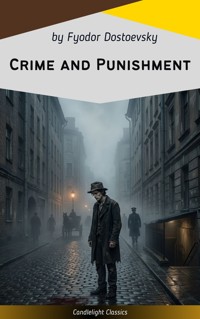
On an exceptionally hot evening early in July a young man came out of the garret in which he lodged in S. Place and walked slowly, as though in hesitation, towards K. bridge.
He had successfully avoided meeting his landlady on the staircase. His garret was under the roof of a high, five-storied house and was more like a cupboard than a room. The landlady who provided him with garret, dinners, and attendance, lived on the floor below, and every time he went out he was obliged to pass her kitchen, the door of which invariably stood open. And each time he passed, the young man had a sick, frightened feeling, which made him scowl and feel ashamed. He was hopelessly in debt to his landlady, and was afraid of meeting her.
This was not because he was cowardly and abject, quite the contrary; but for some time past he had been in an overstrained irritable condition, verging on hypochondria. He had become so completely absorbed in himself, and isolated from his fellows that he dreaded meeting, not only his landlady, but anyone at all. He was crushed by poverty, but the anxieties of his position had of late ceased to weigh upon him. He had given up attending to matters of practical importance; he had lost all desire to do so. Nothing that any landlady could do had a real terror for him. But to be stopped on the stairs, to be forced to listen to her trivial, irrelevant gossip, to pestering demands for payment, threats and complaints, and to rack his brains for excuses, to prevaricate, to lie—no, rather than that, he would creep down the stairs like a cat and slip out unseen.
This evening, however, on coming out into the street, he became acutely aware of his fears.
“I want to attempt a thing like that and am frightened by these trifles,” he thought, with an odd smile. “Hm… yes, all is in a man’s hands and he lets it all slip from cowardice, that’s an axiom. It would be interesting to know what it is men are most afraid of. Taking a new step, uttering a new word is what they fear most…. But I am talking too much. It’s because I chatter that I do nothing. Or perhaps it is that I chatter because I do nothing. I’ve learned to chatter this last month, lying for days together in my den thinking… of Jack the Giant-killer. Why am I going there now? Am I capable of that? Is that serious? It is not serious at all. It’s simply a fantasy to amuse myself; a plaything! Yes, maybe it is a plaything.”
The heat in the street was terrible: and the airlessness, the bustle and the plaster, scaffolding, bricks, and dust all about him, and that special Petersburg stench, so familiar to all who are unable to get out of town in summer—all worked painfully upon the young man’s already overwrought nerves. The insufferable stench from the pot-houses, which are particularly numerous in that part of the town, and the drunken men whom he met continually, although it was a working day, completed the revolting misery of the picture. An expression of the profoundest disgust gleamed for a moment in the young man’s refined face. He was, by the way, exceptionally handsome, above the average in height, slim, well-built, with beautiful dark eyes and dark brown hair. Soon he sank into deep thought, or more accurately speaking into a complete blankness of mind; he walked along not observing what was about him and not caring to observe it. From time to time, he would mutter something, from the habit of talking to himself, to which he had just confessed. At these moments he would become conscious that his ideas were sometimes in a tangle and that he was very weak; for two days he had scarcely tasted food.
He was so badly dressed that even a man accustomed to shabbiness would have been ashamed to be seen in the street in such rags. In that quarter of the town, however, scarcely any shortcoming in dress would have created surprise. Owing to the proximity of the Hay Market, the number of establishments of bad character, the preponderance of the trading and working class population crowded in these streets and alleys in the heart of Petersburg, types so various were to be seen in the streets that no figure, however queer, would have caused surprise. But there was such accumulated bitterness and contempt in the young man’s heart, that, in spite of all the fastidiousness of youth, he minded his rags least of all in the street. It was a different matter when he met with acquaintances or with former fellow students, whom, indeed, he disliked meeting at any time. And yet when a drunken man who, for some unknown reason, was being taken somewhere in a huge waggon dragged by a heavy dray horse, suddenly shouted at him as he drove past: “Hey there, German hatter” bawling at the top of his voice and pointing at him—the young man stopped suddenly and clutched tremulously at his hat. It was a tall round hat from Zimmerman’s, but completely worn out, rusty with age, all torn and bespattered, brimless and bent on one side in a most unseemly fashion. Not shame, however, but quite another feeling akin to terror had overtaken him.
“I knew it,” he muttered in confusion, “I thought so! That’s the worst of all! Why, a stupid thing like this, the most trivial detail might spoil the whole plan. Yes, my hat is too noticeable…. It looks absurd and that makes it noticeable…. With my rags I ought to wear a cap, any sort of old pancake, but not this grotesque thing. Nobody wears such a hat, it would be noticed a mile off, it would be remembered…. What matters is that people would remember it, and that would give them a clue. For this business one should be as little conspicuous as possible…. Trifles, trifles are what matter! Why, it’s just such trifles that always ruin everything….”
He had not far to go; he knew indeed how many steps it was from the gate of his lodging house: exactly seven hundred and thirty. He had counted them once when he had been lost in dreams. At the time he had put no faith in those dreams and was only tantalising himself by their hideous but daring recklessness. Now, a month later, he had begun to look upon them differently, and, in spite of the monologues in which he jeered at his own impotence and indecision, he had involuntarily come to regard this “hideous” dream as an exploit to be attempted, although he still did not realise this himself. He was positively going now for a “rehearsal” of his project, and at every step his excitement grew more and more violent.
With a sinking heart and a nervous tremor, he went up to a huge house which on one side looked on to the canal, and on the other into the street. This house was let out in tiny tenements and was inhabited by working people of all kinds—tailors, locksmiths, cooks, Germans of sorts, girls picking up a living as best they could, petty clerks, etc. There was a continual coming and going through the two gates and in the two courtyards of the house. Three or four door-keepers were employed on the building. The young man was very glad to meet none of them, and at once slipped unnoticed through the door on the right, and up the staircase. It was a back staircase, dark and narrow, but he was familiar with it already, and knew his way, and he liked all these surroundings: in such darkness even the most inquisitive eyes were not to be dreaded.
“If I am so scared now, what would it be if it somehow came to pass that I were really going to do it?” he could not help asking himself as he reached the fourth storey. There his progress was barred by some porters who were engaged in moving furniture out of a flat. He knew that the flat had been occupied by a German clerk in the civil service, and his family. This German was moving out then, and so the fourth floor on this staircase would be untenanted except by the old woman. “That’s a good thing anyway,” he thought to himself, as he rang the bell of the old woman’s flat. The bell gave a faint tinkle as though it were made of tin and not of copper. The little flats in such houses always have bells that ring like that. He had forgotten the note of that bell, and now its peculiar tinkle seemed to remind him of something and to bring it clearly before him…. He started, his nerves were terribly overstrained by now. In a little while, the door was opened a tiny crack: the old woman eyed her visitor with evident distrust through the crack, and nothing could be seen but her little eyes, glittering in the darkness. But, seeing a number of people on the landing, she grew bolder, and opened the door wide. The young man stepped into the dark entry, which was partitioned off from the tiny kitchen. The old woman stood facing him in silence and looking inquiringly at him. She was a diminutive, withered up old woman of sixty, with sharp malignant eyes and a sharp little nose. Her colourless, somewhat grizzled hair was thickly smeared with oil, and she wore no kerchief over it. Round her thin long neck, which looked like a hen’s leg, was knotted some sort of flannel rag, and, in spite of the heat, there hung flapping on her shoulders, a mangy fur cape, yellow with age. The old woman coughed and groaned at every instant. The young man must have looked at her with a rather peculiar expression, for a gleam of mistrust came into her eyes again.
“Raskolnikov, a student, I came here a month ago,” the young man made haste to mutter, with a half bow, remembering that he ought to be more polite.
“I remember, my good sir, I remember quite well your coming here,” the old woman said distinctly, still keeping her inquiring eyes on his face.
“And here… I am again on the same errand,” Raskolnikov continued, a little disconcerted and surprised at the old woman’s mistrust. “Perhaps she is always like that though, only I did not notice it the other time,” he thought with an uneasy feeling.
The old woman paused, as though hesitating; then stepped on one side, and pointing to the door of the room, she said, letting her visitor pass in front of her:
“Step in, my good sir.”
The little room into which the young man walked, with yellow paper on the walls, geraniums and muslin curtains in the windows, was brightly lighted up at that moment by the setting sun.
“So the sun will shine like this then too!” flashed as it were by chance through Raskolnikov’s mind, and with a rapid glance he scanned everything in the room, trying as far as possible to notice and remember its arrangement. But there was nothing special in the room. The furniture, all very old and of yellow wood, consisted of a sofa with a huge bent wooden back, an oval table in front of the sofa, a dressing-table with a looking-glass fixed on it between the windows, chairs along the walls and two or three half-penny prints in yellow frames, representing German damsels with birds in their hands—that was all. In the corner a light was burning before a small ikon. Everything was very clean; the floor and the furniture were brightly polished; everything shone.
“Lizaveta’s work,” thought the young man. There was not a speck of dust to be seen in the whole flat.
“It’s in the houses of spiteful old widows that one finds such cleanliness,” Raskolnikov thought again, and he stole a curious glance at the cotton curtain over the door leading into another tiny room, in which stood the old woman’s bed and chest of drawers and into which he had never looked before. These two rooms made up the whole flat.
“What do you want?” the old woman said severely, coming into the room and, as before, standing in front of him so as to look him straight in the face.
“I’ve brought something to pawn here,” and he drew out of his pocket an old-fashioned flat silver watch, on the back of which was engraved a globe; the chain was of steel.
“But the time is up for your last pledge. The month was up the day before yesterday.”
“I will bring you the interest for another month; wait a little.”
“But that’s for me to do as I please, my good sir, to wait or to sell your pledge at once.”
“How much will you give me for the watch, Alyona Ivanovna?”
“You come with such trifles, my good sir, it’s scarcely worth anything. I gave you two roubles last time for your ring and one could buy it quite new at a jeweler’s for a rouble and a half.”
“Give me four roubles for it, I shall redeem it, it was my father’s. I shall be getting some money soon.”
“A rouble and a half, and interest in advance, if you like!”
“A rouble and a half!” cried the young man.
“Please yourself”—and the old woman handed him back the watch. The young man took it, and was so angry that he was on the point of going away; but checked himself at once, remembering that there was nowhere else he could go, and that he had had another object also in coming.
“Hand it over,” he said roughly.
The old woman fumbled in her pocket for her keys, and disappeared behind the curtain into the other room. The young man, left standing alone in the middle of the room, listened inquisitively, thinking. He could hear her unlocking the chest of drawers.
“It must be the top drawer,” he reflected. “So she carries the keys in a pocket on the right. All in one bunch on a steel ring…. And there’s one key there, three times as big as all the others, with deep notches; that can’t be the key of the chest of drawers… then there must be some other chest or strong-box… that’s worth knowing. Strong-boxes always have keys like that… but how degrading it all is.”
The old woman came back.
“Here, sir: as we say ten copecks the rouble a month, so I must take fifteen copecks from a rouble and a half for the month in advance. But for the two roubles I lent you before, you owe me now twenty copecks on the same reckoning in advance. That makes thirty-five copecks altogether. So I must give you a rouble and fifteen copecks for the watch. Here it is.”
“What! only a rouble and fifteen copecks now!”
“Just so.”
The young man did not dispute it and took the money. He looked at the old woman, and was in no hurry to get away, as though there was still something he wanted to say or to do, but he did not himself quite know what.
“I may be bringing you something else in a day or two, Alyona Ivanovna—a valuable thing—silver—a cigarette-box, as soon as I get it back from a friend…” he broke off in confusion.
“Well, we will talk about it then, sir.”
“Good-bye—are you always at home alone, your sister is not here with you?” He asked her as casually as possible as he went out into the passage.
“What business is she of yours, my good sir?”
“Oh, nothing particular, I simply asked. You are too quick…. Good-day, Alyona Ivanovna.”
Raskolnikov went out in complete confusion. This confusion became more and more intense. As he went down the stairs, he even stopped short, two or three times, as though suddenly struck by some thought. When he was in the street he cried out, “Oh, God, how loathsome it all is! and can I, can I possibly…. No, it’s nonsense, it’s rubbish!” he added resolutely. “And how could such an atrocious thing come into my head? What filthy things my heart is capable of. Yes, filthy above all, disgusting, loathsome, loathsome!—and for a whole month I’ve been….” But no words, no exclamations, could express his agitation. The feeling of intense repulsion, which had begun to oppress and torture his heart while he was on his way to the old woman, had by now reached such a pitch and had taken such a definite form that he did not know what to do with himself to escape from his wretchedness. He walked along the pavement like a drunken man, regardless of the passers-by, and jostling against them, and only came to his senses when he was in the next street. Looking round, he noticed that he was standing close to a tavern which was entered by steps leading from the pavement to the basement. At that instant two drunken men came out at the door, and abusing and supporting one another, they mounted the steps. Without stopping to think, Raskolnikov went down the steps at once. Till that moment he had never been into a tavern, but now he felt giddy and was tormented by a burning thirst. He longed for a drink of cold beer, and attributed his sudden weakness to the want of food. He sat down at a sticky little table in a dark and dirty corner; ordered some beer, and eagerly drank off the first glassful. At once he felt easier; and his thoughts became clear.
“All that’s nonsense,” he said hopefully, “and there is nothing in it all to worry about! It’s simply physical derangement. Just a glass of beer, a piece of dry bread—and in one moment the brain is stronger, the mind is clearer and the will is firm! Phew, how utterly petty it all is!”
But in spite of this scornful reflection, he was by now looking cheerful as though he were suddenly set free from a terrible burden: and he gazed round in a friendly way at the people in the room. But even at that moment he had a dim foreboding that this happier frame of mind was also not normal.
There were few people at the time in the tavern. Besides the two drunken men he had met on the steps, a group consisting of about five men and a girl with a concertina had gone out at the same time. Their departure left the room quiet and rather empty. The persons still in the tavern were a man who appeared to be an artisan, drunk, but not extremely so, sitting before a pot of beer, and his companion, a huge, stout man with a grey beard, in a short full-skirted coat. He was very drunk: and had dropped asleep on the bench; every now and then, he began as though in his sleep, cracking his fingers, with his arms wide apart and the upper part of his body bounding about on the bench, while he hummed some meaningless refrain, trying to recall some such lines as these:
“His wife a year he fondly loved His wife a—a year he—fondly loved.”
Or suddenly waking up again:
“Walking along the crowded row He met the one he used to know.”
But no one shared his enjoyment: his silent companion looked with positive hostility and mistrust at all these manifestations. There was another man in the room who looked somewhat like a retired government clerk. He was sitting apart, now and then sipping from his pot and looking round at the company. He, too, appeared to be in some agitation.
CHAPTER II
Raskolnikov was not used to crowds, and, as we said before, he avoided society of every sort, more especially of late. But now all at once he felt a desire to be with other people. Something new seemed to be taking place within him, and with it he felt a sort of thirst for company. He was so weary after a whole month of concentrated wretchedness and gloomy excitement that he longed to rest, if only for a moment, in some other world, whatever it might be; and, in spite of the filthiness of the surroundings, he was glad now to stay in the tavern.
The master of the establishment was in another room, but he frequently came down some steps into the main room, his jaunty, tarred boots with red turn-over tops coming into view each time before the rest of his person. He wore a full coat and a horribly greasy black satin waistcoat, with no cravat, and his whole face seemed smeared with oil like an iron lock. At the counter stood a boy of about fourteen, and there was another boy somewhat younger who handed whatever was wanted. On the counter lay some sliced cucumber, some pieces of dried black bread, and some fish, chopped up small, all smelling very bad. It was insufferably close, and so heavy with the fumes of spirits that five minutes in such an atmosphere might well make a man drunk.
There are chance meetings with strangers that interest us from the first moment, before a word is spoken. Such was the impression made on Raskolnikov by the person sitting a little distance from him, who looked like a retired clerk. The young man often recalled this impression afterwards, and even ascribed it to presentiment. He looked repeatedly at the clerk, partly no doubt because the latter was staring persistently at him, obviously anxious to enter into conversation. At the other persons in the room, including the tavern-keeper, the clerk looked as though he were used to their company, and weary of it, showing a shade of condescending contempt for them as persons of station and culture inferior to his own, with whom it would be useless for him to converse. He was a man over fifty, bald and grizzled, of medium height, and stoutly built. His face, bloated from continual drinking, was of a yellow, even greenish, tinge, with swollen eyelids out of which keen reddish eyes gleamed like little chinks. But there was something very strange in him; there was a light in his eyes as though of intense feeling—perhaps there were even thought and intelligence, but at the same time there was a gleam of something like madness. He was wearing an old and hopelessly ragged black dress coat, with all its buttons missing except one, and that one he had buttoned, evidently clinging to this last trace of respectability. A crumpled shirt front, covered with spots and stains, protruded from his canvas waistcoat. Like a clerk, he wore no beard, nor moustache, but had been so long unshaven that his chin looked like a stiff greyish brush. And there was something respectable and like an official about his manner too. But he was restless; he ruffled up his hair and from time to time let his head drop into his hands dejectedly resting his ragged elbows on the stained and sticky table. At last he looked straight at Raskolnikov, and said loudly and resolutely:
“May I venture, honoured sir, to engage you in polite conversation? Forasmuch as, though your exterior would not command respect, my experience admonishes me that you are a man of education and not accustomed to drinking. I have always respected education when in conjunction with genuine sentiments, and I am besides a titular counsellor in rank. Marmeladov—such is my name; titular counsellor. I make bold to inquire—have you been in the service?”
“No, I am studying,” answered the young man, somewhat surprised at the grandiloquent style of the speaker and also at being so directly addressed. In spite of the momentary desire he had just been feeling for company of any sort, on being actually spoken to he felt immediately his habitual irritable and uneasy aversion for any stranger who approached or attempted to approach him.
“A student then, or formerly a student,” cried the clerk. “Just what I thought! I’m a man of experience, immense experience, sir,” and he tapped his forehead with his fingers in self-approval. “You’ve been a student or have attended some learned institution!… But allow me….” He got up, staggered, took up his jug and glass, and sat down beside the young man, facing him a little sideways. He was drunk, but spoke fluently and boldly, only occasionally losing the thread of his sentences and drawling his words. He pounced upon Raskolnikov as greedily as though he too had not spoken to a soul for a month.
“Honoured sir,” he began almost with solemnity, “poverty is not a vice, that’s a true saying. Yet I know too that drunkenness is not a virtue, and that that’s even truer. But beggary, honoured sir, beggary is a vice. In poverty you may still retain your innate nobility of soul, but in beggary—never—no one. For beggary a man is not chased out of human society with a stick, he is swept out with a broom, so as to make it as humiliating as possible; and quite right, too, forasmuch as in beggary I am ready to be the first to humiliate myself. Hence the pot-house! Honoured sir, a month ago Mr. Lebeziatnikov gave my wife a beating, and my wife is a very different matter from me! Do you understand? Allow me to ask you another question out of simple curiosity: have you ever spent a night on a hay barge, on the Neva?”
“No, I have not happened to,” answered Raskolnikov. “What do you mean?”
“Well, I’ve just come from one and it’s the fifth night I’ve slept so….” He filled his glass, emptied it and paused. Bits of hay were in fact clinging to his clothes and sticking to his hair. It seemed quite probable that he had not undressed or washed for the last five days. His hands, particularly, were filthy. They were fat and red, with black nails.
His conversation seemed to excite a general though languid interest. The boys at the counter fell to sniggering. The innkeeper came down from the upper room, apparently on purpose to listen to the “funny fellow” and sat down at a little distance, yawning lazily, but with dignity. Evidently Marmeladov was a familiar figure here, and he had most likely acquired his weakness for high-flown speeches from the habit of frequently entering into conversation with strangers of all sorts in the tavern. This habit develops into a necessity in some drunkards, and especially in those who are looked after sharply and kept in order at home. Hence in the company of other drinkers they try to justify themselves and even if possible obtain consideration.
“Funny fellow!” pronounced the innkeeper. “And why don’t you work, why aren’t you at your duty, if you are in the service?”
“Why am I not at my duty, honoured sir,” Marmeladov went on, addressing himself exclusively to Raskolnikov, as though it had been he who put that question to him. “Why am I not at my duty? Does not my heart ache to think what a useless worm I am? A month ago when Mr. Lebeziatnikov beat my wife with his own hands, and I lay drunk, didn’t I suffer? Excuse me, young man, has it ever happened to you… hm… well, to petition hopelessly for a loan?”
“Yes, it has. But what do you mean by hopelessly?”
“Hopelessly in the fullest sense, when you know beforehand that you will get nothing by it. You know, for instance, beforehand with positive certainty that this man, this most reputable and exemplary citizen, will on no consideration give you money; and indeed I ask you why should he? For he knows of course that I shan’t pay it back. From compassion? But Mr. Lebeziatnikov who keeps up with modern ideas explained the other day that compassion is forbidden nowadays by science itself, and that that’s what is done now in England, where there is political economy. Why, I ask you, should he give it to me? And yet though I know beforehand that he won’t, I set off to him and…”
“Why do you go?” put in Raskolnikov.
“Well, when one has no one, nowhere else one can go! For every man must have somewhere to go. Since there are times when one absolutely must go somewhere! When my own daughter first went out with a yellow ticket, then I had to go… (for my daughter has a yellow passport),” he added in parenthesis, looking with a certain uneasiness at the young man. “No matter, sir, no matter!” he went on hurriedly and with apparent composure when both the boys at the counter guffawed and even the innkeeper smiled—“No matter, I am not confounded by the wagging of their heads; for everyone knows everything about it already, and all that is secret is made open. And I accept it all, not with contempt, but with humility. So be it! So be it! ‘Behold the man!’ Excuse me, young man, can you…. No, to put it more strongly and more distinctly; not can you but dare you, looking upon me, assert that I am not a pig?”
The young man did not answer a word.
“Well,” the orator began again stolidly and with even increased dignity, after waiting for the laughter in the room to subside. “Well, so be it, I am a pig, but she is a lady! I have the semblance of a beast, but Katerina Ivanovna, my spouse, is a person of education and an officer’s daughter. Granted, granted, I am a scoundrel, but she is a woman of a noble heart, full of sentiments, refined by education. And yet… oh, if only she felt for me! Honoured sir, honoured sir, you know every man ought to have at least one place where people feel for him! But Katerina Ivanovna, though she is magnanimous, she is unjust…. And yet, although I realise that when she pulls my hair she only does it out of pity—for I repeat without being ashamed, she pulls my hair, young man,” he declared with redoubled dignity, hearing the sniggering again—“but, my God, if she would but once…. But no, no! It’s all in vain and it’s no use talking! No use talking! For more than once, my wish did come true and more than once she has felt for me but… such is my fate and I am a beast by nature!”
“Rather!” assented the innkeeper yawning. Marmeladov struck his fist resolutely on the table.
“Such is my fate! Do you know, sir, do you know, I have sold her very stockings for drink? Not her shoes—that would be more or less in the order of things, but her stockings, her stockings I have sold for drink! Her mohair shawl I sold for drink, a present to her long ago, her own property, not mine; and we live in a cold room and she caught cold this winter and has begun coughing and spitting blood too. We have three little children and Katerina Ivanovna is at work from morning till night; she is scrubbing and cleaning and washing the children, for she’s been used to cleanliness from a child. But her chest is weak and she has a tendency to consumption and I feel it! Do you suppose I don’t feel it? And the more I drink the more I feel it. That’s why I drink too. I try to find sympathy and feeling in drink…. I drink so that I may suffer twice as much!” And as though in despair he laid his head down on the table.




