


Erhalten Sie Zugang zu diesem und mehr als 300000 Büchern ab EUR 5,99 monatlich.
- Herausgeber: epubli
- Kategorie: Abenteuer, Thriller, Horror
- Sprache: Englisch
In "Dead Line - A Technological Dystopia" readers are taken on a thrilling journey through the world of cyber warfare, corruption, and moral dilemmas. The story opens with Professor Kurt Pellmann's harrowing experience of being trapped and tortured for information by the ruthless Agent Waltz from World Corp.'s Network Police. As Pellmann struggles to endure the relentless interrogation, he recalls his former student, Frederickson, whose loyalty is tested when he's asked to extract information from Pellmann. As the narrative unfolds, readers are introduced to Mia Seiert, a skilled cybersecurity expert. Her personal life is burdened by her mother's deteriorating health due to dementia induced by a tumor. Some day, she receives a mysterious message from her former professor, Pellmann. He reveals critical information about her aborted research on quantum encryption, linking it to staged terror attacks and corporate corruption. Mia's sense of purpose is reignited as she receives a flash drive containing the algorithm she developed years ago, leading her to uncover the truth about World Corp.'s sinister intentions. As Mia embarks on her investigation, the story explores her struggles with her past, relationships, and the pervasive influence of World Corp. The intricate web of power dynamics in the digital world becomes apparent as Mia faces mounting frustration and dead ends in her quest for evidence. Despite the isolation and pressure, Mia remains steadfast in her determination to expose the truth. The narrative takes a dark turn when Mia's investigation draws unwanted attention. The book's gripping plot and compelling characters draw readers into a world of secrets, betrayals, and the pursuit of justice. The story delves into the lengths people will go to protect the truth, the sacrifices made for the greater good, and the power of unity in the face of oppression.
Sie lesen das E-Book in den Legimi-Apps auf:
Seitenzahl: 275
Veröffentlichungsjahr: 2023
Das E-Book (TTS) können Sie hören im Abo „Legimi Premium” in Legimi-Apps auf:
Ähnliche




















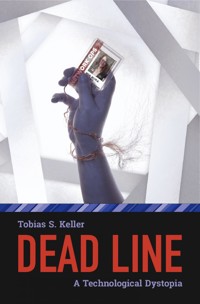
Dead Line - A Technological Dystopia
StartPreambleChapter 1 - Information Gathering by ForceChapter 2 - Long Time no SeeChapter 3 - Shifting Sleep CyclesChapter 4 - A Call of DutyChapter 5 - All Hands MeetingChapter 6 - Parcels of BurdenChapter 7 - Behind Locked DoorsChapter 8 - Under the cityChapter 9 - Unseen ObserversChapter 10 - A Friends BetrayalChapter 11 - Down the Rabbit HoleChapter 12 - Decisions Part 1 — MiaChapter 13 - Decisions Part 2 — PeterChapter 14 - Failsafe ModeChapter 15 - Roles and MasksChapter 16 - Planning GameChapter 17 - A not so Silent NightChapter 18 - RebootAppendixDead Line
A Technological Dystopia
Tobias S. Keller
Text: Tobias S. KellerCover Design: Tobisk MediaCover Photo: Damyeong YooPrint: epubli by Neopubli GmbH, BerlinPublisher: Self-Published
Imprint Tobias S. Keller Beethovenstraße 15 63791 Karlstein
www.tobisk.de/deadline
instagram.com/deadline.dystopia youtube.com/@deadline-dystopia
Dedication
This novel serves as a testament to the seamless fusion of human imagination and technological innovation. Let’s hope for the future, that AI tools will assist, not replace humans.It is based on an idea of Tobias S. Keller and the stage play developed from it. I’d like to acknowledge the actors from TU Darmstadt Schauspielstudio e.V. that brought this first idea to life.
Also, big thanks to Chris. You showed me that, while the way of an artist is not always a straight line, it might be way more direct than expected.
Finally, I would like to extend a heartfelt appreciation to my Grandfather. Your guidance and encouragement in the realms of imaginative thinking and tinkering have played an indispensable role in shaping who I am today.
Without all your influence, I would not have reached the point I am now. Thank you all sincerely.
Content Warning
This book contains realistic and psychological accurate descriptions of physical and psychological torture and suicide. If you struggle with these topics, consult a professional before reading this book.
Preamble
In our age of rapid technological advancements, where the line between humans and computers blurs, and everything is connected, we find ourselves standing at a threshold of virtuality.
On one side, we have politicians, whose ancient beliefs and lack of technological understanding, give them a hard time of grasping the modern digital world. On the other side, we have corporations, which know technology to a level that enables them to manipulate their users with it.
In a world where every thought, every action, leaves a lasting digital fingerprint, we are faced with a crucial choice. Whom shall we entrust with the custodianship of our most intimate selves and whom shall we trust with regulating these new tools?
Corporations that skillfully navigate the vast seas of data but might only endeavor to grow their profits?
Governments striving to slow technological progress, themselves still working with fax machines and stacks of paper, yet supposedly committed to serving the public?
What if the boundaries between them vanish like shadows in the dark, blending into an amalgamation that is hard to distinguish?
As we embark on this gripping odyssey, a tapestry of intrigue and uncertainty unfolds. Our journey will traverse treacherous terrain, revealing secrets hidden in the whispers of shadowed corridors and demonstrating how actions in the virtual world can have very tangible consequences.
Chapter 1Information Gathering by Force
He was trapped. Trapped in a dark, suffocating box that seemed to be closing in on him with each passing moment. No sensory input... maddening.
His mind began to fray at the edges.
Focus on breathing. Breathe in... Breathe Out... In... Out...
The air felt so very thin, like he was almost suffocating. He couldn’t see or hear anything. The complete isolation was starting to drive him insane. How long had he been trapped in this box? Days? Weeks? Even months?
Time had lost all meaning in this void. No way to keep track of it. Only loud buzzing sounds occasionally ripped him out of the endless silence.
Like sharp needles piercing through his already frayed nerves, sending his heart racing.
The worst part was the hunger. He was being fed through a needle to keep him alive. Though it was never enough to satisfy the gnawing hunger in his belly. He had never felt so weak, so helpless.
The professor’s thoughts drifted to his colleagues and friends, wondering if they even knew he was gone, or if they had been told he was dead. He had no wife, children, or other living family.
He regretted not spending more time with his parents, not telling them how much he cared for them before they deceased.
A stab of guilt gripped him as he thought about the danger he had put his friends in by pursuing the truth. Pellmann tried to hold on to his sanity, but he knew it was slipping away from him with every passing moment. He was starting to hallucinate, imagining things that couldn’t possibly be real. He saw flashes of light and heard whispers that he knew weren’t there.
The man felt as though he was losing his mind in the dark confines of the box. The frequent loud sounds, meant to stop him from falling asleep, only served to worsen his already-frayed nerves. Once again, The professor tried to focus on his breathing, but it felt shallow and labored. Amidst the black void, he pondered the limits of his endurance.
Would they break him, or would he remain resistant in his resolve to protect the truth?
As the days or weeks — he had no way to tell — wore on, he started to doubt his own strength. The constant sensory deprivation and isolation were taking their toll on him. Kurt Pellmann began to experience vivid dreams in those short moments he fell asleep, but probably they were just more hallucinations. He saw his parent’s faces, but they were distorted and frightening. They seemed to call him. He saw himself, but he was a monster, struggling to discern reality from his own imagination.
Kurt tried to remind himself of his purpose — to hold strong and protect the truth — but all that felt like an abstract concept now. He wasn’t sure if he would be able to remember his determination when the time came to act. He felt like he was fading away, like he was becoming less of a person and more of an idea.
Pellmann was unsure of how much time had passed, but he knew that he was a different person now than he had been before all this started. The isolation had stripped away everything he once thought he knew about himself, and he was left with only the truth he had sworn to protect.
He didn’t know if he would be able to hold on much longer, but he knew that he had to try. The fate of the world rested on his ability to withstand this mental and physical torture.
Wouldn’t it be better for his colleagues and friends — wouldn’t it be better for the world — if he just ended it all? But how?
He was fed through a needle, but his arms were tied to the soft black padding on the inside walls of the box, so he couldn’t reach it — and there was nothing else of use in this box. He couldn’t hurt himself, even if he tried.
Suddenly, the door of his confinement was ripped open, jolting him out of his deep and destructive thoughts. Whatever awaited him outside the box was blurred away with a bright, blinding light. A cacophony of disorienting sounds flooded his ears, shattering the silence he had grown accustomed to within his tiny, dark cell.
Two masked figures yanked him out of the box, ripping the clothes off his body. Pellmann shivered as cold water hit all of his skin. He could barely see anything as the men threw him a towel and then shoved a fresh set of clothes onto his trembling body.
He tried to steady his breathing and focus on the present, but his mind kept returning to the same questions: How long had he been in this place? How much longer could he endure this torture? And most importantly, would he be able to keep his secret?
He blinked rapidly as the guards led him into another room, parts of which were brightly lit by slightly flickering spotlights. Pellmann’s heartbeat grew faster as he saw the electrical equipment and chemicals on a table and the metal chair bolted to the floor. Based on his previous encounters, he knew exactly what to expect.
The masked men pushed him down onto the cold seat and strapped him in, securing his arms and legs tightly, connecting some electrodes to his body and to a rather large device on the table.
Pellmann’s thoughts raced as he watched them move around him, their faces still hidden behind their masks. He tried to stay calm, reminding himself that he was a man of science and reason. But fear crept in nonetheless, making his breath come in short, rapid gasps.
He knew the pain that awaited him. This wasn’t his first time being interrogated in that room, but every time they went a little further. He tried to keep his mind clear, to steel himself against the inevitable agony. But the sound of footsteps approaching from behind him still sent a shiver down his spine.
Pellmann’s heart raced as a low voice spoke, strangely friendly. “Professor Pellmann, what a wonderful day it is! Let’s continue where we ended our last session.”
He closed his eyes, preparing himself for the worst.
“You know why you are here. Will you tell us this time, where you have hidden it and who else knows about it?” the interrogator, Agent Waltz, continued.
“I won’t,” Pellmann replied in a tiny but still confident voice.
“Well then, this time we will change the game a little.” The interrogator placed his folded-down newspaper and cup of steaming coffee on the table.
The door opened. The professor could see a young man walk in, probably in his early twenties, dressed in a crisp white shirt and black pants. His nervousness was evident in his fumbling with his fingers. One could tell he was not comfortable in that room, with this kind of work.
The interrogator introduced the young man as his apprentice and explained that for today, he would be the one conducting the physical work. Pellmann’s heart sank, knowing that this young man would be forced to harm him. He could see the fear in his eyes, and he felt sorry for him. The agent took a step back and allowed the apprentice to take over.
The young man hesitantly approached the chair, his hand trembling as he picked up a small device equipped with a toggle switch and a large turning knob from the table. Pellmann could see the sweat on his forehead and the terror in his eyes as he tried to maintain a professional demeanor.
“Frederickson, last time we finished on energy level 2. Continue on Level 3,” Waltz explained to the trainee. As the apprentice hesitated, the interrogator became impatient: “Level 3! Now!” Left with no choice, Frederickson flipped the switch on his remote, and a sharp stitch went through the professor’s body from one electrode to the other.
It made his muscles cramp. He tried to hold back the pain, but it was excruciating. All he could do was not scream. He felt tears streaming down his face as the young man hesitantly continued the torture, as if he were being forced against his will.
“You know what we want to know. Where did you hide the copies of the algorithm, and who else knows about it?” the interrogator asked. He placed a chair just outside the light cone and took his coffee and newspaper from the table while seating himself on that chair. And, after a few seconds, commanded with an indifferent voice: “Increase the power, Frederickson! We’ll continue until he speaks.”
As the rather one-sided interrogation went on, Pellmann began to understand that the apprentice was also tortured, just like him. He got forced to do something he did not want to do, just to survive. The professor felt a deep sadness for Frederickson, and it made him realize the true cruelty of those in power.
Despite the physical pain, he tried to maintain a feeling of compassion for the young man. He could sense his fear and desperation.
Although the interrogator started to do a crossword in the newspaper while drinking his coffee, Pellmann knew that he was watching and that any show of weakness, from either of them would only make things worse. However, it became harder and harder to suppress the pain.
“Increase the power,” Agent Waltz commanded.
The professor was not able to suppress the agony from the electricity running through his muscles anymore. The cramps were unbearable.
After a while, the interrogator mumbled, “Information gathering by force, 7 letters. Hmm…,”
“Shut it off, Frederickson; he won’t speak,” the interrogator snapped towards his apprentice.
Pellmann’s eyes widened in terror as he watched the interrogator approach him with the steaming mug of coffee. The smell of the beans was overpowering, and he felt his mouth start to water. Suddenly, the interrogator held his head back and poured the hot liquid all over his face.
Pellmann screamed in agony as the steaming coffee seared his skin. The burning sensation was intense as he felt the coffee running down his face and onto his chest, leaving him feeling sticky and uncomfortable. The pain was unbearable, and he felt like he was going to pass out.
The interrogator laughed sadistically as Pellmann writhed in agony, taunting him with cruel words. Pellmann tried to shut out the sound, but the pain had been too much. He had wondered how much more of this he could take before he broke.
He had always prided himself on his resilience, years back, before World Corp took over the civil security forces. But now he had started to doubt whether he possessed what it took to withstand this kind of torture.
As the interrogator continued to torment him, Pellmann’s thoughts drifted back to his life before this nightmare had begun.
He thought about the work he had been doing before he got caught up in all of this. He had found something that probably could end the terror of the regime, even though it was not his own work.
The professor had wondered if it was a good idea to try to publish it or if it might endanger his colleagues that originally had worked on that code. He had decided to remove all evidence of other people’s involvement and to publish the work as his own.
It was safer for them that way.
But now? He really doubted that going public was worth all of this. Even as he thought about giving up, something inside him refused to let go. He knew that if he broke, he would betray everything he had ever stood for. Everything he believed in.
He took a deep breath and tried to steel himself against the pain, knowing that he was going to need all his strength to get through this.
Pellmann slowly lifted his head as the interrogator left, and the room was strangely silent. He finally took a good look at the man who remained in the room with him.
The young man seemed familiar.
“Don’t I know you from my classes?” Pellmann rasped, his voice hoarse from the pain. It took him a moment to place the face, but then he recognized him: Frederickson, one of his own students from years ago.
The young man nodded, visibly embarrassed, “I’m sorry, Professor. They’re making me do this. If I don’t torture you, they’ll fire me and probably torture me as well.”
Pellmann felt a wave of sympathy for his former pupil. He knew what it was like to be caught in the grip of powerful forces beyond his control. But at the same time, he couldn’t help but feel a sense of betrayal. How could Frederickson do this to him?
“Could you please scream for me? I don’t want to hurt you,” Frederickson asked with a shaking voice.
“I can’t. I am hoarse, I can barely whisper,” Pellmann replied in a quiet, croaking voice.
“Please. You have to scream. I don’t want to hurt you. Please scream!”
Pellmann just slowly shook his head.
As the student saw that, he felt so helpless, so betrayed. He flipped the switch on his remote.
Instantly, the burning sensation returned where the electrodes touched the professor’s skin. His muscles contracted and cramped again, as if they wanted to rip themselves apart. He knew that Frederickson didn’t want to torture him; that he just had to scream. But he couldn’t. His voice was barely able to produce a croak.
“Please scream!” Frederickson pleaded in tears towards his former teacher. “Please!” . Frederickson looked away, his eyes brimming with tears.
If the professor wouldn’t scream, he would have failed his task, so he thought. All he had to do was make him scream. To torture him just as he had been threatened to be tortured when he wanted to quit his job. If he could not make the professor scream, he was sure, Waltz would torture him instead of the professor. For failing him.
The only thing Frederickson could do was increase the power level until the professor had to scream.
So he slowly turned the knob. “Please scream. Please,” he whispered.
The pain increased. For the professor as well as for the student. In the body of the professor, all muscles contracted, pausing his ability to breathe, unnoticed by Frederickson.
The pain that the student experienced was of a completely different kind. He slowly became a monster. A horrible person who tortured people that clearly were sympathetic to him. But was the professor actually on his side? He didn’t want to scream; he wanted him to fail. He would fail.
Frederickson continued increasing the power until he realized that the knob wouldn’t turn anymore. The student had maxed out the power setting on the device. The professor had wide-open eyes, shaking on his whole body, his face being distorted by pain. But Frederickson couldn’t see that. He could not bear looking at his former teacher.
The professor didn’t even feel the pain anymore — the electricity must have overloaded his brain. Or was he dead, and this was the moment where one sees oneself? He could not think; he could not feel; all he heard was the buzzing of the electricity. He felt drowsy, realizing he could not take breath because his muscles didn’t work anymore. Then everything slowly went to black.
Waltz trotted back into the room, balancing a fresh cup of coffee in one hand. As he opened the door and saw Professor Pellmann’s motionless body, he froze. A wave of shock washed over him. The professor appeared unconscious, his eyes closed, and the device displayed the maximum possible power level.
Panic started to rise within Waltz as he realized the severity of the situation. He immediately turned to Frederickson, who was still clutching the controller. “Shut it off — Frederickson — Shut it off!” he shouted towards his apprentice. Totally shocked about what he had done, the student flipped the switch on the remote to the off position. Had he killed the professor? He never imagined that he would be able to go this far.
“Get the Epinephrine,” Waltz commanded, his voice noticeably annoyed, ripping Frederickson out of his thoughts. The student’s hand trembled when he opened the drawer of the metal cabinet in the corner of the room, just beside the one-way mirror. He searched among the many glass and plastic bottles containing different medicines and drugs and pulled out a little vial with the Epinephrine.
After drawing up 5 milliliters into a syringe, he hands it to Agent Waltz, who immediately rams the needle directly into the professor’s heart. He then slowly depressed the plunger, delivering the life-saving medication directly into the man’s bloodstream. Both Waltz and Frederickson watched anxiously, desperately hoping for a response. Waltz took a deep breath to steady his nerves. Seconds felt like hours as they stared at their victim, waiting for any sign of improvement.
As if stirred from a deep slumber, Professor Pellmann’s body jolted with a sudden surge of energy. His eyes flew open, wide with confusion and disorientation. He threw his head back and gasped for air, the sound of his raspy breaths filling the room. Slowly, his muscles began to regain their functionality, but they were still intensely hurting from the ripped fibers within.
Waltz asked, his voice filled with concern, “Professor Pellmann, can you hear me?”
The professor blinked rapidly, his gaze unfocused for a moment, he was wide awake. In shock.
“Professor. We need your attention!” and to Frederickson: “Give him half a dose of Thiopental. Don’t overdose, we don’t want him to pass away ... again.”
Waltz took another syringe and pressed it into the student’s hand. He slowly injected it into the professor’s vein. As the Thiopental coursed through Pellmann’s bloodstream, his body gradually relaxed, the tension dissipating from his limbs. The professor’s facial expression shifted from one of distress to a more serene and peaceful state.
Then Agent Waltz slowly turned his attention to Frederickson, his facial expression getting angrier and angrier. He stood up and closed on the apprentice, who moved backward away from his boss. Frederickson felt the cold concrete as his back touched the wall.
Agent Waltz seemed to calm himself down. He first spoke in a quiet tone, then got louder and louder, shouting at the apprentice from just centimeters away: “Are you out of your mind? You could have killed him. Could you at least find out where he has hidden the copies or who else knows about it?”
Frederickson swallowed. “No, sir,” he replied in a tiny voice.
He probably would have killed Professor Pellmann, if Waltz wouldn’t have intervened — that was the sad thing. How could he have fallen so deeply? Once, he wanted to help the world get rid of all evil. Yes, that might have been a bit naive, but that’s what he read in his fantasy books back when he was in school.
However, somewhere along the way of reaching his goals, he took a wrong turn. That monster he now had become — Torturing people — was this really him? But what else could he have done? When he tried to quit, they interviewed him and very strongly suggested rethinking his position.
“Professor Pellmann,” the sadistically nice voice of Agent Waltz pierced the silence after a while, addressed towards the interrogated, “now that you had your first near-death experience, would you care to tell us who wrote that code, or who knows about it, and where you have hidden the backups?” And after a few seconds, he smiled at him and added, “Or do we need to repeat that procedure?”
Chapter 2Long Time no See
Mia Seiert came home from work feeling exhausted and stressed out. She had spent the entire day trying to solve a connectivity issue at DECIX, the internet backbone in Frankfurt.
The problem supposedly had been caused by a cyberterrorist group that had managed to infiltrate the system, causing significant problems on many peering connections, especially those to the World Corp. data centers.
Of course, it had happened on a Friday, the day on which she usually leaves work early to visit her mom in her retirement home.
Now she sat in the back of the tram car on line 9, listening to heavy metal music on her headphones.
The tram stopped near the market. It was two more stops until Mia was finally home.
Today she could only visit her mom for 15 minutes before the visitation time ended at 18:30 and the inhabitants got served dinner — usually she tried to stay at least two hours each Friday. She felt terrible about that, but luckily her mother would not remember, as Nora Seiert, Mia’s mother, had dementia.
It started around six years ago, just a few months after the war ended, and after she had been diagnosed with an inoperable brain tumor. First, she asked Mia about people that were no longer in her life, and she was forgetting smaller things like the bottles of water from the grocery store, but her mental state decreased rapidly. Now her mother barely recognizes her.
While the old woman always told Mia about her daughter and how she met that pretty photographer years ago, her mother didn’t realize that Mia, the woman she talked to, actually was her daughter. It pained Mia deeply to witness her mother’s deteriorating mental state, knowing that the strong, vibrant woman she once knew was slipping away.
The memories and shared moments they had cherished together were fading into the abyss of forgetfulness. It was a heartbreaking reality that Mia had to face daily, grappling with the loss of connection and the strain it placed on their relationship. She tried to visit her at least twice a week, telling her stories from work and reading to her from fantasy books — having as much time with her, while it still was possible.
As the wheels of the tram slowly started to roll with a rattling sound, the vehicle’s bell ringing as the car left the station, she looked out of the window and saw the new building that had just been finished.
Back when she moved into her apartment, she had been told this lot had been empty for decades as nobody wanted to build on that corner, next to one of the oldest buildings in the city that had housed a bar and a club for as long as she could remember.
Her dad had met her mother there when he studied in that city, and she wouldn’t be surprised if her grandparents had also visited that bar. A very old building, probably from the “Art Nouveau” period.
The new building, which was placed wall to wall with the bar, however, was in a completely different, very modern style. Its facade was made out of steel, concrete, and glass. It belonged to World Corp., was a recruitment center, and had a food delivery drone charging hub on its roof. After a few hundred meters, the tram stopped again, and she left the car. Just a few more steps, she thought, and she would be finally home.
As Mia entered her apartment, it greeted her, turned on the lights, and started the newsflash:
“World Corp. had announced in the 2023 annual report that, following the expansion of the high-speed network in all 150 countries serviced by World Corporation, an average speed of 5 gigabits per second was now guaranteed.”
Zap.
“Berlin. To combat terrorism more quickly and effectively, the “Registration of Internet-Enabled Devices Act (RIEDA)” was passed. Every citizen had until the end of 2024 to register their smartphone, tablet, laptop, or other mobile internet-enabled device.”
Zap.
“‘Das Internet ist für uns alle Neuland,’ said former Chancellor Merkel about 13 years ago. Since that speech, much has changed: exactly 5 years ago today, World Corp. implemented a more direct, fair democracy with their direct online voting.”
Of course, the news didn’t speak about any of the negative stuff today, Mia thought. The promise of a connected and efficient world seemed to have faded, replaced by a constant battle against cyber threats and the erosion of privacy. She couldn’t help but question the decisions made by governments and corporations, wondering if their focus on profit and control had overshadowed the well-being and security of individuals.
She hated her job, despite it being an easy and usually low-stress one. Mia hated every moment of it and felt like she was just existing, but that was acceptable given her circumstances. She purposefully worked those long hours, intentionally leaving no time for a personal life. Her life had ended eight years ago.
This lack of motivation spilled over into her personal life, as her apartment was in a constant state of disarray. Though it was not necessarily dirty, there were clothes and dishes scattered about, and she had not bothered to properly clean in weeks.
She knew she should take better care of herself and her home, but the apathy she felt towards everything made it hard for her to bring up the energy to do anything else.
From her living room, which also housed her connected kitchen, Mia could see the university campus in the city center. She had studied there years ago and had always been fascinated by the way technology had been shaping the world. But now, as she remembered the chaos caused by the cyberattack today, she was reminded that the world was way too reliant on technology.
Lost in her thoughts, Mia absentmindedly wandered into the kitchen and opened the refrigerator, staring blankly at its contents. She knew she should eat something, but not much was in there. It wasn’t that she couldn’t afford the food; on the contrary, she had quite a well-paid job. She was just so stressed that she forgot to go grocery shopping.
Mia sighed as she leaned against the kitchen counter, ripping open some instant soup she had taken from the back of the shelf and putting it in the microwave. While waiting for the timer to run down, she went to the bathroom, changed into some more comfortable clothes, and then went to the toilet. As she sat down, she couldn’t help but feel a sense of despair wash over her.
Was this all there was to life? Working a job she hated, living in a small apartment with no real purpose or direction? No real friends, no relationship anymore? She could feel the weight of the world bearing down on her, suffocating her with its endless demands and expectations.
As she flushed the toilet, her AI assistant interrupted her thoughts, reminding her once again about her health. “Your blood sugar levels are too high,” the AI assistant notified her. “I recommend scheduling a doctor’s appointment to discuss potential treatment options.” Yet another thing to feel guilty about. After washing her hands, she went back to the kitchen.
Mia stood in front of the microwave, staring blankly at it. She remembered when she first got it, almost fifteen years ago. It had been one of the first things she bought for the new apartment. But now, the microwave looked worn and outdated. It had seen better days, just like Mia. Stuck to the microwave, there was a Polaroid showing her and a young man, her pointing at a laptop screen. She had been happy back then.
At that time, she had known her boyfriend for seven years, and while she had been very stressed, being in the last few weeks of her doctorate thesis, it had been a nice time. A very different time.
The humming of the microwave grew louder in her ears like a drone, deepening her trance-like state. The time back then had been better.
A time before pandemics, before the third world war, before the world had been governed by a company. A time of innocence. Or maybe just a time of ignorance?
Her mother did still have a real life back then and Mia had thought she could reach anything.
The microwave bell rang and ripped her from her thoughts. She let out a deep sigh and turned her attention back to her food. She took the plate out of the microwave and set it on the counter, burning herself slightly, then absentmindedly stirred the soup with a fork.
Mia didn’t even remember what she had heated up. As she ate, she glanced around her apartment. It wasn’t dirty, but it was definitely a mess.
Clothes were strewn across the couch and the floor, and a pile of dishes sat in the sink. She knew she should clean up, but the thought of doing so made her feel even more tired. Mia realized that she had been living like this for a while now.
Going through the motions of her job and her daily routine, but not really living. She became complacent and stagnant, just like her microwave. But unlike the microwave, she couldn’t just replace herself with a newer model.
She heard a strange sound — a sound she hadn’t heard in years. At first, she thought she just imagined it, but after a few seconds, it repeated.
It was her old Nokia phone. But where was it? After some searching, she remembered that she had put it in the cabinet with the TV.




