


0,49 €
Niedrigster Preis in 30 Tagen: 1,99 €
Niedrigster Preis in 30 Tagen: 1,99 €
Mehr erfahren.
- Herausgeber: Booksell-Verlag
- Kategorie: Geisteswissenschaft
- Sprache: Englisch
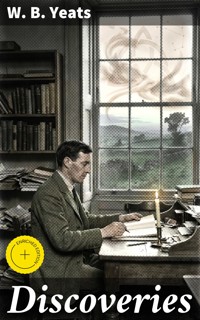
In "Discoveries," W. B. Yeats invites readers on a profound journey through the realms of art, politics, and spirituality, intricately woven together by his masterful literary style. This collection of essays, written with lyrical precision and emotional depth, explores the intersection of personal vision and the collective experience. Yeats delves into the nature of inspiration and the role of the artist as a conduit for transcendent truths, offering readers insight into his creative process against the backdrop of early 20th-century Ireland, where national identity and artistic expression were inextricably linked. W. B. Yeats, a towering figure in modernist literature and a key architect of the Irish Literary Revival, draws from his rich life experiences and deep engagements with mysticism and folklore to inform his writings. His diverse intellectual pursuits, including his fascination with theosophy and his commitment to reviving Irish culture, significantly shaped his philosophical outlook and literary voice. Yeats'Äôs profound reflections on the relationship between the individual and the cosmic have rendered him one of the most influential poets of his time, firmly sealing his legacy as an innovator in prose and poetry alike. "Discoveries" is an essential read for anyone intrigued by the intricate dance between art and life. Yeats's essays provoke thoughtful consideration and invite readers to examine their own understanding of creativity and reality. This work not only enriches one's appreciation of Yeats's poetry but also serves as a springboard for deeper explorations into the philosophical inquiries that continue to resonate in contemporary discussions of art. In this enriched edition, we have carefully created added value for your reading experience: - A succinct Introduction situates the work's timeless appeal and themes. - The Synopsis outlines the central plot, highlighting key developments without spoiling critical twists. - A detailed Historical Context immerses you in the era's events and influences that shaped the writing. - An Author Biography reveals milestones in the author's life, illuminating the personal insights behind the text. - A thorough Analysis dissects symbols, motifs, and character arcs to unearth underlying meanings. - Reflection questions prompt you to engage personally with the work's messages, connecting them to modern life. - Hand‐picked Memorable Quotes shine a spotlight on moments of literary brilliance.
Das E-Book können Sie in Legimi-Apps oder einer beliebigen App lesen, die das folgende Format unterstützen:
Veröffentlichungsjahr: 2021
Ähnliche


Discoveries
Table of Contents
Introduction
Discoveries brings together a group of prose pieces by W. B. Yeats under a single cover, presenting the reader with a focused view of his critical and reflective writing. Rather than a selection of poems or a sequence of plays, this collection gathers shorter works—many of them essayistic in manner—that range across art, belief, and the conditions of modern culture. Read consecutively, they form a sustained inquiry into how literature is made, what it is for, and what kinds of inner discipline and public tradition can sustain it.
The scope of the volume is defined by the titles included, which collectively emphasize Yeats’s interest in first principles: the sources of authority, the shaping power of personality, and the relation between imaginative vision and public expression. These pieces are best approached as a single-author collection of discrete works rather than a continuous treatise, yet their adjacency is itself purposeful. Yeats returns repeatedly to the same problems from different angles, allowing readers to see a mind testing its own convictions and refining its language about art’s responsibilities and limits.
The genres represented here are primarily essays and short prose compositions, written in Yeats’s characteristic critical voice. Several titles indicate direct engagement with drama and performance, suggesting discussion of theatrical subject matter, contemporary stage practice, and the question of whether modern life can generate forms with deep roots. Other pieces point toward folklore and narrative tradition, where Yeats often sought living sources of imaginative power. The collection thus moves between the speculative and the practical, treating both the making of art and the cultural conditions that enable it.
A major unifying thread is Yeats’s insistence that artistic creation involves more than technical skill. Across these writings he explores the interplay between the intellect and what he calls essences, between the public role and the private temperament, and between disciplined practice and visionary insight. The titles themselves imply an argument about hierarchy and vocation—prophet, priest, king; musician, orator; saint, artist—and about the special kinds of attention demanded by symbolic work. The pieces collectively invite readers to consider art as an activity shaped by belief, custom, and inward necessity.
The collection also highlights Yeats’s sustained attention to performance and the spoken word. When he turns to the musician and the orator, to drama’s subject matter, or to modern manners on the stage, he is not merely classifying genres; he is considering how voice, gesture, and audience create meaning. The theater becomes a testing ground for larger questions about modern experience—its surfaces, its conventions, and its capacity for depth. Yeats’s prose, like his dramatic and poetic work, is attentive to cadence and emphasis, valuing words as sounded and embodied.
In several pieces, Yeats addresses tradition as something active rather than museum-like. The praise of old wives’ tales points toward the persistence of folk narrative and the imaginative authority of inherited story. Such material matters to Yeats not only for its charm but for its shaping force: it furnishes images and patterns that can outlast passing fashions. In this collection, tradition is presented as a resource for renewal, offering a language of symbol and an economy of meaning that modern habits of thought may neglect yet still require.
Alongside tradition runs a fascination with images—mirrors, trees, towers, arrows, hair, holy places—that signal how Yeats thinks through emblem and motif. These titles suggest that the symbolic is not an ornament added after the fact, but a means of knowledge in its own right. Yeats’s prose often proceeds by juxtaposition and implication, allowing a concrete image to carry an argument that might otherwise be abstract. The looking-glass, the tree of life, and the tower on the Apennine point toward reflection, growth, and vantage, recurring concerns in his imaginative landscape.
The collection’s attention to the body and to asceticism indicates that Yeats treats artistic and spiritual questions as inseparable from human temperament and discipline. When he considers the thinking of the body or distinguishes between kinds of asceticism, he is addressing how thought is lived, not merely how it is stated. These pieces suggest an ethics of making: a sense that style, belief, and self-command shape the artist’s ability to form symbols that endure. The result is criticism that refuses to be only academic, because it remains attached to life as practice.
Another sustained concern is the relation between religion and art, approached not as doctrinal summary but as a question of necessity for symbolic creation. Yeats’s title on religious belief and symbolic art signals a view that certain kinds of imagination depend upon a serious framework of meaning, whether inherited, tested, or newly made. The holy places likewise imply attention to site, memory, and reverence—how spaces become charged with significance and how that charge affects artistic vision. These essays take belief seriously as a cultural and imaginative force.




