


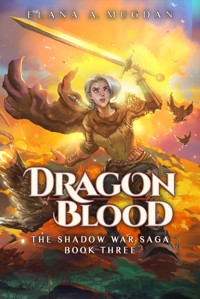
4,49 €
Mehr erfahren.
- Herausgeber: Shivnath Productions
- Kategorie: Für Kinder und Jugendliche
- Serie: The Shadow War Saga
- Sprache: Englisch
The Shadow will rule.
A hero will rise.
Keriya Soulstar awakens on the other side of the world, far from Allentria, far from the dragon god Shivnath, far from everyone she's every known and loved. She can't remember what happened during her final battle with Necrovar, and she doesn't want to. Besides, she's comfortable in Jidaeln, a country where no one wields magic. She fits in.
But Keriya knows she can't hide forever. With her sword—the only reminder of her troubled past—she ventures to a school where she can train with military masters to learn the arts of battle. Under the tutelage of Ansai Viran, the leader of the academy, she takes her first step in becoming a warrior who can finally defeat the Shadow.
She will return to Allentria and finish what she started…or she’ll die trying.
Contains: Fantasy violence, depictions of PTSD
Das E-Book können Sie in Legimi-Apps oder einer beliebigen App lesen, die das folgende Format unterstützen:
Seitenzahl: 817
Veröffentlichungsjahr: 2020
Ähnliche

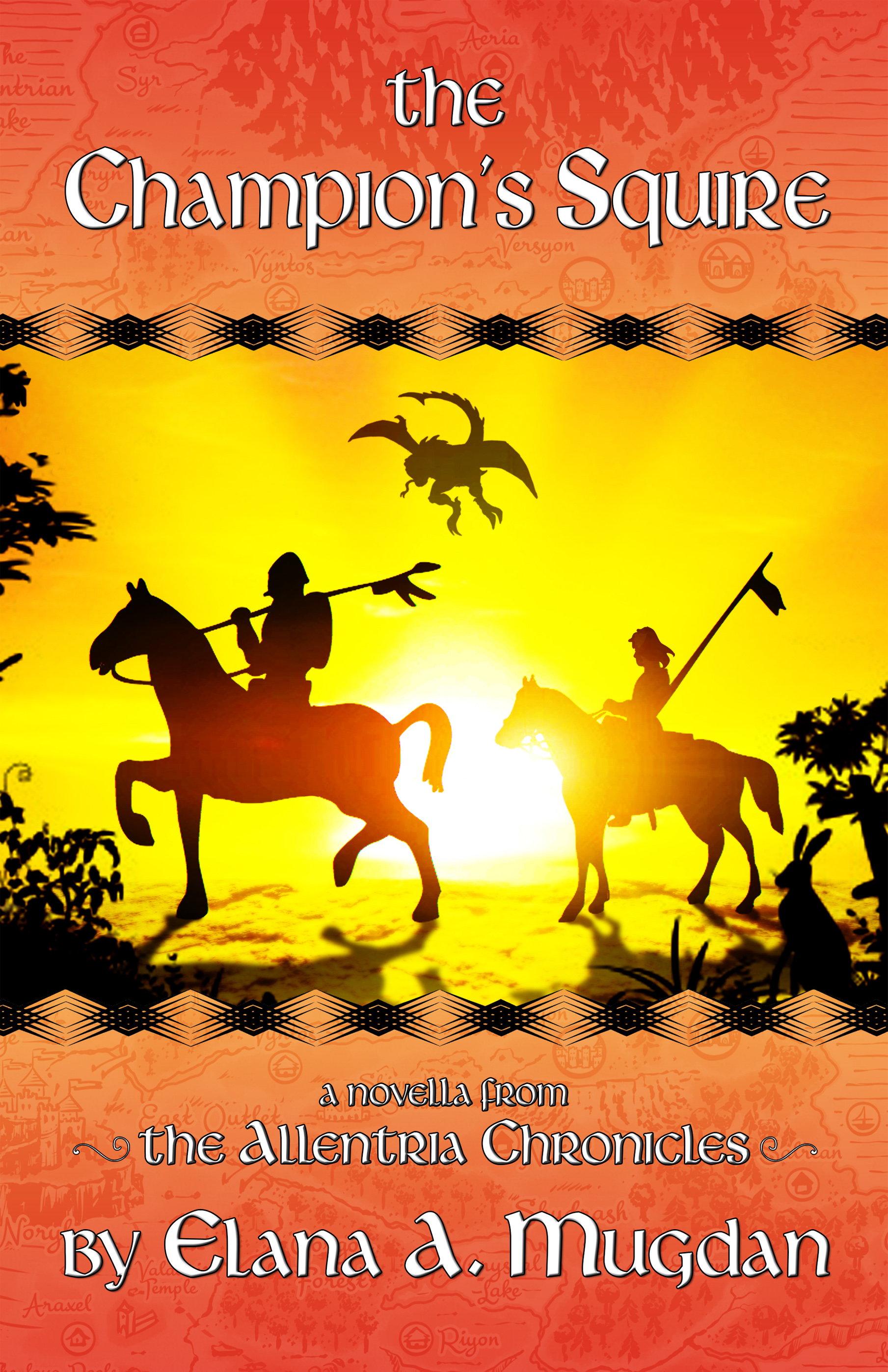













Copyright © Elana A. Mugdan 2020
www.allentria.com
All rights reserved. No part of this publication may be used, reproduced, stored in a retrieval system, or transmitted in any manner whatsoever without the written permission of the publisher.
This book is a work of fiction. Names, characters, places, and incidents are the product of the author’s imagination, and any resemblance to actual persons, living or dead, business establishments, events, or locales is entirely coincidental.
Cover Art by Jaka Prawira
Interior Art by Neiratina
ISBN: 978-1-5323-8801-9
Check out the other books of The Shadow War Saga!
Learn more at www.allentria.com
Or join the Allentria Community on our Discord Server!
Table Of Contents
PROLOGUE
CHAPTER ONE
CHAPTER TWO
CHAPTER THREE
CHAPTER FOUR
CHAPTER FIVE
CHAPTER SIX
CHAPTER SEVEN
CHAPTER EIGHT
CHAPTER NINE
CHAPTER TEN
CHAPTER ELEVEN
CHAPTER TWELVE
CHAPTER THIRTEEN
CHAPTER FOURTEEN
CHAPTER FIFTEEN
CHAPTER SIXTEEN
CHAPTER SEVENTEEN
CHAPTER EIGHTEEN
CHAPTER NINETEEN
CHAPTER TWENTY
CHAPTER TWENTY-ONE
CHAPTER TWENTY-TWO
CHAPTER TWENTY-THREE
CHAPTER TWENTY-FOUR
CHAPTER TWENTY-FIVE
CHAPTER TWENTY-SIX
CHAPTER TWENTY-SEVEN
CHAPTER TWENTY-EIGHT
CHAPTER TWENTY-NINE
CHAPTER THIRTY
CHAPTER THIRTY-ONE
CHAPTER THIRTY-TWO
CHAPTER THIRTY-THREE
CHAPTER THIRTY-FOUR
CHAPTER THIRTY-FIVE
CHAPTER THIRTY-SIX
CHAPTER THIRTY-SEVEN
CHAPTER THIRTY-EIGHT
CHAPTER THIRTY-NINE
CHAPTER FORTY
CHAPTER FORTY-ONE
CHAPTER FORTY-TWO
CHAPTER FORTY-THREE
CHAPTER FORTY-FOUR
EPILOGUE
BOOK IV AVAILABLE NOW!
GLOSSARY & PRONUNCIATIONS
ABOUT THE AUTHOR
“You have all the power in the world, because you are alive.”
~ Thorion Sveltorious, Twelfth Age
PROLOGUE
Second Age, Year 918
THE FIRE IN THE STONE PIT FLICKERED MERRILY, lending Helkryvt’s lean face the appearance of calm. He raised his purple eyes and glowered across the flames at Ghokarian. The pale dragon was surrounded by tribesmen celebrating the impending end of their journey. Beledine stood beside him, her face alight with quiet pride as she stared at her constant companion, the dragon who shared part of her soul.
It doesn’t mean anything, Helkryvt told himself for the hundredth time. She loves me.
Yet he couldn’t make himself believe that anymore. Ghokarian said something and Beledine threw back her head to laugh. Waves of red-gold hair spilled over her shoulders, catching the firelight so they shone like flames themselves.
Helkryvt’s fingers contracted into fists. People revered Ghokarian because he was a dragon. He was powerful, yes, but what had he done? Been born? That was no reason to worship him. Helkryvt had wielded miracles beyond anyone’s reckoning, yet no one groveled at his feet or sang his praises around bonfires.
Ghokarian saved my life.
The memory of that fateful sun stung with bitter shame. When Helkryvt had been grievously wounded in the war against the eastern tribes, Beledine had begged her dragon to give him blood to keep him from dying.
Technically Beledine saved me. The worm only helped because she asked him to. He would have happily watched me perish. I owe him nothing.
“Helkryvt?” A musical voice pulled him from his brooding. He looked up and found Beledine before him. She bore the wear of past battles on her russet skin. Two grisly scars stretched across her otherwise smooth cheeks, marking where her old tribe had branded her as a mage.
He rose to embrace her. He was tall and powerful, and Beledine—who was small and slight of figure—felt like a fragile treasure in his grasp. Holding her was bittersweet; it reminded him of better times, when their relationship had not been strained and confusing.
“Ghokarian says there’s a chance we’ll reach the city tomorrow,” she said, pulling away. “We’ll finally be in a peaceful place. Think of how much we’ll learn!”
“I can’t wait,” Helkryvt lied. He wanted nothing less than to be trapped in a crowded oasis packed with simpletons. He wished to stay in the north, working with the allied forces Beledine had brokered for the war—but she’d turned her back on warfare, and her people had followed her.
Beledine graced him with a gentle smile. “Don’t be afraid.”
Helkryvt bit back a harsh response. For all the time they’d spent together, she still had no idea who he was. He had never once been afraid—with the possible exception of the time Ghokarian had saved him—and he never would be.
“Life in the nation-states isn’t like the life we knew as nomads,” she continued. “The Norythian Tribe welcomes newcomers, especially those who can offer something. We have Mota, Embre, and Lykora. We have you. And of course, we have Ghokarian.”
Helkryvt’s bubble of pride popped, releasing a torrent of jealousy. The way she said Ghokarian’s name made his blood burn.
Beledine brushed his black hair—which had grown long on the road—from his brow. <What troubles you?> she asked telepathically, her thoughts magically winding their way into his head.
<It will be one full cycle tomorrow,> he replied. <One cycle we’ve been together.>
Her violet eyes grew over-bright, gleaming with a film of tears. “Oh Helkryvt . . . how did you ever keep track of the time?”
“I have counted every sun I spent with you,” he said, cupping her chin with one strong hand. “I cherish every moment we’re together.”
“The war took its toll on me. My focus was on our tribe, on keeping us together—keeping us alive—but that’s no excuse. I’ll make it up to you.”
He nodded, pleased. “We can celebrate and—”
“I must remind Ghokarian,” she exclaimed. “Should I ask for his blessing?”
Helkryvt didn’t trust himself to speak. He yearned to scream at her, shake sense into her, forbid her from doing any such thing . . . but she was Chieftain of the Araxi Tribe, and therefore his superior—a fact which didn’t sit well with him. He gritted his teeth and nodded stiffly. Beledine grinned and twirled away, gone like a leaf in a summer wind, off to speak to her dragon.
Something ugly boiled through Helkryvt. He hated Ghokarian. He hated the people around Ghokarian, every fool in the world who felt the smallest amount of respect for Ghokarian, and—this frightened him most of all—he hated Beledine. Because she valued her bond with Ghokarian more than she valued her relationship with Helkryvt.
That thought was enough to send him over the edge. Simmering with suppressed rage, he strode out of the firelight.
It wasn’t long before the canyon walls stood between him and the noise of the tribe. He walked until he came to the edge of a cliff. Far to the left, the Norythian Mountains were little more than a bump on the horizon—there was no chance of reaching the human city nestled amid those grand peaks by tomorrow. Ghokarian had lied to Beledine.
Beledine’s voice suddenly echoed through the rocky ravine. Helkryvt automatically opened his mouth to respond, but paused before he did so. She was talking about him—why? And to whom?
Heart constricting with suspicion, Helkryvt stole behind a boulder as Beledine rounded the bend, Ghokarian plodding dutifully by her side.
“I saw him come this way,” she was saying. “He’s been on edge since the war ended, but he won’t tell me what’s bothering him. You know how stubborn he is.”
Anger flared anew in Helkryvt. He might have brushed it off if she’d said such a thing to his face, but her words took on a sinister meaning when spoken in secret to her dragon.
“He may want to be alone,” said Ghokarian, “in which case we should leave him be.”
“If only I had the luxury of alone time,” Beledine muttered. “There’s no rest for a chieftain. I still feel out of place in this position.”
“It is a well-deserved honor, Beledine.”
“I thank you for saying that, but I’ve made many mistakes.”
“You’re human,” he quipped, coaxing a laugh from her. “No one expects you to be flawless. A great leader may not always know the right thing to do, but she always cares about doing the right thing.”
They stopped and stared across the empty wastes. Helkryvt tensed in anticipation. He longed to do something, but was unable to decide what.
“I am out of place in this world,” Beledine murmured, leaning against the dragon’s sturdy frame. “But I am glad of it. I wouldn’t trade you for anything.”
Ghokarian bent his neck and touched his snout to the top of her head, his breath rustling her hair. “Your words warm my soul.”
It was like the two of them were taking turns twisting a dagger into Helkryvt’s heart. Revulsion spread through him like poison.
Beledine stood on tiptoe to whisper something in Ghokarian’s ear, and he nodded.
“It would give me great joy.”
She smiled—not the slow, burdened smile she wore as chieftain, but the fierce and wild smile Helkryvt had fallen in love with, the smile that lit her face with the radiance of the sun.
“I love you, Ghokarian,” she proclaimed.
It was what Helkryvt had been waiting for. He’d waited for it like a vulture waits for its prey to fall dead. This confirmed his suspicions. There was no more escaping the truth, no more making excuses.
The dragon raised a paw silhouetted in silver-blue moonlight. Before he could touch Beledine, he roared in pain—a black arrow had sliced through the darkness and burrowed in his shoulder. Dark purple blood spurted from the wound as he collapsed, clawing at the projectile protruding from the vulnerable flesh near his wing joint. Beledine shrieked and dropped beside her bondmate, reaching for the weapon to wrench it free.
“Beledine.”
She jerked around, and Ghokarian raised his head to see who’d addressed her.
“Helkryvt,” she gasped, “thank the gods you’ve come. We’re under attack!”
Helkryvt strode forward, bow in hand. Beledine reached for him, naïve as ever, but a furious rumble of comprehension rippled through her dragon.
“It was you,” Ghokarian growled. “Why would you do such a thing?”
“Ghokarian, be still,” said Beledine. “Helkryvt is here to help.”
The beast ignored her. “Well, human? Speak! You’ve committed the greatest sin—”
“Nay, you have committed the greatest sin,” spat Helkryvt. “Deceit, perversion, betrayal. May the Shadow take you and be done with you!”
“I’m not the one taken by the Shadow,” hissed Ghokarian. “I knew from the moment Beledine met you that you’d hurt her. You are evil.”
Beledine’s scream shattered the night. Her voice pierced Helkryvt as surely as his second arrow pierced Ghokarian’s left eye, lodging itself in the monster’s brain up to its feathered shaft. Ghokarian dropped and hit the sun-parched stone, silent at last.
It was only then that Helkryvt, caught in the gale of dark emotion twisting his heart, heard a commotion from the far end of the canyon. Beledine had been loud enough to wake the dead, so the tribe would be coming to investigate. She was now sobbing over Ghokarian’s body—she’d always been sentimental. Tears couldn’t bring back what she’d lost.
She stood and turned so quickly that Helkryvt was taken unawares. Fire streamed from her hands, ribbons twirling thick and bright. They wrapped around him, constricting like snakes but not quite touching.
“Why, Helkryvt?”
“You have to ask? You made me believe you loved me—”
“I do love you,” she wailed, tearing at her hair. “I did, I—all the things we worked on, the things we wanted . . . the promises you made, the things you said—”
“Don’t play the victim. You chose him over me. You said you loved him. What darkness resides in your heart, that you would choose to be with one of them, these monsters who use us and destroy us in the process?”
She stood stunned, her chest rising and falling with broken breaths. “He was to stand in as my family and give me away to you. Of course I love him—he is the only father I’ve ever known. He is my bondmate. You should understand that!” A fresh sob worked its way through her, and she sagged with a crushing, damning realization: “But perhaps you are incapable of understanding any kind of love at all.”
Helkryvt didn’t stop to think. He no longer wanted to look at the girl before him, this barefaced liar, this traitor above all traitors. He needed to be rid of her presence. Reaching for his magicsource, he wielded to extinguish Beledine’s fire spell. Before she had time to counter-wield, he drew an arrow from his quiver, pulled it against his bowstring, and released it.
Beledine went limp and collapsed next to Ghokarian. Blood blossomed from her breast around the shaft of a third black arrow.
“What—!”
Helkryvt had been so distracted that he hadn’t heard his comrades approaching on the canyon trail. It was the smaller night unit, led by Malek. A few tribesmen gasped. Retching sounds announced someone being sick. Helkryvt’s sharp ears caught a tearful, whispered prayer. He sneered in contempt. They were pathetic, always had been.
“Helkryvt . . . ” Malek’s voice was empty and haunted. He stared from Helkryvt to the crumpled bodies by the cliff. “What have you done?”
“Only what was necessary,” said Helkryvt. “Your chieftain and her dragon deserved what they got.”
“You have committed the greatest sin. You killed—”
Twang! Before Malek could finish his sentence, Helkryvt put an arrow in his throat. Malek scrabbled at his torn jugular for a few frenzied moments. He sank to his knees, choking on his blood, then fell flat on his face. The force of his fall drove the arrowhead clean through his neck.
Helkryvt smiled; he’d never liked Malek.
“Traitor,” someone cried into the horrified silence.
“Murderer!”
“He’s taken by the Shadow!”
The unit rushed Helkryvt. He wasn’t worried; he was stronger than all of them combined. He attacked them with magic as he pulled more arrows from his quiver, felling Rotys and Aev—people who’d once been his teammates, his brothers, his friends.
No. They were never my friends. It was Beledine they followed. Beledine they loved. How many of them did she deceive? How many of them were snared in her spell?
As the unit closed in, Helkryvt drew Nighttalon, his magnificent black-silver sword. Saanug tried to block a blow from Nighttalon with an earthen shield. Helkryvt tore through the spell with his own magic and ripped the older man’s chest open with a swipe of his mighty blade. He wielded and slashed without restraint, heedless of whether it was male or female, young or old whom he felled. Weak and useless, every last one of them.
And then—Helkryvt blinked. Not a single person was left standing. The ground was black with blood. The stillness of the night settled on the clifftop once more.
A piteous gurgle rose behind him. Helkryvt turned, his fur cloak trailing across entrails and broken bodies. He froze, caught halfway between revulsion and shock. Ghokarian was awake, and he was crying over Beledine. No, not crying—he was bleeding. Blood oozed from his left eye socket, dark droplets dribbling onto Beledine’s parted lips.
“I thought bonded dragons were supposed to be easy to kill,” snarled Helkryvt.
“I am strong enough that I might survive, but Beledine is fading.”
A fresh surge of hatred rose in Helkryvt. “Go on, then. Despite being a mediocre wielder, people worship the ground you walk on. Save her, if you’re so clever.”
“Timemagic can only do so much.” Ghokarian stared at Beledine, and the expression on his scaly face made Helkryvt want to scream—or possibly weep. “She needs lifemagic, too. Helkryvt, you and I can save her together. You have the power.”
The dragon looked up again. His one remaining eye glinted in the moonlight, emotions flashing through it faster than Helkryvt could read them. “Help me. I . . . I beg you.”
Helkryvt hesitated. No matter how deeply Beledine had hurt him, he couldn’t deny his love for her. It was in his heart, his soul, his very blood. He approached, gazing at the face he so adored. They could move past this, couldn’t they? He would forgive her disloyalty, she would forgive his attack, and the world would be right again.
Then a light appeared, washing Beledine with an eerie purple hue. Ghokarian’s eye was glowing. Surely that meant the creature was wielding some foul magic, and Helkryvt reacted like lightning. Before Ghokarian had time to complete a spell, Helkryvt struck with his sword, lopping off the dragon’s head. It thudded to the ground next to Beledine and the purple eye dimmed, light and life snuffed out in a heartbeat.
Silence reigned once more. Triumph sang in Helkryvt’s veins as he surveyed his handiwork. “It wasn’t hard to kill you after all,” he panted. “So ends Ghokarian Equilumos.”
The smile faded from his lips as he stared. Something alien was gnawing at the feeling of triumph, fighting to take its place. Beledine lay unmoving, the gray fur of her toga slick with ruby liquid. A trickle of dragon blood ran from the corner of her mouth. Her eyes, which had once been vibrant and full of fire, were closed forever.
Helkryvt had killed the only woman he’d ever loved.
The unfamiliar feeling—which he expected must be guilt—swelled until it consumed him.
“Beledine,” he whispered uselessly, kneeling by her head. He smoothed silky, fiery hair from her death-stilled brow. “Why did you make me do this to you? We were meant for glory, you and I—and you ruined it.” He repeated the words in a hollow voice: “You ruined it.”
His life was spent, aimless, destroyed without Beledine. What was there to fight for, if not her honor? What was there to strive for, if not her approval? Helkryvt had followed his chieftain wherever she led, even when he disliked the direction she took. He’d lived by her side . . . it seemed fitting he should die there, too.
Nighttalon flashed wickedly as he turned the sword on himself. Settling beside Beledine, he pushed up the left sleeve of his tunic and placed the blade against his forearm.
The pain of slicing open his flesh was acute and oddly fulfilling. Warm liquid bubbled from the cut, sheeting across his tanned skin. Even in the pallid light of the moon, Helkryvt could tell something was wrong. His blood wasn’t red—it was purple.
“What is this?” he breathed.
<It is the dragons’ greatest secret,> a familiar, phantom voice purred in his head.
Helkryvt floundered around, staring into the night. He caught a glimmer of movement in the darkness. The shadows were tearing themselves from the ground, materializing into a human shape.
“You again.” He glared at the wispy apparition. “I have nothing more to say to you. Leave me to die in peace.”
<You aren’t dying, Helkryvt.> The telepathic whisper bloomed in Helkryvt’s mind, as clear as spoken words, as alluring as ambrosia. <And our conversation is far from finished. You haven’t answered my question.>
“I gave you an answer, Necrovar. You just didn’t like it.”
<Perhaps now you’ll reconsider.>
“Why? Because I’ve committed such an irredeemable act of evil that I have no choice but to join you?” Helkryvt sneered, his voice cold and mocking. Unbidden, his gaze flickered to Beledine’s corpse.
<No evil act has been committed here,> said Necrovar. <You’re a smart man, Helkryvt. You should know better than to judge me—or yourself—by standards others have foisted upon you. Humans call me evil, and they call the dragons their saviors. But you know the truth about dragons, don’t you? After all, you killed one.>
A hesitant curiosity trickled into Helkryvt. Sensing it had caught his attention, Necrovar seeped closer through the air.
<The world is at a crossroads,> the Shadow explained. <While one war has ended, another is brewing. Humans think working with these beasts will bring them greatness, but they’re wrong. You know they’re wrong. Dragons are warping and corrupting them. Seriath destroyed your mother. Exandrya destroyed the Moothvaler Tribe. Ghokarian destroyed Beledine. Your bondmate—>
“Don’t speak of my bondmate.” Helkryvt’s dragon, the creature who was supposed to be his greatest ally and supporter, had left him after the war. The pain was too fresh, the wound too deep. Helkryvt did not want to think about it, much less discuss it with Necrovar.
<She abandoned and betrayed you, just like everyone else did.>
“Did you come to torment me?” Helkryvt snapped. “Or was there something you wanted?”
A rumble emanated from Necrovar, the ominous thrum of untapped power. <I want what I’ve always wanted, Helkryvt. You can save your people from destruction, but you can’t do it alone. Let me help you, and I will make you a god among men.>
Helkryvt had rejected this offer in the past because he hadn’t wanted to risk losing Beledine. She was one of those people who believed the Shadow was the root of all evil—as if evil could be boiled down to something so one-dimensional.
Nothing left to lose, Helkryvt reasoned. Beledine was the only thing that had stood in his way of a partnership with Necrovar—but Beledine was gone.
“What do you want in return?” said Helkryvt. Necrovar had made plenty of tempting promises, but had never specified a price for their fulfillment.
The Shadow’s form flickered, stirred by unearthly wind. <I need a body . . . and a soul.>
“You want to steal my soul?”
<No, I want to share it. Join me, Helkryvt Moothvaler, and together we can eradicate evil. We’ll punish the wicked and reshape the universe in our image, perfect and balanced. What say you?>
“I’m considering it.” The concept had always been tempting, but Helkryvt hadn’t gotten this far in life by trusting. “Before I commit to anything, I have to ask: why me?”
<What do you mean?>
“You could have chosen anyone. Why did you choose me?”
<Because I see you for what you are, Helkryvt, and I appreciate your talents. You are the cleverest man in Allentria, the bravest warrior in the west, the strongest wielder on Selaras, and most importantly . . .>
The Shadow oozed closer. Helkryvt stood his ground, allowing it to draw near.
<You have partaken of dragon blood. So you are immortal.>
Helkryvt looked at Ghokarian once more, then at his left arm, slick with congealed purple fluid. His lingering guilt vanished. If he was no longer a mere mortal . . . why, the possibilities were endless. Everything would be different. Everything would be better.
“So that was their secret,” he breathed, touching Ghokarian’s severed head. His fingers came away coated with viscous violet liquid. “The dragons’ power can be stolen through their blood.”
<It was one of their secrets.> Necrovar extended a hand. <I will tell you the truth about dragons if you join me. They are evil, and they must be destroyed. They are powerful, yes; but together, we will be unstoppable.>
Helkryvt didn’t hesitate. He grasped the Shadow’s proffered hand, which was surprisingly solid. Not a shadow at all, only the illusion of it.
<And just like that,> said Necrovar, <the world has changed.>
It was a moment, a small slice of infinity. It lasted a fraction of a breath and lingered for an age. She was as vast as the universe, confined to a singularity, alone, lost in darkness.
Then she was elsewhere.
The sky opened with a thunderclap, and she was falling from a great height. She was going too fast. The impact would kill her.
Light wrapped around her, weightless yet firm, and slowed her descent. She jerked to a halt a few heights from the ground.
The brightness faded and she dropped. Her lungs flattened when she hit the earth. She was bleeding, suffocating, ripping apart at the seams.
Darkness closed in again.
CHAPTER ONE
“It is not what you do on the worst day of your life that defines you.
It is what you do on the day after.”
~ Beledine Arowey, Second Age
Twelfth Age, Year 608
Eventually her senses returned. She heard voices and felt a touch on her shoulder.
“She’s coming ’round—”
“Ra’s teeth, get away from her, Caimos!”
Her eyelids fluttered and the world came into focus. Two suntanned faces hovered above her, belonging to a balding man and a portly woman.
“What’s your name, child?” said the man.
“Don’t speak to her—look at them eyes, would you?”
They spoke with strange accents in an even stranger dialect. Some words were familiar, some were from the old language, some were incomprehensible.
“Hush, Seema! Come girl, we mean you no harm. Tell us what happened.”
The man slipped an arm beneath the girl’s shoulders and pulled her into a sitting position. She groaned as pain rippled across her body. Her head lolled limply to one side.
“Lord of Fire, she’s bleeding something awful. I say, Caimos, don’t touch her!”
“She won’t last the night like this.”
“Then leave her. Suppose she’s Moorfainian?”
“And how’d a Moorfainian get inland?”
The man put another arm under the crook of the girl’s knees and lifted. She coughed and choked as he jostled her to the bed of a wooden cart. The woman flitted after them like a nervous bird.
“There,” said the man, placing the girl on the weathered planks. “You’re safe. Now, let’s try again. What’s your name?”
The girl stared into the cloudless sky for a long time. The man and the woman watched her, waiting. Finally, she closed her eyes in defeat.
“I don’t remember.”
When next she opened her eyes, she was on a lumpy pallet in a modest room. The peaked ceiling was crosshatched with rafters, making the space seem smaller than it was—though it wasn’t large to begin with. A cabinet crouched in one corner, sporting a washbowl full of blood-darkened water.
“How do you feel?” The man leaned into view to peer at her. Kind eyes sparkled out of his face. Those eyes reminded her of something. Someone.
“Here, don’t cry.” He dug in the pocket of his vest and pulled out a cloth to dab at her cheeks. “What hurts?”
“Everything,” she murmured.
“Aye, we saw the lightning strike as we were returning to town. We went to investigate—Pergran can’t afford a fire, not in this drought—and found you. What hurts most?”
Her throat tightened. “My heart.”
“Can you breathe?” he asked. His expression was concerned, open and warm. Who did he remind her of?
“Not my heart.” She raised an aching hand and laid it on her chest. Her dress was in tatters. A patch of rough, uneven skin met her touch. “My soul.”
“Hmpf. Talking of souls. You sure she’s not Moorfainian?” asked a sharp voice. The portly woman was also present, kneeling on a cushion by the door, mending holes in a blanket.
As the adults argued about Moorfainians, a sword caught the girl’s attention. It rested upright in its dirt-caked scabbard, propped against the wall. She reached for it with burnt and bloody fingers. As she strained sideways, she saw small, spade-shaped red leaves plastered over the lacerated flesh of her arms.
The man noticed her movement. “That yours, then?”
“Unnatural for a girl to have a weapon,” the woman declared.
“We thought the metal might’ve drawn the lightning—but there wasn’t a cloud in the sky when it struck,” said the man. “Can you tell us what happened?”
A sob caused the girl’s torso to spasm, which in turn caused a fresh wave of pain to radiate through her. Her wounded heart and leaking eyes were remembering things her brain could not.
“I don’t know what happened,” she whispered.
“She speaks awful strange,” the woman observed, giving her husband a meaningful glare. “Foreign words.”
He ignored her. “Any detail. Your name?”
The girl glanced at the sword, and something surfaced from the depths of her damaged mind: “Soulstar . . . Keriya Soulstar.”
“I’m Caimos Cairi, and this is my wife, Seema. So, Kayah,” he said, blending her name into something new with his drawling, non-rhotic accent, “where’s your home?”
Keriya couldn’t remember anything before she’d been born from light and agony. “Where am I now?”
“Pergran,” said Seema.
“Maybe if I saw it?” Keriya suggested weakly. To appease Seema, she dredged up words from the old language. Interesting that she remembered how to speak, but knew nothing of the past few months—years—of her life. “On a map, if you have one?”
Caimos gestured to Seema, who stood and bustled off. She returned with a large book, which she gave to her husband. He thumbed through it until he found what he was looking for.
“The Dor’av province. Here’s Pergran.”
The book was an atlas, but nothing about the Dor’av province looked remotely familiar. Keriya didn’t recognize the printed runes, either.
“Sorry, but . . . is there anything else?”
Caimos raised an eyebrow but obligingly flipped the page.
“This is all of Jidaeln,” he explained, pointing. “There’s Pergran, the capital, and the Weln and Sayrune rivers.”
Keriya shook her head, at a loss.
“Told you she wasn’t Jidaelni,” said Seema.
“Don’t mean she’s Moorfainian, neither,” Caimos returned, moving on. “What about this? A map of the Western Shore. Here’s Jidaeln, there’s Syrion and Moorfain,” —he shot a pointed look at his wife— “and down there’s the southern countries.”
Keriya remained silent. Seema looked relieved that she hadn’t recognized Moorfain, but a crease appeared between Caimos’s eyes. Slowly, as if he wasn’t sure why he was bothering, he turned one more page. He gave Keriya no prompts this time.
“That’s Jidaeln?” Keriya asked, tapping a small outline on the right side of the map.
“Yes.”
“What’s this?” she asked, her hand leaving the continent, traveling west.
“The Waters of Chardon,” he told her, sounding nonplussed. She moved her hand across the ocean onto the left page. Her fingers brushed a series of inked lines.
“And this?”
“Shouldn’t be in the atlas no more, if you ask me,” Seema sniffed.
“That’s Allentria,” said Caimos.
“Oh.” Keriya let her hand fall to the bed. She stared at Allentria, which looked impossibly far away from Pergran. Halfway across the world, if this map were to be believed.
“Bunch of blood-burned dregs,” Seema was saying. “No honor in any one of ’em.”
“Nothing looks familiar?” Caimos asked Keriya.
“No.” She rolled away from him and slid her feet onto the dusty floor.
“Here, lie down!”
“I appreciate what you’ve done,” she said, “but I can’t reimburse you for your kindness because I have no money. And you won’t find anyone to return me to, because I’m alone.”
Even as she said it, she knew it was true.
She approached her sword, but her legs were too weak to support her. She would have fallen had Seema not caught her around the waist. Keriya stifled a grunt of pain.
“You’re in no condition to walk,” the older woman snapped.
“Why are you helping me? I can’t give you anything,” said Keriya, allowing Seema to settle her on the pallet.
“Our family manages,” said Caimos. “We’re only doing what any proper-minded folk would. When you’re better, you can earn your living. Ra knows we could use an extra pair of hands ’round the tavern, once your hands are healed.”
“I know how to wash dishes,” Keriya said slowly. Hadn’t she worked at an inn once, long ago? Yes . . . she had worked there with—
But she didn’t want to pursue that line of thought. She shied away from it, nausea roiling in her stomach.
As Seema propped her up with pillows, Keriya caught sight of herself in a small, oval mirror that rested on the floor beside the cabinet. Two fuchsia eyes glinted like droplets of discolored blood in her pale face, which was covered with half-healed scabs. White hair hung limp and lifeless around her shoulders. Her cheeks were sunken and her expression weary. She looked down, losing the staring contest with her reflection.
“Dishes will do fine,” said Caimos.
Keriya closed her eyes. Caimos and Seema withdrew, leaving her to rest. More tears leaked between her lashes, though she didn’t know why. She couldn’t remember anything.
No, that wasn’t it . . .
She didn’t want to remember.
CHAPTER TWO
“There is great courage in failure—so long as failure is not the end.”
~ Keleth Stellarion, Seventh Age
A low hum swelled in the air. Mount Arax convulsed. Fletcher, Roxanne, and Seba tumbled down the slope, landing in a heap. Smoke unfurled from the volcano’s mouth as a spasm rattled the earth. A plume of scarlet lava jettisoned into the sky. Blinding liquid oozed over the lip of the plateau.
“We’re going to die,” Seba said in a hollow voice.
“Keriya . . .” Fletcher stared at the burning summit, horror-struck. “She needs us. We have to . . . to find a way—”
Roxanne grabbed Fletcher’s hand. “We have to run.”
No sooner had she helped him to his feet than another explosion knocked them flat. Fletcher looked pleadingly at her. “Can’t your animals help? What about the phoenix you met? He’s a fire wielder. You can call him. He’ll come.”
Roxanne’s eyes were wide and anguished as she looked at him. “I don’t think anyone’s coming to help us, Fletch. Not this time.”
Keriya shot up in bed with a strangled cry. She took a few steadying breaths, fighting to suppress the horror of the dream that haunted her every night.
The window tempted her near, and she stumped over to survey the oasis city of Pergran. Mudstone buildings, most in want of repair, huddled together along cobbled streets. Caimos and Seema ran an inn called The Golden Veil, which was one of the tallest establishments in town. From her attic room, Keriya could see beyond the city walls all the way to the boundary of the growing fields, prominently marked by a series of angry red posts and barbed wire.
“Good thing I’m awake early,” she murmured.
She shuffled around the room, collecting her threadbare wool dress, her worn-out shoes, and a leather satchel stocked with provisions. Lastly, she went to the corner and grasped her ancient sword.
The weapon was coated in a thick layer of age-old filth. She couldn’t remember where she’d gotten it—she’d struggled to remember many things over the past two months, after the accident that had turned her world upside-down—but she knew it was valuable. Powerful, somehow.
A sound from the hall startled her and she turned, yanking the grimy blade from its equally grimy scabbard.
“Ra’s sake, Kayah!” Seema said as she entered the room. “Put that horrid thing down before you take someone’s eye out!”
“Sorry.” Keriya sheathed the sword with shaking hands.
“I know it’s your off-day, but we need help in the common room.”
This cut into Keriya’s plans, but she could hardly complain. Since she was leaving today, she figured one last morning of work was the least she could do for the people who’d nursed her back to health. She nodded and gently laid the weapon on her pallet.
“There’s spare clothes in the cabinet,” Seema added, eyeing Keriya’s shabby brown frock.
Keriya wasn’t fond of the revealing garments the Jidaelni favored, so she went downstairs in her old dress. She donned a washcap and a pair of dark-tinted glasses—sunshields, Seema called them—before heading into the common room. The sunshields were for the benefit of the patrons; people here were superstitious, and most assumed she was from some hostile foreign country.
When she entered the seating area, she saw soldiers in mottled, sand-colored uniforms scattered among the regulars. Keriya went to an empty table and cleared the plates.
It had been a morning like this when she’d begun plotting her departure from Pergran. The inn had been packed with soldiers on that occasion, too, and Keriya—who’d learned quite a bit of the Jidaelni tongue by that time—had eavesdropped on their conversation.
“You’re lucky you’re only heading to the capital,” one man had said to his fellows. “We’re being transferred to the Syrionese Border Outpost.”
“It’s cause of the Moorfainians, I’ll wager,” another had speculated in dark undertones. “Antigonus Leech is planning something, mark my words. We’re reporting to the Xamarai to receive additional battle training.”
The conversation had piqued Keriya’s curiosity, which was a welcome change from her baseline of numb detachment. After asking around, she’d discovered that the Xamarai were elite warriors who had a military school on the other side of the growing fields. Their land was private, and civilians were forbidden from entering by royal decree.
Today, Keriya would cross into that forbidden territory. Though her stomach clenched in painful anticipation, she was pleased that there were no aches in her joints as she worked. She’d healed as much as she needed. Now it was time to move on.
When the morning rush was over, Keriya retreated to her room. She left a gold lucrum coin on her pillow for Caimos and Seema—a thank-you and a farewell. She buckled her sword around her waist, grabbed her satchel, and donned a hooded cloak to hide the weapon before she left the inn.
Outside, Pergran was waking up. On the corner, one man hoisted a crossbeam into place using nothing but his own strength. Across the street, the baker was feeding fires in his brick ovens with coal. A woman tended the wilting flowers in her window box, watering them by hand. The grocer organized his wares, an assortment of desert fruits he’d grown and harvested, all without the use of any magic whatsoever.
Once, Keriya had been obsessed with magic. Now it felt like a far-fetched fantasy, something she’d imagined to make the world seem brighter, better than it was.
There were no wielders in Jidaeln. The few times she’d made the mistake of mentioning magic, she’d been met with derision or fear. People spoke of dangerous foreigners in connection to magic—and Keriya had quickly learned she’d be safer if she never brought up the subject again.
Oddly enough, she was comforted by the magicless state of affairs. No longer was she the only girl in the world who couldn’t wield—now she was like everyone else. There was no one around to make her feel inferior. She was almost ordinary.
A nasty punch of shock jolted her from her musings. Three heights in front of her stood a young man with umber skin and black, spiky hair, browsing a stand of Syrionese silks. A name surfaced on her tongue—a name she had forgotten, a name she would never forget.
“Effrax?” she croaked. “Effrax, is that you?”
Effrax turned away from her, threading through the morning crowd. Another panicked jolt thundered through Keriya. She couldn’t lose him—she needed to tell him something important.
“Effrax!” She ran to him and grabbed his shoulder. “It’s me, I’m—”
She bit off her words as she spun the boy around. Those mean, watery eyes were certainly not Effrax’s, nor was that round face or crooked nose.
He angrily shrugged out of her grasp. “Unhand me, urchin! Who do you think you are?”
“Sorry. I thought you were someone else.” Keriya ducked her head and continued on.
She often recalled things from her past with some sort of visual prompt. Her friends’ names and faces had returned to her because she dreamed of them often, saw them dying horrible deaths. The visions were so clear, so insistent, that she was starting to fear they were more than night terrors.
When she reached the city wall, the gate guard scowled. “Miss Kayah. Going out alone again?” His tone screamed his disapproval. “Make sure you’re home before curfew.”
He went into the watchtower to open the gates of Pergran. The stone doors creaked outwards, and Keriya ghosted into the arid air of the growing fields.
The only interruptions in the golden sea of sorghum grass were plot markers denoting where one field ended and another began. Workers toiled in the irrigated plots closest to town, but as Keriya walked further the crowds thinned, then vanished. She passed the final plot marker and veered off the dirt road, making her way to a distant hill.
Beyond the hill lay a charred crater in a shallow valley. The scar in the land had barely begun to heal—only now, two months later, had fountain grass dared to creep in at the edges. This was where she’d fallen from the sky.
Keriya removed her sunshields and stared at the crater, shaking her head. “What power can transport someone halfway across a planet?”
It was like someone had unraveled her memories, sliced them up, and strewn the pieces haphazardly across her mind. She didn’t know how she’d gotten here, she wasn’t sure what ill fate had befallen her friends . . . and she couldn’t remember what had happened to the young dragon who’d been destined to save them all.
Memories of him were the most obscure. She’d extracted glimmers from her shattered brain—a flash of bronze scales, a pearly-fanged smile, an afternoon playing in a snowy forest—but guilt pressed on her whenever she thought of him. In her heart, she knew something terrible must have happened.
“It’s Necrovar’s fault,” she murmured to the crater. “It has to be.”
Keriya remembered him vividly. His demonic face leered at her from the depths of her nightmares. He was the cause of her pain. It had been her job to fight him, and she had failed.
Every fragment of recovered memory was drenched with the underlying knowledge that she’d been given a hopeless mission—after all, how could a girl with no magic be expected to kill the most powerful wielder in the history of Selaras? The answer had come after she’d eavesdropped on the soldiers: she had to learn to use her sword.
A breeze whispered over the hill, brushing her long hair past her cheeks. Tawny grass rippled beneath the azure sky, beckoning her onward. With a stout nod, Keriya left the crater and followed the wind away from Pergran.
Today she would find the Xamarai. She would ask for sword training. The blade had saved her from Necrovar—that was a feeling more than a memory, but Keriya didn’t doubt the truth of it. The ancient weapon was her only hope of victory. Once she’d mastered it, she would return to Allentria to defeat the Shadow.
A nervous thrill coursed through her as she approached the boundary. Her footsteps faltered. What if the Xamarai turned her away? Would they deign to teach a lowly peasant girl? There were a lot of things she hadn’t considered when she’d concocted this scheme in the safety of her attic room.
She paused at the fence. This was an ill-conceived plan. It was something the old Keriya would have come up with. The old Keriya would have likely considered it brilliant.
“And I’m not the old Keriya,” she whispered to the wind, as if in apology. “I’m not that person anymore.”
You’re not, said the voice in her head. Hearing the voice came as something of a shock. That part of her personality had lain dormant in the aftermath of the accident, silenced beneath the weight of her trauma. But neither are you Kayah, the best dishwasher in Pergran.
“Then who am I?” she said aloud.
She’d been speaking to herself her whole life, albeit under the guise of conversing with inanimate objects. It was what lonely people did . . . and she was very alone now. She had no family, no friends, and no Shivnath to tell her what to do or tangle the threads of her fate.
Her hands clenched involuntarily as her thoughts turned to the powerful dragon god. Did Shivnath know what had happened? Did it matter? Keriya was finally free of the Allentrian guardian’s influence, free to make her own choices. She could give herself—and the world—a fighting chance.
“I have to try,” she whispered.
She’d been angry once, resentful, bitter, hungry for revenge . . . but this wasn’t about revenge anymore. It was about something, to be sure, but Keriya couldn’t explain what made her square her shoulders and slip through the loops of barbed metal wire. Maybe if she’d had her memories, she’d have known. Maybe not even then.
She’d walked about a league past the fence when an angry cry reached her ears. Two riders appeared on the eastern ridge.
“Halt, trespasser!” The riders were mounted on large, bipedal lizards with stunted arms and strong back legs tipped with ivory talons. The animals’ faces were lupine in nature—pointed ears and manes of dark fur ringed their heads, and they bared sharp fangs around leather bridles.
Keriya raised her hands in surrender, but it was too late. The wolf-lizards slowed a few heights from her, and their humans produced silvery-white whips. With a metallic buzz, the whips sliced through the air. With suspiciously alarming accuracy, they lashed around Keriya’s wrists. The riders swiftly circled her, ensnaring her, pinioning her arms against her chest.
“Stop,” she cried. “I mean no harm—”
“Silence,” snapped one of the men. He spurred his wolf-lizard, and Keriya was wrenched forward as the riders trotted away.
They dragged her north for two hours, ignoring her pleas and explanations. By the time she and her captors crested a steep slope marked with wooden pikes, her throat was parched, her arms were cramped, and her feet were throbbing. Despite her growing panic, her eyes widened in awe when she beheld what lay on the other side of the hill.
Below sprawled a vast, flat valley. A thick sandstone wall circled its perimeter, festooned with barbed wire. There was only one entrance: a massive black gate flanked by ornate watchtowers.
Within the confines of the wall was a town, or something akin to it. The biggest structure was a long, low building of black marble crouched at the far end of the valley. Its western corner rose into a clock tower seven stories tall, each marked by a ring of red slate tiles. In the open space amid the buildings, hundreds of people toiled in the heat. They wore loose tan robes, secured at the waist with belts, that had short sleeves and pant legs that cinched below the knee.
Keriya had found the Xamarai.
Or rather, she thought, as the riders yanked on the chains to pull her forward, they found me.
The massive gates creaked open to admit the trio. Once inside, she surveyed the valley. Most of the trainees were young men. There were some who looked older, and a group of boys who looked quite young, and . . .
Her stomach sank, twisting with unease. There were no women in sight.
The metal whips loosened and retracted, returning to the riders. A rough hand took their place, grabbing Keriya. At the uninvited touch, a forgotten memory catapulted to the forefront of her mind, a recollection of shadowy fingers clamping down on her. She turned and found herself staring into a pair of dark, angry eyes.
“How did you find us? Speak, if you value your life!”
Suddenly that face was covered in blood and its owner was crouched on the ground, holding his hands to a gash that stretched from jaw to nose. Shouts rang across the valley, and Keriya dimly registered the fact that her sword was in her hands.
“Now it’ll be death for you,” the young man hissed, his tan face flushing with fury.
She was shaking, wondering where that violent outburst of hers had come from. The man’s mouth widened in a nasty smile as a fighting staff was drawn against her neck. Her sword and satchel thudded to the hard-packed dirt as her hands were caught and yanked behind her back to be tied together.
The staff was removed and she was shoved to her knees. Panicked and breathless, she knelt in the red dust. The commotion of training had ceased. The men were frozen, watching her.
Out of the throng stepped a brown-skinned fellow of middle age, every inch of him muscle. Close-cropped black hair ringed his square head, which perched above a stocky neck and broad, sloping shoulders. His robes were gray, edged with golden thread.
“Sullsai Hanso,” said one rider, “we found this woman trespassing in the southern quadrant.”
Square-head nodded a dismissal to the riders. They saluted him, pressing their fists to their hearts, before wheeling their wolf-lizards around and loping out of the training grounds. The black gates slammed shut behind them with chilling finality.
“Why did you trespass on our grounds?” Square-head asked Keriya.
“I came to ask for training.” She glanced sideways at her fallen blade. “I need to learn to use my sword.”
Square-head’s coppery eyes narrowed when he noticed the color of hers. “It would appear you already know how to use your sword,” he said at last, indicating the guard she’d attacked.
“I need to learn how to fight. And win.”
“Enough! Sullsai Hanso, we’ve heard enough of this.” Another gray-robed man stomped out of the shifting masses. His eyes were black and his mouth was a cruel, jagged line. Like Square-head, and most Jidaelni men, his hair was cropped to escape the heat.
“Look at her,” he continued. “She’s a Moorfainian spy, or worse. Put her to death and be done with it.”
“Peace, Airo. Before we kill her, we must be certain of her motives.” The square-headed man—Hanso—spoke over Airo. To Keriya, he said, “State your name.”
She opened her mouth to say Kayah. She’d adopted the pronunciation for sake of ease. But for the first time since she’d come to Jidaeln, it sounded wrong.
“Keriya Soulstar,” she told him quietly.
Hanso raised an eyebrow. Airo let out a derisive snort.
“Not a Jidaelni name,” said a third gray-robed figure who appeared at Hanso’s side, “but being foreign doesn’t mitigate her crime. I agree with Sullsai Airo—we’d do better to kill her.”
“From a political standpoint, it would be unwise to execute a foreigner,” said Hanso.
Keriya nodded a vehement agreement, but no one was paying attention to her anymore.
“If you don’t kill her, she should be made into a servant who will never tell our secrets,” said Airo, his suntanned face darkening. “Bring her to Scron and let him hang her tongue on a post as a warning. Let the world know what happens when outsiders cross the Xamarai!”
A bloodthirsty cheer rose from the spectators. Someone wrenched Keriya to her feet and shoved her into the crowd.
“Stop!” Her pleas were buried beneath the uproar of the tan-robed troops, who parted ways before her as she was pushed along. “I just want to learn. I won’t tell anyone your secrets!”
“What’s going on?”
A new voice cut through the tumult, silencing the shouts. Everyone snapped to attention and bowed, pressing their right fists to their chests. Keriya was pushed to her knees again. The force of the shove was enough to land her face-down in the dirt.
“Ansai Viran,” came Airo’s scratchy voice, “this girl has trespassed on our grounds.”
“She clearly isn’t Jidaelni,” said Hanso. “I don’t think we should do her any violence.”
“Why not?” said the newcomer. He sounded commanding. A leader, given that the other men were deferring to him.
“She claims she wants to learn the sword, Ansai.”
“Is this true?”
Only silence answered.
“I asked, is it true?” This time the voice was as sharp as the crack of a whip. Someone gripped one of Keriya’s ponytails and yanked her head up.
What she saw was not what she’d expected. The man before her was young, perhaps not much older than herself. He had light-brown skin, raven hair that fell in proud waves around his lean face, and blue eyes—she’d been in Jidaeln long enough to know that was an oddity. Ankle-length black robes covered his tall frame. How he could stand the garments in this heat, Keriya didn’t know.
“Yes, Ansai,” she stammered, hoping she’d addressed him correctly. “It’s true.”
The leader puzzled over Keriya, matching her stare for stare. People had always been mesmerized by her eyes—and had usually been frightened by them—but his smooth features betrayed neither fear nor judgement.
“You attacked one of my men.” His accent was different from anything she’d heard thus far—lilting, less drawling, more staccato. Maybe he, too, was foreign? “Why?”
“I was hauled here by two hostile riders.” There was more snap in her tone than was prudent. She forced herself to add, in a calmer voice, “I was frightened.”
Sounds of scorn drifted through the masses, yet the ansai remained impassive. “You weren’t sent by anyone?”
She shook her head.
“And you have your own weapon?”
She nodded. He regarded her for another moment, then untied his belt and shed his dark robes, revealing a pristine white uniform. A thin blade hung at his waist and he wore a single metallic gauntlet on his right hand. It was segmented to allow for dexterous movement, and fitted to his body like a glove.
“If this girl wishes to train in the elite ranks of the Xamarai, she will be put to a test,” he announced. “Let her fight me, and we’ll see what she’s made of.”
Airo sprang forward, screaming and waving his arms like a windmill. Hanso and the other gray-robed man began arguing. The students conferred amongst themselves. Ansai Viran had but to raise his hand, and the chaos subsided.
“If she passes, she will be bound as an indentured apprentice of the Xamarai. If not . . .” His gaze fell on Keriya like a hammer on an anvil. “Then we must deduce that she is lying about her motives for coming here.”
No one moved. The silence was somehow worse than the screaming had been.
“Apprentice Jaidon,” said the ansai. The boy whom Keriya had attacked scuttled forward obediently. “Fetch her sword.”
Jaidon’s mouth twisted in distaste, but he reluctantly jogged to retrieve Keriya’s weapon.
“Curse your blade, wretch,” he hissed, throwing it on the ground in front of her and spitting before disappearing into the mob.
The bonds on Keriya’s wrists were cut. She rolled her shoulders and rubbed her hands before reaching for her sword.
Hanso stepped forward as Keriya stood. “This match is between Viran Kvlaudium, Ansai of the Xamarai, and the trespasser Kayah So’stah.”
Keriya tensed. She hadn’t felt this alert, this present, this alive since before the accident. Across from her, Ansai Viran drew his weapon with his left hand and assumed a fighting stance. She assumed hers, eliciting derisive laughter from the crowd.
A stray recollection sparked in her brain like a tiny fire in a pile of damp leaves: she’d fought shadowmen with this sword—fought, and won. It was the only familiar thing in a world that had changed irrevocably. It had protected her before, and it would do so again.
“Begin!”
The ansai swept forward at Hanso’s cry, the sun flashing on his gauntlet, his blade carving a graceful arc over his head. Keriya lost her footing as their weapons clashed with jarring pain. Before she could recover, he struck at her other side. She barely managed to deflect the blow.
He moved in circles, pushing her one way, then another. Her arms burned with the effort of holding her heavy sword, and her body screamed in protest as she twisted and turned.
Shouts and jeers rang in the background, but she couldn’t be distracted by them. She was fighting for her life, and she didn’t know how much longer she could last.
Then it happened. The ansai swung his sword at her from the left. Instead of countering, Keriya lunged beneath the blade and swiped at his unguarded torso. She had no idea whether she’d hit her mark, because the move forced her into an awkward dive. She rolled and scrambled to her feet, prepared for anything . . . except for what she saw.
The ansai was standing still, examining his torn robes. A shallow cut ran down the left side of his muscled stomach. His eyes glinted as he raised them to her, and she thought she saw the edges of his lips twitch upwards.
Pressing her advantage, Keriya rushed in. The ansai retreated slowly, fending off her attacks as she hacked at him. Another thrill shot through her, a frisson of excitement and desperate hope. She was the one in control now. She was winning!
Unexpected pain made her drop her weapon. She collapsed, clutching her side. When she drew her hands away, they were covered in blood.
The ansai towered over her, face blank, sword pointed at her throat. He’d broken through her defenses so quickly, so easily, that she hadn’t even seen how he’d done it.
Winded from the exertion and dizzy from the heat, it took a monumental effort for Keriya to grasp her fallen sword. She felt she had no strength to stand, but she managed it. Meeting the ansai’s cold gaze with as much defiance as she could muster, she raised her blade. Her abdomen ached in protest of the movement. Her arms shook and she swayed on the spot.
The ansai made no move to continue his assault. He stared at her appraisingly before announcing, “You have passed my test.”
Keriya blinked. Ansai Viran was growing fuzzy. Everything was going fuzzy. Before her world dissolved into darkness, a smile crept across her face—the first time she had smiled since she’d come to Jidaeln.
She had been deemed worthy.
CHAPTER THREE
“If you have made it this far, you can make it one more day.”
~ The White Stag, Eighth Age
Hanso strode into the council chamber on the third floor of the Orai’s clock tower, scowling. The expression was a formality. He was more curious than angry—unlike Airo, who was on a warpath, furious about the foreigner. Hanso could only guess at her motives for approaching the school, though he didn’t think they were as dark and terrible as the other sullsai did.
He nodded to the High Xamarai seated at the short-legged arudai table and took his place on one of the two remaining cushions. The final cushion was large and ornate, reserved for the ansai. The cushion to its immediate right was no different from the other ten, but it was always reserved for Hanso. He was the ansai’s most trusted advisor.
As if thinking about him had summoned him, Ansai Viran stepped through the sliding silk-panel doors at the back of the room. The High Xamarai rose and saluted him: right fist over the heart, torso bowed at a forty-five-degree angle. The ansai returned the gesture, though he used his left hand to salute, and they all sat together.
“Some of you are displeased with my decision,” said the ansai, gazing around as if daring anyone to speak against him.
Airo rose to the bait. “Ansai, the girl must be punished. She’s committed a criminal act in trespassing—”
“She may not have known she was committing a crime,” said Hanso. “She’s foreign, unfamiliar with the severe punishments associated with trespassing on military property.”
“Severe, yet she’s still alive,” Ithrin said from the far end of the arudai. He was a graying, sour-faced man who was a stickler for rules.
Viran clasped his hands, lacing metal and flesh. “There is no honor in killing a civilian, and no sense in killing a foreigner who may have ties to countries we are friendly with—or worse, countries we are at odds with.”
“And what if she’s from Moorfain?” Ithrin shot back. “Her eyes are—”
“Purple eyes were once a marker of great power,” Viran interrupted in a dangerously quiet voice. Hanso shot him a swift, searching look.
“Ten ages ago,” Ithrin muttered moodily.
“In legends,” said Airo, determined to doom the girl. “This is the real world, where only Moorfainian sorcerers have eyes remotely like hers. If the color is a mark of power, it’s a mark of evil power.”
“Airo, be reasonable,” said Hanso. “Would the Moorfainians have sent a spy like her, someone so blatantly visible and out-of-place?”
“If so, their strategy seems to be working,” Airo snapped.
“I doubt she’s Moorfainian, but we can’t allow a foreigner, a female, no less, to work alongside the future protectors of Jidaeln,” said Ithrin.
“I set her a challenge, and she passed,” said the ansai. “She handled the blade in a familiar manner, if not a skilled one. She proved determined to finish the fight, despite sustaining injury. She even broke through my guard to land a blow of her own.”
“That sword of hers doesn’t look like it could cut through a pat of warm butter,” said Airo. “More likely she cheated.”
“How?” said Hanso. It was a simple question—he was genuinely curious as to Airo’s theory—but the other man refused to offer an answer.
“It was a fair fight,” said Viran, “and the girl has earned her place.”
“Her place to do what?” Airo demanded. “She can’t graduate to become a warrior of our nation. She can’t rise through the ranks to become a sullsai.”
“Her place to learn,” Viran replied, as if this addressed every one of his subordinates’ concerns.
“What if she discovers our secret while she’s here?” Airo pressed.
“She will be prohibited from attending or discussing our evening classes.”
“And if she were to somehow unearth the truth anyway?”
Viran shrugged. “Then the only recourse will be to execute her.”
Hanso nodded and stared around at his peers. “I can accept these terms. Kayah So’stah will stay.”
There was still some bickering to be done on Airo’s part, but in the end he submitted to the combined will of Viran and Hanso. Defeated, he and the other sullsai stood, bowed, and left the chamber.
When the men had gone, Viran let the tension melt out of his body. “They aren’t happy.”
“Of course not. This is the most controversial decision you’ve ever made.” Hanso fixed Viran with a shrewd look. “Why are you doing this, Ansai? What is this girl to you?”
“She’s nothing to me.”
If that were the truth, Hanso was a wyvern’s uncle. “Why do you defend her?”




