


0,99 €
Mehr erfahren.
- Herausgeber: Maria Peitcheva
- Kategorie: Geisteswissenschaft
- Sprache: Englisch
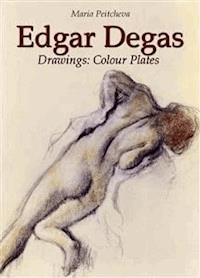
One of Degas' principal concerns as a draftsman was analyzing the movements and gestures of the female body. On view are several drawings featuring dancers, easily recognizable as the study for the celebrated wax sculpture Little Dancer, Fourteen Years Old, depicting the young dancer Marie van Goethem. In this large sheet, the artist studied her from three different angles, attempting to understand the figure in the round in preparation for sculpting it. Other examples of drawings with dancers include Seated Dancer (ca. 1871), one of the studies for Dance Class at the Opéra on the Rue le Peletier, as well as Two Studies of Dancers (ca. 1873), Dancer with Arms Outstretched (ca. 1878), and Two Studies of a Ballet Dancer (ca. 1872). Though noted for his attention to the female figure, Degas executed many studies of grouped horses and jockeys from which he would use figures in later compositions. Later in his career, Degas experimented with mixing drawing media and printmaking techniques.
Das E-Book können Sie in Legimi-Apps oder einer beliebigen App lesen, die das folgende Format unterstützen:
Veröffentlichungsjahr: 2016
Ähnliche





Edgar Degas
Drawings: Colour Plates
By Maria Peitcheva
First Edition
*****
Edgar DegasDrawings:Colour Plates
*****
Copyright © 2016 Maria Peitcheva
Foreword
Degas began studying law in Paris in 1853, though he soon turned his attention to copying works in the Louvre. Later, he entered the studio of Louis Lamothe, who was a pupil of Ingres and also studied at the École des Beaux-Arts. He left Paris in July 1856 to study independently in Rome, where he filled sketchbooks and sheets with studies of models and copies of old masters. Study of a Male Nude dates from his first year in Rome and reflects the artist's early academic efforts.
Thirty-eight sketchbooks by Degas have survived essentially intact. They cover the period between 1853 and 1886 and constitute the most significant sustained record of any Impressionist artist. His early sketchbook contains diligent student work, such as sketches of antique statuary and copies of Renaissance frescoes and paintings. The subjects range from the whimsical to the thoughtful, with quick portraits of dinner guests, sketches of dancers, and scenes from a Turkish bath in the later notebook.
Degas' much-heralded explorations of dancers—in rehearsal, on stage, and at rest—began in the 1870s and intensified during the ensuing decades. This period also marked the beginning of his success as an artist. One of Degas' principal concerns as a draftsman was analyzing the movements and gestures of the female body. On view are several drawings featuring dancers, including Three Studies of a Dancer (ca. 1880), easily recognizable as the study for the celebrated wax sculpture Little Dancer, Fourteen Years Old, depicting the young dancer Marie van Goethem. In this large sheet, the artist studied her from three different angles, attempting to understand the figure in the round in preparation for sculpting it.
Other examples of drawings with dancers include Seated Dancer (ca. 1871), one of the studies for Dance Class at the Opéra on the Rue le Peletier, now in the Musée d'Orsay in Paris, as well as Two Studies of Dancers (ca. 1873), Dancer with Arms Outstretched (ca. 1878), and Two Studies of a Ballet Dancer (ca. 1872).
Though noted for his attention to the female figure, Degas executed many studies of grouped horses and jockeys from which he would use figures in later compositions. Later in his career, Degas experimented with mixing drawing media and printmaking techniques. He began the drawing in 1885 using an impression from his 1877–78 lithographs of a concert at Café des Ambassadeurs, which he extended along the bottom and right edges, and drew over in dense strokes of pastel. Degas first produced a monotype—a unique print made from drawing in ink on a metal or glass plate—of two singers on stage, seen from behind, with a view to the audience. He then enlivened the print with richly colored pastels. In the village of Diénay near Dijon, Degas recalled scenery from the drive through the Burgundian countryside and produced about fifty monotype landscapes. To create this drawing, he used oil paint (and apparently his fingers) to indicate a few lines of landscape on the plate and printed one or two proofs, hanging them to dry. Later, he completed the composition with a rich layer of pastel.
After the Franco-Prussian War of 1870–71, Degas focused almost exclusively on dancers and nudes, increasingly turning to sculpture as his eyesight weakened. In his later years, he was concerned chiefly with showing women bathing, entirely without self-consciousness and emphatically not posed. Despite the seemingly fleeting glimpses he portrayed, he achieved a solidity in his figures that is almost sculptural.
In later life, Degas became reclusive, morose, and given to bouts of depression, probably as a consequence of his increasing blindness. Degas continued working as late as 1912, when he was forced to leave the studio in Montmartre in which he had labored for more than twenty years. He died five years later in 1917, at the age of eighty-three.
Drawings
Two Studies of a Jockey, 1884, black chalk, charcoal, and pastel on brown laid paper
Detail
Self-Portrait, 1855, red chalk on laid paper




