


0,49 €
Niedrigster Preis in 30 Tagen: 1,99 €
Niedrigster Preis in 30 Tagen: 1,99 €
Mehr erfahren.
- Herausgeber: Booksell-Verlag
- Kategorie: Abenteuer, Thriller, Horror
- Sprache: Englisch
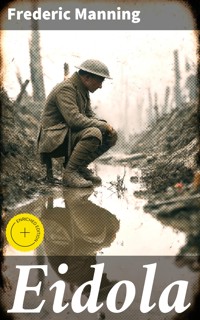
Frederic Manning's "Eidola" is a haunting and multifaceted exploration of memory, identity, and the ephemeral nature of existence. Written in a stream-of-consciousness style, the narrative delves into the experiences of a group of individuals as they navigate the complexities of life in wartime Europe. The prose is rich and evocative, reflecting a nuanced understanding of human emotion and the philosophical underpinnings of reality. Set against the backdrop of World War I, Manning's masterful use of symbolism and imagery elevates the text to a profound meditation on the transient yet impactful nature of human connections and the spectres that haunt our memories. Frederic Manning, an Australian poet and novelist, lived through the tumult of the early twentieth century, which significantly shaped his literary voice. His experiences as a soldier during World War I deeply influenced his writing, lending authenticity and urgency to his portrayal of loss and the search for meaning amidst chaos. Manning's keen perception of the human condition, sustained by both his adventurous spirit and introspective depth, informs the philosophical inquiries woven throughout "Eidola." This remarkable novel is recommended for readers seeking a deeply reflective and artistically crafted narrative. Manning's skillful prose not only invites contemplation but also challenges conventional understandings of reality and identity, making "Eidola" an essential read for those interested in modernist literature and the intricate interplay of memory and experience. In this enriched edition, we have carefully created added value for your reading experience: - A succinct Introduction situates the work's timeless appeal and themes. - The Synopsis outlines the central plot, highlighting key developments without spoiling critical twists. - A detailed Historical Context immerses you in the era's events and influences that shaped the writing. - A thorough Analysis dissects symbols, motifs, and character arcs to unearth underlying meanings. - Reflection questions prompt you to engage personally with the work's messages, connecting them to modern life. - Hand‐picked Memorable Quotes shine a spotlight on moments of literary brilliance. - Interactive footnotes clarify unusual references, historical allusions, and archaic phrases for an effortless, more informed read.
Das E-Book können Sie in Legimi-Apps oder einer beliebigen App lesen, die das folgende Format unterstützen:
Veröffentlichungsjahr: 2019
Ähnliche















Eidola
Table of Contents
Introduction
At its core, Eidola explores how the images we carry—of self, others, and the past—both clarify and disturb our grasp of truth. Frederic Manning’s book invites readers to consider the fragile boundary between what is seen and what is understood, tracing the ways thought and feeling refract experience into shifting forms. Rather than offering a single, linear narrative, it dwells on perception itself: how memory fixes, alters, or dissolves what once seemed solid. The result is an inward journey concerned less with events than with the patterns that consciousness makes of them, and the ethics such patterns quietly imply.
Written by Frederic Manning (1882–1935), an Australian-born writer long resident in Britain, Eidola emerges from the early twentieth century, within the atmosphere of modernist experimentation and post-Victorian scrutiny. The period’s pressures—intellectual, cultural, and historical—shape its measure and restraint. It is not a book anchored to a single, concrete locale so much as to states of mind, reflection, and recollection. Readers encounter a work that is formally concise and tonally controlled, using economy rather than amplitude to achieve its ends. In this context, Eidola stands alongside contemporaneous literary efforts to test language against the complexities of modern experience.
The premise is simple yet demanding: to follow a mind examining the “seen” and the “felt” until their limits—and their mutual distortions—come into view. Manning’s voice is measured and scrupulous, favoring cadence, clarity, and an exacting register over ornament or display. The mood is grave but never inert, moving between austerity and quiet tenderness. Readers should expect a reflective, intimate encounter rather than conventional plot or spectacle. That intimacy rewards patience: ideas accrue by subtle inflection, images echo and evolve, and meaning emerges less as thesis than as a tempered poise, a way of standing amidst uncertainty without surrendering to it.
Themes gather around perception, memory, and the ethics of attention. The title points toward the ancient Greek notion of eidola—images or semblances—which here signals an inquiry into appearances: how they attract, mislead, and sometimes disclose what argument alone cannot. Manning probes the tension between the transience of sensation and the human urge to impose order, asking what kind of truth can be won from fragments. The book contemplates the costs of self-knowledge, the pull of illusion, and the discipline of seeing things as they are. In doing so, it considers the responsibilities that attend remembrance, judgment, and language itself.
Eidola also bears the hallmarks for which Manning is widely recognized: a classical poise, moral seriousness, and resistance to rhetoric. Known for his unsparing clarity in The Middle Parts of Fortune (published under two titles in different forms), he brings similar exactitude here, though turned inward, toward perception and form. The sentences are crafted to carry weight lightly—lean, precise, and attentive to nuance. This stylistic restraint shapes the reading experience: the book invites contemplation rather than assertion, insisting that significance be earned through exact observation and carefully tested feeling, not bestowed by grand claims or sentimental flourish.
For contemporary readers, the book’s preoccupation with images and appearances feels strikingly current. In an age crowded with representations—photographic, digital, ideological—Eidola asks what we owe to what we see, and how we can honor experience without distorting it. Its inquiry into memory’s treacheries and gifts resonates with ongoing debates about testimony, history, and the fragile status of truth. The work values patience, attentiveness, and humility before complexity—qualities at a premium when speed and certainty often dominate. By modeling a rigorous, humane way of looking, it offers an ethical stance as much as an aesthetic one.
Approached as a meditative companion rather than a conventional narrative, Eidola offers a quietly intense experience: spare in design, rich in aftereffects. It rewards slow reading and re-reading, inviting the eye to linger and the mind to test each inference. Readers drawn to reflective prose, to the interplay of image and idea, and to the disciplined pursuit of clarity will find much to admire. Without rehearsing answers, the book sharpens questions that remain urgent: what is it to see well, to remember justly, and to speak truthfully about what passes through us. Its resonance lies in that sustained, exacting attention.
Synopsis (Selection)
Eidola is a collection of poems by Frederic Manning that assembles meditations on appearance, memory, and the shaping force of images. The title signals an interest in likenesses—forms that seem to stand in for the real—and the poems proceed to examine how such figures arise in thought, history, and daily experience. Without adopting a single narrative, the volume moves in a deliberate sequence, beginning with abstract considerations and proceeding toward more concrete scenes. Throughout, the voice presents objects and moments with restrained clarity, allowing themes of mortality, time, and perception to emerge as the organizing concerns that hold the collection together.
The opening poems define the book’s terms by reflecting on eidola as the seen and the imagined. They weigh the difference between essence and semblance, pondering how the mind projects patterns onto things. Images from antiquity—statues, shadows, and mirrors—frame these entries, not to ornament but to illustrate the distance between what endures and what fades. The tone is reflective and precise, setting out problems rather than resolving them. In tracing how memory preserves an outline while detail recedes, the section establishes the book’s central method: attending to appearances as evidence, acknowledging their partial truth, and testing them against the pressures of reality.
From these initial premises, the collection turns to a series of portraits and short scenes that consider public and private selves. Figures from history and myth appear less as subjects than as examples of how reputation hardens into image. The poems observe speech, gesture, and setting, recording how character is inferred from surfaces. The writing remains economical, careful to show rather than explain. These pieces introduce a tension between the observed and the inferred, preparing the shift toward contemporary realities. By aligning the past’s figures with present impressions, the book frames recognition as an act of seeing through, while noting the limits of such seeing.
As the sequence advances, the focus moves into the atmosphere of modern conflict. The poems present landscapes altered by war, routines of service, and the compressed relations among men under strain. Rather than narrate operations, they attend to the ordinary: a road at dusk, a shelter, the passing of orders. The presence of danger is registered through detail and cadence. Appearances assume new urgency, since misreading them can be costly. In this context, the notion of eidola expands to include fear’s projections and the mind’s defenses. The section emphasizes observation as discipline, sustaining attention when judgment or consolation are uncertain.
Subsequent poems address loss and remembrance with measured reserve. The dead appear as forms kept by those who survive, their identities reduced to tokens, names, or the outline retained by routine. Dreams and waking recollection intermingle, not to dramatize grief but to show how memory maintains its own order. Anonymous graves, lists, and rituals of duty structure these pieces. The idea of an eidolon becomes practical: an image held to keep a place for what is gone. The poems neither idealize nor dismiss; they record what can be said, admitting the remainder that cannot be recovered or securely known.




