


5,49 €
Mehr erfahren.
- Herausgeber: Rock Rooster Books
- Kategorie: Religion und Spiritualität
- Sprache: Englisch
Understand God Like Never Before!
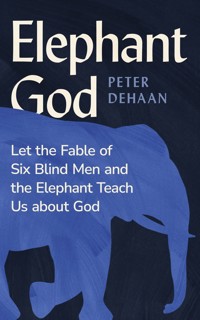
Take a profound journey toward understanding God through the lens of a timeless fable. Recall the six blind men exploring an elephant—each touching a different part and each declaring partial truth. Do their limited perceptions mirror our own attempts to understand the Almighty? Let Elephant God provide clarity.
In this captivating exploration, embrace your spiritual curiosity. Drawing on vivid biblical metaphors—from God as our Father and Jesus as our Shepherd to the Holy Spirit as a gentle wind—this book paints a multifaceted portrait of the Almighty.
Each chapter reveals a fresh piece to our puzzle, 32 pieces in all. Explore how these images merge to provide a fuller picture to better understand God and our relationship with him.
Are we seeking a deeper connection, clarity, or even awe in our spiritual walk? As we navigate the intricate tapestry of God’s nature, we’ll discover that while we may never fully comprehend the Divine, each metaphor will bring us a step closer to the true essence of God—a loving Creator eager to know us intimately.
Embark on this enlightening quest, where clarity emerges from complexity, and where the incomprehensible becomes a source of wonder. Elephant God is sure to expand your vision and enrich your faith, one metaphor at a time.
Don’t just view God from a distance. Comprehend him with increased understanding and renewed appreciation.
Get your copy of Elephant God today.
Das E-Book können Sie in Legimi-Apps oder einer beliebigen App lesen, die das folgende Format unterstützen:
Veröffentlichungsjahr: 2025
Ähnliche





ELEPHANT GOD
LET THE FABLE OF SIX BLIND MEN AND THE ELEPHANT TEACH US ABOUT GOD
PETER DEHAAN
Elephant God: Let the Fable of SixBlindMen and the ElephantTeachUsAboutGod
Copyright © 2025 by PeterDeHaan.
All rights reserved: No part of this book may be reproduced, disseminated, or transmitted in any form, by any means, or for any purpose, without the express written consent of the author or his legal representatives. The only exceptions are brief excerpts, and the cover image, for reviews or academic research. For permissions: peterdehaan.com/contact.
Unless otherwise noted, Scriptures taken from the HolyBible, NewInternationalVersion®, NIV®. Copyright © 1973, 1978, 1984, 2011 by Biblica, Inc.™ Used by permission of Zondervan. All rights reserved worldwide. www.zondervan.comThe “NIV” and “NewInternationalVersion” are trademarks registered in the UnitedStatesPatent and TrademarkOffice by Biblica, Inc.™
Library of CongressControlNumber: 2025901918
Published by RockRoosterBooks, GrandRapids, Michigan
ISBNs:
Credits:
To Shara
Series by PeterDeHaan
40-DayBibleStudySeriestakes a fresh and practical look into Scripture, book by book.
Bible CharacterSketchesSeriescelebrates people in Scripture, from the well-known to the obscure.
Holiday CelebrationDevotionalsrejoices in the holidays with Jesus.
Visiting ChurchesSeries takes an in-person look at church practices and traditions to inform and inspire today’s followers of Jesus.
Be the first to hear about Peter’s new books and receive updates at PeterDeHaan.com/updates.
CONTENTS
Six Blind Men and the Elephant
Father God
God Is Our Father
Father God Is the Gardener
Father God Is the Potter
Father God Is an Eagle
Father God Is Our Refuge
Father God Is Our Rock
Embrace Father God
Son
Jesus Is the Son of God
Jesus Is Our Shepherd
Jesus Is the Gate
Jesus Is the Lamb
Jesus Is Our Savior
Jesus Is Our High Priest
Jesus Is Our Great Physician
Jesus Is a Hen
Jesus Is the Bridegroom
Jesus Is the Vine
Jesus Is the Cornerstone
Jesus Is Our King
Jesus Is the Word
Jesus Is Light
Jesus Is the Way
Embrace Jesus
Holy Spirit
Holy Spirit Is Our Advocate
The Holy Spirit Is Fire
Holy Spirit as Wind
Holy Spirit as a Dove
Holy Spirit Gives Power
Embrace the Holy Spirit
More Metaphors
Creator
Lord
Judge
Consuming Fire
Master
Friend
Embrace More Metaphors
Wrapping Up
For Small Groups, Sunday School, and Classes
About Peter DeHaan
Books by Peter DeHaan
SIX BLIND MEN AND THE ELEPHANT
There is a well-known fable in India about six blind men who encounter an elephant. The men have never seen one and don’t know what to expect. When they meet this massive beast for the first time, they rely on their sense of touch to explore the creature and form their understanding of him.
The first man marches forward in confidence and walks into the side of the elephant. With a thump, the man falls to the ground. To him, the elephant is unmovable, a fixed object. He declares that the elephant is like a brick wall. He is not incorrect.
The second man, wanting to avoid what the first man encountered, is more cautious. He drops to the ground, crawling toward the elephant. When he reaches one of the beast’s legs, he wraps his arms around its girth. Unable to make the leg move, he proclaims that the elephant is like a tree trunk. He is not incorrect.
The third man gingerly approaches the elephant with hands stretched out in front of him. The first thing he touches is the elephant’s ivory tusk. His fingers explore its formidable length, ending up at the pointed tip. He asserts that the elephant is like a spear. He is not incorrect.
The fourth man, following closely behind the third, cautiously approaches the elephant. He’s hesitant. Not wanting to walk into a spear, he stops short. He’s curious but wary. The elephant is also curious and stretches out its trunk to touch the man, wrapping his proboscis around the man’s arm. The muscular snout surprises the man, and he tries to push it away. He can’t. In a panic, he concludes that the elephant is like a snake. He is not incorrect.
The fifth man is much more adventurous than the three who preceded him and not unlike the first. He boldly moves forward and encounters the elephant’s side. Unlike the first man, however, he doesn’t fall. He gropes his way forward until he reaches the animal’s shoulder. That’s when the elephant flaps his ears, producing a cool breeze that comforts the man. He states that the elephant is like a fan. He is not incorrect.
The sixth man doesn’t take the same path as those who came before him. Instead, he walks toward the animal’s hindquarters. The elephant swishes his powerful tail and thwacks the man’s shoulder. It stings. He announces that the elephant is like a whip. He is not incorrect.
Each of these six blind men made a reasonable determination about the elephant, comparing the creature to what they knew. Yet each of their assessments is incomplete, laughably so.
Yes, the elephant has the characteristics of a wall, a tree, a spear, a snake, a fan, and a whip. Yet the elephant is so much more.
Even merging these six characteristics into a composite understanding of an elephant still falls far short.
So it is with us and God. As spiritually blind people—at best with spiritually incomplete vision—we can seek to better understand God through word pictures, metaphors, and imagery of what we can comprehend, but we’ll still fail to fully grasp what is beyond our comprehension. Still, we’re wise to push forward in our quest.
Compare this to working on a jigsaw puzzle. We can hold one puzzle piece and maybe get a hint of what the full picture will look like. Yes, it is a piece of the whole, but it’s just a small part of the picture. What we see in that one puzzle piece is reliable, but it’s also incomplete.
Now, consider connecting two pieces in our puzzle. Together they represent more knowledge and provide more information than what either can provide alone. More of the picture comes to the forefront. More of it becomes clear, but it’s still just a small part of the picture.
Even when we complete our puzzle, we’re still looking at a picture, a representation of something far better and grander. At best it’s like looking at a reflection in a mirror, where we only know in part (1 Corinthians 13:12).
For now, accept that we’ll never fully understand who God is as long as we’re here on earth. Though we can understand a part of who he is, we’ll never fully comprehend him. Even so, we must embrace all the individual pieces to move toward the completion of the puzzle and gain a more comprehensive idea of who God is and how we relate to him.
In this book, we’ll explore many biblical characteristics of who God is. In doing so, we’ll move forward to better comprehend the incomprehensible. Though our conclusions will still fall short, they will draw us closer to the AlmightyGod as revealed to us in Scripture.
Some of these metaphors of God specifically address one part of his being: God the Father, God the Son, or God the HolySpirit. Others are inclusive, applying to all parts of the Trinity. We’ll organize our discussion of these godly metaphors accordingly, all the while expecting to see overlapping characteristics between each part of the godhead. We should not let this trouble us and instead marvel at the wondrous complexity of who God is.
As we do so, some of these word pictures of who he is will resonate with us powerfully. Others will give us pause or even cause consternation. But don’t be distressed by that. Each image moves us closer to a holistic understanding of the brilliant mystery of the all-powerful God who created us and wants to be in a relationship with us.
May these scriptural images of God produce awe and admiration, moving us into a deeper appreciation of him.
Questions:




