


5,00 €
Mehr erfahren.
- Herausgeber: Daniel B. Smith
- Kategorie: Für Kinder und Jugendliche
- Sprache: Englisch
The main purpose of these book series is to provide you an impressive and invaluable collection of English Grammar multiple-choice exercises.
This book comprises different items and will take you on a beautiful journey towards improving your English.
The following subjects have been specially crafted for you, with regard to: word order, articles, verb tenses, active and passive voice, phrasal verbs, prepositions, nouns, conditionals, reported speech, confusing words, word formation, idioms.
There will be many levels of difficulty in my English Grammar Exercises books: Beginner, Pre-intermediate, Intermediate, Upper Intermediate and Advanced.
This book deals with Intermediate and Upper Intermediate levels.
Please keep an eye on further releases.
Good luck!
Das E-Book können Sie in Legimi-Apps oder einer beliebigen App lesen, die das folgende Format unterstützen:
Veröffentlichungsjahr: 2022
Ähnliche






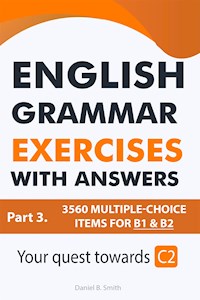
English Grammar Exercises with answers
Your quest towards C2
Part 3: 3560 multiple-choice items
Daniel B. Smith
Daniel B. Smith Copyright © 2020
All rights reserved. No part of this publication may be reproduced, distributed or transmitted in any form or by any means, including photocopying, recording, or other electronic or mechanical methods, without the prior written permission of the author, excepting the case of brief quotations embodied in critical reviews and certain other noncommercial uses permitted by copyright law.
ENGLISH GRAMMAR EXERCISES WITH ANSWERS
Your quest towards C2
-Part 3: 3560 multiple-choice items-
Intermediate and Upper Intermediate(B1&B2)
Table of contents
Introduction
PART I: Intermediate level
Word order
Articles
Present Tenses
Past Tenses
Future Tenses
Passive Voice
Modal Verbs
Phrasal Verbs
Irregular Verbs
Pronouns
Adjectives
Adverbs
Relative Clauses
Noun plus preposition
Prepositions
Adjective plus preposition
Nouns
Some, any, a lot of, many, much
Conditionals
Reported Speech
PART II: Upper intermediate level
Word order
Articles
Present Tenses
Past Tenses
Future Tenses
Passive Voice
Confusing Words
Phrasal Verbs
Irregular Verbs
Linking Words
Adjectives
Adverbs
Gerunds and Infinitives
Noun plus preposition
Prepositions
Adjective plus prepositions
Nouns
Some, any, a lot of, many, much etc.
Expressing Hypothetical Meaning
Word formation
PART III: Intermediate and Upper intermediate levels
Present Simple
Present Continuous
Present Perfect
Past Simple
Past Continuous
Past Perfect
Future Tenses
Articles
Prepositions
Spelling
Conjunctions
Dictionary
Guess the tense
Synonyms
Antonyms
Phrasal verbs
Idioms
Mixed tests
PART IV: Consolidation
Nouns consolidation
Adjectives consolidation
Verbs consolidation
Adverbs consolidation
Prepositions consolidation
Conjunctions consolidation
Reported speech consolidation
Articles consolidation
Determiners consolidation
Mixed tests consolidation
PART V: Final items
Answers
Conclusion
Introduction
The main purpose of these book series is to provide you an impressive and invaluable collection of English Grammar multiple-choice exercises. This book comprises different items and will take you on a beautiful journey towards improving your English.The following subjects have been specially crafted for you, with regard to: Word order, Articles, Verb tenses, Active and passive voice, Phrasal verbs, Pronouns, Adjectives, Adverbs, Relative clauses, Prepositions, Nouns, Conditionals, Reported speech, Confusing words, Word formation, Idioms and many more…
The table of contents provides you with a wide range of exercises and you can easily choose what to practice and how hard theat subject will be. Every topic has in brackets the difficulty level, as you’ve already seen.
There will be many levels of difficulty in my English Grammar Exercises books: Beginner, Pre-intermediate, Intermediate, Upper Intermediate and Advanced.
This book deals with Intermediate and Upper Intermediate levels.
Please keep an eye on further releases.
Good luck!
PART I: Intermediate level
Word order
1. Choose the sentence with the right word order:
a) Tom a lot of people invited. b) A lot of people Tom invited. c) Tom invited a lot of people. d) Tom invited of people a lot.
2. Choose the sentence with the right word order: a) I think you should never put this T-shirt on. b) I think you never should put this T-shirt on. c) I think you should put this T-shirt never on. d) I think you should put never this T-shirt on.
3. Choose the sentence with the right word order: a) The biggest animal on Earth the blue whale is. b) On Earth is the biggest animal blue whale. c) Is the biggest animal on Earth the blue whale. d) The blue whale is the biggest animal on Earth.
4. Choose the sentence with the right word order: a) We often don’t go to the cinema. b) We don’t often go to the cinema. c) We don’t go often to the cinema. d) We don’t go to the cinema often.
5. Choose the sentence with the right word order: a) Scott drives to work every day. b) Every day to work Scott drives. c) Scott every day drives to work. d) Every day drives Scott to work.
6. Choose the sentence with the right word order: a) I can to the swimming pool go with you. b) I can go to the swimming pool with you. c) Can I go to the swimming pool with you. d) To the swimming pool can I go with you.
7. Choose the sentence with the right word order: a) You would like some coffee? b) Some coffee would you like? c) Would like you some coffee? d) Would you like some coffee?
8. Choose the sentence with the right word order: a) John doesn’t often go to the theatre. b) John often doesn’t go to the theatre. c) John doesn’t go often to the theatre. d) Often John doesn’t go to the theatre.
9. Choose the sentence with the right word order: a) A federation is Australia of six states. b) A federation of six states Australia is. c) Australia of six states is a federation. d) Australia is a federation of six states.
10. Choose the sentence with the right word order: a) Is how far your town from here? b) How far your town from here is? c) How far your town is from here? d) How far is your town from here?
11. Choose the sentence with the right word order: a) When did Apollo 11 land on the Moon? b) When Apollo 11 did land on the Moon? c) Did Apollo 11 land on the Moon when? d) When did land Apollo 11 on the Moon?
12. Choose the sentence with the right word order: a) In a modern big house lived Harry. b) Harry in a big modern house lived. c) Harry lived in a modern big house. d) Harry lived in a big modern house.
13. Choose the sentence with the right word order: a) My purse my brother found outside the house. b) My brother found my purse outside the house. c) Outside the house found my brother my purse. d) My brother outside the house found my purse.
14. Choose the sentence with the right word order: a) Is what the name of this street? b) The name of this street is what? c) What is the name of this street? d) What the name of this street is?
15. Choose the sentence with the right word order: a) Julia bought eleven yellow amazing tulips. b) Julia eleven amazing yellow tulips bought. c) Julia bought eleven amazing yellow tulips. d) Julia eleven yellow amazing tulips bought.
16. Choose the sentence with the right word order: a) Pete comes from England. b) Comes Pete from England. c) From England Pete comes. d) Pete from England comes.
17. Choose the sentence with the right word order: a) Patrick White received in 1973 the Nobel Prize. b) Patrick White received the Nobel Prize in 1973. c) In 1973 the Nobel Prize Patrick White received. d) Received Patrick White the Nobel Prize in 1973.
18. Choose the sentence with the right word order: a) Steve was wearing a fantastic Italian coat. b) Steve was wearing an Italian fantastic coat. c) Steve was a fantastic Italian coat wearing. d) Steve was an Italian fantastic coat wearing.
19. Choose the sentence with the right word order: a) They not are walking in the park. b) They are walking in the park not. c) Not they are walking in the park. d) They are not walking in the park.
20. Choose the sentence with the right word order: a) New Zealand is about the same size as Great Britain or Japan. b) New Zealand about the same size as Great Britain or Japan is. c) About the same size as Great Britain or Japan New Zealand is. d) New Zealand about the same size is as Great Britain or Japan.
21. Choose the sentence with the right word order: a) You have ever been to Boston? b) Have you ever been to Boston? c) Have you been ever to Boston? d) Have you been to Boston ever?
22. Choose the sentence with the right word order: a) It is a nice small town in France. b) It is a small nice town in France. c) In France it is a nice small town. d) In France it is a small nice town.
23. Choose the sentence with the right word order: a) The Olympics take place every four years. b) Every four years take place the Olympics. c) The Olympics take every four years place. d) Take place the Olympics every four years.
24. Choose the sentence with the right word order: a) Her husband returns usually home at 7 p.m. b) Her husband usually returns home at 7 p.m. c) Her husband returns home at 7 p.m. usually. d) Her husband returns home at usually 7 p.m.
25. Choose the sentence with the right word order: a) You can show me the way to Westminster Abbey? b) Can show you me the way to Westminster Abbey? c) Can you show me the way to Westminster Abbey? d) To Westminster Abbey you can show me the way?
26. Choose the sentence with the right word order: a) What your favourite colour is? b) Is what you favourite colour? c) What is you favourite colour? d) Your favourite colour is what?
27. Choose the sentence with the right word order: a) Five years before in London had she met Jim. b) She had five years before met Jim in London. c) She five years before had met Jim in London. d) She had met Jim in London five years before.
28. Choose the sentence with the right word order: a) A famous American actress Marilyn Monroe was. b) Marilyn Monroe was a famous American actress. c) Marilyn Monroe a famous American actress was. d) Was Marilyn Monroe a famous American actress.
29. Choose the sentence with the right word order: a) 2,500 kilometers long The Great Wall of China is. b) The Great Wall of China is 2,500 kilometers long. c) Is The Great Wall of China 2,500 kilometers long. d) The Great Wall of China 2,500 kilometers is long.
30. Choose the sentence with the right word order: a) Wolfgang Mozart was in 1756 in Salzburg born. b) Wolfgang Mozart was born in 1756 in Salzburg. c) Wolfgang Mozart was born in Salzburg in 1756. d) Wolfgang Mozart in 1756 in Salzburg was born.
Articles
31. Have you got … pen? a) a b) the c) an
32. We have got only … hour to do this task. a) the b) an c) a
33. I saw a bird in the tree. … bird was grey. a) The b) A c) An
34. Paris is … capital of France. a) a b) an c) the
35. I see … three men outside. a) the b) - c) a
36. Charles Dickens was … famous English writer. a) an b) the c) a
37. Is this … your new car? a) a b) the c) –
38. … Moon is beautiful today, isn’t it? a) The b) - c) A
39. I’ve bought some cheese, five apples and … bottle of wine. a) the b) a c) an
40. Have you ever been to … Sicily? a) a b) - c) the
41. … Kilimanjaro is situated in Tanzania. a) A b) The c) –
42. She told us … interesting story. a) an b) the c) a
43. My friend was born in … USA. a) - b) the c) an
44. I don’t like to come home late in … evening. a) the b) an c) a
45. Have you seen … Tom today? a) the b) a c) –
46. Who said that … Earth is round? a) - b) the c) an
47. Where is … Sahara desert? a) a b) an c) the
48. My cousin wants to become … policeman. a) the b) - c) a
49. My nephew plays … piano very well. a) the b) - c) a
50. He wrote a poem for her. … poem was beautiful. a) A b) The c) –
51. We travelled to … Netherlands last year. a) - b) an c) the
52. I ate … plum and went out. a) a b) an c) –
53. Can you show me … Volga on the map? a) - b) the c) a
54. New York is … city in the USA. a) - b) the c) a
55. Her husband gave her … twenty five roses. a) - b) the c) some
56. Everest is … highest mountain in the world. a) an b) a c) the
57. … Africa is the world’s second largest continent. a) The b) An c) –
58. Steve works in … Hague. a) a b) the c) –
59. We are going to travel around … Europe next year. a) a b) the c) –
60. Tom sent me a photo of … Trafalgar Square. It’s amazing! a) - b) a c) the
Present Tenses
61. Tim … a newspaper now. a) reads b) reading c) is reading
62. Jill … in a hospital. a) is working b) works c) have worked
63. Oh, no! We are late! Nobody opens the door. They … out. a) have gone b) went c) are going
64. She … thirty pancakes today. a) cooked b) cooks c) has cooked
65. The climate … rapidly nowadays. a) has changed b) change c) is changing
66. I … to Spain. a) was never b) am never c) have never been
67. He … at 8 o’clock every day. a) gets up b) is getting up c) has got up
68. You … too loud! a) always talk b) talking c) are always talking
69. Look! Your puppy …! a) swim b) is swimming c) is swiming
70. We all know that the Earth … round. a) is b) is being c) be
71. Oh, no way, I … that man before! a) saw b) have seen c) see
72. The train from Berlin … at 11:15. a) arrives b) is arriving c) arrive
73. I’m fond of history. I often … to museums. a) went b) go c) been
74. My wife usually … a cup of coffee before going to work. a) drink b) is drinking c) drinks
75. I can’t find Mark. It seems he … . a) already go b) already went c) has already gone
76. The sun … in the west. a) has set b) sets c) is setting
77. My plane to Los Angeles … at 07:30. There’re no changes in the timetable. a) is departing b) departs c) depart
78. It’s better to get rid of this toaster. It … more and more insecure. a) is getting b) gets c) has got
79. Steve is very busy. He … a rest very seldom. a) takes b) is taking c) has took
80. It … colder. Do you really want to go out? a) getting b) is getting c) gets
81. I … Alexia since 1999. a) knew b) know c) have known
82. I like to watch thrillers, but now I … a comedy. a) watching b) watch c) am watching
83. Steve and Olivia … friends for many ages. a) have been b) are c) are been
84. Don’t disturb! He … a letter at the moment. a) writes b) is writing c) writing
85. Rachel … in Frankfurt since Sunday. a) has been b) was c) is
86. Robert … the task yet. a) finishes b) finishing c) hasn’t finished
87. Michael … this car for five years. a) is having b) has had c) has
88. Actually, I … apples. a) don’t like b) like not c) am not liking
89. I can bring his umbrella back now. He … from Spain recently. a) return b) returning c) has returned
90. Oh my God! He … the race! a) has just won b) win c) is just win
Past Tenses
91. The Romans … to Britain in 54 BC. a) coming b) came c) come
92. We were strolling in the park when suddenly it … . a) thundered b) thunders c) was thundering
93. I was watching TV while the kids … in the garden. a) played b) playing c) were playing
94. She was writing a letter while her husband … . a) was cooking b) cooked c) cooking
95. I … the guitar at 9 o’clock yesterday. a) play b) was playing c) played
96. Einstein … a paper on the general theory of relativity in 1916. a) was publish b) published c) was publishing
97. Carol was eating a banana while Sandy … his home task. a) has done b) was doing c) did
98. He … the Nobel Prize in literature in 1954. a) had won b) was winning c) won
99. I … home at 7 p.m. yesterday. a) driving b) was driving c) drove
100. The boy … to music when the door bell rang. a) listened b) listen c) was listening
101. I woke up at 7 a.m., ironed my clothes and … out. a) went b) gone c) was going
102. Marian … Mary two years ago. a) has met b) was meeting c) met
103. We … to Australia last year. a) had gone b) went c) had been
104. My cat … with a toy when I called it. a) played b) has played c) was playing
105. Pavarotti … his last performance at the 2006 Winter Olympics in Turin. a) had given b) was giving c) gave
106. Beethoven … his first piece of music when he was 12. a) composed b) composing c) had composed
107. I put my coat on and … a look in the mirror. a) taken b) had taken c) took
108. I was going to a supermarket when the fire … out. a) break b) broke c) was breaking
109. Bill … football at 10 o’clock yesterday. a) played b) was playing c) have played
110. Henry … to his cousin while his wife was reading a newspaper. a) talking b) talk c) was talking
111. Steven … the first book when he was four years old. a) had read b) read c) was reading
112. We went to Hyde Park and then we … in a restaurant. a) relaxed b) have relaxed c) were relaxing
113. David Beckham … for Manchester United from 1993 to 2003. a) was playing b) played c) playing
114. Jill wiped the table after supper, took a shower and … to bed. a) was going b) had gone c) went
115. Lincoln … the 16th President of the United States in 1860. a) had become b) became c) become
116. I was sitting in the café when my phone … . a) was ringing b) had rung c) rang
117. I was listening to music when my mom … my room. a) entered b) has entered c) entering
118. I was trying to concentrate when suddenly my girlfriend … me a fright. a) had given b) gave c) given
119. I was reading a book while the children … . a) slept b) had slept c) were sleeping
120. The first Derby … place in May 1780. a) took b) has taken c) had taken
Future Tenses
121. Bill … his parents tomorrow. He has got an appointment with them. a) visits b) will visit c) is visiting
122. Jim has invited us to his birthday party. He … 27 next week. a) will be b) is c) is going to be
123. It’s a wonderful evening. I really don’t think it … tomorrow. a) rain b) will rain c) is going to rain
124. Carol is 15. She already knows what she wants. She … a singer. a) becomes b) become c) is going to become
125. I’m sorry, but I have no time to do it. I … in serious negotiations tomorrow. a) take part b) will take c) am going to take part
126. Can you help me? – Well, it’s a difficult situation but I … what I can do for you. a) will see b) am seeing c) am going to see
127. I promise, I … tomorrow. a) ring you up b) will ring you c) am going to ring you
128. I … very glad to see you tomorrow. a) am b) will be c) am going to be
129. Kate doesn’t know whether she … to Amsterdam next summer. a) go b) is going c) will go
130. They are planning the wedding. They … soon! a) marry b) will marry c) are going to marry
131. Wait a minute, I … a notepad. a) take b) will take c) am going to take
132. I suppose that he … to Berlin in a few days. a) will return b) is returning c) is going to return
133. Jill … to the dentist next Monday. She has made this decision today. a) will go b) shall go c) is going to go
134. My parents chose a new car two days ago. Today they … buy it. a) will b) are going to c) had
135. Their team is stronger. I believe they … . a) will win b) winning c) are going to win
136. When water … at 100 degrees, put some salt and spaghetti into the saucepan. a) will boil b) is boiling c) boils
137. She has got serious problems. She … a lawyer. She has already informed him about her visit. a) will visit b) is visiting c) is going to visit
138. Well, I … this pair of shoes. a) am taking b) will take c) am going to take
139. I have won the lottery. I … the prize to charity. I had decided to do that before. a) donate b) will donate c) am going to donate
140. He has to do so much today. He … tired after work. a) will be b) be c) is going to be
141. Carol … busy tomorrow. a) is going to be b) is c) will be
142. Ok, I’ve decided! I … to the gallery tomorrow. a) will go b) go c) am going
143. I’m so tired of this town. I … to Paris. a) will move b) am moving c) am going to move
144. She … to the birthday party this weekend. Sarah invited her a week ago. a) has to go b) will go c) is going to go
145. It’s very cold today. I expect it … tomorrow. a) snows b) will snow c) is going to show
146. David is in Boston now. You … him till Monday. a) won’t see b) don’t see c) are not going to see
147. The company … a new store tomorrow. a) opens b) opening c) will open
148. It’s so difficult to make a choice. Ok, I … the red one. a) buy b) will buy c) am going to buy
149. I wanted to go for a walk but I’m too tired to do something today. I … at home and watch TV. a) am to stay b) stay c) am going to stay
150. I don’t know what to do. I can’t visit you because I … for Madrid tomorrow. a) will leave b) leave c) am going to leave
Passive Voice
151. Hey, look! The mail … . a) delivers b) is delivered c) is delivering
152. This book … by Charles Dickens. a) was written b) wrote c) is written
153. Winston Churchill … during the Boer war. a) captured b) is captured c) was captured
154. Cookies … from milk, eggs and flour. a) are made b) makes c) made
155. Napoleon … in 1815. a) defeated b) defeat c) was defeated
156. Many buildings … by the fire in 1980. a) destroys b) destroyed c) were destroyed
157. The fire … under control yesterday. a) brought b) was brought c) was been bring
158. The Beatles … all over the world. a) are known b) knew c) are knew
159. This poem … by Robert Burns. a) was wrote b) is written c) was written
160. That state … by the British in the 18th century. a) captured b) capture c) was captured
161. America … in 1492. a) discovered b) was discover c) was discovered
162. Australia … by Dutch explorers in 1606. a) discovering b) discovered c) was discovered
163. Everybody … about the accident tomorrow. a) informs b) will inform c) will be informed
164. My wallet … yesterday. a) was stolen b) steal c) was stole
165. Your TV … tomorrow. a) delivered b) delivers c) will be delivered
166. The president … tomorrow. a) will elect b) elected c) will be elected
167. Greenpeace … in 1969. a) was founded b) founded c) is founded
168. New Year … all over the world. a) celebrate b) is celebrated c) was celebrated
169. That opera … by Verdi in 1851. a) composed b) composing c) was composed
170. This single … last month. a) release b) releasing c) was released
171. The door … 2 hours ago. a) breaks b) was broke c) was broken
172. This project … tomorrow. a) completed b) compete c) will be completed
173. Berlin … in the 12th century. a) was founded b) founded c) is founded
174. These shoes … in Italy. a) were make b) were made c) made
175. The room … tomorrow. a) cleans b) will clean c) will be cleaned
176. The ballots … several hours ago. a) counted b) counts c) were counted
177. Their dynasty … in 1485. a) established b) is establish c) was established
178. The theatre … next year. a) will be built b) built c) is build
179. That film … by Scorsese in 1990. a) directed b) was directed c) is directed
180. This sweater … of wool. a) is make b) is made c) makes
Modal Verbs
181. My sister is only 6, but she … already play the piano. a) can b) must c) has to
182. … you open the window, please? a) Should b) Could c) Must
183. Perhaps he … pass the exam tomorrow. a) must b) may c) has to
184. Students … listen to the teacher. a) may b) can c) must
185. You look very pale. I think you … go to the doctor. a) should b) might c) can
186. I must be at work at 9 o’clock every day. So, I … wake up at 7 a.m. a) can b) have to c) may
187. Steve … drive a car very well. He is a skillful driver. a) can b) might c) has to
188. She … speak German, Italian and French. a) may b) can c) should
189. … you tell me where Trafalgar Square is? a) Must b) Might c) Could
190. Do you see black clouds? It … rain this evening. a) needs b) could c) may
191. Sorry, I have no time to discuss anything now. I … be at a meeting at 10 o’clock. a) must b) may c) could
192. She told me to watch that movie. She told that I … go to the cinema immediately. a) have to b) should c) might
193. I’m very ill. I … go to the doctor. a) may b) have to c) can
194. I can’t understand anything. … you help me, please? a) Should b) Might c) Could
195. Mary says she … read minds. a) can b) must c) have to
196. … you give me a pen, please? a) Must b) Should c) Could
197. I don’t know where to go next summer. I … go to London. a) have to b) may c) should
198. My car is way too dirty. I … clean it immediately. a) might b) must c) can
199. He is a good sportsman, but he … stop smoking. a) might b) may c) should
200. It’s very cold outside. We … put on warm clothes. a) have to b) could c) may
201. I can’t hear you at all. … you speak louder? a) Could b) May c) Must
202. Sabina is 12 and she … skate yet. a) must b) couldn’t c) can’t
203. … you make me a cup of coffee, please? a) Might b) Could c) Must
204. Don’t run! The dog … get furious. a) needs b) may c) must
205. Carol is very ill. She … take medicines every day. a) can b) must c) may
206. You are sometimes totally unbearable! You … be more tolerant. a) should b) may c) have to
207. Pupils … wear a school uniform in some countries. a) can b) may c) have to
208. I’m very busy today. I … stay at work till night. a) may b) have to c) can
209. I’m sorry, I … hear you. a) can’t b) mustn’t c) haven’t to
210. … you take an umbrella, please? a) Should b) Could c) Must
Phrasal Verbs
211. At first you have to … the application form. a) fill in b) try on c) come on
212. Hey! The floor is wet! Look …! a) in b) out c) after
213. Our plane will … in 23 minutes. a) take up b) turn up c) take off
214. Charles, could you … for a minute? I need to talk to you. a) hold on b) hold up c) hold in
215. Excuse me, I cannot hear you. Could you … please? a) speak above b) speak c) speak up
216. I don’t like this old desk. I’m going to … . a) let it out b) take it off c) throw it away
217. If you aren’t watching TV, … . a) switch it off b) switch it on c) switch it away
218. Sandra, look, what a nice skirt! You should … . a) hold it on b) try it on c) carry it on
219. Mike, …! It’s almost 11 o’clock! a) grow up b) turn up c) hurry up
220. I sometimes … early in the morning. a) wake up b) give up c) grow up
221. Learning languages is very difficult but I need to … doing it. a) keep on b) hold on c) come on
222. Carl is ill, he … today. a) is out b) is after c) is away
223. Let’s go home. The concert … . a) is off b) is over c) is out
224. It’s so nice to see that he … her. a) fell out b) fell for c) fell in
225. Oh, Steve, nice to meet you! You should … to my place some day. a) come away b) come round c) come in
226. She has just … that he lied to her. a) found out b) found in c) found on
227. I don’t want to … (to disappoint you) . a) let you up b) let you in c) let you down
228. I hate this town. I will never … here again. a) go on b) go back c) go behind
229. I think it’s important … with your colleagues. a) to keep in b) to hold on c) to fill in
230. I need … this task until the end of this week. a) to keep on b) to hold on c) to carry out
231. Jenny, could you … my cat for a couple of days? a) look out b) look after c) look into
232. She is … summer holiday. a) looking after b) looking for c) looking forward to
233. Melanie has to … because she is the leader in her squad. a) go ahead b) go on c) go into
234. They … two children. a) bring up b) bring after c) bring at
235. It’s a great pity that they … (to separate). a) woke up b) broke up c) gave in
236. You play chess well. I think you should … the school competition. a) go in for b) go back c) go on
237. I don’t want … with you but you are so wrong. a) to fall in b) to fall for c) to fall out
238. I … with my younger sister very well. We are like close friends. a) get in b) get along c) get up
239. We are planning to … at 9 o’clock tomorrow. a) set off b) set on c) set up
240. He doesn’t know what to do in this situation. I think he’ll … some day. a) get off b) fall for c) give in
Irregular Verbs
241. Choose two forms of the verb “to be” according to the order: Past Simple – Past Participle a) was/were – been b) was – was c) been – been d) been –was
242. Choose two forms of the verb “to become” according to the order: Past Simple – Past Participle a) became – became b) become – become c) become – became d) became – become
243. Choose two forms of the verb “to begin” according to the order: Past Simple – Past Participle a) begun – began b) began – began c) began – begun d) begun – begun
244. Choose two forms of the verb “to break” according to the order: Past Simple – Past Participle a) broke – broken b) broke – broke c) broken – broken d) broken – broke
245. Choose two forms of the verb “to choose” according to the order: Past Simple – Past Participle a) chosen – chosen b) chose – chose c) chosen – chose d) chose – chosen
246. Choose two forms of the verb “to come” according to the order: Past Simple – Past Participle a) came – came b) came – come c) come – come d) come – came
247. Choose two forms of the verb “to do” according to the order: Past Simple – Past Participle a) done – did b) did – did c) done – done d) did – done
248. Choose two forms of the verb “to drink” according to the order: Past Simple – Past Participle a) drank – drank b) drank – drunk c) drunk – drunk d) drunk – drank
249. Choose two forms of the verb “to drive” according to the order: Past Simple – Past Participle a) drove – driven b) drove – drove c) driven – driven d) driven – drove
250. Choose two forms of the verb “to eat” according to the order: Past Simple – Past Participle a) eaten – eaten b) ate – ate c) ate – eaten d) eaten – ate
251. Choose two forms of the verb “to fly” according to the order: Past Simple – Past Participle a) flew – flown b) flew – flew c) flown – flown d) flown – flew
252. Choose two forms of the verb “to forget” according to the order: Past Simple – Past Participle a) forgotten – forgot b) forgot – forgot c) forgot – forgotten d) forgotten – forgotten
253. Choose two forms of the verb “to give” according to the order: Past Simple – Past Participle a) gave – given b) gave – gave c) given – given d) given – gave
254. Choose two forms of the verb “to go” according to the order: Past Simple – Past Participle a) went – went b) went – gone c) gone – gone d) gone – went
255. Choose two forms of the verb “to know” according to the order: Past Simple – Past Participle a) knew – knew b) knew – known c) known – known d) known – knew
256. Choose two forms of the verb “to ring” according to the order: Past Simple – Past Participle a) rung – rang b) rung – rung c) rang – rang d) rang – rung
257. Choose two forms of the verb “to rise” according to the order: Past Simple – Past Participle a) rose – risen b) rose – rose c) risen – risen d) risen – rose
258. Choose two forms of the verb “to run” according to the order: Past Simple – Past Participle a) ran – ran b) ran – run c) run – run d) run – ran
259. Choose two forms of the verb “to see” according to the order: Past Simple – Past Participle a) seen – saw b) seen – seen c) saw – saw d) saw – seen
260. Choose two forms of the verb “to sing” according to the order: Past Simple – Past Participle a) sang – sang b) sang – sung c) sung – sung d) sung – sang
261. Choose two forms of the verb “to speak” according to the order: Past Simple – Past Participle a) spoken – spoke b) spoken – spoken c) spoke – spoken d) spoke – spoke
262. Choose two forms of the verb “to steal” according to the order: Past Simple – Past Participle a) stole – stole b) stole – stolen c) stolen – stolen d) stolen – stole
263. Choose two forms of the verb “to swim” according to the order: Past Simple – Past Participle a) swam – swum b) swam – swam c) swum – swum d) swum – swam
264. Choose two forms of the verb “to take” according to the order: Past Simple – Past Participle a) taken – took b) taken – taken c) took – took d) took – taken
265. Choose two forms of the verb “to wake” according to the order: Past Simple – Past Participle a) woken – woke b) woke – woke c) woke – woken d) woken – woken
266. Choose two forms of the verb “to write” according to the order: Past Simple – Past Participle a) wrote – written b) wrote – wrote c) written – written d) written – wrote
267. Choose two forms of the verb “to blow” according to the order: Past Simple – Past Participle a) blew – blown b) blew – blew c) blown – blown d) blown – blew
268. Choose two forms of the verb “to fall” according to the order: Past Simple – Past Participle a) fell – fell b) fell – fallen c) fallen – fallen d) fallen – fell
269. Choose two forms of the verb “to shake” according to the order: Past Simple – Past Participle a) shaken – shook b) shaken – shaken c) shook – shook d) shook – shaken
270. Choose two forms of the verb “to hide” according to the order: Past Simple – Past Participle a) hid – hid b) hid – hidden c) hidden – hidden d) hidden – hid
Pronouns
271. Your brother is so rude. I don’t like … . a) he b) himself c) him
272. May I take … umbrella? a) your b) you’re c) yours
273. Whose car is this? – This car is … . a) our’s b) our c) ours
274. This is Maria’s book. The book is … . a) she b) hers c) her’s
275. Who are these people? I don’t remember … . a) them b) they c) their
276. What a wonderful machine. Have you done it by …? a) yours b) your c) yourself
277. Steve didn’t do … wrong. a) anything b) something c) nothing
278. The classroom is empty. I can see … here. a) somebody b) nobody c) anybody
279. She spoke to Brad Pitt … . a) itself b) yourself c) himself
280. I’m so sorry, but I can do … in this situation. a) something b) nothing c) anything
281. Jake, we haven’t seen you for ages. When will you come and see …? a) us b) we c) our
282. Look at …! He’s so happy. a) his b) he c) him
283. They have done … work properly. a) them b) their c) they’re
284. Be careful with the knife! You can cut … . a) yourself b) you c) your
285. She had to send an email to the headmaster … . a) him b) yourself c) himself
286. Oh no, am I alone here? I can’t find … . a) anybody b) nobody c) everybody
287. Steven moved out from his parents when he was 19. He has lived by … since that time. a) him b) himself c) his
288. If someone comes tell … to wait for a while. a) him b) her c) them
289. We’ve bought a boat for … . a) ourselves b) our c) us
290. She didn’t answer Bill. She didn’t know what to tell … . a) her b) him c) he
291. She went to the shop but she bought … . a) nothing b) everything c) something
292. She left him and returned to Seattle. Now she lives by … . a) hers b) her c) herself
293. He said the he saw Jessica Alba … in the street. a) herself b) itself c) yourself
294. Is there … who can speak Russian? a) nobody b) anybody c) somebody
295. Do you want to give anybody these flowers? No, I’ve bought them for … . a) myself b) mine c) themselves
296. Caroline, if someone sends a message answer … . a) her b) him c) them
297. It seems Mark and Jessica have taken my umbrella because I can see only … on the shelf. a) theirs b) them c) their
298. Hey! Do you see …? I’m standing in front of the station. a) mine b) me c) my
299. Marry, could you hold on, please? I want to tell you … . a) anything b) nothing c) something
300. Do you know … who can help me? a) somebody b) anybody c) everybody
Adjectives
301. You should be very careful. Snowboarding is a … hobby. a) boring b) dangerous c) awful
302. He gave her a beautiful … ring. The ring is made of gold. a) goldful b) golden c) gold
303. She is … than Caroline. a) shorter b) short c) shortly
304. I think she is … girl in our school. a) beautiful b) beauty c) the most beautiful
305. I think that BMW is a good car. But my brother thinks that AUDI is … . a) good b) better c) gooder
306. They have bought a … table. a) new brown round wooden b) round new brown wooden c) new round brown wooden d) new wooden brown round
307. Mary speaks … German. a) fluent b) fluently c) fluenty
308. We all think his behavior is … . a) antinormal b) unnormal c) abnormal
309. She has a beautiful … (made of gold) ring. a) goldish b) golden c) gold
310. Our guide showed us a/an … tower. a) gloomy old high water b) high gloomy old water c) gloomy high old water d) water old high gloomy
311. I would like to buy this flat because it’s … than that. a) large b) larger c) the larger
312. We can’t work with her anymore. She’s too … . a) unresponsible b) inresponsible c) ilresponsible d) irresponsible
313. Jane bought a nice … skirt. a) metally b) metallic c) metal
314. He is always … . a) inattentive b) unattentive c) imattentive
315. They lived in a … house. a) big three-storey detached nice b) three-storey detached nice big c) nice big three-storey detached d) detached nice big three-storey
316. I like to spend time at home. I’m so … . a) inactive b) unactive c) disactive
317. This chair has a … cover that looks like natural. a) leatherish b) leathery c) leather




