


1,99 €
Mehr erfahren.
- Herausgeber: Booksell-Verlag
- Kategorie: Gesellschafts- und Liebesromane
- Sprache: Englisch
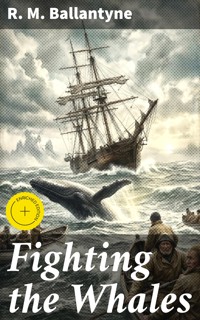
In "Fighting the Whales," R. M. Ballantyne crafts a gripping narrative that explores the perilous world of whaling in the 19th century. Combining adventure with vivid descriptions, Ballantyne delves into the harsh realities faced by whalers, drawing on his own experiences at sea. The book's literary style is marked by a blend of realism and romanticism, reflecting the era's fascination with exploration and the sublime forces of nature. With its rich detail and dramatic encounters, the novel serves as both a thrilling adventure and a critical commentary on humanity's relationship with nature. R. M. Ballantyne was an English author known for his compelling tales aimed at young readers, often inspired by his journeys and the maritime life. His background in the fur trading and whaling industries profoundly influenced his perspective on the moral complexities and dangers of such vocations. This life experience, combined with his storytelling prowess, allows Ballantyne to bring authenticity and depth to the thrilling yet morally ambiguous world he depicts in "Fighting the Whales." Recommended for both avid readers of historical adventure fiction and anyone interested in the ethical considerations of whaling, this vivid tale invites readers into a tumultuous period of maritime history. Ballantyne's novel remains relevant today, urging reflection on humanity'Äôs impact on marine life, while providing an exhilarating escapade that will resonate with lovers of adventure and deep-sea suspense. In this enriched edition, we have carefully created added value for your reading experience: - A succinct Introduction situates the work's timeless appeal and themes. - The Synopsis outlines the central plot, highlighting key developments without spoiling critical twists. - A detailed Historical Context immerses you in the era's events and influences that shaped the writing. - A thorough Analysis dissects symbols, motifs, and character arcs to unearth underlying meanings. - Reflection questions prompt you to engage personally with the work's messages, connecting them to modern life. - Hand‐picked Memorable Quotes shine a spotlight on moments of literary brilliance. - Interactive footnotes clarify unusual references, historical allusions, and archaic phrases for an effortless, more informed read.
Das E-Book können Sie in Legimi-Apps oder einer beliebigen App lesen, die das folgende Format unterstützen:
Veröffentlichungsjahr: 2023
Ähnliche
















Fighting the Whales
Table of Contents
Introduction
In Ballantyne’s whaling tale, the pursuit of profit and prowess collides with the ocean’s immensity and the moral costs of mastering a living world.
Fighting the Whales by R. M. Ballantyne is a work of adventure fiction rooted in the maritime tradition that flourished in the nineteenth century, when sea narratives offered readers both instruction and exhilaration. Its setting is the working seascape of the whaling voyage, shaped by shipboard routines, long distances, and sudden moments of peril. Ballantyne writes from within a Victorian-era cultural moment that valued tales of endurance, practical competence, and character tested under pressure. Readers should approach it as a period piece whose assumptions reflect its time, even as its narrative energies remain direct and accessible.
The story introduces a whaling expedition and draws the reader into the rhythms of life aboard ship: watches, weather, discipline, and the constant readiness required by dangerous work. Rather than relying on mystery or delayed revelation, the book gains momentum from procedure and escalation, showing how ordinary tasks can tip quickly into crisis. The premise is simple and immediately graspable, which lets the novel focus on experience—how men live together in confined quarters, how decisions are made when conditions change, and how the sea alters every plan. The reading experience is immersive and forward-moving, engineered to keep tension close to the surface.
Ballantyne’s voice is brisk and outward-facing, intent on action, observation, and the concrete details that make seafaring intelligible to landbound readers. The style favors clear description and steady narrative progression, with attention to the tools, habits, and hierarchies that sustain a voyage. Its tone balances excitement with an earnest, instructional seriousness characteristic of much nineteenth-century adventure writing. Even when scenes heighten into danger, the prose tends to prize composure and competence, framing hardship as a proving ground for resilience. That combination yields a story that can feel both like a travel account and like a moralized adventure, without requiring specialized knowledge from the reader.
At its core, the book explores courage and fear as practical forces rather than abstract virtues, measuring them against fatigue, isolation, and the unpredictability of nature. It also examines the discipline of teamwork, where survival depends on coordinated effort and trust in shared routines. The whaling context brings additional tensions: the line between skill and domination, the transformation of awe into extraction, and the way economic motives structure risk. Ballantyne’s narrative invites readers to consider how communities justify hazardous labor and how individuals find meaning in work that demands endurance. These themes emerge through situations rather than sermons, giving the novel its enduring narrative drive.
For contemporary readers, Fighting the Whales matters partly because it captures a historical maritime world with immediacy, preserving the texture of shipboard life as adventure literature once imagined it. At the same time, its subject inevitably raises questions that resonate today about human relationships to animals and the environment, and about the narratives cultures build around resource industries. The book can be read as a window into Victorian-era attitudes toward nature, labor, and masculine ideals of fortitude, while also prompting critical reflection on what those attitudes omit. Its relevance lies in this dual capacity: to entertain and to complicate.
Read now, the novel offers a compact lesson in how adventure fiction generates suspense from process, peril, and the stark geometry of sea and weather. It invites admiration for seamanship and solidarity even as it asks readers to sit with the consequences of making the natural world a battleground. Ballantyne’s straightforward storytelling makes the book approachable, while its setting keeps the stakes vivid and elemental. Approached with historical awareness and modern ethical attentiveness, Fighting the Whales becomes more than an old seafaring yarn: it is a study in how danger, ambition, and environment shape character, community, and conscience.
Synopsis
R. M. Ballantyne’s Fighting the Whales follows a youthful protagonist who is drawn into the nineteenth-century world of commercial whaling, a trade presented as both adventurous and relentlessly hazardous. The narrative quickly establishes the social and practical realities of life at sea: discipline aboard ship, the dependence on weather and luck, and the mixture of excitement and dread that accompanies the hunt. Ballantyne frames the voyage as a formative experience, using the ship as a confined community where character, courage, and judgment are constantly tested under pressure.
paragraphs are not solely concerned with action; they trace the protagonist’s adjustment to shipboard routines and to the hierarchy of officers and crew. Early episodes emphasize seamanship, watchkeeping, and the hard labor needed to keep a whaler functioning for long stretches far from land. As the vessel pushes into whaling grounds, the men’s anticipation grows, and the narrative clarifies the economic stakes that drive the expedition. This pragmatic motivation contrasts with the grandeur and unpredictability of the ocean, which repeatedly disrupts plans and exposes vulnerabilities.
paragraphs continue as the ship begins encountering whales, shifting the story into the technical and moral intensity of the chase. Ballantyne depicts the coordinated procedures of lowering boats, managing lines, and attempting to control a powerful animal in open water. These scenes highlight the central conflict between human ingenuity and nature’s force, where success depends on teamwork and composure as much as bravery. The protagonist’s perspective keeps the focus on learning and observation, showing how ordinary men become capable through experience, mentorship, and repeated exposure to danger.
paragraphs also explore the strains that prolonged voyages impose: fatigue, isolation, and the pressure of expectations within a tight-knit crew. Interpersonal dynamics become significant as the protagonist navigates trust, authority, and the varying temperaments of shipmates. Ballantyne balances practical detail with moral emphasis, suggesting that steadiness, restraint, and mutual reliance are as crucial as daring. The whaling enterprise is not romanticized as effortless heroism; instead, the book presents it as work—demanding, often uncomfortable, and occasionally terrifying—undertaken for livelihood and pride.
paragraphs introduce further complications as the voyage progresses through uncertain conditions that can turn routine tasks into emergencies. The sea itself becomes an active antagonist through storms, accidents, and other maritime hazards that threaten ship and crew even when whales are not in sight. Setbacks affect morale and test the officers’ judgment, while moments of success bring only temporary relief before new challenges arise. The protagonist’s growth is measured not by a single triumph but by the accumulation of lessons about risk, responsibility, and the limits of control in an unforgiving environment.
paragraphs remain anchored in the evolving pursuit of whales, emphasizing how each encounter differs and how quickly advantage can reverse. Ballantyne keeps attention on the discipline required to avoid catastrophe, the physical cost of labor, and the ethical ambiguities that can shadow the excitement of the hunt. The narrative sustains tension through near-misses and hard decisions without resolving every uncertainty immediately, maintaining a forward momentum shaped by the voyage’s shifting fortunes. Throughout, the protagonist’s outlook matures, moving from fascination with adventure toward a more sober appreciation of consequences.
paragraphs close with the sense that Fighting the Whales is as much a portrayal of maritime life as it is a tale of perilous pursuit. Without hinging on a single surprise, the book’s power lies in its sustained examination of endurance, camaraderie, and human ambition set against a vast natural world. Ballantyne’s story preserves a view of a historically significant industry and the skills and values it demanded, inviting readers to consider how work, danger, and moral choice intertwine. Its enduring resonance comes from that blend of adventure and reflective realism, kept largely spoiler-safe.
Historical Context
R. M. Ballantyne published many adventure narratives for young readers during the mid-to-late Victorian period, when Britain’s global maritime reach shaped popular culture. Fighting the Whales draws on that world of sail, long-distance commerce, and seafaring labor. In the nineteenth century, British and American whalers ranged across the Atlantic and into the Pacific, operating from ports such as London, Hull, Nantucket, and New Bedford. Whaling voyages could last years and required complex shipboard organization, strict discipline, and specialized skills. This institutional setting underlies Ballantyne’s depiction of life at sea and perilous work.
paragraphs
By the early nineteenth century, whaling had become a major industrial enterprise tied to urban markets. Whale oil was used for lighting and lubrication, and baleen was used in manufactured goods, creating sustained demand. The industry expanded into the “Southern Fishery,” including the waters around the Cape of Good Hope and into the Indian and Pacific Oceans, following earlier depletion of nearer grounds. Crews were multiethnic and often recruited from diverse maritime communities, reflecting broader patterns of labor mobility. These historical conditions inform the narrative’s attention to long voyages, hazardous hunting, and the economic motives that drove ships far from home.
paragraphs
Whaling technology and practice in Ballantyne’s era were shaped by developments that increased efficiency and risk. Crews hunted primarily sperm whales and right whales using small open boats, hand-thrown harpoons, and lances, a method that required close approach and exposed men to capsizing, injury, and drowning. Shipboard processing involved cutting-in and trying-out blubber in large tryworks, which created fire hazards and constant smoke and heat. The distribution of work—lookouts, boatsteerers, mates, and captains—reflected a rigid hierarchy common to sailing ships. Such details provide a realistic framework for the book’s action.
paragraphs




