


3,99 €
Mehr erfahren.
- Herausgeber: BOYD MEDIA
- Kategorie: Sachliteratur, Reportagen, Biografien
- Sprache: Englisch
* Step into the shoes of a founding father and witness the remarkable life of George Washington unfold before your eyes.
* In this meticulously researched biography, delve into the captivating narrative of a man who transformed from a distinguished military leader to the revered first President of the United States.
* Discover the untold stories of Washington's leadership during the American Revolutionary War, where he steered a fledgling nation towards victory against all odds.
* Explore the trials and triumphs of his presidency as he navigated the complexities of building a new nation from scratch.
From his strategic brilliance on the battlefield to his unwavering commitment to the principles of democracy, Washington's legacy continues to shape the very fabric of American society today. Gain insight into the personal struggles and sacrifices behind the legend, and uncover the enduring principles that propelled him to greatness.
Whether you're a history enthusiast, a student of leadership, or simply seeking inspiration from one of America's most iconic figures, "George Washington: The Journey from Commander-in-Chief to First President" offers a compelling and immersive experience unlike any other. Click the Buy Now button and embark on a journey through history with George Washington as your guide.
Das E-Book können Sie in Legimi-Apps oder einer beliebigen App lesen, die das folgende Format unterstützen:
Veröffentlichungsjahr: 2024
Ähnliche




















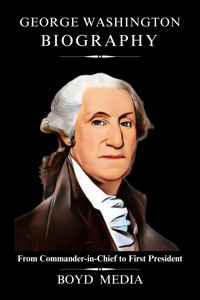
GEORGE WASHINGTON
BIOGRAPHY
-----------------
From Commander-in-Chief to First President
BOYD MEDIA
All rights reserved. No part of this book may be reproduced, stored in a retrieval system, or transmitted in any form or by any means—electronic, mechanical, photocopying, recording, or otherwise—without the prior written permission of Boyd Media, except for brief quotations in critical reviews and certain other noncommercial uses permitted by copyright law.
The information in this book is provided "as is" and without warranties of any kind, either express or implied. The author and publisher make no representations or warranties with respect to the accuracy or completeness of the contents of this book and specifically disclaim any implied warranties of merchantability or fitness for a particular purpose. The advice and strategies contained herein may not be suitable for your situation. You should consult with a professional where appropriate. The author and publisher shall not be liable for any loss of profit or any other commercial damages, including but not limited to special, incidental, consequential, or other damages.
Copyright © 2024 by Boyd Media. All rights reserved
Table Of Contents
Introduction
chapter 1: early life and family background
chapter 2: education and youth
chapter 3: washington's military aspirations
chapter 4: the french and indian war
chapter 5: marriage and mount vernon
chapter 6: road to revolution
chapter 7: commander-in-chief of the continental army
chapter 8: crossing the delaware and victory at trenton
chapter 9: valley forge and the winter of 1777-1778
chapter 10: the alliance with france
chapter 11: victory at yorktown
chapter 12: return to civilian life
chapter 13: shays' rebellion and concerns for the nation
chapter 14: the constitutional convention
chapter 15: the federalist papers
chapter 16: inauguration as the first president
chapter 17: establishing the executive branch
chapter 18: formation of political parties
chapter 19: the whiskey rebellion
chapter 20: the jay treaty and challenges with foreign affairs
chapter 21: farewell address and retirement
conclusion
Introduction
In the hallowed annals of American history, few figures cast as long a shadow as George Washington. Picture this: it's the chilly morning of February 22, 1732, on the Pope's Creek Estate in Westmoreland County, Virginia. The world was blissfully unaware that within the confines of this rustic setting, a colossus was about to be born. Our protagonist, George, would grow to become a linchpin in the creation of a fledgling nation.
Fast forward to April 30, 1789, a pivotal day where history made an indelible mark. In the heart of New York City, on the balcony of Federal Hall, Washington stood poised, ready to assume the mantle of the nation's first President. The weight of this responsibility on his shoulders was palpable, a burden he bore with an air of gravitas.
Imagine the atmosphere charged with a sense of expectation and trepidation as he took the oath of office. The nascent United States was like a newborn, fragile yet pulsating with potential. Washington's journey from a young surveyor in the untamed wilderness to the Commander-in-Chief of the Continental Army was a saga marked by grit, determination, and an unwavering commitment to a cause greater than himself.
The tale unfolds against the backdrop of a fledgling nation yearning for independence. Washington, with a resolute spirit, led his troops through the crucible of the Revolutionary War. The snow-strewn hardships at Valley Forge, the daring crossing of the icy Delaware River, and the decisive victory at Yorktown – these are the crucibles that forged his legacy.
But George Washington's story is more than a mere chronicle of military triumphs. It's a narrative etched with the ink of diplomacy and statecraft. In the sweltering summer of 1787, he presided over the Constitutional Convention in Philadelphia, deftly guiding the drafting of the document that would lay the foundation of the American Republic.
As we traverse the pages of this biography, we'll unravel the enigma of the man behind the powdered wig and stern countenance. What motivated him to spurn the temptation of a crown, opting instead for a role as a public servant? How did he grapple with the contradictions of a slave-owning Founding Father advocating for liberty? The answers lie in the labyrinth of his life, a tapestry woven with the threads of sacrifice, ambition, and an unyielding commitment to the ideals of a burgeoning democracy.
Join me as we embark on a journey through the corridors of time, exploring the life and legacy of a man who transcended the boundaries of his era to become the cornerstone of a nation. George Washington's story is not just a history lesson; it's a captivating saga of resilience, leadership, and the birth pangs of a nation. So, fasten your seatbelts, dear reader, as we traverse the landscape of George Washington's life – a narrative etched in the very fabric of the American experience.
chapter 1: early life and family background
In the quaint corner of Westmoreland County, Virginia, on February 22, 1732, a legend was born - none other than the Father of His Country, George Washington. Picture a world where the echo of horse hooves on cobblestone streets was as familiar as the rustling of leaves in a summer breeze. Here, in the embrace of a rural setting, young George spent his early years on the Washington family estate, Popes Creek. It wasn't a life of silver spoons and grandeur; it was a life of grounding, of familial roots burrowed deep into the Virginia soil.
George's family tree, like the sprawling branches of an ancient oak, extended back to the Old World. His great-grandfather, Lawrence Washington, had sailed across the Atlantic, planting the Washington seed in American soil. Augustine Washington, George's father, continued this legacy, marrying Mary Ball Washington in 1731. Together, they embarked on the journey of parenthood, nurturing the seeds of greatness within young George.
The Washington household, a bustling hive of activity, was not without its trials. George was the eldest of six children, a position that naturally bestowed upon him the mantle of responsibility. From the very beginning, he was destined for leadership, tasked with setting an example for his siblings. His upbringing wasn't one of extravagance, but rather a steady diet of hard work, moral teachings, and the timeless virtues of integrity and discipline.
As a lad, George, with his sandy hair and earnest eyes, soaked in the wisdom of the land. The fertile grounds of the family estate served as his first classroom, where he learned the intricacies of farming and the art of horsemanship. These were the foundations upon which the young Washington built his character, laying the groundwork for the indomitable spirit that would define him in the years to come.
The Washington homestead was not only a haven for agricultural pursuits but also a nurturing ground for the budding leader's education. Formal schooling may have been a luxury, but life's lessons were abundant. George's insatiable curiosity led him to absorb knowledge like a sponge, grasping the nuances of mathematics, surveying, and the natural sciences. In the absence of a classroom, the world around him became the stage for his education, with every challenge and triumph etching its mark on his growing intellect.
As he entered his teens, the currents of fate took young Washington on a journey of resilience. The untimely death of his father when he was just 11 years old cast a shadow over his adolescence. Yet, in the face of adversity, George embraced responsibility with a stoic determination. His mother, Mary, became the cornerstone of his support, guiding him through the tempest of grief and shaping the steadfast resolve that would later define his leadership.
chapter 2: education and youth
Picture a young George Washington, full of vigor and curiosity, navigating the labyrinth of his early years in the wilds of colonial Virginia. Born on February 22, 1732, on the Pope's Creek Estate, George's journey toward becoming the father of a nation was far from a predetermined path. The canvas of his youth was painted with the hues of rural life, shaped by the verdant landscapes of the Virginia countryside.
In his formative years, Washington's education was an eclectic mix of experiences, a patchwork quilt woven from threads of practical knowledge and a thirst for learning. His formal education was somewhat limited, but his life was a constant lesson in resilience and resourcefulness. Young George's academic pursuits began at the local elementary school in Fredericksburg, where he honed his basic arithmetic and grammar skills. It was a modest start for a boy who would one day lead a revolution and preside over a burgeoning nation.
As the adolescent Washington matured, so did his appetite for knowledge. His yearning for a broader education led him to embark on a self-guided journey through literature, shaping his mind and character. By the age of sixteen, he had compiled a list of "Rules of Civility & Decent Behavior," a testament to his commitment to personal growth and discipline. These rules, ranging from the importance of humility to the virtue of silence, reveal a young mind grappling with the complexities of morality and social interaction.




