


0,49 €
Niedrigster Preis in 30 Tagen: 1,99 €
Niedrigster Preis in 30 Tagen: 1,99 €
Mehr erfahren.
- Herausgeber: Booksell-Verlag
- Kategorie: Lebensstil
- Sprache: Englisch
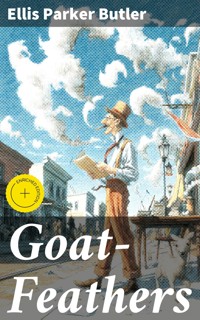
In Ellis Parker Butler's whimsical collection, "Goat-Feathers," readers are taken on a delightful exploration of the human experience through satire and humor. Butler's literary style is characterized by a sharp wit and keen observation, deftly illustrating the absurdities of everyday life. Each essay serves as a humorous reflection on society, culture, and the quirks of human behavior, all framed within Butler's distinctively conversational tone that invites readers into his quirky world while encouraging critical reflection on contemporary issues. This work was produced during the early 20th century, a period ripe for social commentary and a burgeoning genre of humor writing. Ellis Parker Butler, an American humorist and writer, drew inspiration from his upbringing and experiences in small-town America, which provided fertile ground for his comedic sensibilities. With a robust career featuring stories published in major literary journals and magazines, Butler established himself as a prominent figure in American literature. His ability to encapsulate the charm and idiosyncrasies of life is a hallmark of his writing, making "Goat-Feathers" a significant entry in his oeuvre. For readers seeking both laughter and insight, "Goat-Feathers" is a brilliant selection that stands out in American humor literature. Its engaging narrative style and clever observations make it not only a pleasurable read but also a profound commentary on societal norms that still resonate today. Dive into this collection to appreciate Butler's timeless wit and discover the amusing truths it reveals. In this enriched edition, we have carefully created added value for your reading experience: - A succinct Introduction situates the work's timeless appeal and themes. - The Synopsis outlines the central plot, highlighting key developments without spoiling critical twists. - A detailed Historical Context immerses you in the era's events and influences that shaped the writing. - A thorough Analysis dissects symbols, motifs, and character arcs to unearth underlying meanings. - Reflection questions prompt you to engage personally with the work's messages, connecting them to modern life. - Hand‐picked Memorable Quotes shine a spotlight on moments of literary brilliance. - Interactive footnotes clarify unusual references, historical allusions, and archaic phrases for an effortless, more informed read.
Das E-Book können Sie in Legimi-Apps oder einer beliebigen App lesen, die das folgende Format unterstützen:
Veröffentlichungsjahr: 2019
Ähnliche


















Goat-Feathers
Table of Contents
Introduction
A life’s best work can be smothered by the small, tempting tasks that steal our attention. Ellis Parker Butler’s Goat-Feathers turns that everyday peril into a wry subject of inquiry, using humor to probe how diversions accumulate and derail intention. Without preaching, the book invites readers to notice the subtle ways energy disperses when purpose is unfocused. It is not a novel but a compact, reflective work of comic nonfiction, shaped by an author keenly aware of the pressures of making a living as well as making meaning. Its center is a simple dilemma: what do we owe our main work?
Composed in the early twentieth century and first published in the late 1910s, Goat-Feathers belongs to the American tradition of magazine-bred humor that speaks directly to everyday experience. The work reflects the rhythms of office desks, household errands, and civic obligations familiar to its time, yet it keeps its gaze on concerns that outlast any particular setting. Butler, an American humorist, writes with the brisk clarity favored by popular periodicals of the era, balancing playful imagery with practical counsel. The text’s brevity and directness reveal its origins in a culture that prized accessible, immediately useful prose.
At heart, the premise is straightforward: a busy person discovers how quickly apparent opportunities, favors, and side projects multiply, and he names the flock of such distractions goat-feathers. Butler develops this premise through anecdotes, candid self-scrutiny, and gentle exaggeration, creating a voice that feels companionable rather than severe. The mood is amused, occasionally rueful, and consistently encouraging. Readers encounter an author who treats his own foibles as evidence, not as excuses, and who frames efficiency as a matter of integrity as much as of time. The result is a lively, persuasive invitation to focus.
Among the book’s central themes are attention, priority, and the cost of unchosen commitments. Butler explores how busyness can masquerade as purpose, how flattering requests can drain momentum, and how social or professional restlessness can fragment a day. He distinguishes between the necessary friction of life and the optional burdens we pick up without reflection. The argument is not anti-variety; it is pro-intention, urging readers to decide what truly matters and to align effort accordingly. In this way, Goat-Feathers functions as an early, entertaining meditation on focus, discipline, and the stewardship of one’s talents.
Stylistically, the book blends anecdotal storytelling with aphoristic punch, moving quickly from example to insight. Butler’s humor leans on the plausible and the familiar, letting situational irony carry the point rather than elaborate wordplay. The prose is clean, conversational, and buoyant, designed for readers who prefer a friendly nudge to a scolding. Structure follows the essay tradition: short sections, cumulative emphasis, and recurring images that reinforce the central metaphor without overburdening it. This approach keeps the pace brisk and the tone generous, so the pieces of advice arrive lightly yet linger, sharpened by experience.
For contemporary readers, its relevance is immediate. While the technologies have changed, the temptation to disperse ourselves across minor tasks remains constant. The book’s lens clarifies many modern dilemmas—overcommitment, reactive work, performative busyness—without requiring any specialized knowledge. It offers language for naming distractions and a humane rationale for declining them. Readers interested in creativity, entrepreneurship, civic life, or simply calmer days will recognize the tensions Butler describes. And because the work is brief and witty, it can be read in a single sitting, then revisited whenever priorities blur.
Approached as a companionable essay rather than a system, Goat-Feathers offers not a formula but a perspective: protect your main endeavor by trimming the underbrush around it. It pairs comic self-awareness with moral clarity, leaving space for the reader’s own circumstances to supply the details. Those who enjoy classic American humor, reflective nonfiction, or brisk counsel on craft and time will find it especially engaging. Above all, it is a reminder that attention is a finite gift. To use it well is to grant one’s best work the chance to exist.
Synopsis
Goat-Feathers by Ellis Parker Butler is a short, humorous nonfiction work that examines the ways people lose focus on their main purpose. Butler introduces goat-feathers as a metaphor for trivial distractions that feel productive but divert energy from essential work. Framed as a practical and candid reflection, the book presents personal observations and general advice about efficiency, time management, and professional discipline. It adopts a conversational tone while remaining pointed about common habits that undermine success. The central purpose is to help readers identify their own goat-feathers and resolve to concentrate on the one big job that truly matters in their lives.
The narrative opens with Butler confessing how easily he himself gathers goat-feathers and explaining why this habit is costly. He defines a goat-feather as any task, commitment, or novelty that looks useful, garners approval, or fills time, yet does not advance the principal work a person is meant to do. The metaphor emphasizes adornment without substance. Rather than scolding from a distance, he uses the first person to show the pattern in action. He sets the stage for a sequence of examples and generalizations, building a case for ruthless focus as a condition for steady, meaningful output.




