


7,19 €
Mehr erfahren.
- Herausgeber: Pushkin Children's Books
- Kategorie: Für Kinder und Jugendliche
- Sprache: Englisch
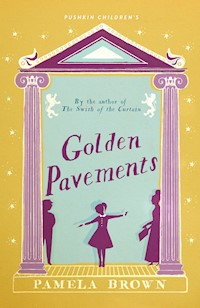
The third book in the Blue Door series, which starts with The Swish of the Curtain, the classic story which inspired actors from Maggie Smith to Eileen Atkins "I wanted to act before I read this book, and afterwards there was no stopping me" Maggie Smith 'How do you think you'll like the Academy?''Like it!' cried Lyn. 'I love it already. I'd not have missed it for the world. This has been the happiest day of my life.' At the Actors' Guild in London, the Blue Door Theatre Company are throwing themselves into anything that will bring the dreams of their own theatre to life - touring the country with the Guild's summer productions, working behind the scenes at local theatrical companies, even taking walk-on parts between classes. But just as plans for their own beloved Blue Door seem almost within their grasp, a disaster threatens to destroy one career for good... Pamela Brown (1924-1989) was a British writer, actor then television producer. She was just fourteen when she started writing her first book, and the town of Fenchester in the book is inspired by her home town of Colchester. During the Second World War, she went to live in Wales, so The Swish of the Curtain was not published until 1941, when she was sixteen. She used the earnings from the books to train at RADA, and became an actor and a producer of children's television programmes.
Das E-Book können Sie in Legimi-Apps oder einer beliebigen App lesen, die das folgende Format unterstützen:
Veröffentlichungsjahr: 2018
Ähnliche














![Tintenherz [Tintenwelt-Reihe, Band 1 (Ungekürzt)] - Cornelia Funke - Hörbuch](https://legimifiles.blob.core.windows.net/images/2830629ec0fd3fd8c1f122134ba4a884/w200_u90.jpg)



CONTENTS
1
OVER THE THRESHOLD
“And don’t embarrass me by talking about the Blue Door Theatre all the time,” said Nigel. They were sitting at breakfast in No. 37 Fitzherbert Street, W.1, on the first morning of the Spring Term. It was now nine o’clock. At nine-thirty they must set out for the British Actors’ Guild Dramatic School. Nigel, who had already spent a year there, had assumed a somewhat superior manner and was giving them advice as to their behaviour.
“But why shouldn’t we mention the Blue Door?” demanded Lynette. “I’m not ashamed of it—even if you are.”
“My dear girl,” said Nigel. “All the shows we used to do were amateur, decidedly amateur. Now that you’re going to train for professional acting, you’ll have to forget all that. Nobody’s interested in it. It doesn’t mean a thing.”
There was silence except for Bulldog, who scrunched toast, regardless of his elder brother’s sermon. Vicky, who was Bulldog’s twin, and shared his red hair and freckles, looked round the table thoughtfully. Yes, it was rather obvious that Nigel had already begun his training for the stage. Whereas Bulldog and Jeremy were well-scrubbed and polished, with neatly cut hair and dark suits, ready for their first day at dramatic school, Nigel wore corduroy trousers, a green shirt, a yellow tie, and a sandy sports coat. Occasionally as he talked a lock of dark hair fell over his brow and he shook it back with a careless gesture. The other five felt rather in awe of him these days. He seemed an actor already.
Sandra, practical as ever, glanced at the clock. “We’d better get a move on,” she said; “it would be awful to be late the first day. And whatever shall we do about the porridge?” She indicated six bowls of grey lumpy mixture that stood untouched before them.
“Mrs. Bosham will be heartbroken if you don’t eat it,” said Nigel. “She takes it as a personal insult if you leave a crumb.”
“Well, I’m leaving mine,” announced Jeremy, wrinkling his nose fastidiously, “it’s quite disgusting. What have you done with yours every day since you’ve been here, Nigel?”
“This!” said Nigel, as with expert aim he flung the revolting mass into the fire.
“But we can’t all do that,” objected Sandra. “It would put the fire out. And supposing Mrs. Whatnot comes in—oh, whatever shall we do?” She looked helplessly round the ugly little boarding-house room, with its greying lace curtains, china animals, and photos of the Bosham family in every conceivable position, and many ornate little vases, presents from Bognor, Southend, or Margate.
“We could fill up some of the vases,” suggested Vicky.
“But what would we do tomorrow?” Sandra wanted to know. “And after a while it would begin to smell. No, we must do it all up in a parcel and dump it somewhere—in a litter basket.” She snatched up the morning paper and began to scoop the glutinous messes into it.
“Who’s going to carry it?” Bulldog asked suspiciously.
“You!” replied five voices determinedly.
“H’m! Well, I will today, but someone else must do it tomorrow.”
“We’ll work out a rota,” laughed Nigel. “Come on. Step on it. I’d like to get there early today to see if I’ve been moved up or not.” They ran upstairs to their bedrooms to put on their hats and coats.
As Lyn arranged her furry Cossack hat in the mirror her heart was thumping with excitement. At last it was to begin—a real stage training. Her stomach turned over with a delicious mixture of joy and trepidation. Vicky was pirouetting across the landing.
“I do hope we have dancing today,” she said.
“I hope we have singing,” volunteered Sandra, brushing her fair hair until it gleamed.
“I don’t,” breathed Lyn, into the mirror. “I just want to act, and act, and act—”
“Come on, you hags!” roared Nigel. “Stop titivating, for goodness’ sake.” They assembled in the hall, each clasping massive volumes of Shakespeare. Mrs. Bosham came out to wish them luck. She was a completely circular woman, round face, round body, eyes and mouth continually rounded with surprise at the world in general, and plump round hands that were always busy knitting some shapeless garment which she could never quite master.
“Well, well!” she cried in wonderment. “So you’re off now, are you? (Two plain, two purl, slip one…) Well, I never did! Did you enjoy your breakfast?”
“Oh, yes, Mrs. Bosham!” they chorused.
“I always think a nice spot of porridge is so warming of a cold morning.” Bulldog clutched the sticky parcel closer to him. “I shall expect to see you come back tonight as famous actors—all of you! (Knit two together.)”
They smirked feebly and Nigel opened the door with impatience.
Outside in the clear winter air they realized that No. 37 had a slight but permanent odour of cabbage. Fitzherbert Street was a dingy street, there was no denying it. On one side there were Victorian houses, like No. 37, that had come down in the world and were now cheap lodging-houses for students, artists, and workers of every nationality. The other side consisted mainly of restaurants—French, Italian, Greek, Hungarian, with stripy shades over the windows, and menus outside that read like poetry. It was a brisk winter morning, and the whole world seemed to be on its way to work.
“London!” sighed Lyn contentedly.
“Is it far to the Academy?” Sandra asked Nigel as they strode along.
“Five minutes.”
They crossed Tottenham Court Road where the traffic roared and newsboys cried the names of morning papers, and entered a quiet square where plane trees braved the soot and dust. And there was a tall, grey stone house with lions at the doorposts. In simple lettering over the lintel were the words, “British Actors’ Guild Academy”, and underneath, “They have their exits and their entrances.”
Instinctively their pace slowed, and they looked up at the many large windows, from which came the sound of laughter and tinkling pianos. A constant stream of students entered through the swing doors, all talking very loudly at the same time. Most of them had very long hair, wore gaily coloured clothes, and many of the girls wore slacks. Suddenly a tall girl with chestnut hair and a lot of lipstick put her head out of the door, saw Nigel, and launched herself at him.
“Darling!” she cried. “How are you? I’ve got simply piles to tell you! We’ve both been moved up, and what do you think?” Nigel was dragged inside the swing doors and out of their sight.
They turned and looked at each other in amazement. “Well, I do think that’s rude!” exclaimed Lyn. “She didn’t even speak to us. Now what do we do, I wonder?”
“Go in,” said Sandra firmly, mounting the steps with an assurance she did not feel.
Inside was a large foyer that churned and swelled with a laughing, shouting, gesticulating crowd of young people. In one corner was a large, green-baize notice-board, which seemed to be the centre of attraction. Students would rush up to it with set countenance, elbow their way to the front of the crowd, and run their fingers down the lists. Then they would either crow with delight and embrace all within reach, or turn away with a wry smile saying, “Of course, I didn’t really expect to move up.”
The five of them stood in a timid group on the doormat, on which were the initials B.A.G.A. in large block letters. Only the violent entry of someone through the doors behind them propelled the five into the crowd. Lynette, being thin, was the first to reach the notice-board. There, at the bottom of the list, below fifteen other names, for Class One, she read, “Jeremy Darwin, Lynette Darwin, Sandra Fayne, Victoria Jane Halford, Percy Turnbull Halford.” Vicky and Bulldog seethed with indignation.
“However did they get our middle names? I bet it was that Nigel’s doing!”
At this moment there appeared on the broad marble staircase a smart, black-clad, grey-haired woman, who, smiling, rang a large bell to silence the din.
“If you wish to attend prayers, go down into the theatre,” she announced, when she could make herself heard.
“Prayers!” gasped Vicky. “Gosh! Wouldn’t our parents be surprised? They were afraid we were coming to a den of iniquity.”
The crowd began to surge down the stone stairs to the basement, still talking incessantly. The Blue Doors heard many intriguing scraps of conversation.
“…So I went round to the stage door and asked to see the producer—and what do you think?” … “Are you going in for the fencing comp. this term?” … “My dear, I’ve been in pantomime over Christmas. Yes, really—front row chorus—it was a scream” … “But she could never play Hedda Gabler” …
The theatre was small and cosy with red plush tip-up seats, and hanging round the wall a gallery of faces of famous ex-students.
“There’s Felicity Warren!” Lynette pointed out. “And Roma Seymore! Oh, how lovely to be here at last!”
The hubbub silenced suddenly as Mr. Wainwright Whitfield, the principal, appeared in front of the curtains of the little stage. He was a tall, imposing, silver-haired man, with kind eyes and a furrowed brow.
“My mother told me he was a matinee idol when she was young,” Vicky hissed Sandra’s ear. “Understandable, don’t you think?”
“Good morning and welcome everybody,” he began. “I trust that we shall all spend a very happy term together.” He went on to explain some of the aims and rules of the Academy, and then stopped suddenly and said, “Let us pray.” There was a shuffle and a squeaking of seats, and a hundred and fifty students stood with bowed heads.
Lyn was acutely conscious of the rise and fall of Wainwright Whitfield’s velvet voice, the watching portraits on the wall, and her own heart, thumping with a will to work and succeed. The only phrase of the prayer that remained with her was, “…and make us to be worthy citizens of the London in which we live.”
When everyone had trooped up into the foyer again, the secretary with the bell appeared and rang it furiously for silence.
“You will find a list of your classrooms on the notice-board,” she announced. “First-termers will please follow me.” There was a buzz of interest as the twenty beginners detached themselves from the crowd and mounted the steps in single file, running the gauntlet of stares from the senior pupils. Nigel made a face at the Blue Doors, followed by a cheering smile, and then resumed his deep conversation with the chestnut-haired female. The first-termers were led into a long light studio, surrounded with book-cases and portraits of Edmund Kean, Mrs. Siddons, and other famous actors and actresses of the past. And there, behind a desk, sat Roma Seymore. The Blue Doors knew her already, for she had judged the amateur drama contest that they had won at Fenchester, and it was very comforting to see a familiar face amongst all these strangers.
“Good morning,” she said, smiling the famous smile that had warmed the hearts of theatre-goers for the last forty years. “Do sit down, everybody.” They ranged themselves in chairs in a semi-circle around her. “Now some of you I know, and others I don’t,” she continued, “so I’ll start the term properly by calling the register. Say ‘Yes’ or ‘Here’ or ‘Adsum’ or whatever you please.” Bulldog was so busy taking stock of the other students that he missed his name altogether, and it had to be called twice before he came to with a start, and said “O.K.,” which set the whole class laughing. The other students appeared to be a great mixture. They varied from a mousey little girl of about fifteen, in pigtails and a gym slip, to an elderly foreign gentleman who seemed unable to speak or understand English. There was also a young Indian boy whom the Blue Doors recognized as having played several large roles in adventure films. In a group together sat three very beautifully dressed young girls of about seventeen, and two youths in stove-pipe trousers, wearing ties that Jeremy announced in a whisper were old Etonian.
When Roma Seymore had completed the register she said, “And now I want to get to know you, and to hear just how much acting you have all done previously.” She turned to the Blue Doors. “You five, of course, I know your work. You’ve done a good lot of amateur, haven’t you?” The Blue Doors blushed scarlet and looked down as though it were a crime. “And a very good thing, too,” she went on. “Don’t look so ashamed of it. You’ll probably have to unlearn a lot, but at least it’s a start.” She turned to the foreign gentleman. “Mr. Gottlieb, I know that you have made a fine reputation in Austria—I think we’ve all heard of Otto Gottlieb, haven’t we?” The class made vague noises of agreement, although nobody had. “And I hope we shall be able to help you considerably with your English!”
“Thanks much, kind lady,” was Mr. Gottlieb’s appreciative reply, and although he was sitting down he bowed gallantly from the waist.
“And you too, Ali, must concentrate on your English, mustn’t you?” The Indian boy replied only with a shy smile.
“I’m afraid I don’t know anything about the rest of you, so I must inquire in turn what you have done.” The three society girls and the old Etonians replied “amateur” in rather bored voices, the little girl in the gym tunic said, “I’ve done some broadcasting,” and two blondes, one fat and one thin, said they had done chorus work. A very ugly girl, in shabby slacks and a torn macintosh, replied, “Nothing,” in a sulky tone.
“Then what has made you want to be an actress?” asked Mrs. Seymore quite kindly.
“Because I know I can,” the girl replied almost fiercely.
A dark, statuesque girl with an elaborate hair-style said she had done some film work, and a young man with numerous pimples on his face said he had been in the O.U.D.S. at Oxford. Of the remaining two, one was middle-aged and the other young. The woman was about forty with a heavily made-up face, and hair dyed an unnatural auburn. “Well, I’ve been in the profession for over twenty years,” she began in a fruity voice.
“Twenty years!” exclaimed Mrs. Seymore. “Then why have you come to the Academy?” The woman laughed richly. “A few months ago I found myself playing Wigan Empire for the tenth time, so I says to myself, ‘Myrtle, my girl, if you’re still playing Wigan Empire at forty there mustbe something wrong with you.’” After the laughter which followed this frank explanation, Roma said kindly, “Well, I think it’s a very brave gesture on your part, and I hope we shall be able to help you.”
The last member of the class to be questioned was a fat boy of about sixteen, who appeared to have an impediment in his speech.
“And have you been on the stage before?” Roma inquired.
“Oh, yeth,” he answered. “My Mummy and Daddy are in the profethion.”
“Really? And what do they do?”
“They have a theal act.”
“A what?”
“A theal act. You know—with thealth!”
“I’m sorry—I didn’t quite—”
“Performing thealth,” spluttered the boy, quite hurt by this time.
“Oh, I see. Performing seals. Oh, yes, that must have been interesting. And what did you do?”
“I uthed to throw the fish for them.” There were subdued giggles from various quarters, but Mrs. Seymore retained her gravity.
“Well, you’ll be used to appearing on the stage, at least, won’t you?” she said hurriedly.
“Oh, no, I uthed to thtand in the wingth.”
“What a collection of people!” whispered Lynette to Sandra.
“P’raps we strike them as just as odd,” she replied.
For the rest of the lesson Roma Seymore read to them the play in which she was to produce them during the term. It was Shaw’s Pygmalion, and although Roma read all the parts, she seemed to change character visibly. One minute she was the little Cockney gamin, then the pedantic professor, and next minute the alcoholic dustman. They were in stitches of laughter by the end of the period.
“That was the most enjoyable lesson I’ve ever had in my life!” said Vicky as they filed out. “I didn’t dream that a school could be like this,” and she wiped tears of hilarity from her eyes.
But the next lesson was more nerve-wracking. It was Shakespeare, taken by Mr. Whitfield, who went straight through the class, demanding a Shakespearean speech from every member.
The Blue Doors found themselves experiencing all the familiar symptoms of stage fright, a thumping heart, dry lips, a watery feeling in the knees. The first person to be called on was Otto Gottlieb. He did Hamlet’s “To be or not to be” with great drama of expression and gesture. The only drawback being that not one word was intelligible. The next person to be called on was Bulldog. He walked to the centre of the room, which suddenly seemed very large. When he turned round to face the class he noticed the horrified expressions of the Blue Doors. What could be wrong? Had he got a smut on his nose? He smoothed down his ginger hair self-consciously and began.
“Friends—Romans—countrymen…” Suddenly he saw Vicky double up with laughter, and he stopped dead, with a horrible realization. He was still clutching the parcel of porridge! Scarlet to the tips of his ears he stood rooted to the spot, looking at the disgusting soggy paper parcel. Then Sandra came to the rescue. She ran quickly across the floor, saying, “Give me the parcel, Bulldog.” He floundered through the speech, completely unnerved, and received merely a cold, “Thank you. Sit down” from Mr. Whitfield. The only person who received any praise from him was the ugly girl in slacks, who did a speech of Lady Macbeth, and curdled the blood of her listeners.
“Very strong—sincere, but lacking in technique,” was Wainwright Whitfield’s verdict.
Lunch was the next item on the time-table. It was served in a long cafeteria, where, over coffee and liver sausage, more words per minute were exchanged than the Blue Doors had ever heard before. They sat at a table together, and just stared round them dumbly. “They’re all so happy and self-assured,” thought Lynette. “I shall never be able to behave like that.”
Nigel was sitting at a long table with a lot of the senior pupils, and seemed to be in the middle of a heated argument. On the way out of the lunch-room he came over to their table with the chestnut girl. She was very tall and wore a scarlet jumper and emerald slacks. She stood with hands on hips and surveyed them, laughing.
“So these are the infant prodigies, are they?”
“This is Auriole,” announced Nigel. “She’s heard a lot about you.”
“Where’s Maddy?” she wanted to know. “I liked the sound of her best.”
“We had to leave Maddy at home,” explained Sandra. “She’s too young to come to Dramatic School yet.”
“What a shame! You’re her sister, aren’t you? And those are the twins, aren’t they? And that’s Lynette and Jeremy. I say, come here!” she cried to some of her friends.
“Come and look at Nigel’s private repertory company.” A crowd of seniors came and stared at them as if they were strange beasts. The Blue Doors glared back, and Auriole seemed to find their discomfort amusing. At last she took Nigel’s hand and led him away, saying, “Come on, ducky. I want to know your hopes, your dreams, and your telephone number.” When she had gone Lyn said, “She’s just what our parents hoped we wouldn’t turn into—”
“But rather attractive,” added Sandra fairly. They were all somewhat upset at seeing Nigel so firmly under the sway of what they considered “an outsider”.
The afternoon was taken up with a dancing class, in which Vicky outshone everyone. Very few had had any previous training except the two ex-chorus girls, and no-one as yet had the correct practice dresses or shoes. Bulldog, in his socks and shirt-sleeves, laboured away at the barre, puffing and blowing heavily, as the little dancing mistress prodded him in the back and knees with her ruler.
“Oh, dear! Oh, dear! All this to be an actor!” he groaned.
When the day was over they felt completely exhausted, and when Nigel joined them on the stairs saying, “How about a cup of tea at Raddler’s?” it sounded like a very good idea.
Raddler’s was a little baker’s shop in Tottenham Court Road that smelt of fresh bread and coffee. Its windows were packed with gaily coloured cakes. The first floor was filled with respectable business men having their afternoon tea, but as one ascended the stairs a peculiar noise wafted down from the second floor—a sort of muffled roar. The low, smoky room was dim and filled to overflowing with B.A.G.A. students. Sprawled across the tables, they drank coffee, consumed enormous doughnuts, and reformed the theatre. Fanny, the harassed little waitress, shouted down the hatch unceasing and gargantuan orders.
“Ten white, three black, and sixteen éclairs,” or, “Three ’ash and baked.”
Gradually the congenial atmosphere enveloped the Blue Doors and the constrained correctness that had hampered them all day fell away. Soon they were talking freely to all and sundry, telling of their past and planning for the future. The hours slipped by, and suddenly a completely strange boy came up to them and said, “There’s a free pass for twenty B.A.G.A. students tonight at the Coronet Cinema in Tottenham Court Road. Coming?”
“Rather!” they chorused. As they trouped down the road a barrel organ played “Over the Sea to Skye”, and the sadly sweet cadence filled Lynette with emotion. The cinema was tiny and uncomfortable, and showed foreign films that did not attract the public. But the Blue Doors sat enthralled at the acting of the French screen stars whom they had never seen before. “Gosh!” exclaimed Jeremy afterwards, “and we think we can act.”
Outside in the cold street they called goodnight to the other students, and Nigel said, “Come on, I know a good place for supper.”
In Fitzherbert Street they went into a Greek café opposite their digs and ate a delicious dish of meat balls speared on skewers, and spiced rice.
“Rather different from Mrs. Bosham’s cooking,” observed Nigel. “But we mustn’t do this every night. It’ll have to be the Corner House if you want your allowance to last the week.”
They were too tired to talk much, but sat smiling contentedly at each other, listening to the chatter of the Greek waiters, unwilling to return to their cabbage-smelling digs.
“Well,” said Nigel, with a proprietary air, “how do you think you’ll like the Academy?”
“Like it!” cried Lyn. “I love it already. I’d not have missed it for the world. This has been the happiest day of my life.” Nigel toasted her, raising his glass of water.
“And here’s to many more!”
2
SPRING TERM
“So much to learn, and so little time to learn it in,” sighed Lynette, stretching and yawning on her bed. The five of them were gathered in the girls’ bedroom as it was the largest, doing their evening study. Although the room was big, very little of it could be seen, for it was snowed under with books and gramophone records. The ugly wallpaper was nearly covered with ballet pictures by Degas belonging to Vicky and photos of film stars belonging to Sandra, and the mantelpiece had been turned into what they called “Lynette’s Shrine”. There were three photos, Henry Irving, Ellen Terry, and Sarah Bernhardt, and two books, a volume of Shakespeare and Stanislavsky’s An Actor Prepares. On each end of the shelf burned a twisty red candle in a brass candlestick, throwing shadows on to the faces of the Blue Doors as they bent over their books.
It was the fifth week of term, and all were endeavouring to master their lines for the end of term shows. Not only were they doing a complete production of Pygmalion with two casts, but also some Shakespearean scenes produced by Mr. Whitfield, and a Molière comedy in the French acting class. Nearly every night there was a fresh speech to be learned for the diction, voice-production, or verse-speaking class next day. Bulldog interrupted the low murmur of voices.
“Will you listen to my mime, for a minute?”
“How can we listen to your mime?” mocked Lynette. “O.K. Go ahead.”
Bulldog got up, made a gesture of opening a door, stepped in, stood still, bent his knees slightly, then straightened them, stood blank-faced, bent his knees once more, opened the imaginary door, and stepped out.
“What on earth…” they laughed.
“Bulldog, you are a fool! Whatever is it?”
“Going up in a lift,” announced Bulldog proudly. “Now, what’s this?” He repeated exactly the same movements.
“Going up in a lift!” they shouted.
“You’re wrong,” he grinned. “I was going down that time.”
Lynette hurled a cushion at his head.
At this moment the clock struck nine and Mrs. Bosham shouted up the stairs, “Y’r supper’s on.” There was a stampede down for the rather watery macaroni cheese and college pudding that Mrs. Bosham served up regularly on Mondays, Wednesdays, and Fridays.
“Is Mr. Nigel in?” she asked, as she entered the dining room.
“Er—no,” said Sandra, “I shouldn’t bother to keep his hot. He probably won’t appear.”
“Well, I never!” she cried, her eyes like saucers. “He is a one, isn’t he? (Would you mind kindly stepping off my ball of wool, Mr. Bulldog.) Never used to be like this, you know. First term he was here, he was up in his room every night, rantin’ and shoutin’ like one o’clock.”
“The old ham,” murmured Jeremy.
“Hasn’t paid ’is rent this week, either,” Mrs. Bosham replied, somewhat meaningly.
“Oh, dear!” sighed Vicky. “I suppose I’ll have to pay it again.” She opened her handbag and took out the money.
“Well, thank you, Miss Vicky. Don’t like to have it hanging over, y’know.” After she had waddled out Vicky said, “Whatever does Nigel do with his money? He gets a bigger allowance than we do, anyhow.”
“What does he do with it? I should think it’s perfectly obvious what he does with it,” Lyn said coldly. “He spends it all on that Auriole creature. He’s out with her every night.”
“But surely,” objected Vicky, “she wouldn’t let him pay for her when they go out? I mean—no-one at the Academy ever does. It’s always Dutch treat.”
“H’m!” growled Lynette. “Not with Auriole. She was boasting in the girls’ dressing-room the other day that a Guards officer spent his month’s pay in two evenings taking her out, so she must be going through Nigel’s allowance like water.”
“I tried to talk to him about it the other day,” put in Jeremy, “but he wouldn’t listen. Said he wasn’t ‘gadding about’, he was merely doing what old Whitfield is always advising—seeing as many plays as possible.”
But there are ways and ways of seeing plays,” observed Sandra. “We’ve been to the theatre every Saturday this term, but we’ve stuck to the gallery, consequently we can pay our rent.”
“And our theatre-going doesn’t include an expensive meal afterwards, and dancing until all hours in some low dive,” added Lynette acidly.
“Sometimes,” Bulldog began timidly, “I wonder if we don’t work a little too hard. It doesn’t look as if it’s getting us anywhere.” They reflected for a minute. Certainly they had as yet made very little impression at the Academy. There seemed to be so many things to unlearn first.
“And they say that Nigel’s student production is terrific,” Bulldog went on.
The senior pupils were all allowed to do one act of a play every term, produced by one of themselves, and this time the honour had fallen to Nigel.
“He only chose Macbeth so that Auriole could play Lady Macbeth. I think she’s rotten,” stated Lynette.
“This is Friday night’s college pudding warmed up,” Bulldog suddenly announced.
“How do you know?”
“Because it has the same funny taste.”
“But it always tastes funny.”
“Yes, but this is the same funny taste as on Friday—not a different one.”
“Oh, let’s fill up on bread and cheese.”
“And pickled onions,” said Bulldog, grabbing the bottle.
“What low tastes!” sighed Jeremy, getting up from the table. “Oh, if only there were a piano!” This was his one complaint. In order to practise he had to get up early and go round to the Academy.
“Who’s coming out for a toddle before bed?” inquired Bulldog. They all set out, muffled up to the ears against the biting February wind, and strode through Regent’s Park, where frost and moonlight were silvering the trees.
“How different this life is from school!” said Lyn, after an argument on voice-production. “Can you imagine us going for a walk after we’d done our homework and arguing about long division or the rivers of Europe?”
“No,” laughed Sandra. “Our conversation was exactly the same in those days as it is now—theatre!”
It was true. They talked, lived, and dreamed theatre. They forgot to look at the newspaper, they had no hobbies, they met no-one who was outside the magic circle. At No. 37, over the lunch table at the Academy, in Raddler’s Café at tea, over snacks in the Corner House, they spoke of nothing else. But their own particular problems depressed them at times.
“Why isn’t sincerity enough?” Lynette would demand. “Everyone talks about technique all the time—but what is it? Nobody ever defines it properly.”
“P’raps it’s really experience, and that’s why we haven’t got it.”
“And by the time we’ve gained experience and technique we shall be too old to play all the lovely young parts that there are.”
“Oh, I know. Let’s play the new game.”
This game consisted of stating what part in what play at which theatre they would like to be performing that night. Vicky plumped for “Peter Pan” at the Winter Garden; Sandra for “Candida” at the Phoenix; Lynette for “Desdemona” in Othello at the New; Bulldog for “Falstaff” in The Merry Wives of Windsor at the Haymarket; and Jeremy for “Hamlet” at the St. James. This game made them walk much farther than they had intended, and it was midnight when they returned. Nigel was still out. “He’ll be late for the Academy again in the morning,” sighed Sandra. “Can’t you talk to him, Vicky? He’s your brother.”
“‘Am I my brother’s keeper?’” quoted Vicky. “I’ll say he needs one.”
They went to bed and their dreams were of diverse things, from learning how to control the diaphragm muscles, to the sound of an orchestra tuning up for the overture.
Next day at prayers Mr. Whitfield announced, “There is to be a new competition this term. One of the governors has offered a prize for scenic design. The subject is James Elroy Flecker’s Hassan. Only one set is wanted. It must be to scale, and must fit the model theatre in the workshop.” The Blue Doors looked at each other.
“Sounds like Nigel’s cup of tea,” whispered Sandra to Lyn.
“You’re telling me! He could win that with one hand tied behind his back.”
“The work is to be done in spare time, not in Academy hours, but the workshop will be open in the evenings for this purpose. Will those who wish to enter give in their names to Miss Smith afterwards.” Bulldog peered round the theatre for Nigel, but he was not present.
“Looks as if he’s late again,” he muttered. “We must make him give in his name.”
“And Hassan too! A wonderful subject,” enthused Lyn. “We just can’t go home these holidays with not one of us having won anything. And it’s quite obvious that none of us five will.”
Sometimes Lyn despaired of ever learning to act. There was so much to remember all the time. If she tried to think about her voice, she forgot her moves, and if she concentrated on her moves, she forgot her lines.
“You don’t know how to relax,” she was told in Mime.
“Your voice is monotonous,” she was told in Diction.
“You have no poise,” she was told in Ballet. And as for Fencing—poor little Monsieur Desmoulins would twirl his moustache in anguish and cry, “Miss Darwin, please! It is not a sword dance. From ze wrist, if you please.”
In the production of Pygmalion that they were doing, Lynette and Vicky each had a scene of Eliza Doolittle, and Jeremy was playing Professor Higgins, opposite Lyn. Sandra was playing Mrs. Higgins, a character part that she found very difficult, and Bulldog was playing Doolittle; over-playing it, in fact. But Roma Seymore did not object to this at all.
“That’s right,” she would cry. “Go for it. I’d much rather have to tone it down than bolster it up.”




