


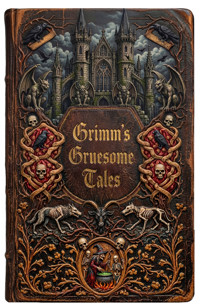
Erhalten Sie Zugang zu diesem und mehr als 300000 Büchern ab EUR 5,99 monatlich.
- Herausgeber: XSPO
- Kategorie: Abenteuer, Thriller, Horror
- Sprache: Englisch
Forget everything you thought you knew about "happily ever after." This edition strips away centuries of censorship to reveal the raw gothic darkness of Jacob and Wilhelm Grimm's original tales. These were never bedtime stories for children — they were warnings for adults, forged in a world of famine, superstition, and unforgiving forests. What makes this edition unique: 130+ Original Color Illustrations. Each page comes alive with vivid artwork that plunges you into the shadowy heart of pre-industrial Europe — a world where magic was bloody and survival was never guaranteed. Modern Translation. The archaic German narratives have been rendered into crisp, contemporary English. The language feels immediate and sharp while preserving the dark spirit of the originals. Uncompromising Authenticity. No softened endings. No moral polish. Justice here is served with red-hot iron, and the forest shows no mercy to the weak. This is not simply a book — it is a collector's artifact and an excavation of primal human fears. Created for readers who dare to look into the merciless mirror of the past and recognize the nightmares still embedded in our culture. WARNING: This edition is intended for mature audiences. Contains graphic violence and disturbing imagery faithful to the original folklore.
Sie lesen das E-Book in den Legimi-Apps auf:
Seitenzahl: 1181
Veröffentlichungsjahr: 2026
Das E-Book (TTS) können Sie hören im Abo „Legimi Premium” in Legimi-Apps auf:
Ähnliche






Grimm's Gruesome Tales
The Unsanitized Original Stories
Forget everything you thought you knew about "happily ever after."
This edition strips away centuries of censorship to reveal the raw gothic darkness of Jacob and Wilhelm Grimm's original tales. These were never bedtime stories for children — they were warnings for adults, forged in a world of famine, superstition, and unforgiving forests.
Featuring over 130 original color illustrations, a modern English translation, and uncompromising authenticity — no softened endings, no moral polish. Justice here is served with red-hot iron, and the forest shows no mercy to the weak.
This is not simply a book — it is a collector's artifact and an excavation of primal human fears.
WARNING: This edition is intended for mature audiences. Contains graphic violence and disturbing imagery faithful to the original folklore.
Grimm's Gruesome Tales: The Unsanitized Original Stories
Translation © 2026 Alexander Nemirov
Illustrations © 2026 Alexander Nemirov
All rights reserved.
No part of this publication may be reproduced, stored in a retrieval system, or transmitted in any form or by any means — electronic, mechanical, photocopying, recording, or otherwise — without the prior written permission of the copyright holder.
This edition is intended for mature audiences and is presented as a cultural and historical artifact. The narratives reflect the worldviews and harsh realities of a bygone era and are not intended as moral guidance or a reflection of contemporary values.
First Edition.
Jacob Grimm (1785–1863), Wilhelm Grimm (1786–1859)
Preface
The tales collected by Jacob and Wilhelm Grimm are not merely stories; they are jagged shards of a vanished world. This edition presents these narratives in modern American English, breathing new life into the archaic records of the past while preserving their original, unflinching darkness. What you hold in your hands is a literary artifact reimagined for today—a raw reflection of old beliefs, primeval fears, and the brutal contradictions of the human soul.
The Brothers Grimm never intended these accounts to serve as polite moral guidebooks or sanitized anthologies for the fragile. Instead, these tales are mirrors held up to a merciless past, revealing the brilliance of human imagination alongside the long, haunting shadows cast by the era’s cultural norms. These stories were born in the mouths of peasants, laborers, and wanderers—people whose lives were defined by hardship, superstition, and the bleak realities of pre-industrial Europe. Their work captured a landscape where magic and brutality bleed into one another, where survival depends on cunning rather than kindness, and where social hierarchies were reinforced through dark, visceral allegory.
In this collection, the gothic dread that made these tales unforgettable is dialed to its highest pitch. The casual violence, the iron-fisted retributions, and the suffocating terror of the deep woods remain entirely intact. We have enhanced these narratives with atmospheric detail that honors the original German spirit, presenting them with a clarity intended to haunt. These narratives were shaped by a world where famine, disease, and death were constant, uninvited guests at the dinner table.
This volume rejects the "domestication" of folklore. Over the course of seven editions, the Brothers Grimm themselves often softened the blows of their collection, adding Christian themes to make the stories more palatable for the middle class. This volume rejects that dilution. These tales are meant to unsettle and provoke. They remind us that the world was once a much more brutal place—and that surviving it required both extraordinary courage and cold-blooded ruthlessness.
You are invited to experience these stories as they were meant to be: vivid, unnerving, and utterly compelling. When a witch shrieks while burning in her own oven, when red-hot iron shoes sear flesh in a fatal dance, or when a forest devours the lost, you are witnessing the authentic darkness that shaped the human imagination for centuries. These stories are not lessons; they are visceral experiences—invitations to feel the crushing weight of a harsher world and to marvel at the fact that humanity survived it.
This book is offered not as nostalgia, but as immersion: a chance to step into the shadows of the past and emerge with a deeper understanding of the nightmares that continue to haunt our collective consciousness.
Editorial Disclaimer
This volume is intended for a mature audience and is presented strictly as a cultural and historical artifact. The narratives contained within reflect the worldviews, social structures, and harsh realities of a bygone era. It is not the intent of the editors to disparage or offend any individual, group, or belief system.
Readers are encouraged to approach these stories as a "cross-section of history"—a raw look at the folklore that shaped the human imagination centuries ago. These tales should be viewed through an analytical lens and are not to be taken as literal advice, moral guidance, or a reflection of contemporary values.
Warning: Due to the presence of visceral violence, grim themes, and disturbing imagery characteristic of original folklore, discretion is strongly advised. This work may not be suitable for sensitive readers or those who find depictions of historical brutality distressing.
The Frog-King, or Iron Henry
A long time ago, back when making a wish actually meant something, there lived a king whose daughters were all beautiful. But the youngest was so stunning that even the sun—which has seen everything since the beginning of time—was left breathless every time it shone on her face.
Right next to the king’s castle lay a massive, suffocating forest. It was a place of deep shadows and gnarled roots, where the air felt heavy and damp like a held breath. Deep inside those dark woods, under the sprawling limbs of an ancient lime tree, was an old well. The well was a jagged circle of moss-covered stone, and the water inside was so dark it looked like a black hole cut right into the earth. On the hottest days, the princess would wander into the forest to sit by the edge of that cold, silent water. To pass the time, she played with her favorite toy: a ball made of solid gold. She would toss it high into the air and catch it, watching the sunlight glint off its polished surface.
One day, the golden ball didn't land back in her hand. It bounced off the dirt and rolled straight toward the well. She watched, paralyzed, as it slipped over the edge and vanished into the water. The well was terrifyingly deep—so deep that the bottom was a mystery lost in a cold, watery abyss. The princess realized her treasure was gone forever, and she began to sob. Her cries grew louder and more frantic, echoing through the silent, predatory trees.
As she sat there wailing, a voice suddenly broke through her grief. “What’s wrong, Princess? Your crying is loud enough to melt a stone.”
She looked around, startled, and saw a frog. It was a repulsive thing, poking its wide, blunt head out of the dark water. Its skin was a mottled, slimy green, and its eyes bulged like wet marbles.
“Oh, it’s just you, you old paddler,” she said, wiping her eyes. “I’m crying because my golden ball fell into the well.”
“Stop crying,” the frog said. “I can help you. But what will you give me if I go down there and get your toy?”
“Whatever you want, dear frog!” she promised quickly. “My dresses, pearls, and jewels—I’ll even give you the golden crown I’m wearing.”
The frog blinked his cold, glassy eyes. “I don’t care about your clothes, pearls, or jewels. And I have no use for a golden crown. But if you will love me—if you let me be your companion and playmate, let me sit next to you at your table, eat from your golden plate, drink from your cup, and sleep in your bed—if you promise me that, I’ll dive down right now and bring your ball back.”
“Oh, I promise!” she cried. “I’ll promise you anything if you just get my ball!” But in the back of her mind, she thought, What a ridiculous creature. He’s just a disgusting frog who croaks in the mud with other frogs. He could never be a companion to a human.
As soon as he got her word, the frog pulled his head under the water and sank into the darkness. A few moments later, he paddled back to the surface with the golden ball in his mouth. He spat it out onto the grass, and the princess was so happy to see her toy that she grabbed it and bolted.
“Wait! Wait!” the frog croaked, his voice desperate. “Take me with you! I can’t run as fast as you can!”
But she didn't care. She ignored his wet, gasping cries and ran all the way back to the safety of the castle. By the time she reached her room, she had forgotten all about the poor frog.
The next day, she was sitting at the royal dining table with the King and the rest of the court, eating from her golden plate. Suddenly, a strange sound echoed through the hall: splish, splash, splish, splash. Something wet was dragging itself up the marble staircase. Then, there was a heavy, damp thud against the door, followed by a knock. A voice called out:
Princess, youngest princess,
Open the door for me!
Have you forgotten what you promised
By the well beneath the tree?
She ran to the door, but when she opened it, she saw the frog—cold, wet, and pulsing—sitting on the threshold. Terrified, she slammed the door shut and hurried back to her seat, her face turning pale. The King noticed she was shaking and asked, “My child, what are you so afraid of? Is there a giant at the door coming to take you away?”
“Oh, no,” she replied, her voice trembling. “It’s not a giant. It’s just a disgusting, slimy frog.” She told her father everything—how the ball had fallen into the bottomless well and how she had made a promise to the frog just to get it back. She hadn't actually expected the creature to crawl out of the water and find her.
The King looked at her sternly. “If you gave your word,” he said, his voice cold and commanding, “you have to keep it. Go and let him in.”
With trembling hands, she opened the door. The frog hopped into the room, following her every step right up to her chair. He sat on the floor and looked up at her. “Lift me up,” he demanded.
She hesitated, her stomach turning at the thought of touching his clammy skin. But the King glared at her, and she was forced to lift the frog onto the table.
“Now,” the frog said, “push your golden plate closer so we can eat together.” She did it, but everyone could see she hated every second of it. Every bite she took felt like sawdust in her mouth as she watched the frog’s throat pulse and distend while he ate from her dinner.
When he had finished, the frog said, “I’m full, and now I’m tired. Carry me up to your room, prepare your silk bed, and let’s go to sleep.”
The princess burst into tears. She couldn't stand the thought of that cold, shivering creature touching her clean, soft sheets. But the King’s eyes flashed with anger. “He helped you when you were in trouble,” the King said. “It is cruel and wrong to despise him now that you have what you wanted.”
She had no choice. She picked the frog up using only two fingers, her skin crawling, and carried him upstairs. She set him down in the farthest corner of her room and tried to ignore him. But as soon as she climbed into bed, the frog hopped over to the bedside.
“I’m tired too,” he croaked. “I want to sleep in a soft bed just like you. Lift me up, or I’m telling your father.”
That was the breaking point. A dark, violent rage washed over her like a fever. She didn't see a helpless creature; she saw a monster that was trying to ruin her life. She grabbed the frog in her fist and, with all her strength, screamed, “Now you’ll finally be quiet, you disgusting thing!” She hurled him against the stone wall.
The frog hit the wall with a sickening, wet crunch, but he didn't fall to the floor dead. Instead, as he hit the ground, his body shifted and stretched. In the blink of an eye, the green slime and bulbous eyes were gone. Standing there was a prince with kind, gentle eyes.
He told her that a wicked witch had cast a cruel spell on him, turning him into a frog and trapping him in that dark well. No one could have saved him except for her. Now that the curse was broken, he was his own man again.
The very next morning, as the sun began to rise, a magnificent carriage pulled up to the castle gates. It was drawn by eight white horses wearing white ostrich feathers on their heads, their harnesses jingling with heavy gold chains. At the back of the carriage stood the prince’s loyal servant, Faithful Henry.
When the prince had been turned into a frog, Henry had been so consumed by grief that he felt his heart might burst. To keep it from shattering, he had gone to a blacksmith and had three thick iron bands forged around his chest to hold his heart together.
Henry was there to take the prince and his new bride back to his kingdom. They all got into the carriage, but as they drove away, a loud, sharp CRACK echoed through the air like a pistol shot.
The prince jumped. “Henry, is the carriage breaking?”
“No, my lord,” Henry replied. “It isn't the carriage. It’s the iron bands around my chest. They’re snapping because the sorrow is gone. You’re free, and my heart can finally beat on its own again.”
Twice more during the journey, they heard that same violent CRACK, like a dry bone snapping in the dark. Each time, the prince thought the wheels were falling off, but it was only the iron bands bursting off Henry’s chest as his joy grew. And so, they traveled on into the sunlight, leaving the dark forest and the cold well behind them forever.
Cat and Mouse in Partnership
A cat once met a mouse. She went on and on about how much she loved and respected the little creature, lying so smoothly that the mouse finally agreed they should move in together and run a household as a team.
"But we've got to get ready for winter," the cat said, her eyes narrowing as she watched the mouse's pulse fluttering in her throat. "Otherwise, we're going to starve. And you, little mouse, can't just go wandering off looking for crumbs, or you'll end up caught in a trap one of these days."
The mouse took the advice to heart. They went out and bought a pot of fat—rich, heavy lard that would keep them alive when the world turned white and frozen. The problem was, they didn't know where to hide it. After thinking it over, the cat had an idea.
"The church is the best place," she said. "No one would dare steal anything from a holy sanctuary. We'll tuck it away under the altar and promise not to touch it until we're absolutely desperate."
So, they hid the pot in the damp shadows of the cold, stone church. But it wasn't long before the cat started craving that fat. The thought of the greasy, salty lard made her whiskers twitch with greed.
"Listen, little mouse," the cat said one morning. "My cousin just had a baby boy. He's white with brown spots, and she wants me to be the godmother at the christening today. You can handle the house alone for a bit, right?"
"Of course! Go ahead," the mouse answered. "If you eat anything delicious, think of me. I wouldn't mind a drop of that sweet red christening wine myself."
But it was all a lie. The cat didn't have a cousin, and there was no baby. She slunk straight to the church, creeping through the silent, echoing aisles where the shadows stretched like long, black fingers. She reached the pot of fat, pried off the lid, and licked the entire top layer clean. When she was finished, she took a leisurely stroll over the rooftops of the town, stretched out in the sun, and licked her paws, savoring the taste of her betrayal. She didn't come home until the sun had dipped below the horizon.
"Well, you're back," the mouse said. "I bet you had a great day."
"Everything went fine," the cat replied coolly.
"So, what name did they give the baby?"
"Top-Off," the cat said, without blinking.
"Top-Off?" the mouse cried. "That's a really weird name. Is that common in your family?"
"What's the big deal?" the cat snapped. "It's no worse than 'Crumb-Stealer,' like your godchildren are called."
A few days later, that hunger was gnawing at the cat's gut again. She couldn't stop thinking about the smooth, white lard.
"You have to do me a favor," she told the mouse. "I've been asked to be a godmother again. This baby has a white ring around its neck, and I just can't say no. Can you hold down the fort for one more day?"
The kind-hearted mouse agreed. The cat, meanwhile, hurried back to the church. The air inside was freezing, heavy with the scent of old incense and rot, but the cat didn't care. She dug into the pot and devoured exactly half of the fat.
"Nothing tastes as good as what you keep for yourself," she purred, feeling very satisfied.
When she returned home, the mouse asked, "And what did they name this one?"
"Half-Done," the cat answered.
"Half-Done? Seriously? I've never heard such a name in my life!"
Before long, the cat's mouth was watering for the rest of the stash. "Good things come in threes," she told the mouse. "I have to go be a godmother again. This baby is jet-black with white paws—not a single white hair anywhere else on its body. That only happens once every few years. You'll let me go, won't you?"
"Top-Off! Half-Done!" the mouse sighed. "Those names are so strange, they're starting to make me really uneasy."
"You just sit here with your dark-gray fur and long tail, letting your imagination run wild because you never get out of the house," the cat hissed.
While the cat was gone, the mouse spent the day cleaning the house until it sparkled. But the greedy cat was at the church, scraping the very bottom of the pot until every last bit of fat was gone.
Once everything is eaten, one can finally have some peace, she thought. She was so full she could barely move, and she didn't crawl back home until late at night. The mouse immediately asked for the third baby's name.
"You aren't going to like this one either," the cat said. "He's called All-Gone."
"All-Gone!" the mouse shouted. "That's the most suspicious name yet! I've never heard anything like it. All-Gone... what could that even mean?" She shook her head, curled into a ball, and went to sleep, feeling a chill that had nothing to do with the weather.
From then on, no one invited the cat to be a godmother. But when winter at last arrived, it was brutal. The ground froze solid as iron, and there wasn't a scrap of food to be found outside. The mouse, her ribs starting to show, thought of their secret stash.
"Come on, cat," she said. "Let's go to the church and get that pot of fat we saved. We're going to have a feast!"
"Oh yeah," the cat replied, her voice dripping with malice. "You'll enjoy that fat about as much as you'd enjoy sticking your tongue out the window and licking the wind."
They walked to the church, their tiny paws crunching on the frozen ground. When they reached the altar and pulled out the pot, it was there—but it was bone-dry and empty.
"Oh no," the mouse whispered, the realization hitting her like a physical blow. "Now I get it. Now the truth comes out! You're a real piece of work, aren't you? You call yourself my friend, but you ate everything while you were 'being a godmother.' First Top-Off, then Half-Done, then—"
"Shut your mouth!" the cat shrieked. "One more word and I'll eat you, too!"
"All-Gone!" the poor mouse cried out, the word escaping her lips before she could stop it.
In a flash of fur and claws, the cat lunged. She pinned the tiny mouse to the cold stone floor, teeth sinking into the mouse's neck with a sickening crunch. The cat swallowed her down in one gulp.
And that, as they say, is just the way of the world.
Our Lady’s Child
Deep on the edge of a vast, suffocating forest lived a woodcutter and his wife. They had only one child, a little girl who was just three years old. They were so desperately poor that they no longer had enough to eat for their daily meals; they had no idea how they would provide for her or where her next bite would come from. One morning, the woodcutter walked into the dark woods, his heart heavy with a sorrow that felt like lead. As he began to swing his axe against a towering tree, a woman suddenly appeared before him. She was tall and radiant, wearing a crown of stars that cut through the forest's gloom like shards of ice.
"I am the Virgin Mary, mother of the child Jesus," she said to him. "You are poor and in need. Bring your child to me. I will take her with me, become her mother, and look after her."
The woodcutter, seeing a way to save his daughter from a slow death by starvation, obeyed. He brought the child and handed her over to the Virgin Mary, who carried the girl up to heaven. Life there was beautiful beyond imagination. The girl ate sweet cakes and drank rich, creamy milk. Her clothes were woven from pure gold, and she spent her days playing with the little angels in fields of light.
When she turned fourteen, the Virgin Mary called her over. "Dear child," she said, "I have to go on a long journey. I'm leaving you in charge of the keys to the thirteen doors of heaven. You are allowed to open twelve of them and look at the wonders inside. But this thirteenth key belongs to a door that is strictly forbidden. Don't open it. If you do, you will bring nothing but misery upon yourself."
The girl promised to be obedient. After the Virgin Mary left, the girl began to explore the different rooms of heaven. Every day she unlocked one, until she had seen all twelve. Inside each room sat one of the Apostles, surrounded by a blinding, holy light. She marveled at the grandeur and splendor of it all, and the little angels who followed her everywhere shared in her joy.
Finally, only the forbidden door remained. A gnawing, relentless curiosity began to eat at her heart. The desire to know what was hidden behind that lock tormented her, giving her no rest. She said to the angels, "I won't open it all the way, and I won't go inside. I just want to unlock it a tiny bit so we can peek through the crack."
"Oh no," the little angels whispered, their voices trembling. "That would be a sin. The Virgin Mary forbade it. It will bring you nothing but heartache."
She fell silent, but the urge inside her didn't go away—it grew like a fever. One day, when all the angels were away and she was completely alone, she thought, Now is my chance. I'll just take a quick look. No one will ever have to know.
She found the key, and her hands shook as she slid it into the lock. She turned it, and the door swung open. There, sitting in a whirlwind of fire and terrifying majesty, she saw the Holy Trinity. She stood there for a long time, frozen in awe. Then, she reached out and touched the edge of the brilliant light with her finger. Instantly, her finger turned into solid gold.
Panic seized her. She slammed the door shut and ran away as fast as she could. But the terror wouldn't leave her. Her heart hammered against her ribs like a trapped bird. No matter how much she rubbed or washed her finger, the gold remained—a bright, shining mark of her sin.
It wasn't long before the Virgin Mary returned. She called the girl to her and asked for the keys back. When the girl handed over the ring, Mary looked deep into her eyes. "Did you open the thirteenth door?" she asked.
"No," the girl lied.
The Virgin Mary laid her hand over the girl's heart and felt it thumping wildly. She knew immediately that her command had been broken. "Are you sure you didn't do it?" she asked again.
"Yes, I'm sure," the girl said for the second time.
Then Mary saw the golden finger. She saw the evidence of the sin and asked a third time, "Did you really not do it?"
"No," the girl insisted for the third time.
"You haven't obeyed me," the Virgin Mary said, her voice like cold iron. "And on top of that, you have lied. You are no longer worthy to stay in heaven."
A heavy, death-like sleep fell over the girl. When she woke up, she was lying on the hard ground in the middle of a brutal wilderness. She tried to scream, but no sound came out—she was completely mute. She jumped up to run, but everywhere she turned, she was blocked by massive, tangled hedges of thorns. The thorns were like jagged teeth that tore at her skin and snagged her clothes. She was a prisoner in a desert of briars.
In the middle of this wasteland stood an old, hollow tree. This became her home. When night fell, she would crawl into the damp, dark hole to sleep. It was her only shelter from the biting wind and freezing rain—a miserable, lonely existence. She wept bitter tears when she remembered the warmth of heaven and how she used to play with the angels.
Her only food consisted of bitter roots and wild berries that she had to scavenge for. In the autumn, she gathered fallen nuts and dry leaves, dragging them into her hollow tree. The nuts kept her alive through the winter, and when the snow and ice turned the world into a frozen tomb, she would huddle deep in the leaves like a shivering animal to keep from freezing to death. Before long, her golden clothes were nothing but shredded rags that eventually fell off her body. When the sun returned, she would sit outside her tree, and her long hair grew until it covered her from head to toe like a heavy, golden cloak. Year after year, she sat there in silence, feeling the raw pain and misery of the world.
One spring day, when the trees were turning green again, the King of that country was out hunting. He was chasing a deer that fled into the thickest, darkest part of the woods. The King jumped off his horse and used his sword to hack through the dense, thorny brush. When he broke through to the other side, he froze. There, sitting under a tree, was a woman of incredible beauty, entirely draped in her own shimmering, golden hair.
"Who are you?" he asked, astonished. "Why are you sitting here in this wasteland?"
But she couldn't answer. She sat in total silence.
"Will you come with me to my castle?" the King asked.
She gave a small, slow nod. The King picked her up, placed her on his horse, and rode home. At the castle, he made sure she was dressed in the finest silks and given everything she needed. Even though she couldn't speak, she was so beautiful and gentle that the King fell in love with her. It wasn't long before they were married.
About a year later, the Queen gave birth to a son. That night, while she lay alone in her bed, the Virgin Mary appeared to her.
"If you will tell the truth and admit that you opened the forbidden door," Mary said, "I will open your mouth and give you back your voice. But if you keep lying and stay stubborn in your sin, I will take your newborn son away."
The Queen was allowed to speak for a moment, but her heart remained hard. "No," she said. "I didn't open the forbidden door."
At that, the Virgin Mary took the baby right out of her arms and vanished. The next morning, when the child was missing, a horrific rumor began to spread among the people. They whispered that the Queen was a monster—a man-eater who had murdered and devoured her own child. She heard the accusations but couldn't defend herself. The King, however, loved her too much to believe such a nightmare and refused to listen to the rumors.
A year later, the Queen had another son. Again, Mary appeared in the night. "If you confess that you opened the door, I'll give you back your first son and let you speak. But if you keep lying, I'm taking this child too."
The Queen repeated, "No, I didn't open the forbidden door." Mary took the second child and disappeared into the clouds.
The next morning, the cries of the people grew louder. They shouted that the Queen had eaten another baby. The King's advisors demanded she be put on trial and executed. But the King's love was so fierce that he threatened to kill anyone who spoke another word against her.
The following year, the Queen gave birth to a beautiful daughter. For the third time, the Virgin Mary appeared at night. "Follow me," she commanded.
She took the Queen by the hand and led her up to heaven. There, she showed her the two older sons. They were happy, smiling, and playing with a golden ball. When the Queen saw them, her heart swelled with joy.
"Is your heart still not softened?" Mary asked. "If you admit you opened the door, I will give you both of your sons back."
But the Queen, stubborn to the end, answered for the third time, "No, I did not open the forbidden door."
Mary let her fall back down to earth and took the third child away.
The next morning, when the daughter was found missing, the entire kingdom erupted in fury. "The Queen is a cannibal! She must be judged!" they screamed. This time, even the King couldn't stop his advisors. A trial was held, and because she couldn't speak to defend herself, she was found guilty. She was sentenced to be burned alive at the stake.
The executioners piled the wood high. They tied her to the stake, and as the flames began to lick at her feet and the smoke filled her lungs, the cold ice of her pride finally cracked. She was overwhelmed with regret. If only I could confess before I die, she thought. If only I could tell her I opened the door.
Suddenly, her voice returned. She cried out at the top of her lungs, "Yes, Mary! I did it!"
In that very instant, the sky opened up. A torrential rain fell, drenching the logs and putting out the fire. A brilliant light shone down, and the Virgin Mary descended from the heavens. She had the two sons walking beside her and the baby daughter in her arms.
She spoke kindly to the Queen. "Those who truly regret their sins and confess them are forgiven."
She handed the three children back to the Queen, fully restored her voice, and granted her a life of peace and happiness from that day forward.
A Note on "Our Lady’s Child"
In this narrative, the Virgin Mary functions less like the merciful figure of modern devotion and more like a powerful, ancient deity or a "Fairy Godmother" from older, pagan roots. Her actions—demanding silence, inflicting muteness, and spiritng away children—reflect a "fire-and-brimstone" morality where the sin of lying is punished with clinical severity. The accusation of cannibalism against the Queen adds a layer of "Gothic horror" that was common in medieval folklore. This tale highlights the complex blending of Christian motifs with older folk-logic, where divine figures could be as unpredictable and terrifying as the magic of the woods themselves.
The Story of the Youth Who Went Forth to Learn What Fear Was
Once upon a time, a father had two sons. The older one was sharp and practical—he knew how to handle himself in any situation. The younger one, however, was considered slow. He couldn’t seem to grasp anything, and when people saw him, they’d shake their heads and say, "That kid is going to be a heavy burden on his father."
Whenever there was work to be done, the older son handled it. But if the father asked him to fetch something late at night, and the path led through the churchyard or some other desolate, eerie place, the older son would protest. "Oh no, Dad, I’m not going there! It gives me the creeps!" he would say, because he was genuinely afraid. On winter nights, when stories of ghosts and witchcraft were told by the fire, the listeners would sometimes cry out, "Oh, it makes me shudder!"
The younger son sat in the corner, listening to all of this, completely baffled. They’re always saying "it makes me shudder, it makes me shudder," he thought. But I don’t feel a thing. That must be some kind of skill I just haven't learned yet.
One day, the father sat him down. "Listen to me, you in the corner. You’re getting big and strong, and you need to learn a trade to support yourself. Look at how hard your brother works, while you’re barely worth the bread you eat."
"Well, Dad," the boy replied, "I’m perfectly willing to learn something. In fact, if possible, I’d like to learn how to shudder. I still don’t understand what that is."
The older brother laughed to himself. God, what a moron my brother is. He’ll never amount to anything. As the twig is bent, so grows the tree.
The father sighed heavily. "You’ll learn how to shudder soon enough, but you won't make a living doing it."
A few days later, the sexton came to visit. The father vented his frustrations, complaining about his younger son’s incompetence. "Just think," the father said, "when I asked him how he planned to earn a living, he actually said he wanted to learn how to shudder."
"If that’s all he wants," the sexton replied, "I can teach him. Send him to me. I’ll polish him up in no time."
The father agreed, hoping a little discipline would do the boy good. So, the sexton took the boy in and gave him the job of ringing the church bells. After a few days, the sexton woke the boy at midnight and told him to go up into the church tower to ring the bell. You’re about to learn what shuddering feels like, the sexton thought, as he secretly snuck up the tower ahead of the boy.
When the boy reached the top of the dark, drafty tower and turned to grab the bell rope, he saw a white figure standing on the stairs opposite the window. The moonlight hit the figure, making it look like a pale, frozen corpse.
"Who’s there?" the boy shouted.
The figure didn't answer and didn't move.
"Answer me!" the boy yelled. "Or get lost! You have no business being here at night."
The sexton remained perfectly still, hoping the boy would mistake him for a ghost. The boy shouted a second time, "What do you want? Speak if you’re an honest man, or I’ll throw you down the stairs!"
The sexton thought, He’s just bluffing, and stood there like a statue. For the third time, the boy called out, and when there was still no answer, he lunged. He shoved the "ghost" right over the edge. The sexton went tumbling down the stone steps, his body hitting the masonry with sickening thuds before he crumpled in a heap in the corner. The boy rang the bell, went home, crawled into bed without saying a word, and fell fast asleep.
The sexton’s wife waited for her husband for hours, but he never returned. Worried, she woke the boy up and asked, "Do you know where my husband is? He went up the tower ahead of you."
"No idea," the boy said. "But someone was standing by the window on the stairs. He wouldn't answer me or leave, so I figured he was a prowler and threw him down the steps. Go check if it was him; I’d feel bad if it was."
The woman ran to the church and found her husband moaning in the dark, his leg snapped like a dry twig.
She carried him home and then rushed to the boy’s father, screaming. "Your son has caused a disaster! He threw my husband down the stairs and broke his leg! Get that good-for-nothing out of our house!"
The father was horrified. He ran to his son and started yelling. "What kind of twisted tricks are you playing? The Devil must have put this into your head!"
"Dad, listen," the boy said calmly. "I’m innocent. He was standing there in the middle of the night like he was up to no good. I didn’t know who it was. I warned him three times to speak or leave."
"I’m done with you," the father said. "You bring me nothing but misery. Get out of my sight. I never want to see you again."
"Sure thing, Dad," the boy replied. "Just wait until daylight. Then I’ll go out and learn how to shudder. At least then I’ll have a skill to support myself."
"Learn whatever you want," the father snapped. "It makes no difference to me. Here are fifty gold pieces. Take them and get out into the world. But don’t tell anyone where you’re from or who your father is. I’m ashamed of you."
"Yes, Dad. Whatever you say. If that’s all you ask, I can do that."
At sunrise, the boy put the money in his pocket and hit the highway, muttering to himself, "If I could only shudder! If I could only shudder!"
A man walking nearby overheard him. After they had walked a while, they passed a hill where a gallows stood. Seven dead men were hanging from the crossbeam, their bodies swaying in the wind, their necks stretched and their faces blackened by rot.
"Look," the man said, pointing. "There’s a tree where seven men married the rope-maker's daughter and are now learning to fly. Sit down beneath them and wait for nightfall. You’ll learn how to shudder soon enough."
"If that's all it takes," the boy answered, "that’s easy. If I learn to shudder, I’ll give you my fifty gold pieces. Come back tomorrow morning."
The boy went to the gallows and sat under the hanging corpses. As night fell, a bitter, bone-chilling wind began to blow. He built a fire, but the cold was relentless. The wind knocked the dead men against each other, making a dry, rattling sound as their stiff limbs collided.
I’m freezing down here by the fire, the boy thought. Those poor guys up there must be miserable.
Feeling sorry for them, he took a ladder, climbed up, and cut all seven bodies down. He dragged the cold, heavy corpses to the fire, propping them up in a circle to warm them. But they sat there, dead and silent. Eventually, the fire caught the hem of their tattered clothes. The smell of burning cloth and scorched flesh filled the air.
"Hey, watch out!" the boy said. "Or I’ll hang you back up."
The dead men didn't move. They just sat there while their rags turned to ash. The boy got annoyed. "If you won't pay attention, I can't help you. I’m not letting you burn my fire down." He picked them up one by one and hung them back on the gallows. Then he sat by his fire and fell asleep.
The next morning, the man returned for the money. "Well? Did you learn how to shudder?"
"No," the boy said. "How was I supposed to learn from them? Those guys didn't say a word, and they were so stupid they let their old rags burn while sitting right next to the fire."
The man realized he wasn’t getting the gold and walked away, muttering, "I’ve never met anyone like this kid."
The boy kept walking, still saying, "If I could only shudder! If I could only shudder!" A wagon driver coming up behind him asked, "Who are you?"
"I don't know," the boy said.
"Where are you from?"
"I don't know."
"Who is your father?"
"I can't tell you."
"What are you always mumbling about?"
"I want to learn how to shudder," the youth replied, "but nobody can teach me."
"Cut the crap," the driver said. "Come with me. I'll find a place for you to stay."
They arrived at an inn that evening. As they walked in, the boy announced loudly, "If I could only shudder! If I could only shudder!"
The innkeeper laughed. "If that’s what you want, there’s a great opportunity for it nearby."
"Be quiet," the innkeeper's wife whispered. "So many curious people have already lost their lives. It would be a sin for such a handsome young man to never see the sun again."
But the boy insisted. "I don't care how hard it is. That's why I'm here."
He pestered the innkeeper until the man finally told him about a haunted castle nearby. The King had promised his daughter’s hand in marriage to anyone who could survive three nights inside. The castle was filled with massive treasures guarded by evil spirits. If someone could break the curse, the gold would make a poor man rich for life. Many men had gone in, but not a single one had ever come out.
The next morning, the boy went to the King and said he wanted to spend three nights in the haunted castle. The King liked the boy's attitude and said, "You can bring three inanimate objects into the castle with you."
"Fine," the boy said. "I’ll take a fire, a wood-turning lathe, and a butcher’s block with a knife."
The King had the items moved into the castle during the day. As night approached, the boy went inside, lit a bright, roaring fire, placed his butcher’s block next to it, and sat on the lathe.
"If I could only shudder!" he sighed. "But I probably won't learn it here either."
Around midnight, as he stoked the fire, a voice shrieked from the corner: "Meow! We’re so cold!"
"You idiots!" the boy shouted. "What are you crying for? If you're cold, come sit by the fire."
Suddenly, two massive black cats leaped out of the shadows and sat on either side of him. They glared at him with glowing, predatory eyes. After they warmed up, they said, "Comrade, how about a game of cards?"
"Sure," the boy said. "But first, let me see your paws."
The cats stretched out their claws, which were long and razor-sharp.
"Wow," the boy said. "Those are some long nails. Wait, I need to trim them for you."
He grabbed the cats by the scruff of their necks, pinned them to the butcher's block, and screwed their paws down tight. "Now that I've seen your fingers, I've lost interest in cards," he said. He killed them with swift, brutal strikes and threw their bodies into the dark, stagnant water of the castle moat.
But as soon as he sat back down, the room erupted. From every crack and corner, black cats and black dogs with red-hot glowing chains swarmed out. There were so many he couldn't move. They yowled and barked with a deafening, demonic noise, jumping into his fire and scattering the burning logs. He watched calmly for a while, but when they went too far, he grabbed his knife and shouted, "Get out, you vermin!"
He started hacking away. Some ran off, and the ones he killed, he threw into the moat. He gathered the embers back together and blew the fire back to life. Feeling tired, he looked around and saw a huge bed in the corner.
"Perfect," he said, and hopped in.
But as soon as he closed his eyes, the bed began to move. It raced through the castle like it was being pulled by six wild horses—up and down stairs, through hallways, and over thresholds.
"This is great!" the boy shouted. "Faster!"
Suddenly, the bed flipped over, pinning him underneath a mountain of wood and heavy quilts. He wriggled out from the rubble, shoved the bed aside, and said, "Anyone who wants to drive can have it." He went back to his fire and slept until morning.
The next day, the King arrived. When he saw the boy lying on the floor, he assumed the spirits had killed him. "What a shame," the King said. "He was a good-looking kid."
The boy sat up and yawned. "I’m not dead yet."
The King was shocked but happy. He asked how it went. "Pretty good," the boy said. "One night down, two to go."
The boy went back to the inn, and the innkeeper’s jaw dropped. "I didn't think I'd see you alive! Did you learn to shudder?"
"Nope," the boy said. "It's useless. I wish someone would just tell me how to do it."
On the second night, he went back to the castle and sat by his fire. "If I could only shudder," he muttered.
At midnight, a chaotic noise started in the chimney. It began as a rumble and grew into a thunderous roar. Suddenly, half a man’s body tumbled down the chimney and landed in front of him.
"Hey!" the boy yelled. "That’s only half! Where’s the rest?"
The noise started again, and the top half of the man came crashing down.
"Hold on," the boy said. "Let me stoke the fire for you."
When he turned back, the two halves had fused together into a hideous, towering man who was now sitting in the boy’s chair.
"Move it," the boy said. "That’s my seat."
The monster tried to shove him away, but the boy was stronger. He pushed the creature off the bench and sat back down. Then, more men fell down the chimney, bringing nine skeletal legs and two skulls. They set the legs up like bowling pins and started playing.
"Can I play?" the boy asked.
"Do you have money?" they growled.
"Plenty," he said. "But your balls aren't round."
He took the skulls, put them on his lathe, and turned them until they were perfectly spherical. "There! Now they'll roll better. Let’s play!"
He played with the ghouls and lost a little money, but as soon as the clock struck midnight, everything vanished. He lay down and slept. The next morning, the King returned.
"How was last night?" the King asked.
"I played some bowling," the boy said. "Lost a couple of coins."
"But didn't you shudder?"
"Are you kidding? I had a blast. I still don't know what shuddering is."
On the third night, the boy sat on his bench, looking depressed. "If I could only shudder," he lamented.
Late that night, six tall men walked in carrying a coffin.
"Ha!" the boy said. "That must be my little cousin who died a few days ago." He signaled to them. "Bring him over here!"
They set the coffin down, and the boy opened the lid. A dead man lay inside. The boy touched the face; it was cold as ice. "I’ll warm you up," the boy said. He heated his hand by the fire and held it to the corpse’s cheek, but the body remained cold. He took the corpse out, sat by the fire, and rubbed its arms to get the blood moving. When that failed, he thought, If two people share a bed, they warm each other up.
He carried the corpse to the bed, covered it, and lay down beside it. After a while, the dead man began to warm up and move.
"See, cousin?" the boy said. "I told you I’d get you warm."
The dead man suddenly sat up and snarled, "Now I’m going to strangle you!"
"Is that how you thank me?" the boy said. "Back in the box you go." He picked the man up, threw him into the coffin, and slammed the lid shut. The six tall men came back and carried it away.
"I just can't do it," the boy sighed. "I'll never learn to shudder here."
Suddenly, a man entered who was bigger and more terrifying than any before him. He was ancient, with a long, bone-white beard. "You pathetic insect!" the giant roared. "You’re about to learn what shuddering is, because you’re about to die!"
"Not so fast," the boy said. "I'm just as strong as you, maybe stronger."
"We’ll see about that," the old man sneered. "If you’re stronger, I’ll let you go. Follow me."
He led the boy through dark tunnels to a blacksmith's forge. The old man took an axe and, with one massive swing, drove an anvil deep into the earth.
"I can do better," the boy said, walking to the other anvil. The old man leaned in close to watch, his long white beard hanging over the metal. The boy swung the axe, split the anvil in two, and caught the old man’s beard in the crack.
"Now I’ve got you!" the boy shouted. "You're the one who's going to die."
He grabbed an iron bar and began to beat the old man. The spirit screamed and begged for mercy, promising massive riches if the boy would stop. The boy pulled the axe out, freeing him. The old man led him to a cellar and showed him three huge chests of gold.
"One is for the poor, one for the King, and the third is yours," the spirit said.
The clock struck midnight, and the spirit vanished, leaving the boy in total darkness. "I’ll find my way out," the boy said, feeling his way back to his room where he fell asleep by the fire.
The next morning, the King arrived. "So, did you finally learn to shudder?"
"No," the boy said. "My dead cousin was here, and a bearded man showed me a lot of gold, but nobody told me what shuddering is."
"You have broken the spell," the King said. "You shall marry my daughter."
"That's great," the boy replied, "but I still don't know how to shudder."
The gold was retrieved, and the wedding was celebrated. But even though the young King loved his wife and was happy, he still walked around muttering, "If I could only shudder! If I could only shudder!"
Eventually, the Princess got tired of it. Her maid said, "I’ll find a cure for him. He’ll learn to shudder soon enough."
The maid went to the stream in the garden and caught a whole bucket of cold water full of tiny, wriggling minnows. That night, while the young King was asleep, the Princess pulled the covers off him and dumped the bucket—cold water and squirming fish—all over him.
The boy woke up screaming as the tiny fish flopped all over his skin. "Oh! Oh! That makes me shudder! What is this? Ah! Now I know, my dear! Now I know what it is to shudder!"
The Wolf and the Seven Little Kids
Once upon a time, an old goat lived with her seven little kids. She loved them with the fierce, protective devotion only a mother knows. One day, she needed to go deep into the forest to find some food to keep them fed. She gathered all seven around her and said, "My dear children, I have to go into the woods. Stay on high alert for the wolf. If that monster gets in, he will devour every single one of you—skin, hair, bones, and all. That creep is a master of disguise, but you'll know him the second you hear his raspy, gravelly voice and see his coal-black paws." The kids looked at her with wide eyes and promised, "Don't worry, Mom. We'll take good care of ourselves." The mother goat let out a soft bleat and headed into the dark, oppressive forest where the trees grew so thick they seemed to swallow the sunlight.
It wasn't long before a heavy knock echoed against the house door. A voice called out, "Open the door, my dear children! Your mother is back, and I've brought a little something for each of you." But the kids weren't fooled. The voice was rough and grating, like stones grinding together in a mixer. "We're not opening the door," they shouted. "You're not our mother. She has a soft, beautiful voice, but yours is raspy and disgusting. You're the wolf!"
Snarling in frustration, the wolf ran to a shopkeeper and bought a large slab of chalk. He chewed it down, the dry white powder coating his throat and smoothing out his voice. He went back to the house, knocked again, and called out in a sickeningly sweet tone, "Open the door, my dear children. Your mother is here and she's brought a gift for everyone." But as he spoke, the wolf rested his huge, ink-black paws against the windowsill. The kids saw them and shouted, "We won't open the door! Our mother doesn't have black feet like yours. You're the wolf!"
The wolf hissed and ran to a baker. "I hurt my feet," he lied, baring his yellow teeth. "Spread some dough over them for me." Once his paws were coated in sticky dough, he ran to the miller. "Dust some white flour over my feet," he demanded. The miller realized the wolf was trying to trick someone and hesitated, but the wolf leaned in close, the scent of rot and old blood heavy on his breath. "Do it, or I'll tear your throat out right now." Terrified for his life, the miller did it and turned the wolf's paws white. That's just how people are—far too easy to scare into helping a monster.
The predator went to the house for the third time. He knocked and said, "Open the door for me, children. Your dear little mother has finally come home, and she's brought something back from the forest for everyone." The little kids shouted, "First, show us your paws so we know you're really our mother!" The wolf shoved his flour-dusted paws through the window. When the kids saw they were white, they believed his lies and unbolted the door. But it wasn't their mother who burst inside. It was the wolf.
The kids screamed in pure terror and scrambled to find anywhere to hide. The first jumped under the table, the second dove into the bed, the third crawled into the stove, the fourth ran to the kitchen, the fifth ducked into the cupboard, the sixth hid under the washbasin, and the seventh squeezed himself into the tall case of the grandfather clock. But the wolf was a professional killer. He hunted them down one by one without a hint of mercy. He didn't even bother to chew. He simply opened his massive jaws and gulped them down. One, two, three, four, five, six little kids slid down his throat, their tiny hooves kicking against his gullet until they landed in the dark pit of his stomach. The only one he missed was the youngest, hidden away in the clock case.
Once the wolf was gorged and satisfied, he lumbered out of the house. He dragged his heavy, distended belly to a green meadow nearby, slumped down under a tree, and fell into a deep, snoring sleep.
A little while later, the mother goat returned from the forest. The scene waiting for her was a nightmare. The front door hung wide open, one hinge torn from the frame. The table, chairs, and benches were smashed and overturned. The washbasin was shattered into jagged shards, and the bedding had been ripped from the bed, shredded as if by giant claws. She screamed for her children, calling their names one by one, but only silence answered her. Finally, when she called the name of the youngest, a tiny, muffled voice whispered, "Mom... I'm in the clock case." She pulled the trembling kid out, and he sobbed as he told her how the wolf had come and murdered his siblings. The mother's agony was unbearable—she wailed and wept for her lost babies.
Finally, driven by a mix of grief and resolve, she walked out of the house with the youngest kid following her. When they reached the meadow, they found the wolf. He was snoring so loudly the branches above him shook. The mother goat walked around the beast, looking at his bloated, disgusting body. She noticed something strange: something was moving and struggling inside his overstuffed belly. "Oh, heavens," she whispered. Is it possible? Are my poor children still alive inside that monster?
She sent the youngest kid racing back home to fetch her heaviest sewing scissors, a needle, and some strong thread. The mother goat knelt over the sleeping predator. She pressed the blades against the wolf's taut, hairy stomach and began to cut. As the skin parted with a wet, stretching sound, a tiny head immediately popped out. She cut further, and one by one, all six kids jumped out of the wolf's gut. They were all alive and completely unharmed because the greedy monster had been so focused on devouring them that he'd swallowed them whole.
The reunion was a frantic scene of joy and tears. They hugged their mother and danced around, but she stopped them. "Go quickly," she whispered, her eyes turning toward the sleeping wolf. "Find the biggest, heaviest stones you can carry. We're going to fill this beast's stomach while he's still unconscious." The seven kids scrambled to the riverbank and dragged back massive rocks as fast as they could. They shoved the heavy stones into the wolf's open, bloody belly until it was packed tight. Then, the mother goat took her needle and thread and stitched the wound shut with incredible speed. The wolf was in such a deep food coma that he didn't even flinch.
When the wolf finally woke up, he felt a crushing weight in his gut. The salt from the kids' fur had made him incredibly thirsty, so he decided to head to the well for a drink. But as he stood up and started to limp toward the water, the jagged stones inside him shifted and slammed against his ribs with a dull, heavy rattle. He growled:
"What rumbles and tumbles
Against my poor bones?
I thought it was six kids,
But it's nothing but stones."
He reached the edge of the stone well and leaned over the water, desperate for a drink. But as he tilted his body forward, the immense weight of the rocks shifted all at once. He lost his balance and plummeted into the deep, dark water. The stones acted like an anchor, dragging him straight to the bottom. The wolf drowned miserably in the cold, black depths, his claws scraping uselessly against the stone walls as the water filled his lungs.




