


Erhalten Sie Zugang zu diesem und mehr als 300000 Büchern ab EUR 5,99 monatlich.
- Herausgeber: Titan Books
- Kategorie: Abenteuer, Thriller, Horror
- Sprache: Englisch
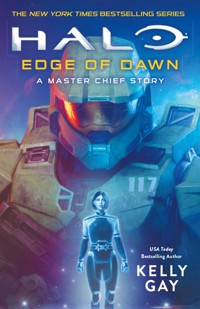
An original novel set in the Halo universe—based on the New York Times best-selling video game series! 2560. After eliminating War Chief Escharum and sending the Banished leadership into chaos, the Master Chief continues the fight on Zeta Halo, accompanied by his new AI companion and their loyal pilot Fernando Esparza. As Spartan-117 searches for scattered allied forces, a young combat medic—tortured and imprisoned for months by the Banished and the enigmatic Harbinger—may hold the key to unlocking deeper mysteries within this ancient ringworld. But every step toward answers is haunted by the sinister and elusive blademaster Jega 'Rdomnai, who is hellbent on vengeance...
Sie lesen das E-Book in den Legimi-Apps auf:
Seitenzahl: 391
Veröffentlichungsjahr: 2025
Das E-Book (TTS) können Sie hören im Abo „Legimi Premium” in Legimi-Apps auf:
Ähnliche

















Contents
Cover
Title Page
Leave us a Review
Copyright
Dedication
Historian’s Note
Epigraph
Prologue
Chapter 1
Chapter 2
Chapter 3
Chapter 4
Chapter 5
Chapter 6
Chapter 7
Chapter 8
Chapter 9
Chapter 10
Chapter 11
Chapter 12
Chapter 13
Chapter 14
Chapter 15
Chapter 16
Chapter 17
Chapter 18
Chapter 19
Chapter 20
Chapter 21
Chapter 22
Chapter 23
Chapter 24
Chapter 25
Chapter 26
Chapter 27
Chapter 28
Chapter 29
Chapter 30
Chapter 31
Chapter 32
Chapter 33
Chapter 34
Chapter 35
Chapter 36
Chapter 37
Chapter 38
Chapter 39
Chapter 40
Chapter 41
Chapter 42
Epilogue
Acknowledgments
About the Author
Adjunct
Harbinger’s Lament
EDGE OF DAWN
DON’T MISS THESE OTHER THRILLING STORIES IN THE WORLDS OF
HALO INFINITE
Kelly Gay
The Rubicon Protocol
THE FERRETS
Troy Denning
Last Light
Retribution
Divine Wind
RION FORGE & ACE OF SPADES
Kelly Gay
Smoke and Shadow
Renegades
Point of Light
THE MASTER CHIEF & BLUE TEAM
Troy Denning
Silent Storm
Oblivion
Shadows of Reach
ALPHA-NINE
Matt Forbeck
New Blood
Bad Blood
GRAY TEAM
Tobias S. Buckell
The Cole Protocol
Envoy
BATTLE BORN
Cassandra Rose Clarke
Battle Born
Meridian Divide
THE FORERUNNER SAGA
Greg Bear
Cryptum
Primordium
Silentium
THE KILO-FIVE TRILOGY
Karen Traviss
Glasslands
The Thursday War
Mortal Dictata
THE ORIGINAL SERIES
The Fall of Reach Eric Nylund
The Flood William C. Dietz
First Strike Eric Nylund
Ghosts of Onyx Eric Nylund
STAND-ALONE STORIES
Contact Harvest Joseph Staten
Broken Circle John Shirley
Hunters in the Dark Peter David
Saint’s Testimony Frank O’Connor
Shadow of Intent Joseph Staten
Legacy of Onyx Matt Forbeck
Outcasts Troy Denning
Epitaph Kelly Gay
Empty Throne Jeremy Patenaude
SHORT STORY ANTHOLOGIES
Various AuthorsEvolutions: Essential Talesof the Halo UniverseFractures: More Essential Tales of theHalo Universe
EDGE OF DAWN
KELLY GAY
BASED ON THE BESTSELLING VIDEO GAME FOR XBOX®
TITAN BOOKS
LEAVE US A REVIEW
We hope you enjoy this book – if you did we would really appreciate it if you can write a short review. Your ratings really make a difference for the authors, helping the books you love reach more people.
You can rate this book, or leave a short review here:
Amazon.co.uk,
Goodreads,
Waterstones,
or your preferred retailer.
Halo: Edge of Dawn
Print edition ISBN: 9781835416600
E-book edition ISBN: 9781835416617
Published by Titan Books
A division of Titan Publishing Group Ltd
144 Southwark Street, London SE1 0UP
www.titanbooks.com
First Titan edition: December 2025
10 9 8 7 6 5 4 3 2 1
This book is a work of fiction. All of the characters, organizations, and events portrayed in this novel are either products of the author’s imagination or are used fictitiously. Any resemblance to actual persons, living or dead (except for satirical purposes), is entirely coincidental.
Copyright © 2025 by Microsoft Corporation. All Rights Reserved. Microsoft, Halo, the Halo logo, Xbox, and the Xbox logo are trademarks of the Microsoft group of companies.
No part of this publication may be reproduced, stored in a retrieval system, or transmitted, in any form or by any means without the prior written permission of the publisher, nor be otherwise circulated in any form of binding or cover other than that in which it is published and without a similar condition being imposed on the subsequent purchaser.
A CIP catalogue record for this title is available from the British Library.
EU RP (for authorities only)eucomply OÜ, Pärnu mnt. 139b-14, 11317 Tallinn, [email protected], +3375690241
The fort was held. Thanks, JG.
HISTORIAN’S NOTE
This story takes place in June 2560, immediately following the Master Chief’s defeat of the Harbinger within the Silent Auditorium on the fractured ringworld Zeta Halo—itself currently located in an unknown region of space.
This Is the Way My World Ends
We are as one, you and I, forged of the same steel
You, soft around the edges, untested
Me, tempered and quenched, hardened by time
Tempted with wings that could never fly
The world is a beautiful place, despite its sorrows and turns
And our cage is a temple made of fire, in it we must burn
So strike and blow and light the forge blue
I leave all that is left to the crucible
Did she know I would wield the hammer?
Of course she did
She is the steel from which we are born
The sword in hand to meet the impossible storm
The first slant of light now blackens my eyes
I am racing comets and learning to fly
What is an ending, really, but a journey set anew
But even so, I hope . . . You’ll miss me a little, won’t you?
/START AUDIO FILE/
Two days of searching and no sign of the Chief or the Weapon. I don’t know what to do or where to look. There is no one to call for help and the Banished are everywhere. I hate this place, Alitza. I hate it so much.
I found him, did I tell you?
I, Fernando Esparza, a simple engineer, found an honest-to-god Spartan.
The Master Chief. Out there, floating in space.
After the Banished ambushed Infinity, I thought I was the only human left alive. For six months, I hid in my Pelican. . . . Well, you know the story. I did record an ungodly amount of audio files during that time, didn’t I?
But I don’t think I’ve recorded one since. There hasn’t been time.
Finding the Master Chief was a blessing and a curse. After bringing the big guy in from the cold and waking him up, he hauled me right down to the surface of the Halo ring (more on that later) and has been fighting ever since, trying to gain a foothold. And he managed the impossible, killing a bunch of high-level Banished leaders and their war chief, Escharum. The stories about Spartans . . . the hype. It’s all true.
But this ring isn’t just full of technology that the enemy wants—it’s also a prison to an ancient species called the Endless. And the Banished released one of them, the Harbinger.
The things I know now are way above my pay grade, let me tell you.
It’s insane to think that things like Halos exist. Imagine a giant wheel, made by an ancient, advanced civilization, as round as our own planet floating in space with living habitats all along its inner band. . . . This is what we’re fighting for, this weapon . . . and the things on and in it.
Infinity and her fleet came to the Halo to apprehend Cortana, the leader of the Created and—get this—former AI partner to the Master Chief himself. After the Banished ambushed us, she blew a nice-sized hole in the ring and sent it through slipspace to some unknown part of the galaxy, taking us all along for the ride and leaving us stranded, unable to call for help.
She was destroyed in the explosion, but, if you ask me, she deserved far worse, and I for one am glad she’s dead.
I can only imagine how scary it must have been to hear her galaxy-wide ultimatum, to witness her Guardians appearing above our homeworld, and to be at the mercy of those in power choosing to make a stand rather than succumb to her idea of “peace.”
I know that you, our daughter, and everyone else are long gone. But I can’t stop hoping that somehow, through some miracle, you survived Cortana’s planet-killers.
I don’t know why I even make these entries. You won’t get to read them anyway. I guess it’s as pointless as replaying some other man’s holo-message. And yet . . . it reminds me of you both, of the family I stupidly left behind.
I’m afraid, Alitza. But I won’t give up. I’ll keep surviving. I’ll return home, to see for myself. Whatever it takes.
Chapter 1
Silent AuditoriumJune 3, 2560
The light from the portal filled his heads-up display, white and blinding. In an instant, the neural interface linking the Master Chief—Spartan John-117—to his armor’s systems went dark. No latent or real-time data populated across his HUD’s interior screen. He was blind in more ways than one, left with only the adrenaline of recent battle and the sound of his pulse still thundering in his ears.
Against the warning of the Weapon, the young artificial intelligence currently residing in the crystalline layer between his Mjolnir armor and inner padding, and with the Silent Auditorium collapsing around them, there hadn’t been time to question the portal’s sudden appearance or its origins, so he’d made the call and leapt into the unknown.
Only to be spit out in midair seconds later.
Immediately, his display cleared, revealing a dusk-colored sky before his screen filled with data that told him what he already knew.
He was falling backward. And fast.
No time to react, he crashed shoulders-first onto a mountainside, his armor taking the brunt as he slid down the jagged cliff-top, all four hundred and fifty kilos of him busting through granite and schist and finally coming to a rolling stop on a flat ledge.
He lay there for a half second, numb to the pain, muscle fatigue, and hunger accumulated over days of intense combat. With a grunt, he pushed to his feet. “Let’s not do that again.”
“I did try to tell you it was a bad idea.”
John ignored the Weapon’s cheerful I told you so and stepped toward the cliff’s edge to get his bearings, gazing across the vast span of Zeta Halo’s inner surface, where a gaping hole had been blown into the ancient ringed structure six months earlier. The fiery glow from the nearest star illuminated the Halo’s distant debris field, a patchwork of islands, broken superstructure, and remnants of spent battles all caught in place by the ring’s artificial gravity.
The portal had taken them from the Silent Auditorium, deep within the interior of one of those islands, and cast them out here, moments later, clear across the ring.
His comms suddenly crackled to life. “Chief! Your beacon just appeared out of nowhere. Oh, I thought I’d lost you. Where did you go?”
“Echo 216?” the Weapon responded, clearly surprised.
She wasn’t the only one.
The fact that the Pelican pilot had managed to find them so far from where he’d initially dropped them off only a few hours earlier seemed almost impossible.
“Stay put,” Echo 216 said, “I’m coming to you.”
Dust blew across the barren rocks, drawing John’s gaze away from the cliff’s edge to what lay around him. “Where are we?”
As he turned, he saw that he stood in the shadow of a five-meter-tall totem ring, one of seven stone rings lodged in a continuous line within the barren rock. Ancient and weathered, a few broken, the totems were carved with strange symbols and iconography, and contained data relating to Zeta Halo’s distant past. The Weapon had decoded several of these records during their short time on the ring and found the totems unnerving. Couldn’t say he blamed her.
“Chief, I think the better question is when are we,” the Weapon replied. “I don’t know how, but we’ve been gone for days. Three days, to be precise.”
In his decades of service to the United Nations Space Command, fighting the Covenant, the Flood, the Banished, Cortana’s Created, and countless other threats, he’d seen his share of uncanny alien technologies, but the revelation still caught him off guard.
“This ring,” he noted quietly, “is different than the others.”
Zeta Halo was part of the neoteric array—seven super-weapons created over a hundred thousand years ago by an ancient, technologically advanced species known as the Forerunners to combat the Flood. The parasitic hivemind had been sweeping through system after system, infecting world upon world. The Halo Array, fired in concert, was designed to eliminate the Flood’s food source—namely all thinking life in the galaxy. Nothing survived. To counter the horrific effects of their weapons and to later reseed life back into the galaxy after the Flood died out from starvation, the Forerunners had designed the Halos’ inner bands to house all manner of life, preserving flora and fauna specimens from across the stars in a multitude of habitats and genetic repositories. The rings contained vast archives of history, information, and technology . . . and some, like this one, held secrets even the Forerunners feared.
John sensed the soft nudge through his neural link and lifted his hand in response. The Weapon instantly projected her blue holographic form onto his open palm. Thirty centimeters tall, she was clad in a translucent UNSC bridge cadet uniform. Lines of code ran vertically through her entire body, growing luminous or dim depending on her mood, which for the most part was sunny and optimistic. Her face was impish, and she often tucked one side of her cropped dark hair behind her ear.
“The Banished and the Harbinger were looking for something that was never found,” she said, studying the archaic totems. “Why would the Forerunners hide something and throw away the key? Doesn’t that scare you?”
“No. You?”
The Weapon considered his question. “Of course not.”
A familiar whir filled the air as his comms buzzed again.
“Is anyone going to ask me what I think?”
John turned as a Pelican rose from the depths below the ledge to hover directly in front of him. The dropship’s windshield was cracked in places, its armor plating charred and dented and its chin gun completely inoperable, but the venerable D77-TC was still proving its worth.
“I guess not. Get inside, big guy,” Echo 216 said, executing a one-eighty to put the Pelican’s back hatch a few meters away from the cliff ledge, its door already opening.
As the Weapon withdrew into his armor, John ran forward, leaping off the ledge and into the troop bay, the metallic clang of his armored boots echoing through the space as his momentum carried him toward the cockpit.
With autopilot engaged, Echo 216 unclipped his harness and hurried out of the cockpit, his arms outstretched to embrace the Spartan. “Chief! Chief!”
The hug was unexpected, but it told John how traumatized the man must have been in their absence.
The pilot had been existing in a constant state of fear for far too long. First, stuck alone in the ring’s orbit for six months, the dead floating all around him, while evading enemy patrols . . . then thrust into the ongoing battle on the surface, assisting John as he fought to regain control over the ring, a fight not without its consequences.
That, along with the last seventy-two hours, had taken their toll.
Though now the sudden appearance of Echo 216 made a bit more sense. The pilot hadn’t found them quickly at all; he’d been out searching for days, finally happening upon their signal.
“Sorry. I’m really happy to see you. Really happy.” Echo 216 stepped back, gazing up at John’s faceplate, a relieved smile breaking through his dark beard, before grabbing an MA40 assault rifle leaning against one of the troop seats. “So . . . what do we do now?”
The Master Chief took the offered rifle and attached it to his back, feeling the magnetic plate grab hold. “We finish the fight.”
The pilot laughed, punched the air, and then saluted, his animated behavior bordering on manic. It didn’t take a therapist to see the trauma lurking behind his excitement. “Yes! Yes, sir!” He headed back to the cockpit. “The Banished still control the rest of the ring—”
“Wait.” The Weapon appeared on John’s palm. “I know this is weird,” she said, “given all that’s happened, but . . .”
“What? What is it?” The pilot turned, his hand resting on the back of the flight seat.
“We still don’t know your name. We can’t keep calling you Echo 216.”
“No, you can’t.” He gave a genuine smile. “Esparza. Fernando Esparza.”
“It’s nice to meet you, Esparza. Fernando Esparza.”
“Good work, soldier,” John said, feeling somewhat guilty he’d never asked the question himself, given that his reliance on the pilot had put the man in danger many times. But he knew why he hadn’t. The war they’d been fighting, like all the other endless battles over the years, all the names and faces of marines and civilians, soldiers and friends . . . He’d gotten used to keeping people at arm’s length. It was better that way.
“And what about you?” Esparza asked the Weapon.
“What about me?”
“What do I call you?”
She turned away from Esparza, uncertainty in her expression. “Any ideas?” John asked.
“Well . . .” She put her hands behind her back as she considered it, then: “Do you think it would be okay?”
He nodded. The naming of oneself was a privilege granted to all smart AIs. This one, however, had been the exception. The Weapon had been created for a single purpose; a critical mission she wasn’t meant to outlast. But now that she’d be hanging around for a while, the choice was all hers.
“You’re sure?” she asked.
“You get to choose your name.”
“Then . . . I think . . .” She pivoted back to Esparza, smiling. “I think I might have the perfect one.”
Esparza slid into the pilot’s chair and locked it into place. “All right. Here we go.” John took up position behind the seat. With a glance over his shoulder, Esparza laughed and then pushed the throttle. “Get ready. . . .”
* * *
Hugging Zeta Halo’s inner curve, the Pelican flew at subluminal speed back toward the fracture. John linked his HUD to the dropship’s radar, keeping a close eye on its long- and short-range sensors. Most Banished forces seemed to be concentrated in the area of the ring’s debris field where the heaviest fighting had taken place over the last six months, but scouting parties and patrols could be anywhere on its surface. And without an operational chin gun, they’d do well to steer clear of Banshee patrols or anti-air guns.
“What’s it been like the last three days?” John asked, though he had a feeling he already knew. He’d killed the Banished leader Escharum before heading into the Silent Auditorium and facing the Harbinger. The blowback would have been significant.
“It’s not good, Chief. After you took out Escharum, the Banished went berserk. Well, more berserk than usual. They’ve been broadcasting mass prisoner executions over their comms towers. Making a real spectacle. They’ve retaken a few of the FOBs you guys liberated. Some of the Banished are even turning against the human factions within their own ranks.”
“Chief?” The Weapon’s concerned gaze told him she was aware of the spike in his limbic system.
He’d expected retribution for the Banished leader’s death, but he hadn’t expected to be MIA for three days while UNSC forces sat in the cross-hairs, paying the price—just as they’d had to do when he’d been adrift in space and unable to join the fight. “I’m supposed to take the brunt. I can handle it. There are too many out there that can’t.”
“It’s not your fault,” she replied carefully.
“I know.” But knowing didn’t make the situation any less frustrating.
“There’s no leadership,” Esparza continued in an obvious attempt to redirect the conversation. “Word is that’ll all be worked out tomorrow.”
“What happens tomorrow?” the Weapon asked.
“The last day of Escharum’s funeral. Stay frosty, my friends, we’re approaching the break. This is Banished territory.”
Several kilometers out, islands began to take shape within Zeta Halo’s massive fracture, many of which had retained their topography in the cataclysm—rocky terrain, high-altitude forests and meadows, a few small lakes, and scattered clusters of hardy vegetation still flourished beneath a manufactured atmosphere and gravity—while other small fragments were nothing more than chunks of exposed pillars and alloy substructure, stripped bare in the explosion, revealing the complex machinery and vast underworld that existed within the ring.
Even from this distance, signs of occupation dotted the debris field; the faint glow of fires and long threads of smoke rising into the atmosphere marked clear indications of life, any one of which might be human, might be the members of his team.
John had no doubt that Blue Team—Fred-104, Kelly-087, and Linda-058—were out there somewhere, just as he felt certain that Dr. Halsey, Spartan Commander Sarah Palmer, and Infinity’s captain, Thomas Lasky, had survived and were even now making inroads to take back Zeta Halo from the Banished. Hundreds of Spartans had been aboard the flagship when she’d entered the ring’s orbit. But with the Banished routinely jamming UNSC comms, it was difficult to know just how many had survived the initial ambush and how many were still alive after six months of relentless fighting here on the surface.
As much as he wanted to search for Blue Team and the others, he had to take advantage of the power vacuum created by Escharum’s death before losing the opportunity altogether.
“Without UNSC leadership and a clear centralized command, Rubicon Protocol is still in effect,” the Weapon said, in line with his thoughts.
“What’s Rubicon Protocol?” Esparza asked.
“It’s permission to act,” she answered. “To do what needs to be done to keep Zeta Halo out of enemy hands and prevent a new leader from rising out of the ashes.”
“Whatever it takes,” John said.
“‘Whatever it takes,’” Esparza echoed. “I’m afraid to ask what that entails. Never mind. I don’t want to know.”
“It means we’re going to fan the flames, sow chaos and division,” John said. “Then we use the distraction to sever Banished communications and jamming towers and restore UNSC commsats so survivors can start communicating and regrouping.”
“Chaos sounds fun,” the Weapon responded, grinning at Esparza. “Doesn’t it?”
“Oh, so much fun. Just drowning in fun,” he muttered, rolling his eyes.
The dropship continued its descent toward the edge of the fracture and the familiar alpine landscape that made up the broken fragments of the ring. The unknown system’s nearby sun had set, leaving behind an evening sky with thin clouds and the maw of space lurking beyond.
“So now that you know my name”—Esparza glanced over at the Weapon—“you plan on sharing this perfect name of yours?”
John lifted the Weapon higher as she linked her hands behind her back and cocked her head, a slow mischievous grin building on her pert face.
“It’s . . . Steve.”
Esparza blinked. “Steve?” he echoed after a dumbstruck moment. His brow furrowed as he glanced between them. “Are you serious?” When she didn’t respond, he said, “Of all the random names . . . Chief, come on, are you hearing this?”
John shrugged. “I like it.”
“What’s wrong with Steve?” Steve blinked innocently.
“I just . . . it doesn’t . . . I mean . . .” Esparza stammered incredulously until the Weapon burst with laughter.
“You should see your face.”
Esparza’s shocked expression gradually shifted, becoming a grudging smile. “Ha-ha. You got me. Very funny.”
“Oh, trust me, it was.”
She turned her head and caught John’s attention, the wide grin on her face sweeping through his chest like a solid punch to the solar plexus.
She looks just like her . . . His own words to Dr. Catherine Halsey were ingrained in his memory. In her lab on Infinity, the doctor had shown him “the Weapon.”
. . . “If you say so. I see something else. Something more innocent . . . from a simpler time,” Halsey had said.
“Does she know me?”
“No. She is a blank slate. No memories, no history. Her core is nearly complete. Once it is ready, it will be up to the two of you. The Weapon will lock her down. You will retrieve Cortana and bring her back here.”
“For execution.”
“For deletion. We are at war, Master Chief. If you do not think you can do this . . . now is the time to step down. I am sure Spartan Locke is available.”
“That won’t be necessary.”
“Good. Tomorrow will test us all.” . . .
Dr. Halsey had been right—as usual.
They’d been tested.
Tested and failed.
He stowed the memory and turned his attention back to the Weapon. “Did you decide?”
“Mmm. I did.” Her shoulders went straight, and she said with confidence: “I’m UNSC AI Serial Number CTN 0453-0. Name designation: Joyeuse.”
“Hmm. Not as good as Steve, but . . . I like it,” Esparza said, giving her a wink.
John knew there was a chance she might have called herself Cortana, and while he would have supported her decision, he couldn’t deny the strong feeling of relief that swept through him. Holding on to a name that carried so much history and unresolved grief would have been . . . difficult.
The clearing of Joyeuse’s throat drew his gaze to hers once more. She was waiting, wanting to know what he thought.
John dipped his head. “I like it too. It suits you.”
She smiled. “Thanks.”
“Joyeuse . . .” Esparza mulled it over. “Never really heard a name like that before. What does it mean?”
“Well, among other things, it means good-natured, with a really amazing personality. Describes me pretty well, don’t you think?”
“I think you’re right then—it is perfect.”
“Precisely,” she said, pleased.
“You know, my wife loved unique names too. When we chose our daughter’s name, Iahlee, oh man, it took forever. Nothing felt right.”
“So how did you choose?”
“Well, right up until the day she was born, we couldn’t decide. And then she was there, in the world, this perfect little being, and it all just clicked. I guess it took meeting face-to-face to really know—hold on,” he said, hard-banking the Pelican around jagged pillars jutting from the side of a barren mountain peak.
As they talked names, John’s mind took him back to the first time he’d met Joyeuse’s predecessor. Her matrix had poured into the neural interface implanted in the back of his head with a sharp, icy stab. That initial feeling had been unexpected—as was hearing another internal voice besides his own, coexisting and speaking in his mind. . . .
“Not a lot of room in here. Hello, Master Chief. . . .”
“Hello, Cortana.”
Chapter 2
Pelican Echo 216June 3, 2560
At the edge of the fracture, Esparza eased back on the thrusters and settled the Pelican into a level descent along the break.
They were barely a speck compared to the enormity of Zeta Halo, its depth a staggering forty-seven kilometers. And while the ring was unquestionably impressive on the outside, its inner workings—now exposed—were no less astonishing. A dark labyrinth, a world within a world of alloy substructure, conduits, support girders, and pillars. They were seeing only a slice into its massive interior, but John knew that far deeper within that darkness lay vast complexes, archives, research facilities, repair centers, generators, manufacturing sites, hangar bays, and passageways as wide as humanity’s largest supercities.
Signs of the ring’s repair were in full progress. Swarms of Constructor and Aggressor sentinels—Forerunner machines designed for maintenance, repair, and security—were methodically healing the gaping wound, rebuilding the structure’s extensive outer plating and intricate inner systems as others mended the colossal framework, which would eventually support the weight of new artificial topography.
Joyeuse, her form now generated atop the Pelican’s forward console via the cockpit’s holo-emitter, seemed mesmerized by the awesome sight.
“Don’t worry about them,” Esparza said, mistaking her reaction for concern. “They don’t seem to notice or mind who passes by.”
“Oh, trust me, they notice,” she replied. “But lucky for us they won’t attack unless provoked or redirected by the ring’s monitor or sub-monitors. With Zeta Halo’s monitor currently gone, they’re probably working on autopilot.”
Reaching the final few kilometers of the ring’s depth, the Pelican began a slow path away from the jagged edge and into the open break, the small craft weaving beneath massive islands and floating chunks of twisted metal and the occasional debris of Banished and human vessels.
“Where are we headed?” John asked.
“You’ll see. We’re almost there. I found this place a couple days ago. Banished salvagers have already scoured the area, taking the big guns and ammo. They don’t come this way much since it’s far from the main islands. I tried hiding the Pelican back there”—he jabbed a thumb over his shoulder—“inside the ring, but there’s nothing—no food, water, supplies. . . .”
Another debris-strewn patch came into view. Loose rocks, boulders, trees, and shattered topography shared space with clumps of twisted and burned-out wreckage: Banished and UNSC starfighters, a few drop pods, a Warthog, and smaller equipment like cannons, cargo bins, land vehicles, along with the grim remains of their operators. Somberness settled in the cockpit. John’s jaw clenched tightly. He couldn’t help but think he’d failed his fellow soldiers. As the enemy ambush had torn through the UNSC’s fleet, the Banished warmaster, Atriox, had boarded Infinity intent on capturing the Weapon. John had fought Atriox himself to prevent the Jiralhanae’s ingress and was soundly defeated, tossed out of the ailing ship, unconscious and unable to assist. . . .
Esparza navigated through the haunting field, eventually making a clear approach to a jagged, dark-gray mass. John recognized the material instantly: Titanium-A plating. They were headed straight toward what remained of a UNSC frigate, FFG-611 imprinted on its hull, one of many in the flagship Infinity’s support fleet. Telltale plasma burns had curled the metal edges, effectively melting the powerful vessel in two, its other half nowhere to be seen.
“Give me a minute,” Esparza said, “it’s a tight squeeze.”
This particular frigate possessed only one bay large enough for storage compartments and a single Pelican dropship. An experienced pilot could slot a bird into a fully stocked single bay with ease. But Esparza was an engineer by training and far from experienced. John winced as the wing scraped the frigate’s hull.
Joyeuse stared slack-jawed at the pilot as a shower of sparks floated across the dropship’s windshield. “You’ve been flying this thing for the past six months.”
“Most of that was drifting in space, doing the bare minimum to stay off the radar. There was hardly any flying at all until that guy showed up,” he said, gesturing to the Spartan.
Joyeuse snorted. “At this rate, I could handwrite an entire manual on ‘How Not to Land a Pelican.’”
“Yeah, yeah, don’t rub it in.” The skin above Esparza’s beard turned pink. “Doing my best here. It’s trickier than usual because of that bent bulkhead.” He cast a nod toward the holographic display on the screen showing a four-meter bulge in the hangar’s starboard wall.
The Pelican wobbled starboard to port three times before its landing gear finally connected with the hangar floor. The engines powered down, and the whine of machinery faded into silence.
Esparza unclipped his harness and exited his seat. “And now for the best part.” He headed into the troop bay and retrieved an atmospheric suit from the locker. After the engineer had suited up and put his helmet on, the Chief’s comms lit up.
“Every frigate like this has a small generator with just enough power to seal the hangar bay,” Esparza told him through the speakers as he disengaged the airlock and opened the troop bay door.
Impressed by his resourcefulness, John held out his hand to allow Joyeuse to step from the holodeck onto his palm, then followed Esparza into the frigate’s hangar bay.
“Besides a few leaks I had to seal, the hull and oxygen tanks are in good shape.”
Crates of provisions had been haphazardly clamped and stacked against one wall. Esparza weaved between the crates and two large storage containers to get to the housing containing a midsize generator.
“You’re not worried about the energy signature?” Joyeuse asked.
“These frigates have a very low sensor emission, the generator even less. What little is emitted gets lost in all the other junk still powered on in the field. And before you ask . . . I checked. No survivors. But what is here is food, water, supplies.”
Once the generator powered on, an energy shield encapsulated the entirety of the hangar bay, sealing them off from the vacuum of space.
“There’s a handful of small portable lights by my cot there, but otherwise I keep the bay lights off,” Esparza said. “Just in case.”
“Shields operating at ninety-six percent. Oxygen levels increasing,” Joyeuse noted, sounding impressed.
“I mean, I might not be a great pilot, but I’d like to think I’m a decent engineer.”
“More than decent. Good work.” John strode to the hangar bay’s control suite. The console was equipped with an AI port. He reached around to the base of his helmet. As he did, he felt Joyeuse direct her matrix from the layer in his suit into the crystal data chip designed to house her matrix. A small click sounded, and the sensation of pressure releasing swept through his brain as he removed the chip and inserted it into the AI port.
Joyeuse shimmered into being over the holopad on the console. “Is this an invitation to dig into the ship’s files? Because I do love a good research session.”
“The ship’s AI will have scrubbed most of its sensitive data per protocol,” John said, “but there should be enough ancillary data on current events to get you up to speed.”
“She’s an AI,” Esparza said. “Isn’t she already up to speed?”
“Not quite.” Joyeuse answered. “My insight into human history, the nuances of your culture, and the complexity of military life is lacking.” A hint of uncertainty crossed her features. “I understand mission parameters and tactics, and I’ve increased that understanding through the Master Chief’s database and the UNSC forward operating bases we liberated, but . . . I’m missing the context that comes with history and experience. Since the Chief found me, I’ve only had a few days to glean whatever data I could about humanity and the Banished. . . .”
“When Joy was deployed, she was only given the relevant data necessary for mission success,” John explained.
“‘Joy’?” She blinked, seeming to ponder the nickname as John tilted his head, silently asking if she approved. “I like it!”
“So you’re like a fresh, out-of-the-box Cortana model?” Esparza asked, “Uh . . . no offense.”
“None taken.”
There was no disputing the fact. Both Joyeuse and Cortana had been made from one of the cloned brains of their creator, Dr. Catherine Halsey. Their replicated neural pathways, simulated electrical impulses and signals; their perception, reasoning, and emotional response models were all based on an identical template. Upon activation, each had emerged with the same appearance, voice, and thought patterns. The only thing that separated them was input and “life” experience.
“None of her history or memories . . . ?”
“Not . . .” Joy was slow to answer. “. . . really. I’m essentially a clean slate. Unless we’re talking Forerunners. I’ve already acquired and disseminated a vast amount of data contained within this section of the ring, though I was limited by the security measures put in place when the ring was fractured.”
This was the first John was hearing about it. “What kind of measures?”
“The flow of certain data around Zeta Halo was suspended and partitioned into sectors, which is why I’m unable to build a clear picture of what’s happening on other parts of the ring.”
As John absorbed that bit of information, Esparza resumed his own line of questioning. “So you’re not exactly an ‘exact copy.’”
Joyeuse paused, cocking her head in a thoughtful manner. “Well, when you put it that way . . . I am and I am not.”
Esparza laughed and headed to a stack of storage containers. “Well, while you feed on information, I’m going to fill my belly with”—he dug through the bin—“taco pizza or . . . moa meatballs and gravy over rice.”
While he rummaged through the available food supply, Joy seemed to hesitate on the console before saying, “Chief, you went from six months of induced stasis to several days of consistent combat. You could use a thorough maintenance check across all systems—”
“I’ll take care of it.”
“But—”
“I said I’ll take care of it.”
Discouraged, she fell silent. In the few seconds that passed, the confusion, concern, and embarrassment flitting across her features made John regret his blunt tone.
“Okay,” she finally replied. “If you say so.”
With that, she disappeared.
Meals in tow, Esparza headed to a small, cleared-out section of the bay where two large storage containers touched to make a corner. Here he’d gathered essential supplies and had set up a cot and requisitioned a small ammo crate to use as a table.
“Oxygen levels are good now,” he said, removing his helmet and setting it on the cot beside him as he sat. From the makeshift table, he grabbed a palm-sized portable light and activated it with a wave of his hand. The small chemlight flickered in the dimness, casting large shadows across the hangar bay. “Welcome to the UNSC Casa del Esparza. It isn’t much, but it’s kept me alive the past three days.”
“It’ll do. You’ve done well.”
John made for one of the storage bins pushed against a large container. He sat, released the atmospheric seal to his head gear, and then removed his helmet, placing it next to him and drawing in a deep, unfiltered breath of air. The oily smell of engine components and ozone mixed with the familiar metallic tang of titanium plating might be off-putting to some, but he’d always found the scent comforting.
Esparza pulled a rucksack laden with supplies over to his feet and rummaged through it. “Here you go, Chief.” A water bottle and a standard-issue energy bar sailed through the air. “What am I thinking?” With a short laugh, he tossed three more bars John’s way. “Nothing standard about you.”
John caught the extra packs. “Thanks.” He was used to feeling hungry and never minded it; it reminded him that he was still more human than machine. But Joy was right—he was sorely in need of an ad hoc diagnostic work-up. The significant nutrient deficit caused by six months of stasis followed by nearly nonstop fighting had sapped his energy. The packs and a couple of MREs would do him a world of good.
As Esparza prepped the MREs, pulling the strips off the air-activated ration heaters, John noticed the engineer’s hands shook slightly. “Taco pizza or moa meatballs?” he asked over his shoulder.
“Doesn’t matter.”
Esparza put the finishing touches on the meatballs and handed them off to John before returning to check the temperature of the pizza. The first bite of processed “meatball” held just a hint of meat flavoring, which almost immediately gave way to a bland, cakey wad of calorie-dense nutrient. But it was warm, served its purpose, and was a hell of a lot better than eating bark. As he polished off his meal, John studied Esparza.
In the quiet of his task, the bearded man’s profile became more haggard. The façade he usually wore was slipping. The MRE, however, seemed to steady him somewhat, and after eating, he pulled a small case from beneath the cot and opened it. John saw long cylinders clipped into one side of the case and dispensement capsules on the other. Most likely polly-sue or some other painkiller.
Esparza uncapped one of the capsules and then stuck it against his thigh.
After a few seconds, he let out a slow breath; then he caught John’s eye, causing him to quickly look away, ashamed and exposed, a stark contrast to his usual upbeat personality. His shoulders slumped with a weariness that seemed bone-deep. There was only so long one could sustain the charade.
Before John’s final confrontation with Escharum, the Banished leader had used the Sangheili blademaster, Jega ‘Rdomnai—a Spartan Killer and Escharum’s right hand—to kidnap Esparza in an effort to lure the Master Chief into his stronghold, the appropriately named House of Reckoning. Esparza hadn’t been in Jega’s captivity for long, only a few hours, but it was enough time to experience an accelerated form of torture in the bastard’s interrogation device. John had seen exactly what that device had done to Spartan Griffin—brutally effective while also inflicting maximum psychological damage. Esparza surviving in it for as long as he had was a damn miracle.
Once rescued, pure adrenaline had apparently carried Esparza through the aftermath. But in the last three days, alone and hiding amid constant danger and fear, he’d clearly been suffering the full effects of posttraumatic stress. The hyper moods, the tremors in his hands, the haunted look in his eyes—they were telltale signs that John had seen far too many times before.
John opened one of the cargo pouches on his waist and withdrew a round holodisk. “Here. You dropped this earlier.” He passed the device to Esparza.
Esparza accepted the smooth circular emitter, pulling it in close, cradling it as a host of emotions—longing, heartbreak, regret—crossed his weary face. “I can’t believe you found it.” His softly spoken words turned to a miserable laugh. “You know, this isn’t even mine? How pathetic is that? All this time, listening to a wife, a child, a family that isn’t my own.”
“But they remind you of yours,” John replied, understanding.
John had discovered the disk on the floor of the House of Reckoning as he’d breached the fourth level, just below where Jega had been holding Esparza hostage.
“It’s retribution, I know,” Esparza said quietly.
“Retribution?”
“All of it. Everything that’s happened. It’s no less than I deserve, Chief.” He lay back on the bed and closed his eyes as the drug took effect. “No less than I deserve.”
When the Banished had ambushed Infinity, Esparza had panicked. In the chaos, he’d stolen a Pelican, Echo 216, from one of the ship’s hangar bays and fled for his life. He was an engineer, a volunteer at that, not a soldier. He’d probably never come face-to-face with a Jackal or a Brute before. But he could have saved lives, could have filled the Pelican’s troop bay with evacuating personnel. . . .
Instead, he’d fled with an empty ship.
There was a time in his life when John would have judged Esparza very harshly. But the longer he waged war, the more he’d come to accept that everyone reacted differently, their actions and motivations guided most often by self-preservation, fear, and panic—traits that he, as a Spartan, simply no longer possessed, at least not in any quantifiable measure.
Before this is over, promise me you’ll figure out which one of us is the machine.
Cortana had said that to him once, and he was becoming more convinced that there was no good answer, that he’d carved out a place for himself somewhere in the in-between.
Guilt and war, strengths and weaknesses, the good, the bad—they all went hand in hand. And they all had their fair share of shit and shine.
At least Esparza had admitted the wrong he’d done. And John had a feeling the man would spend the rest of his life trying to make up for it.
Just as Cortana had given hers to make up for—
No.
Not now. He was too tired and his belly was finally full—with field rations, sure, but it was something tangible and warm compared to the nutrients supplied by his Mjolnir armor. With a deep exhale, he leaned back against the hull and shut his eyes. A few hours of sleep, and then back to . . .
Boots on the ground.
Chapter 3
UNSC Casa del EsparzaJune 3, 2560
Absorbing what was left of the frigate’s limited information took mere seconds. Spartan-117 was correct in his assessment—as the vessel broke up in battle, its onboard AI had scrubbed all encrypted and eyes-only data before enacting its own deletion protocol, sacrificing itself. Not much to sift through, really, but there were personnel files left behind and historical data found in the most unremarkable places—learning modules, personal datapads, entertainment, even vending machines—forming a patchwork of the rich history of humanity.
A species given to great acts of depravity and horror. And the most astonishing acts of courage and loyalty.
The dichotomy they posed was puzzling . . . and utterly fascinating.
That humanity had lasted this long was a testament to their inexhaustible tenacity, and what could only be described as extraordinary luck.
Out of all the information, though, it had been the personal journals, the firsthand accounts across the spectrum of routine daily life, from dramatic experiences to mundane inner revelations, that captivated Joy’s attention the most.
And from that, an idea formed.
Why not do the same?
Liking the idea, she reconfigured her event log framework to include a personal journal template, a sort of real-time accounting and review of her very own and very new life. Never mind that she was not supposed to be here. She intended to carve her own path.
Satisfied with her efforts, Joy materialized above the console’s holo-port, sitting cross-legged to watch the Spartan sleep.
When she was unplugged, the Master Chief’s vitals and body responses to stimuli—things that allowed her to “read” his physical state and mood—were unavailable. And even when she was fully interfacing between his brain and his armor, improving his reaction times and aiding him in the field, it wasn’t like she could read his mind.
The personal files and reports within his Mjolnir armor’s dataset had been set to private. There was no information to tell her what kind of human he really was . . . and more importantly, what had made her predecessor care so deeply about him.
He was determined. Obviously.
Persistent. To a remarkable degree.
He cared about his fellow soldiers; had risked his life countless times. . . .
In the thousands of faces and files she’d accessed through the frigate, in Spartan-117’s database, and via UNSC technology on Zeta Halo’s surface, no one compared to him. He simply stood out. It wasn’t that he was the tallest, the smartest, or the strongest, but he was the best at utilizing every ounce of his artificial assets and natural abilities. It set him apart, made him the ultimate Spartan.
He was gruff, untalkative, and much older than her, a seasoned veteran to her very capable and impressive infancy.
They were complete opposites, and yet . . . she liked him.
But could she trust him?
He had attempted to delete her. And while she didn’t think he’d try that again, she did wonder whether, if ordered by his superiors to do so, would he? Once the UNSC learned of her continued existence, her safety might be thrown into question.
Where she’d once had no opinion on the matter of her deletion and was happy to follow the orders that would lead to her demise, now, apparently, she was full of wants and opinions.
She wanted to exist.
To experience. To expand. To learn. To feel.




