


8,39 €
Mehr erfahren.
- Herausgeber: Luath Press
- Kategorie: Geisteswissenschaft
- Sprache: Englisch
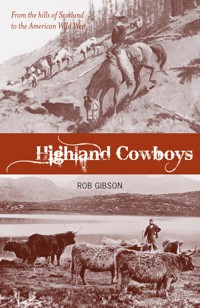
From droving to driving, heilan coos to long horns, "Highland Cowboys" explores the links between the two cattle cultures of Scotland and America through music, song, dance, and folklore. The vast number of Scots who emigrated to North America, whether through forcible eviction during the Highland Clearances or voluntarily in the hope of a better life, has been well documented. With them they took their culture, their language, their music and their skills. Cattle droving in Scotland was an established profession from the 16th century, and many such migrants took cowboy jobs in the American West. The medium of music paints a vivid picture of their social and personal lives, and describes a mutual exchange as music crossed and re-crossed the Atlantic creating strong links between the old culture and the new. This unique exploration of the cowboy culture sheds new light on the everyday life of the cattle communities.
Das E-Book können Sie in Legimi-Apps oder einer beliebigen App lesen, die das folgende Format unterstützen:
Seitenzahl: 207
Veröffentlichungsjahr: 2014
Ähnliche



















ROB GIBSONwas born in Glasgow and brought up in Dennistoun. His early interest in Scottish history has encompassed both Highland hill walking and land reform. In1972he graduated from Dundee University with a degree in Modern History and, until1995, pursued a teaching career in Easter Ross. Through his love of traditional music he has convened the Dingwall-based Highland Traditional Music Festival for 20 years and he has sung in several groups. Currently with the band Ceilidh Ménage, he has performed at festivals in Scotland and Brittany. He wrote the showPlaids and Bandanasfor performance at the Highland Festival of1998. It has played in the Highlands, Edinburgh and Borders and in September2000at 11 venues in Alberta, British Columbia and Montana.
Rob’s interest in land issues has led to an active political life including working for eight years from1988as anSNPDistrict Councillor in Ross & Cromarty. He was first elected to the Scottish Parliament in 2003 asMSPfor Highlands and Islands. He has contributed to various journals over the years and has published several books includingThe Promised Land(1974);Highland Clearances Trail: A Guide(fifth edition,1996);Crofter Power in Easter Ross(1986); andToppling the Duke – Outrage on Ben Bhraggie?(1996).
Highland Cowboys
From the hills of Scotlandto the American Wild West
ROB GIBSON
LuathPress Limited
EDINBURGH
www.luath.co.uk
First Published2003
This edition2010
eBook 2014
ISBN: 978-1-906307-28-8
ISBN (eBook): 978-1-909912-96-0
The author’s right to be identified as author of this book under the Copyright, Designs and Patents Act 1988 has been asserted.
© Rob Gibson
Acknowledgements
MY FELLOW PERFORMERS INCeilidh Ménage and Cowboy Celtic deserve a medal for helping me to develop this book from an array of facts and figures. So thank you, Lizbeth Collie, Jonathan Hill, Malcolm Kerr, Eleanor Scott and Jem Taylor in Scotland, and David Wilkie and Denise Withnell in Canada. Invaluable advice and information about Scots in North America came from writer Tom Bryan. Miranda and Iain MacDonald provided information on Dexter cattle and Doric songs. Thanks also to the Highland Festival that supported the production of the original show in1998; to Charlie Beattie who was game to be photographed in the drover’s gear; to the staff of Dingwall and Evanton libraries and to the Highland Cattle Society, who helped with my many enquiries; to all the sources of quotes and pictures that are duly listed in the text; to various readers who gave advice that helped produce a much better book. I am grateful to all who provided inspiration for this project, which has proved to have wider resonance than we first anticipated. To Jennie Renton I owe a debt to her patience as my long-suffering editor. Finally, a special thank you to Brian McNeill and Calum MacDonald for kindly granting permission to reproduce verses from their songsLads o’ the FairandRocket to the Moonrespectively.
Contents
Maps
Chronology
Foreword
Introduction
CHAPTER 1 Cattle Breeders and Cattle Raiders
CHAPTER 2 Cattle Culture and the Sheiling Life
CHAPTER 3 Highland cattle – a breed evolves
CHAPTER 4 A huge droving trade evolves
CHAPTER 5 Better to sell nowte than nations
CHAPTER 6 Drovers and dealers
CHAPTER 7 The cattle trade goes international
CHAPTER 8 Cattle displace buffalo and the Plains Indians
CHAPTER 9 Invest out West!
CHAPTER 10 A Scots middleman out West – John Clay
CHAPTER 11 Our Scotsman out West – Murdo MacKenzie
CHAPTER 12 Scot in a Western saddle – R.B. Cunninghame Graham
CHAPTER 13 America for the Americans – Scotland for the Scots?
CHAPTER 14 Emigrants and migrants – transferable skills and conflicts
CHAPTER 15 Drovers and cowboys – myths and realities
Places of Interest
Further Reading
Discography
Glossary of Terms
Sutherland & Caithness
A1 Assynt: major clearances of 1812 inland straths for sheep.
A2 Durness: heart of the old MacKay province of Reay.
A3 Strath More: early home of herdboy Rob Donn.
A4 Strath Naver: brutal serial clearances by Patrick Sellar.
A5 Bighouse: seat of MacKay droving laird for whom Rob Donn worked.
A6 Strath Halladale: part of the Bighouse estate.
A7 Strath of Kildonan: cleared 1818–19, scene of gold rush 1860s.
A8 Thurso: sanctuary for some Clearances victims.
Ross & Cromarty
A9 Isle of Lewis: ancient source of black cattle.
A10 Achiltibuie & Polglass: home of migrant Celtic cowboys in Montana.
A11 Coigach: rugged peninsula where clearances were resisted.
A12 Loch Broom: safe harbour & stock raising district.
A13 Ullapool: 1773 departure point of the Hector for emigrants to Nova Scotia.
A14 Braemore: Lochaber cattle thieves caught here.
A15 Poolewe: old mainland port, imported cattle from islands.
A16 Gairloch: MacKenzie estates dominate crofting life.
A17 Applecross: 6th-century Celtic missionary base cleared for19th-century deer forest.
A18 Kintail: cross-country routes reach west coast fjords here.
A19 Kyle of Lochalsh: railhead 1897, ferry for Skye till toll bridge built 1996.
A20 Rathmore: birthplace of Matador rancher Murdo MacKenzie.
A21 Tain: legal centre & market in ‘Lowland Highlands’.
A22 Strathrusdale: attempts to drive sheep from Ross-shire in 1792.
A23 Dingwall: County town with livestock mart and rail junction.
A24 Black Isle: fertile peninsula with port at Cromarty.
A25 Muir of Ord: Am Blar Dubh, site of famous 19th-century cattle tryst.
Inverness-shire, Nairn and Moray
A26 Inverness: scene of Patrick Sellar trial, 1816.
A27 Culloden: battle site of Jacobite defeat in 1746.
A28 Fort George: Extant Hanoverian fort guarding north end of Great Glen.
A29 Strath Errick: old home of droving, song collecting Fraser laird.
A30 Dallas: ‘Scotty’ Philip, who saved American buffalo, born here.
A31 Kilravock: cattle raiding target of Keppoch MacDonalds.
A32 Burghead: huge Pictish fort where bull carvings have been found.
A33 Beauly: original cattle market that moved to Muir of Ord in 1820.
A34 Cannich: first droving inn for forty miles through deer forests.
A35 Glen Affric: ancient drove route and deer forest.
A36 Guisachan: former Chisholm lands turned to deer forest.
A37 Tomich: inn on Glen Cannich drove route south to Torgyle.
A38 Torgyle: point in Glen Morriston to which Cannich drove route descends.
A39 Fort Augustus: Hanoverian fort guarding roads to Corrieyairack and Glenelg.
A40 Corrieyairack Pass: drove & military road from Great Glen to Speyside.
A41 Minigaig Pass: drove route from Badenoch to Atholl.
A42 Drumochter Pass: main Inverness to Perth tolled drove route.
A43 Corriechoile: home of famous drover, John Cameron.
A44 Roybridge: Brae Lochaber gathering point for Larig Leacach drove route.
A45 Fort William: 17th-century fort guarding south end of Great Glen.
A46 Moidart: landfall and departure point of Prince Charles Edward Stewart 1745–46.
A47 Mallaig: West Highland railhead 1901 and port.
A48 Knoydart: Clanranald lands brutally cleared from 1750.
A49 Glenelg: fort, landing point of cattle swum from Skye.
A50 Kyle Rhea: cattle were swum to mainland from here.
A51 Isle of Skye: source of cattle, soldiers and scene of Crofters’ War, 1882.
Argyll and Bute
A52 Arrochar: head of Loch Long, on drove route from Argyll towards Lomondside.
A53 Cowal: early area for improved farming and source of black cattle.
A54 Loch Fyne: Campbell heartland where Knockbuy improved black cattle.
A55 Kintyre: farm improvements featured dairy cattle shipping milk produce to Glasgow.
A56 Islay: black cattle producing island, now famous for Islay malt whiskies.
A57 Jura: cattle producing island, George Orwell wrote 1984 here.
A58 Oban: railhead 1880, port for southern Hebrides.
A59 Mull: island source of black cattle, much cleared, dubbed ‘The Officers’ Mess’.
A60 Tiree: source of black cattle and tenacious crofting culture.
A61 Morvern: cleared cattle country for sheep and stalking empires.
Eastern and Central Scotland
A62 Buchan: source of native ‘humbies’ in Aberdeen Angus breed.
A63 Aberdeen: major farming region, oil and fish port.
A64 Tillyfour: Wm McCombie successfully developed Aberdeen Angus cattle here.
A65 Deeside: Gaelic/Doric disputed cattle breeding area.
A66 Glascune: 1392 battle between locals and cattle raiding Wolf of Badenoch.
A67 Glen Tilt: cleared early for deer forest; blocked drove route in legal dispute.
A68 Glen Lyon: fertile Campbell glen on drove route from Rannoch to Crieff.
A69 Garth: home of General Stewart contemporary critic of Clearances.
A70 Crieff: home of famous cattle tryst 1690–1760.
A71 Doune: site of major livestock tryst in later 18th century.
A72 Dundee: industrial city, home of the Matador Co.
A73 Gartmore: Stirlingshire seat of Cunninghame Graham family on Argyll drove route.
A74 Glengyle: home base of MacGregor Clan chiefs.
A75 Trossachs: MacGregor heartland; Walter Scott’s poems spawned Highland tourism.
A76 Lennox: fertile land preyed on by MacGregor blackmailers.
A77 Luss: Colquhouns lands raided by MacGregors and MacFarlanes in 1603.
A78 Stirling: ‘key to Scotland’, lowest crossing point of River Forth.
A79 Falkirk: top Scottish livestock tryst here 1760–1900.
A80 Edinburgh: Scottish national capital, source of credit for cattle drovers.
South-west Scotland and the Borders
A81 Glasgow: Scottish industrial capital and huge market for cattle and sheep.
A82 Strathclyde: cattle raided here in 600 AD by Urien.
A83 Ayr: capital of cattle rearing county that later specialised in dairy breed.
A84 Galloway: cattle rearing county, with own breed.
A85 Port Patrick: port for Irish cattle en route for England.
A86 Hawick: Border Reivers home on major Scottish – English drove route.
England
A87 Carlisle: English Border strongpoint on drove route to South.
A88 Otterburn: cattle raiders battle site 1388 when ‘dead Douglas won the day’.
USA
Illinois
B1 Chicago: rail centre, huge cattle processing centre. Kansas
B2 Kansas City: rail and cattle processing centre.
B3 Abilene: McCoy used Chisholm Trail to found cattle market at railhead.
B4 Caldwell: railhead cattle town that superseded Abilene.
B5 Elsworth: short-lived railhead cattle town.
B6 Hays: short-lived railhead cattle town.
B7 Dodge City: buffalo killing centre and 1880s cattle town ‘with its hair on’.
Louisiana
B8 New Orleans: early commercial centre and port.
B9 Shreveport: Mississippi River port for early cattle trade.
Missouri
B10 St Louis: rail & market centre.
Colorado
B11 Denver: State capital and rail centre.
B12 Trinidad: base for Murdo MacKenzie of the Matador.
Nebraska
B13 Omaha: cattle marketing centre.
B14 Ogallala: rail junction and cattle market.
Montana
B15 Great Falls: Charlie Russell Wild West artist worked here.
B16 Billings: cattle market & railhead attracted Highland migrant cowboys
B17 Little Bighorn Battle where ‘Custer died a’running’.
B18 Miles City: livestock market & railhead.
North Dakota
B19 Bismarck: capital of North Dakota on main rail line.
South Dakota
B20 Belle Fourche: major cattle producing region.
B21 Black Hills: Indian heartland, gold strike causes flashpoint.
B22 Deadwood: gold panning Mecca in Black Hills.
B23 Murdo: small railhead used for transportation of Matador beef.
B24 Pierre: town near Scotty Philip’s ranch and buffalo saving operation.
B25 Pine Ridge: Indian Reservation and cattle grazing zone.
Wyoming
B26 Buffalo: capital of Johnson County.
B27 Casper: railhead for mid-Wyoming.
B28 Cheyenne: capital of Wyoming and of Stock Growers’ Association.
New Mexico
B29 Fort Sumner: cattle sales point for Indian reservation.
B30 Santa Fé: capital of New Mexico.
Oklahoma
B31 Indian Territory: through which Chisholm Trail reached Kansas railheads.
Texas
B32 Brownsville: town near Mexican border.
B33 Corpus Christi: cattle centre in south Texas.
B34 Matagorda: peninsula where Col. Maverick’s unbranded cattle flourished.
B35 Gonzales: Early Anglo ranches in this area 1830s.
B36 Fort Worth: many Texas cattle trails joined Chisholm Trail here.
B37 Matador: town named for ranching business of the area.
B38 Palo Duro: canyon base of Goodnight’s JA ranch.
B39 Panhandle: north Texas area of big ranching fame.
Canada (Map C)
C1 Calgary: Alberta centre of cattle country.
C2 Lethbridge: important border post for Mounties.
C3 Swift Current: now Saskatchewan, land leased here by Matador Ranch.
Chronology
Foreword
ROB GIBSON IS A HISTORIAN, folk music enthusiast and political campaigner with a passionate belief in Scots and Scotland. Yet he is well aware of Scotland in the wider world and the theme of the drover, the cowboy, the wandering Scot, brings all his many interests into play.Plaids and Bandanasbegan as a show featuring music, drama and slides, comparing the history of the Scottish cattle drover with that of the cattle trade in America, a trade that was significantly financed by Scottish capital and dependent on many colourful Scots. Just as another historian, Dr James Hunter, has chronicled the fascinating interaction between Scots and native North Americans, so has Rob Gibson now given the theme of cattle culture its rightful due. The show itself was a collage of sight and sound. Likewise this book is not dull history. Rather we learn of such characters as Corriecoillie, the irascible Highland drover, and Scots in America such as part-Cherokee Jesse Chisholm, or Murdo MacKenzie, John Clay and Scotty Phillip – who helped save the American buffalo from extinction.
This small book has a large theme, well served by Gibson’s obvious love for the picturesque or even eccentric. He also proves his ability to document main themes such as the effects of the cattle culture on the native peoples of both the Highlands and the western Plains. Rob Gibson has also long been a spokesman for land reform in Scotland and interesting parallels are drawn between land use and depletion in the American West and the Highlands.
This book, too, is an introduction to a greater theme: the Scot in the wider world, contributing to the history and culture of other nations through exploration, enterprise and adaptation. It is fitting then thatPlaids and Bandanashas been performed in the Highlands and Lowlands but also in Canada and America. This reminds people thousands of miles from the great Highland drove roads that the ancient roots of Celtic cattle culture have survived into modern times, with all its danger, colour and flair.
Scots have long been aware of a Scottish diaspora that produced Indian chiefs, cowboys, gunslingers and outlaws. This fascinating study proves that the road from Dingwall to Falkirk extended as far as the Texas Panhandle and Alberta. As one whose own fortunes have taken him to Canada, America and back again, I would like to encourage readers ofPlaids and Bandanasto go beyond Hollywood cliché and learn that the truth is even more colourful and fascinating. Plaid or bandana, the cattle trade was an international brotherhood and sisterhood whose story has now finally been explored with humour and sensitivity.
Tom Bryan
Introduction
CROICK CHURCHYARD, STRATHCARRON, in Easter Ross was for me this story’s unlikely starting-point. I was being interviewed by Canadian filmmaker Tom Radford for a documentary charting the Scots and Irish roots of cowboy songs. The project’s driving force, folk musician David Wilkie of Turner Valley Alberta, had chanced on the words of a Gaelic cowboy song,Mo Shoraidh Leis a’ Coigich– ‘Leaving Coigach’ – by Murdo MacLean. ‘Surely there must be a lot more droving songs in Scotland?’ he asked me on camera. My reply was hesitant. Only Brian McNeill’s modern song,Lads o the Fair,came to mind:
Come Geordie haud the pony For the way is steep and stony, Three lang weeks frae the Isle o Skye And the beasts are thin and bony, We’ll take the last o the siller And we’ll buy ourselves a gill or twa We’ll drink tae the lads wha’ll buy our kye In Falkirk Toon the morn.
I realised that, like most Scots, I probably knew more American cowboy songs than droving songs.
The old Parliamentary Church of Scotland at Croick contains poignant symbols of the clearance of 18 Glencalvie families in May1845. Slogans like ‘Glencalvie people – the wicked generation, May1845’, and ‘Blowship me to the colonies’ have been scratched on the diamond-shaped panes of the east window of the church. Emigration from Scotland, whether forcible or voluntary, is one of the key threads in this story. It is also a thread linking David Wilkie, whose family hailed from West Lothian, and Rod Campbell, the man who first drew his attention toMoShoraidh Leis a’ Coigich. Rod Campbell emigrated from Dingwall, Ross-shire, to settle in Edmonton, Alberta, in the1970s. A folk music enthusiast, he heard of David’s quest to find Scots and Irish links to cowboy music in1995, and remembered seeing Murdo MacLean’s song in a collection published to mark Ullapool’s bi-centenary.Ullapool: A Celebration in Music and Song(1988) was compiled by Tom and Valerie Bryan, then raising their family in Strathkanaird. Valerie, a music teacher, met her Canadian-Scots husband-to-be in Sutherland and both attended a university in Indiana. Their decision to return to Scotland and put their energies into the old country’s musical, social and cultural revival inspired Ullapool resident Andy Mitchell to write a song calledIndianawhich chronicled the Bryans’ return to Scotland.1
Perhaps Scots have looked more to North America for music, films and culture than to our southern neighbours because of the scale of Scots emigration to the ‘land of the free’. In my own family, my mother’s father, Walter Rintoul, a ship’s engineer from Leven in Fife, qualified at Poplar in the port of London in1894and worked on the refrigeration ships plying the South American beef trade to theUK. He tried to set up business in Brazil but failed and came back to London. There he met my grandmother, a civil servant from Fraserburgh. The couple returned to Scotland and for many years Walter worked for the Union Cold Storage Co. in George Street, Glasgow. As a reminiscence of his South American sojourn, their house in Brackenbrae Avenue, Bishopbriggs, was called Alameda. My mother’s older sister Janet and her husband Johnny Myles also emigrated to theUSAin the late1920s.
On my father’s side, some relatives went to Arizona at the turn of the century and family stories tell of armed Mexican raids on the settlements there. My uncle, Tom Gibson, visited the Arizona relatives in Phoenix in the1950s and brought back gifts for us kids. I still possess a whole sheaf ofArizona Highwaysmagazines from that era, full of extravagantly beautiful colour photography and Wild West history. But it was a pair of batwing chaps, the leather leggings which protect a rider from the thorny brush on the range, that gave me and my brother Iain a real prop for our childhood cowboy-and-indian games.
Little did I imagine then that this piece of cowboy apparel made for a five-foot high cowpuncher would end up being pressed into service forPlaids and Bandanas, the show Ceilidh Ménage launched at the1998Highland Festival. The chaps didn’t fit my six-foot-plus frame but were just the trick for the petite Lizbeth Collie who paraded them to great effect in the cowboy section of our show. OurCDfromPlaids and Bandanaswas recorded in late1998. During that timeBBCRadio Scotland broadcastGeronimoon Duke Street, providing me with yet more links between Scotland and the Wild West. I discovered that in1891, Buffalo Bill’s Wild West Show had performed in the Exhibition Showground, not200yards from the house where I was brought up. American Indian performers had camped for three months in Glasgow’s East End. At that time George Crager, Buffalo Bill’s Indian interpreter, sold a Lakota Ghost Shirt and other artifacts to Glasgow’s Kelvingrove Museum and Art Gallery. When the shirt was displayed in1992in theHome of the Braveexhibition, native Americans made the first moves to repatriate it. Eventually Glasgow Council agreed to send it to a museum in South Dakota. Guilt for the part played by Scots in these imperialist ventures sits uneasily with the oft-expressed solidarity of many individual Scots with the oppressed Sioux peoples. All this was played out in a heated debate at the time I began to explore drover-cowboy links.
The droving trade was well established in Scotland by the 16th century. In the Highlands of the 17th and 18th centuries, clanship was transformed into a very successful vehicle for commerce.2The clan gentry, close relations to the chiefs, provided the leadership. Chiefs-turned-landlords were to trigger profound changes in Highland society. They saw a switch to sheep ranching as a way to gain a six-fold increase in return over the rents obtained from cattle pastoralists. But sheep ranching could best be conducted in huge inland straths and hills once these were stripped of what incoming sheep-farmers like Patrick Sellar called ‘the Aborigines’ or ‘these barbarous hordes’.
In North America, settlers encountered indigenous peoples whom they controlled, or exterminated, more completely than the Highlanders had been after Culloden. The actions of abused Scots as abusers of other native peoples in other continents have a familiar ring to the social psychologist. Unsurprisingly the mechanisms of ‘improvement’ already applied in Scotland were practiced even more ruthlessly in the New World. During the flood to ‘modernise’ the New World a remarkable number of Scots emigrants did sympathise with the native peoples and their ways of life, supporting their rights against the tide of corporate business.
You came, you trapped, you charted, You laid the railroads and the schemes, And you tamed this land by enterprise And by the power of your dreams.3
This ‘taming’ of the American Frontier reached a peak between1865and1890, a period that has been described as the Western Civil War of Incorporation.4There are uncanny parallels with the ‘Highland Civil War of Subjugation’ in the previous century.
I have organised the subject matter to lead on from the domestication of cattle in the Stone Age to the present world-wide cattle industry. The ancient Celts learned the skills of breeding, raiding and then trading cattle in an ever-expanding market. The long development of the international cattle trade between Scotland and England leads to the impact on Europe of stock production on the Western Plains of theUSA, this being the culmination of a thousand years’ development. The social importance of cattle on cultural life is traced through the same trajectory. The significance of key characters in the development of the cattle trade are assessed, as are the resultant pressures on indigenous peoples and land in both Scotland and theUSA. Finally the impact of myths and realities are explored.
A chronology of events, glossary and indexed maps are provided to guide the reader as are sections on further reading, places of interest and musical recordings. While there are other source books on droving practice and many on cowboy skills, this book sets its focus on the striking range of economic, social, musical and personal experiences that link Celtic cattle culture and the cowboy life, particularly in the American West.
References
1Living Tradition,issue27,1998pp.22–23.
2 Allan I. Macinnes,Clanship, Commerce and the House of Stuart,1603–1788(East Linton, Tuckwell Press,1996).
3 From the Runrig songRocket to the Moonfrom the albumCutter and the Clan, Ridge Records,1987.
4 Clyde Milner et al,The Oxford Book of the American West(Oxford,OUP,1974).
‘Shuggy was expecting an Injun outfit, but noo we’ll jist hiv tae play at Cowboys an’ Bus Conductors...’
(Cartoon from Bud Neill’s Magic!, reproduced by permission of Zipo Publishing with thanks to Ranald MacColl and the Neill family)
CHAPTER 1
Cattle Breeders and Cattle Raiders
CATTLE WERE DOMESTICATED AT about the same time as Stone Age farmers settled in one place and grew their first primitive crops. The auroch, the wild Eurasian bull that roamed the continent, was the ancestor of all modern cattle. It survived in the wild in Poland till the 17th century, but was first domesticated in Europe around6000 BC. Breeds familiar today such as Highland cattle, Texas Longhorns or sleek, black Aberdeen Angus all derive from the great black auroch and his smaller, reddish, female partner.
From around8000 BCthe last ice age receded and bit by bit broke up the extremities of the great north-western peninsula of Europe into the islands later named Ireland and Britain. Ice melted, land tilted, seas rose, and land bridges slowly sank while climatic changes eventually created the landscapes we recognise today. Wild mammals such as mammoths were isolated and wiped out on the islands and the remaining aurochs were gradually tamed. By around2500 BCmixed oak forests, fields and grassland were common. Domesticated cattle reached Scotland and Ireland at this time in increasing numbers as settlers transported their valuable stock by primitive boats1.
Windswept northern isles like Orkney relied on cattle for domestic consumption as excavations at Skara Brae on the Orkney Mainland reveal2




