


8,99 €
Mehr erfahren.
- Herausgeber: Spines
- Kategorie: Abenteuer, Thriller, Horror
- Sprache: Englisch
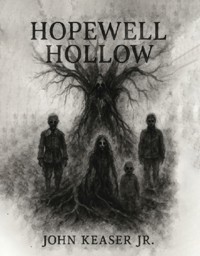
Hopewell Hollow isn’t a gore-filled or jump-scare story — it’s a slow, atmospheric mystery about a small New England town haunted more by its past and secrets than by monsters.
The story blends family drama, folklore, and suspense, exploring how the choices of one generation echo into the next. It’s eerie, emotional, and deeply human — more about the weight of guilt, grief, and silence than outright terror.
Das E-Book können Sie in Legimi-Apps oder einer beliebigen App lesen, die das folgende Format unterstützen:
Veröffentlichungsjahr: 2026
Ähnliche




















John Keaser Jr.
Hopewell Hollow
All rights reserved
Copyright © 2026 by John Keaser Jr.
Content Warning:
This book contains horror elements, suspense, and scenes that some readers may find disturbing.
No part of this publication may be reproduced, distributed, or transmitted in any form or by any means, including photocopying, recording, or other electronic or mechanical methods, without the prior written permission of the publisher, except in the case of brief quotations embodied in critical reviews and certain other noncommercial uses permitted by copyright law.
This is a work of fiction. Names, characters, places and incidents either are products of the author's imagination or are used fictitiously. Any resemblance to actual events or locales or persons, living or dead,
is entirely coincidental.
Published by Spines
ISBN: 979-8-90222-348-1
Hopewell Hollow
Written By:
John Keaser Jr.
For my children…
To my little girls, who first helped breathe life into the legend of the “Grandma Tree” on a hot summer night,
And to my little boy, who loves monsters and reminded me how to imagine again.
ChapterOne
Agatha's Gentle Heart
Sometime in the year 1823, in the heart of Hopewell Hollow, nestled in a quiet clearing where the woods whispered their ancient secrets, stood Agatha Holloway’s cottage. The house was a humble, inviting thing, wrapped in ivy and surrounded by wildflowers that bloomed in every color of spring. Just beyond her doorstep, a grand weeping willow stretched its ancient limbs toward the earth, its swooping branches swaying gently in the breeze. The local natives said the tree had been there longer than any living soul, standing as a guardian over Agatha’s home, a silent witness to every joy and every sorrow. Some whispered that its roots reached deeper than memory’s reach, and that in storms it groaned as if remembering the voices of the dead.
The townsfolk of Hopewell Hollow knew her fondly as “Grandma Agatha,” though she wasn’t old enough to earn the title by years alone. She had a heart vast and gentle enough to earn it in spirit. Her door was always open, and the scent of fresh bread, herbs, and lavender seemed to seep from every stone of her little home. The hearth fire never died, always ready to warm a cold soul or soothe a weary heart.
Her family was the light of her life. Jeremiah, her loving husband, was a man of quiet strength and gentle hands, worn from working the fields yet always tender when they touched her cheek. They shared a bond deeper than words, an understanding that didn’t require explanation. Their two children, Henry and Mary, were pure joy embodied. Henry, a curious eight-year-old, was always covered in dirt from exploring the woods, with pockets full of rocks and strange leaves. Mary, only six, possessed a sharp and curious mind. She often sat beside her mother, pretending to read from the worn herb books that Agatha used for her rituals and remedies, their spines crowding the modest shelves.
Their days were simple and full of love. Mornings began with the scent of fresh bread baking in the oven, followed by tending the herb garden. Agatha’s hands knew every plant by touch: rosemary for remembrance, chamomile for calmness, lavender for peace. She whispered blessings over the herbs as she worked, soft words passed down from her grandmother.
“By root and leaf, by sun and dew, let this garden’s grace renew,” she would hum, her fingers brushing over each stem. The plants seemed to flourish beneath her care, blooming brighter and growing stronger than any others in the village.
The air in Hopewell Hollow always carried a hush in Agatha’s Garden, as though the earth itself listened when she worked. The villagers said her blooms grew taller because she spoke to them, but those who lingered too long at her gate swore they had heard the plants whisper back.
Mary loved to sit among the rows, legs tucked beneath her, watching her mother move between the herbs and flowers like a spirit in her own realm. Sometimes, Agatha’s lips would move in silence, not quite words, only breath and rhythm, like a prayer without a name.
At dusk, the light filtered through the willows and turned the leaves silver. The scent of chamomile and rue hung thick in the air, and from somewhere beneath the soil came the faintest hum—soft, steady, alive.
It was said the Hollow had been blessed once, long before any of them were born. Others whispered it had been bound. But in that twilight between faith and folklore, Agatha found her peace, her power, and her purpose.
Agatha was a healer and midwife known throughout Hopewell Hollow for her gentle hands and wise heart. She had brought nearly every child in the village into the world, staying by the mothers' side through long, painful nights until cries of new life filled the air. No one else could soothe pain or ease suffering the way Agatha could. Her remedies, infused with herbs, love, and a whisper of old magic, worked faster than any others.
“Thank you, Agatha,” mothers would say, cradling their newborns, their eyes brimming with gratitude.
“It’s nothing, truly,” Agatha would reply with a warm smile. “The real magic comes from a mother’s heart.”
Children adored her, gathering under the weeping willow for stories after supper. “Grandma Agatha, tell us about the clever fox again!” little Elsie would call, her cheeks flushed with excitement.
Agatha would settle under the great tree’s branches, her voice soft yet rich with life. “Ah, the fox, clever as the moonlight, faster than the wind… Have I told you how he tricked the hunter who thought himself smarter?”
The children would giggle and gasp as she spun her tales, each story woven with magic and wonder. The willow seemed to listen, its branches swaying as if they were nodding along. Some of the older townsfolk, however, watched from their porches with unease, muttering that the stories were too strange, too old, too close to the “pagan” songs of the forest people who once lived here.
But beyond storytelling, Agatha’s true gift lay in her rituals, gentle acts of love and intention drawn from ancient knowledge. She practiced small spells for protection and happiness, whispered over charms made of twigs, feathers, and dried flowers. To the townsfolk, she was a good witch, a keeper of old ways who honored the natural world. Yet in hushed corners, some whispered differently about the strange pebbles she used in her rites—smooth river stones etched with small triangles, sometimes green, sometimes pale as bone, sometimes black as pitch. Most dismissed them as harmless tokens, but others muttered that such markings were signs of older, darker things.
One warm spring evening, as dusk painted the sky in hues of gold and lavender, Agatha prepared a special ritual beneath the willow. Tonight, she would perform a simple love ritual, not for romance, but for harmony, to nurture the bonds of friendship and community. The air was thick with the scent of honeysuckle and damp earth. She carried her leather-bound journal, its pages filled with the wisdom of those who had come before her.
She knelt beneath the willow, drawing a small triangle in the dirt with her finger. Around her, she placed wildflower petals and lit three lavender candles. To weigh the petals, she set down three river stones: one pale, one dark, and one streaked faintly green. The flame’s glow danced on her serene face as she opened her journal and read aloud:
“By the earth's embrace and the moon's soft light, let love and joy bloom bright tonight. With petals pure and heart sincere, bind this hollow with bonds so clear.”
The wind stirred, gentle but full of life, as if the forest itself acknowledged her words. Yet, for a moment, it carried something else too, a sound too soft to name, like three voices speaking at once. Agatha stilled, listening, then shook her head and smiled, returning to her ritual. The candles flickered but held steady.
As she finished, Agatha closed her eyes and pressed her hand to the earth, feeling the deep, steady pulse of nature beneath her fingertips. A soft smile touched her lips. In that moment, surrounded by the gentle rustle of willow leaves and the hum of the night’s creatures, she felt at peace.
The ritual wasn’t about magic in the way others might think. It was about intention, about pouring love into the world around her. It was about protecting the joy and harmony she had built with her family and her community.
And as the moonlight filtered through the willow's branches, bathing her in silver light, Agatha Holloway felt nothing but gratitude for her simple, beautiful life.
Yet in the shadows beyond the willow’s sway, a pair of unseen eyes lingered, and the earth itself seemed to hold its breath. Little did she know how quickly everything would change.
ChapterTwo
Shadows in the Hollow
The summer of 1823 had begun like a gentle lullaby in Hopewell Hollow: warm breezes, golden sun spilling across the meadows, and the scent of wild honeysuckle lingering in the air. But beneath that beauty, something sour lurked, creeping in slowly, like rot beneath ripe fruit.
It started with the blacksmith's boy.
John Turner was just ten, a bright, eager soul with a crooked grin and a laugh that echoed through the village like wind chimes. His father, Jacob Turner, was respected and feared in equal measure, a man whose arms could bend iron and whose voice carried authority. The Turners were beloved in Hopewell Hollow, stitched into the heart of the community like the very cobblestones of the square.
One humid evening, as the sun hung low and heavy in the sky, John fell ill.
It began with a cough, dry and sharp, like brittle twigs snapping in the quiet. Then came the fever, scorching through him with terrifying speed. His body trembled violently, slick with sweat, muttering fever-dream nonsense under his breath. His parents did all they could: cool cloths on his brow, prayers whispered through cracked lips. But nothing eased the sickness clawing at him.
Desperation sent John’s mother, Martha Turner, to Agatha’s door. She arrived in the dead of night, her voice raw with panic. “Please, Agatha... please help him.”
Agatha didn’t hesitate. She gathered feverfew, willow bark, and her worn journal, hurrying through the thick night air to Turner’s home. But the moment she stepped through their threshold, she felt it: an oppressive stillness, a dread that clung to the walls and seeped into her bones.
John’s body twisted in the bed, eyes rolled back, breath rattling like dead leaves in the wind. The air smelled of sickness and damp earth. Shadows lingered unnaturally, thick and heavy, pressing against the walls.
Agatha rested her hand on his fevered brow. It burned like iron from the forge. She worked quickly, crushing feverfew, blending it with lavender, and whispering a healing charm:
“Cool the fire, ease the breath,
Guide this soul from the hands of death."
The words hung thick in the air, powerless. The fever raged on, devouring him from the inside. His eyes flicked open for a fragile second: wide, terrified, pleading.
“Help me,” he rasped. A child’s voice, paper-thin and breaking.
Agatha’s heart splintered. Remedy after remedy failed. The sickness was relentless, a force beyond her understanding. Jacob’s dark eyes never left her, suspicion simmering beneath his grief. His fists were clenched, knuckles white.
Desperate, Agatha tried something older, something darker, whispering forgotten incantations from her journal’s brittle pages, tracing protective symbols into the air, speaking in a tongue older than the hollow itself. The words felt wrong in her mouth, like borrowing power she was never meant to touch.
But the shadows only thickened.
By the third night, Hopewell Hollow had fallen silent.
John’s body went still. His mother’s scream split the night, raw, guttural, a sound of pure, unfiltered agony. Jacob didn’t speak. He stared at Agatha with hollow hatred, the weight of his loss burning into her like a brand.
Agatha gathered her things and whispered, “I’m so sorry.”
But “sorry” wasn’t enough. It never would be.
The whispers began before dawn.
“She muttered dark words, unnatural things.”
“I saw her under the moonlight, drawing strange symbols in the dirt.”
"No healer should know such curses."
That morning, some said they found strange triangles carved in the dirt near the Turners' home: three stones set in a pattern—one blackened, one pale as bone, and one mossy green. Nobody claimed to have placed them there, and yet they were arranged with purpose.
Then came the stillborn.
Two weeks after John’s death, Ruth Cartwright, heavy with child, went into labor. Her screams echoed through the hollow as Agatha rushed to her side. The air in Ruth’s small cabin was thick with fear and desperation. Agatha worked tirelessly, chanting softly, her hands steady with experience and care. Hours passed in agonizing silence until finally, the baby arrived—silent and unmoving.
Stillborn.
Ruth’s cries filled the room, a mother’s heart shattering into pieces, and the weight of failure settled on Agatha’s shoulders like lead. The midwife’s presence, once a beacon of hope, now felt like an omen of doom.
The whispers turned venomous.
“Two deaths under her care in weeks… this isn't a chance.”
“She’s cursed. A witch, I say!”
And again, strange signs appeared, stones etched with shallow triangles left on doorsteps, in gardens, beneath windows. Some thought Agatha had placed them as charms, but others swore they were warnings of something darker. Few knew the old prophecy, but fragments passed in hushed tones:
“Three stones to bind, three paths to seal.
Green to waken, white to weaken, black to steal.
When the first cracks, the roots will stir.
When the second falls, the sky will blur.
When the third is broken, the mouth will rise
And drink the world until nothing survives.
The kindness once shown to Agatha turned bitter overnight. Eyes that once held warmth now narrowed with suspicion. Doors that had always been open were now closed to her. Mothers pulled their children close when she passed.
Her world shrank, suffocated by fear. Even the wind seemed to carry their judgment.
One evening, beneath the willow’s sorrowful branches, she traced protective runes into the dirt, ancient symbols passed down through generations. The air was thick with dread; the sky was bruised with gathering storm clouds. The tree’s limbs hung low, cradling her in a mourning embrace.
“I tried,” she whispered into the dusk. “I gave everything I had.”
The wind stirred. The shadows beneath the tree lengthened unnaturally, curling around her like smoke. The branches above shuddered as if they were listening.
That night, Hopewell Hollow sealed its verdict with silence. No more visits for remedies. No more smiles or friendly greetings. To them, she was no longer “Grandma Agatha.”
She was something else entirely.
A witch.
And as she sat beneath the willow’s heavy limbs, clutching her journal to her chest, the first true spark of dread ignited deep in her heart.
The Hollow had turned its back on her.
And the shadows had begun to feast.
ChapterThree
Whispers Grow Louder
By the time autumn wrapped its cold fingers around Hopewell Hollow, Agatha Holloway was utterly alone.
The season did not come gently. The woods fell silent, as if the birds had flown too far south and forgotten the Hollow altogether. Leaves rotted in damp piles, releasing a sweet-sick stench that clung to the air. Frost crawled across the windows of her cottage like veins of white bone. The weeping willow outside stood solemn, its long branches swaying like grieving arms, whispering secrets in the wind. It had seen everything: the love, the loss, and now, the slow unraveling of the woman who had given her life to the village.
The unsettling events started with Jeremiah.
At first, it was only a cough, low and dry. “I’ll be fine,” he rasped, his voice raw as he reached for her hand. But Agatha knew better. She watched as the sickness crept through him, stealing the color from his skin, draining the strength from his limbs. His once-sturdy frame shrank, and even his hands—those hands that had broken soil and built their home—shook when he tried to lift a spoon.
Agatha worked tirelessly, day and night. She brewed teas of willow bark, honey, and ginger to soothe his throat. She ground herbs to powder, pressing them into his chest, whispering incantations between shallow breaths.
“By root and leaf, by fire’s breath, I call thee back from the arms of death.”
But the fever only grew worse.
As the weeks passed, Henry and Mary fell ill as well.
Henry, her mischievous boy who once chased butterflies through the fields, now lay still, barely able to lift his head. His voice, full of laughter, was thin, strained, and almost gone.
Mary, her sweet little girl, no longer ran into Agatha’s arms, no longer curled in her lap for stories. Her golden curls clung to her damp forehead, and her tiny hands burned with fever as she whimpered in restless sleep.
Agatha tried everything she knew. Traditional remedies. The old ways. She tore pages from her mother’s journal, scribbled new symbols into the dirt beneath the willow. She used herbs the villagers whispered about but dared not touch, nightshade for purification, belladonna to ease pain. She whispered to the old gods, burned lavender and rosemary in offering.
But death did not listen.
Jeremiah was the first to go.
She sat with him until his breath rattled one last time in his chest. “Don’t leave me,” she begged, but his eyes had already dimmed, his grip loosening until his hand slipped from hers.
Two days later, Henry slipped away in the dark. Agatha had drifted to sleep with her head against his bed and woke to a silence so heavy she knew, before she looked.
And then, Mary.
Mary, who should have had years ahead of her; Mary, whose laughter once filled their cottage; Mary, who clung to her mother’s hand with the last of her strength before her tiny body went limp.
Agatha screamed then, a sound so raw it tore through the Hollow, startling birds into flight and making the trees tremble. But no one came.
No one mourned with her.
She went to the village, her face streaked with tears, her voice hoarse from pleading. She knocked on doors, begging, “Please, someone, help me! My family is gone, and I can’t do this alone!” Her sobs rang through the cold streets, but the people turned away. Shutters closed. Doors latched. Whispers followed her like smoke.
“She’s cursed.”
“This is her doing.”
“Please,” Agatha begged, falling to her knees before the blacksmith. “Help me bury them. I can’t. I don’t have the strength.”
He would not meet her eyes. “I… I can’t. I’m sorry.”
The baker turned away. The seamstress. The midwives she had once worked beside. Not one lifted a hand.
“She’s cursed,” someone muttered again. “This is her doing.”
Grief should have hollowed her, but instead, something darker took root: a slow, seething rage.
If they would not help her, she would do it alone.
With shaking hands, she dragged Jeremiah’s body beneath the willow tree, the only place that still felt like home. She dug with her bare hands until her nails split and bled, soil caking her skin. Her sobs shook her shoulders, but she kept digging.
Henry was next. Then Mary. Her precious children. She laid them side by side, whispering to them between gasps, as if they could still hear.
“By soil and stone, by heart and breath, bind them safe in peace, not death.”
Her fingers carved protective symbols in the dirt, threefold patterns, triangles traced with trembling hands, binding their spirits to the earth. The wind picked up, howling through the willow branches and tearing at her hair.
That night, she knelt before their graves, her mother’s journal open on her lap. A single candle flickered, shadows jagged against the dirt.
“If you can hear me… if you’re still here… give me a sign.”
The branches above her shuddered. A single leaf broke loose, drifting down to land at her feet.
Agatha let out a broken laugh, choking on the sound.
Was it a sign, or was it only the wind?
By the time the first frost came, Agatha had become a ghost in her own home.
She rarely left the cottage. Villagers crossed the street to avoid her. Children whispered prayers when she passed. The Hollow itself seemed quieter now; even the birds were wary of its silence.
And then the accidents began.
A cow was found dead in the pasture, its body bloated, eyes wide, as if startled by something unseen. A child fell ill, muttering a woman’s voice in their sleep. The blacksmith’s forge caught fire in the night, flames flickering green before collapsing into ash.
Each time, the villagers turned toward the woods. Toward her.
“She’s bringing more death.”
“She won’t stop unless we stop her.”
Agatha felt it in the air, their fear sharpening into hatred.
And when she heard footsteps circling her cottage late one night, slow and deliberate, she knew.
They were coming for her.
ChapterFour
A Legend Is Born
Agatha didn’t run.
She stood in the doorway of her little kitchen and listened to the night press in. The woods had been wrong for days, with no cricket trill, no owl call, only that dense, padded hush that swallowed sound whole. Even the willow outside had gone still, its long green veils hanging like a curtain over a stage no one wished to see. Wax dripped down the sides of the candles and hardened against the table. She pressed trembling hands to the scarred wood and whispered the old words under her breath, not to conjure fire or storm, but only steadiness. Only breath.
“By root and leaf,” she murmured, though her voice snagged, “by sun and dew…”
She knew it was too late.
“Boots, many and mean, broke the quiet. The first stones pinged off her shutters. Then came the voices, rough with drink, warmer with grief, and coldest with fear.”
“Come out, witch!”
“You can’t hide!”
“Devil’s whore!”
She closed her eyes and saw Jeremiah’s cracked lips, Henry’s fever-damp curls, Mary’s hand growing weightless in her own. She saw the women whose babies she’d caught, the men whose wounds she’d cleaned, and the children who’d gathered under the willow for fox stories. She saw every face that had ever turned toward her door in need. Now all those faces burned in the dark outside.
The latch held. The door shuddered under fists and shoulders, iron hinges squealing like animals. When the wood refused to give, someone spat the words that would change everything.
“Burn her out.”
The glass exploded. A lantern clanged across the floor and burst open, oil unspooling in a dark, reeking ribbon. Fire leapt as if it had been waiting, licking up the wall with quick, greedy tongues. Another lantern. Then another. Heat rolled across the room, flattening her. Herb bundles flashed and went to cinder; a shelf of vials cracked sharp as a flock of birds; a potion ran green and hissing between the warped boards. The tapestry over her bed blackened, curled in on itself, and lifted as ash.
Agatha flung her sleeve over her mouth and coughed until stars flickered at the edge of her vision. She tried the back door. Smoke met her there, too, thicker and clawing. The house groaned, not like a structure failing, but like a body forced into posture.
She did not pray for rescue. She asked the old ones to keep the children she had buried. She asked the willow to remember her. She asked the ground to be soft.
They dragged her into the night when the roof began to go. The blacksmith and the apothecary took an arm each, one grim with purpose, the other trembling so hard that the torch in his free hand threw nervous light up and down the trunks. Snow squealed under their boots. Agatha’s bare feet found ice and rock and nothing steady. Voices surged behind them, brave now that the fire was at their backs.
At the base of the weeping willow, the accusers threw her down. Frost had sheeted the earth there into a pale, dull mirror. The tree loomed, all shadow and ribbed trunk, its lowest curtains of branches iced into stiff chandeliers. Her palms were already split and slick; she pressed them into the snow and drew a symbol without thinking: a small triangle, points turned inward, a mark she had drawn in bread flour and lint, over infants’ brows and door lintels. She had never taught it. She had never named it. She had only used it to keep things out.
“Hold her,” someone said. Rope rasped. Bark bit into the naked skin of her back; sap bled cold against her ribs. She met no one’s eyes until she found Jacob Turner’s. The forge had hollowed him since John died. Grief had killed the warmth there and left only heat. The torch he held sputtered resin and pitch.
“The curse ends with you,” he said, but the line came out like a lesson learned incorrectly.
A woman in the crowd, Ruth Cartwright, cheeks wet, jaw clenched, looked away and pulled her shawl over a child’s face. The apothecary crossed himself with his wrist because his hands were shaking. Two boys too young to be there mouthed along with the men’s curses, then swallowed hard when Agatha looked at them. The baker’s wife worked on a rosary like worry beads. The blacksmith kept staring at the ground, as if by refusing to see, he could refuse to be seen.
A bucket tipped. Lamp oil ran down her hair and into her eyes, slid cold along her scalp, and pooled at her shoulders. Another bucket. Then another. The air filled with the sour-slick stink of oil over smoke. Something inside her, older than her name, older than the little cottage and the willow and the town, stood up.
“You fear what you do not understand,” she said, and her voice climbed the ropes to the branches. “So, you spill innocent blood. Hear me now and hear me well. This tree, this earth, will remember. The roots will drink the suffering of the forsaken, the wronged, the betrayed. Their pain will not vanish. It will grow. It will fester. And one day, when the weight of your sins has made this tree strong, what you awaken tonight will wake fully. It will look for you. It will look for your children. And it will not be merciful.”
Jacob did not flinch; he threw the torch.
Fire took her like breath in. Oil flared. Wool flashed into orange, then white. Heat sheared thought from bone. She screamed, hoarse and raw, the sound of a body remembering it is mortal. The crowd wavered. A few turned away and gagged into their sleeves. Others held themselves rigid as punishers. The sound went on. It should not have lasted so long. When it broke, it broke not into silence but into a sound no one there would ever forget.
Laughter. Not wild. Not cackling. The scrape of a smile against a blade.
“The willow answered.”
Roots heaved under the snow as if a great beast had stretched and flexed its claws. The ground cracked in thin, shining lines. The trunk shuddered and groaned in a register too deep for the ear, a kind of pressure that made the nose sting and the teeth ache. Embers spiraled up in pairs and trios and then, impossibly, arranged themselves into little shapes that looked like eyes before winking out. Wind roared down into the hollow as if the sky had bent its face to listen. Somewhere, far off, a dog began to howl and did not stop.
The ropes snapped. Not released but cut through by something that did not care for knots. The roots rose and threaded her limbs, her ribs, her hair, not gentle and not cruel, the way ivy takes a wall because it is there. They wrapped and wrapped until there was no woman to see, only a dark cocoon sleeved in bark. The earth opened as neatly as a mouth. The tree pulled what it had been given down into the cold.
Snow slid back over the seam like a lip, and the ground lay smooth again, flawless but for the heat that still breathed from it.
No one moved for a long time. The fire consumed the last of the cottage. A column of sparks ascended into the sky. The willow’s branches settled into a posture the town had never seen it take. The bark, which had been gray and kind, darkened to a stained, splitting black. Sap oozed out of new wounds in slow, tar-thick threads and crusted. Something in the odor changed, less smoke, more copper. No bird sat there. No sound came through the leaves but a whispering that was not wind.
“Go,” the blacksmith said at last, but the word was a prayer, not a command.
The mob went on. Some stumbled. Some walked steadily and did not remember how. Ruth Cartwright wrapped her shawl tighter and cried without a sound. The apothecary dropped his empty bucket and left it in the snow. Jacob Turner did not look back.
That night, the sky over Hopewell went strangely clear. Stars sharpened. Their light seemed to quiver like cold and frightening things. Frost took the fields in a single pass and wrote delicate white veins over every fence rail. Toward morning, a thin mist rose from the hollow and drifted into the streets, cool as breath. Folks woke to find soot on their thresholds and ash in the folds of their curtains. In a few houses, babies fussed and would not be soothed. In one, a pane of glass cracked top to bottom without a hand on it.
By dusk, the story had already become two. In one, men did what was necessary. In the other, a woman who had given too much was taken, and the taking left something in the ground.
Children learned not to take the path that cut closest to the tree. Mothers who had sworn to keep silent found their mouths pulling shapes in the dark. Old men who had thrown lanterns did not step beneath hanging branches again. People stopped saying Agatha’s name and began saying, “the tree,” and then, “the Grandma Tree,” as if by naming it old and loved, they could soften what it had become.
Those who passed at twilight paused just once and pressed two fingers to the pulse in their throats without meaning to. It felt a little slower there, a little heavier, as if something bigger than bodies had settled in to beat beside them.
In winter, hard north winds combed through the willow’s wrecked curtains and carried a smell down into town: sap and smoke and the scorched sweetness of milk left too close to a flame. Now and then, the laughter came again, far off and faint, like a memory that did not belong to any living throat.
Hopewell did not speak of curses. But the soil did. It took on a darker sheen when turned. It held footprints too long. When it froze, it cracked in lines that made triangles without being asked. People planted farther from that patch each spring and pretended the seeds did better for it.
The roots remembered.
And though no one would admit it, every once in a while, on the walk home from evening chores, a person would feel the ground underfoot go soft, just a breath, just a suggestion, and they would step a little quicker, the way one does when the night puts a hand in the small of your back and urges, gently, “Go on now. Keep moving. Don’t look behind you.”
The legend had been born. The tree had been fed. And something beneath Hopewell, bound by a woman’s last words and a town’s first murder, went still, not satisfied, not gone, only still, the way a mouth closes when it is waiting to be asked to open again.
ChapterFive
The Origin of Darkness
Before names and borders, before maps pretended the world could be folded flat, the people who lived along the river already knew something was wrong with this piece of earth. They did not argue about what to call it. They did not need a word to believe in it. They felt it underfoot.
Some nights, the ground breathed.
Not the way soil loosens with rain or settles after frost, but a slow, animal breath drawn, held, released so faint you only noticed if you were very still and very unlucky. On those nights, smoke from the hearth refused to rise. Dogs pressed their bellies to the floor and would not be coaxed away. Children wove themselves into their mothers’ clothes and listened for a heartbeat that was not their own.
The elders said the wrongness was older than the river and more patient than the stones. Not a spirit with a face and a bargain. Not a god hungry for worship. A wound that learned to feed. It drank fear, grief, cruelty, and did not care which mouth served it. If a deer died screaming in a snare, the ground tasted it. If a husband struck his wife, the ground tasted that too. If winter took a baby before dawn, the ground drank deep and slept a little heavier afterward.
It showed itself in small ways first. Soil turned up from the darker seams would shine with an oily wetness even in drought. Corn planted there grew tall but twisted, as if trying to pull itself into the sky. The meat of animals taken near the hollow spoiled by sunset, no matter how quickly it was salted. On still afternoons, one could hear a thin, reedy humming from the roots of the old trees, like breath moving through a flute one could not see.
People learned the shape of the danger and taught it to their children the way they taught them to swim and to light a fire in the rain. “Never sleep with your ear on the ground. Never answer an unknown voice that knows you by your name. Do not dig where the soil sweats. Do not lay a child beneath roots.”
Every family kept their own protections. Some tied cords of hair and river reed above the thresholds; the knots counted breaths and could not be untied by anything without lungs. Some bundled salt and birch bark around a polished stone, then hid the bundle in the rafters. Some women stitched three tiny triangles in blue thread on the lining of their winter cloaks where no one else would see. The triangles appeared elsewhere, too: cut shallow into the bark of a sentinel oak at the edge of a path; pressed into ash on the morning of a burial; drawn with bone-black on the underside of a cradle and wiped away before anyone else rose. No one explained them to outsiders. You did not explain “fire” to a hand that reached for it.
The stories the elders told were not about heroes. They were instructions: a hunter dragged home by his shadow because he looked back when the brush whispered his childhood name; a girl who slept with her ear to the floor to catch the mice and woke gagging, saying the ground was singing with teeth; a winter when the fish came up from the river with their eyes milk-white and their mouths packed with mud. Each tale ended with the same: do not feed it, do not name it, do not bury your shame where it can drink.
There was a season they still called “Quiet.” The snows came late and left early, and in between, nothing wanted to speak. The wind died. Birds nested, but the eggs never hatched. Babies were born and did not cry. Men went into the woods to take deer and returned with their hands bleeding from where bark had slid under their nails, as if the trees were trying to hold them. The people did what they had always done. They put smoke on their skin. They burned bitter herbs and let the taste fill their mouths until they gagged. They walked the perimeter of the wrong place in single file and did not step inside it, not even by an inch.
On the last night of the Quiet, the oldest woman in camp sat beside the wrong place with her back to it and told it a story. Not a prayer. Not a bargain. She named every kindness she had ever witnessed and every cruelty she had ever swallowed. When the sun came up, the frost creaked, and the air moved again. The children cried. The dogs slept. The wrongness slept, too, the way a sated animal sleeps, belly full and mean even in dreams.
They marked their warnings as carefully as they marked their trails. In a certain grove, the trunks bore three shallow cuts at shoulder height: one east, one south, one west. At the river crossing, someone had hammered three flat river stones into the bank and blackened their faces with soot. In the old burial ground, circles of ash lay where the snow never settled, and sometimes in those ash rings, you could find a small triangle of bone, smooth as a tooth and too warm to touch for long. No one said what the signs meant. The signs meant themselves.
Not all rituals were for keeping out; some were for keeping in. When a man beat his brother near to death, the wives of both brothers took his belt and cut it into three strips, then burned two and buried the third where the soil sweated. When a woman miscarried in summer, the midwives took the afterbirth to the far field and laid it on a slab of granite while they sang. When a child died, they opened the ground where the rock was pale and dry, far from any root. If the ground darkened like meat in a pan, they filled the hole and moved on until they found a place that stayed pale.
No child beneath roots. No child beneath roots. No child beneath roots.
The people understood cycles. Rivers flood and draw back. Moons fill and empty. Men are brave, and then they are foolish, and then, if they are fortunate, they are quiet. The wrongness had a cycle of its own. When there had been enough grief and fear, when the ground had been fed slowly for long enough, it swelled. The air turned thick and sour, like milk left in the sun.
Voices carried wrong, as if they had too many edges. You could not tell who was calling you or from where. And then, always, someone forgot a rule. A child’s ear strayed to the floor. A body went into the ground where roots could find it.
Those were the years that needed mending afterward. They mended the way you mend a laceration: with coarse thread, with steady hands, with pain. They told the story of the one who forgot, so no one else would. They hung fresh meat in the doorways until the meat stank. They slept in shifts and kept the fires spitefully hot. They did not ask for mercy. “Mercy” is a face. The wrongness had none.
There were other places you could live. Some left. They went to the high ridge where the wind chewed the snow down to glass and your chest hurt with every breath, or to the deep birch where the brush stayed bright even in late winter. Those who remained did so for reasons that looked like love from the outside and tasted like duty in the mouth: a good salmon run, a grandmother who did not walk far anymore, a grave you could not leave alone.
When strangers came from the north and the west long before ships, the people showed them the signs and said nothing else. Some of the strangers understood without being told. Some cut the marked trees for poles and hammered their tents into the ash rings for luck. Those left quickly or bled out in the path like trickles of dye.
Time moved. Stories hardened into instruction, instruction into habit, and habit into the patient silence of people who expect not to be believed.
The first ones with iron arrived in the spring, the elders still remembered by the year of brown fish: 1620, though no one called it that while it was happening. They came with saws that sang too bright and pious mouths that could not keep closed, carrying their own stories about light and order. They laughed at the ash circles and set their cookfires where the snow never lay. They drove nails into trunks that bore the three cuts and hung bells so they could hear their God move in the night.
The people watched them from the tree line and did not step forward. They had already spoken in the only language the land obeyed. Three notches. Three blackened stones. Three triangles cut with bone into bark and hidden under soot. Warnings are a kind of mercy.
The strangers did not recognize “mercy” when it had no face.
They felled a marked oak and split it for fence rails. They dragged a plow through the seam where the soil sweated and said the earth here was rich, which was true, the way fresh blood is rich. They drove a post at the edge of the wrong place to claim it, and when the post came up blackened on the third morning, they said the wood was rotten and drove a new one made of iron.
The ground breathed at night: slow, held, released. If any of them heard it, they mistook it for their own sleep. If any dreamed, they dreamed of bells moving by themselves and teeth set in the floorboards like seeds.
In time, they would give this place a name to make it behave. The land had its own; it did not need to speak it aloud.
ChapterSix
The Arrival of Hopewell Hollow
The year was 1623, and the land was old.
It had existed long before men thought to lay claim to it, before iron-plated boots crushed its soil and hands carved its trees to build homes for those who did not belong. The forest whispered of a time before the settlers came, days untouched by greed and steel, when rivers ran clean and the sky knew no smoke. The wind carried only birdsong, and creatures roamed without fear.
But that peace had long been shattered. The land had already learned to drink deeply of the blood of men, to swallow their bones and reap their misdeeds. It had seen the evils of humanity before, and it would see them again.
It had not always been this way. There was a time when the land flourished, untainted by sorrow. The trees stood proud, unscarred by axes. Rivers were crystal clear, unsullied by despair. The air was rich with earth and rain, not the acrid stench of burning wood and flesh. But men had come, dragging their fears and hungers with them, and the land learned to listen. It watched. It waited.
The Puritan settlers who came that year believed they had tamed the land. The journey had been long, their trials many, but as they stood upon the soil of what they would call “Hopewell Hollow,” a sense of divine purpose filled their weary hearts. The towering pines framed the valley like the wooden gates of a kingdom waiting to be claimed.




