


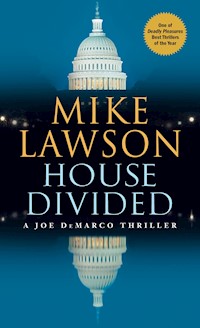
6,99 €
Mehr erfahren.
- Herausgeber: Grove Press UK
- Kategorie: Abenteuer, Thriller, Horror
- Sprache: Englisch
When the National Security Agency was caught wiretapping U.S. citizens without warrants, a political scandal erupted and the secret program came to a screeching halt. But the senior man at the NSA who spearheaded the most sophisticated eavesdropping operation in history wasn't about to sit by while spineless politicians sleepwalked his country into another 9/11. Instead, he moved the program into the shadows. But being in the shadows can cause complications. When the NSA illegally records a rogue military group murdering two American civilians, they can't exactly walk over to the Pentagon and demand to know what's going on. That doesn't mean the NSA's hands are tied, however. As the largest intelligence service in the country, both in money and manpower, they have plenty of options - mostly illegitimate. DeMarco learns all too well just what the NSA is capable of. They bug him, threaten him, and use him to draw out their opponent. But DeMarco doesn't like being used. A strong addition to this celebrated series, House Divided continues Mike Lawson's impressive run of inspired, compelling thrillers.
Das E-Book können Sie in Legimi-Apps oder einer beliebigen App lesen, die das folgende Format unterstützen:
Veröffentlichungsjahr: 2018
Ähnliche

















House Divided
A Joe DeMarco Thriller
MIKE LAWSON
Copyright © 2011 by Mike Lawson
This E-book edition published in Great Britain in 2018 by Grove Press UK, an imprint of Grove/Atlantic Inc.
All rights reserved. No part of this publication may be reproduced, stored in a retrieval system, or transmitted in any form or by any means, electronic, mechanical, photocopying, recording, or otherwise, without the prior permission of both the copyright owner and the above publisher of the book.
This is a work of fiction. Any resemblance to actual persons, living or dead, is purely coincidental.
E-book ISBN: 978-1-61185-929-4
Grove Press Ormond House 26-27 Boswell Street London WC1N 3JZ
www.groveatlantic.com
For my brother Steve, for taking care of Mom and Dad
1
A satellite orbits a blue planet, huge solar panels extended like wings.
Alpha, do you have Carrier?Negative. Monument blocking. Bravo, do you have Carrier? Roger that. I have him clear. Very well. Stand by.
Nothing more was recorded for eight minutes and forty-eight seconds. Time was irrelevant to the machines.
I think Messenger has arrived. Stand by.
Confirmed. It’s Messenger. Messenger is approaching Carrier. Alpha, do you have Messenger?
Roger that.Bravo, do you still have Carrier?Roger that.Very well. Stand by. Transport, move into position.
Four point three seconds of silence followed.
Transport. Acknowledge.
A second later:
Transport. Acknowledge.
Four point nine seconds passed.
Alpha, do you have Messenger?Roger that.Bravo, do you have Carrier?Roger that.You have my green. I repeat. You have my green.
Three heartbeats later:
Transport, Transport. Respond.
There was no response.
I’ll transport in my vehicle. Maintain positions. Keep me advised.
Nothing more was recorded for six minutes and sixteen seconds.
This is Alpha. Two males approaching from the north. I have them clear.
Alpha, take no action. Do I have time to retrieve Carrier?
Negative.
Very well. Stand by.
One minute and forty three seconds later:
This is Alpha. The two males have stopped. They may have sighted Carrier. They have sighted Carrier. They’re approaching Carrier. I have them clear.
Alpha, take no action. Transport acknowledge.
Two point four seconds of silence.
Return to jump-off. I repeat. Return to jump-off.
After thirty-five minutes elapsed, a program dictated that the transmission was complete and the recording was compressed and sent in a single microsecond burst to a computer, where, in the space of nanoseconds, it was analyzed to determine if it met certain parameters. The computer concluded the recording did indeed meet those parameters, and at the speed of light it was routed through a fiberoptic cable and deposited in a server, where it would reside until a human being made a decision.
2
Jack Glazer was getting too old for this shit.
It was two in the morning, rain was drizzling down on his head because he’d forgotten to bring a hat, and he was drinking 7-Eleven coffee that had been burning in the pot for six hours before he’d poured the cup.
And there was a dead guy lying thirty yards from him.
“Has the ME been here?” he asked the kid, some newbie who’d been on the force maybe six months and looked about sixteen years old—but then all the new guys looked absurdly young to him. And naturally the kid was totally jacked up, this being the first homicide he’d ever caught.
“Been and gone,” the kid said. “Forensics sent one guy; he searched the vic, ID’d him from his wallet, and said he’d be back in a couple hours with his crew. They got another—”
“So who’s the victim?”
“The name on his driver’s license is Paul Russo. He was a nurse.”
“How do you know that?” Glazer asked.
“He had a card in his wallet, some kind of nurses’ association he belonged to. He also had the name of an emergency contact, some guy named—”
“Did you write down the contact’s name?” Glazer asked.
“Yeah.”
“Then you can give it to me later.”
“The thing is, sir, this guy has cash in his wallet and he still has his credit cards and his watch. So I don’t think we got a mugging here. I’m thinking drugs. I’m thinking this guy, this nurse, was pedaling shit. You know, Oxy, Vicodin, something, and he gets popped.”
“Could be,” Glazer said. “But now this is really important, uh …” Glazer squinted at the kid’s name tag. “Officer Hale. Where’s the body, Hale?”
Hale, of course, was confused by the question, because the body was clearly visible.
So Glazer clarified. “Hale, is the body in the park or out of the park?”
“Oh. Well, that’s kind of a tough call,” Hale said. “The head’s on the sidewalk but the feet are on the grass. I guess it’s kinda half in and half out.”
“Yeah, I think you’re right. So why don’t you grab his heels and pull him all the way into the park.”
The kid immediately went all big-eyed on Glazer.
“I’m kidding, Hale,” Glazer said, but he was thinking, Shit. Why couldn’t the body have been in the park, or at least three-quarters in the park?
Paul Russo had been shot near the Iwo Jima Memorial, and the memorial was located in a park operated by the National Parks Service. This meant the park was federal property—technically, not part of Arlington County and out of Jack Glazer’s jurisdiction. If the guy had been shot in the park, Glazer would have pawned the case off on the feds without hesitation. He was already dealing with three unsolved homicides and he didn’t need another.
“Where are the two witnesses?” Glazer said.
“In the back of my squad car.”
“Did they see anything?”
“No. They’re dishwashers. They work at a Chinese restaurant over in Rosslyn and were on their way home. All they saw was a body on the ground and called it in.”
Great.
Glazer walked over to look at the body: a short-haired, slimly built man in his thirties with no distinguishing features. Just your average white guy. He was wearing a tan jacket over a green polo shirt, jeans, and running shoes. He was clean and healthy-looking—except for the small, red-black hole in his left temple.
Glazer noticed there was no exit wound from the bullet. This surprised him because it made him think that if Russo had been shot at close range, which he most likely was, the shooter might have used a .22 or .25—and that was unusual. Most folks who bought handguns these days, particularly men, didn’t normally buy small-caliber weapons. Everybody wanted hand cannons—big-bore automatics with sixteen-round magazines.
He took his flashlight and shined it around the area but didn’t see anything—no shell casings, no footprints, no dropped business cards from Murder, Inc. He looked again at the position of the body. Just like Hale had said: it was almost exactly half on the sidewalk—which Glazer was positive belonged to Arlington County—and half inside the park. Goddammit. It was going to be a real tussle to get the feds to take the case.
“Hi there.”
Glazer turned. A man was walking toward him, a handsome dark-haired guy in his early forties dressed in a blue suit, white shirt, no tie, holding an umbrella over his head.
“Sir, this is a crime scene,” Glazer said. “Get back behind the tape.” Glazer glared over at Hale, wondering why the damn rookie had let a civilian into the area. Then he found out.
The guy took a badge case out of the inside pocket of his suit coat and flipped it open. “Hopper, FBI,” he said. “I think this one’s ours.” He smiled at Glazer then, and he had a great smile—charming, disarming, all these even white teeth just gleaming in the dark. “I mean, I’d love to let you have it,” he said, “but my boss says we gotta take this one.”
What the hell?
“How did you know about the victim?” Glazer said.
“Beats me,” Hopper said. “They just told me to get my ass over here. One of our guys must have picked it up on the scanner and heard you folks talking about it. I don’t know. What difference does it make?”
The difference it made was that there was no way an FBI agent would have hustled over here at two in the morning to take over the case. Maybe when it was daylight, but not at two A.M.—and not for an apparent nobody like Paul Russo. And this agent. He wasn’t some low-level Louie; Glazer could tell just by looking at him. This guy had weight.
“The body’s on the sidewalk,” Glazer said. “My sidewalk.”
Hopper looked down at the body. “It’s half on the sidewalk. And the rule is—”
“Rule? What fuckin’ rule?”
“The rule is like football. Wherever the runner’s knee goes down is where they spot the ball. His knee went down in the park.”
“I’ve never heard of any—”
“Come on, Glazer. I’m tr—”
“How do you know my name?”
Irritation flicked across Hopper’s face. “They gave it to me when they called me. Probably got if off the scanner, too. Why are you giving me a hard time here? I’m doing you a favor. This is one less murder on Arlington’s books. It’s one less case you have to clear. You oughta be thanking me, not arguing with me.”
Glazer already knew he was going to lose this fight—and anybody looking at the scene, not knowing a single thing about criminal jurisdictions, would know he was going to lose it, too. In one corner you had this confident six-foot-two, handsome as Mel-fucking-Gibson federal movie star. In the other corner you had Jack Glazer: five-ten, a stocky, strong-looking guy, a guy tough enough to have maybe played linebacker for a small college team but not big enough or fast enough for a big-name school. It was the neighborhood mutt squaring off against the government’s Rin Tin Tin—and nobody would have put their money on the mutt.
But still—even knowing the feds were going to win this jurisdictional tug-of-war—this guy pissed him off. And something was seriously out of whack.
“Yeah, well, we’ll have to settle this later, when it’s daylight,” Glazer said, shifting his position slightly, blocking off Hopper’s path to the body. “I need to check with my boss. But for now—”
Glazer’s cell phone rang. He looked at the caller ID. What the hell?
“Glazer,” he said into his phone. He listened for a few seconds, said, “Yes, sir,” and hung up.
Glazer looked at Hopper for a moment and then slowly nodded his head. “That was my boss. He said this is your case.”
3
Gilbert swiped his badge through the bar-code reader, punched in a six-digit security code, and pressed his thumb against the pad. When the annex door lock clicked, he pulled the door open, nodded to the no-neck security guy who had a small desk on the other side of the door, and went to his cubicle. He tossed his backpack on the floor, spent ten minutes bullshitting with another technician about how his new cell phone was a piece of shit, then proceeded to the coffee mess, where he poured the first of a dozen cups he would drink that day.
Back in his cubicle, he booted up all the machines, spent fifteen minutes on one of them looking at e-mail, then turned to the machine that provided him with an annotated description of transmissions intercepted in his sector in the past twelve hours. He tapped the SCROLL DOWN key as he studied the screen, sipping his coffee, then stopped. “What the hell?” he muttered.
He tapped on a keyboard, routed the transmission he’d selected to a program that would deencrypt it, and for forty-five minutes did other work. Then he put on his headphones.
Alpha, do you have Carrier?Negative. Monument blocking.
Bravo, do you have Carrier?Roger that. I have him clear. Very well. Stand by.
When the recording stopped, Gilbert muttered “Holy shit,” played it again to be sure, then copied the transmission to a CD.
The label on the CD said NATIONAL SECURITY AGENCY. There were a lot of other words printed on the label as well and, when taken collectively, these words indicated the CD was classified at the highest level and whoever listened to it would rot in a federal prison until their teeth fell out if they didn’t have the proper clearance. There was nothing unique about the label, however. Every CD in the annex, including the one that contained forms for purchasing office supplies, had the same label.
CD in hand, he walked through a maze of cubicles, nodding to folks he passed, but didn’t stop until he reached her office. She was sitting at her desk, head down, reading something, and when he knocked on the doorframe to let her know he was standing there, she looked up with those frosty eyes of hers.
“Yes,” she said.
No good morning, how-are-you, how’s-it-going? It was always business with her, never a moment wasted on mundane social interactions.
“I think you need to hear this,” Gilbert said, holding up the CD. “I think two guys got killed last night.”
Other than a slight elevation of one blonde eyebrow, she showed no emotion. She took the CD from him and slipped it into one of the three computer towers beneath her desk.
“Password?” she said.
She wasn’t asking if the disc was password-protected; of course it was. She was asking for the password because if she tried to open the CD without it everything on it would turn to gibberish.
“Grassyknoll, lower case, one word,” Gilbert said.
She typed the password and listened to the recording with her eyes closed, giving Gilbert a chance to study her. She was at least ten years his senior, getting close to forty, he guessed, but she had a good long-legged body, a narrow face with a model’s cheekbones, and those incredible scary blue eyes. He couldn’t understand why such a good-looking woman didn’t have a husband or a lover, but since she worked about sixteen hours a day and was the least approachable person he’d ever met, maybe that wasn’t so surprising.
“When did this take place?” she asked.
“About one A.M.”
“Where were they?”
“I don’t know, exactly. Somewhere in the District or Northern Virginia. For some reason, that’s best location we could get. I need to take a look at the software to see if it’s got some kind of glitch, but it could have been the com gear these guys were using.”
She didn’t say anything for a moment. She just sat there staring at him like it was his fault the fucking software didn’t work, but then she nodded and he exhaled in relief.
Claire Whiting scared the hell out him. She scared everyone. Well, maybe not Dillon, but everyone else.
Dillon Crane was on the phone when Claire entered his office.
Dillon was sixty-three years old, tall and slender—and the subject of infinite office speculation. His short white hair was trimmed each week by the same barber the president used, and his suits were handmade by a Milanese tailor who now resided in Baltimore. The suit he wore today was light gray in color, and his shirt was also gray, a darker gray than the suit. Claire had no name for the color of his tie—something with maroon and charcoal black and dark blue all swirled together—but whatever the color, it matched the suit and shirt perfectly.
Dillon never wore white shirts and simple ties to work. He’d remarked once that a white shirt, accompanied inevitably by the ubiquitous striped tie, was the uniform of a bureaucrat, and even though he was one he refused to dress like one. And since the hundred and fifty thousand dollars a year he earned from the National Security Agency was a pittance compared to the annual income from his trust fund, he could afford to dress however he pleased.
He smiled when he saw Claire in his doorway—that annoying ain’t-life-droll smile of his—but continued with his phone call. “Clark,” he was saying, “all I can do is relay to you what we intercepted. It appears—and I can’t be any more definitive—that a certain opium-growing warlord is about to assassinate an Afghani politician who has grown contrary of late.”
Claire realized Dillon was talking to Clark Palmer, deputy to the president’s national security advisor. Dillon, on one occasion, had said to her, “Clark’s a rock—only not so smart.”
He listened for a moment, rolled his eyes for Claire’s benefit, and said into the phone, “No, Clark, I won’t send you a memo. The entire conversation was two sentences long, and I’ve just given you the NSA’s translation and interpretation of those sentences. Have a nice day.”
Dillon hung up the phone and smiled at Claire again. “You look lovely today,” he said.
She ignored the compliment as she always did.
“We picked up something that could be important.”
“I’m sure it’s important, Claire, or you wouldn’t be here. But is it interesting?”
Dillon, as she well knew, was easily bored. And she knew exactly what he meant by interesting. A White House lackey leaking a memo to the Post; a colonel at the Pentagon whispering bid specs to a contractor; an undersecretary at State calling her lover at the Israeli embassy—those things could be important and they often were—but they weren’t interesting. They were business as usual.
The CD in Claire’s hand was not business as usual.
“Yes, Dillon,” she said, “it’s interesting.” She handed him the CD. “The password’s grassyknoll, lower case, one word.”
“Grassy knoll?” Dillon said, but he didn’t say more and took the CD from her and slid it into the drive of his computer.
Alpha, do you have Carrier?Negative. Monument blocking.
When he had finished listening to the recording, he said, “Now that is interesting. What do we know?”
“What do we know?” Claire repeated. “We know nothing. But would you like me to speculate?”
“Oh, please do, Claire. Speculate away.”
“First,” she said, “I think these guys were military.”
“Logic?”
“These people were on radios, not cell phones, and the radios were something special. They weren’t using walkie-talkies from RadioShack. They were using encrypted AN/PRC-150s.”
“Really?”
“Yes,” Claire said. “They had hard-to-get, encrypted, military com gear. Then you have the lingo: roger this, roger that, return to jump-off. And the discipline. When Transport didn’t respond, the guy-in-charge never lost his cool, and when the two males showed up, instant damage assessment. Told his guys to beat feet and they did, no backtalk, no nothing. We’re talking serious discipline here, the kind that gets pounded into soldiers.”
Dillon waggled a hand, exposing a monogrammed cuff link. “Maybe,” he said, “but not definitive. What else?”
“Well, just the obvious. This was a hit. They knew Carrier was meeting Messenger. They may have been following Carrier. They went high-tech on the radios because they were afraid someone might intercept their chatter, maybe somebody like us, which further indicates they could be military or part of the G.”
Dillon nodded. No disagreement so far.
“This conversation took place at approximately one A.M., and I think this means that the meeting between Carrier and Messenger was intended to be secret. It was two people, for whatever reason, sneaking around in the dark. And now I’m winging it here, going totally from my gut, but I think Alpha and Bravo took long shots. I’m seeing snipers with night-vision scopes, sound suppressors, the whole enchilada.”
“Could be,” Dillon said.
Dillon, as Claire knew quite well, didn’t place much stock in gut feelings, even hers. He may have acted perpetually flippant but he preferred data.
“After they made the hit,” Claire said, “they were planning to take the bodies but Transport didn’t show. They got Messenger’s body but not Carrier’s, so for some reason getting Messenger was sufficient. If it hadn’t been, I think they would have popped the two males.” Claire stopped and took a breath. “And that’s it. End of speculation.”
“Do you have a location for this event?”
“Just the greater D.C. area. We couldn’t get anything better.”
“Why not?”
“We’re looking into that. We could have a software problem.”
“I don’t see how the software—”
Before Dillon could say more, Claire interrupted him. She didn’t have time to get embroiled in some nerdy technical discussion, and sometimes Dillon could be as much of a geek as her technicians. “Look, I’ll deal with the location issue, but do you want me to follow up on the intercept or not?”
Dillon hesitated and she knew why. Two people may have been killed, but solving homicides wasn’t his job—or hers. They could have solved a lot of homicides had they wanted to, but simple murder, at least from Dillon Crane’s perspective, wasn’t really all that important. On the other hand, the fact that these particular killers had been using encrypted radios and might be U.S. military personnel put a whole different spin on things. It could mean some other agency was keeping something from his agency.
And that was a no-no.
“Yes, let’s follow up on it,” Dillon said.
4
DeMarco got a bucket of balls and carried his clubs over to a slot on the driving range between two women in their fifties. His plan was to spend the next two hours whacking golf balls, concentrating particularly on his pitching, because he couldn’t pitch for shit. He was gonna play a lot of golf in the next seven days, and as he hadn’t played since last fall, he wanted to get the kinks out of his swing before he played an actual round.
Normally, he wouldn’t have a week to devote solely to golf, but he did at the moment because the two most important people in his life—and, therefore, the two people who most often prevented him from doing what he wanted to do—were both out of town. The first of those people was his boss.
His boss was inconsiderate and selfish and never gave a moment’s thought as to how his decisions adversely impacted DeMarco’s life. He was also cunning, conniving, corrupt, and unscrupulous—and, if all that wasn’t bad enough, he was an alcoholic and a womanizer. Now had his boss been a used car salesman, all those negative character traits might not have been so surprising—or maybe even expected. But his boss wasn’t a used car salesman. His boss was John Fitzpatrick Mahoney, Speaker of the United States House of Representatives.
DeMarco was, for lack of a better term, Mahoney’s fixer. He was the guy the Speaker assigned when he had some shady job he didn’t want to give to a legitimate member of his staff, jobs that were often morally questionable if not downright illegal. Jobs such as collecting undocumented contributions from Mahoney’s constituents or finding things out about other politicians that Mahoney could use to control their vote. There was very little DeMarco liked about his job, but when Mahoney was not in D.C. DeMarco was often left to his own devices, and right now his employer was lying in a hospital having his gallbladder removed—and no doubt complaining mightily to anyone forced to care for him.
DeMarco had no idea what function the gallbladder performed, but he presumed it wasn’t anything too important if they were simply plucking it out of Mahoney’s corpulent corpus. He wouldn’t have been surprised, however, if the surgeon removed several other organs as well. Mahoney not only drank too much, he also smoked half a dozen cigars a day, and DeMarco figured a heart-liver-lung transplant was overdue.
The second person currently absent from his life was Angela DeCapria, his lover—who also happened to be an employee of the Central Intelligence Agency. They met last year when DeMarco was trying to figure out which member of Congress had leaked a story to a reporter that resulted in a CIA agent being killed. When they met, Angela had been married; she was now divorced and living part-time with him.
Unfortunately—and unlike DeMarco—Angela was serious about her career, and when her boss told her she had to go to Afghanistan for a while, she packed her bags without hesitation and flew away. And because she worked for the CIA, she couldn’t tell DeMarco exactly what she would be doing, how long she’d be gone, or how to reach her—all of which annoyed him. He was sure his annoyance would be replaced by loneliness—and horniness—within a few days.
So for at least a week he was on his own, and he intended to take advantage of the situation by doing only things he liked to do—one of those things being golf. He took his place on a square of green Astroturf, placed a ball on the rubber tee inserted into the carpet, pulled his driver from his bag, and made a couple of practice swings to loosen up. Wham! The heavy-set grandma on his right hit a ball—smacked it about a hundred and fifty yards. Using a three iron. Jesus! He wished he’d found someplace else to stand. He stepped up to take his first shot of the year—and his cell phone rang. Shit!
“Is this Joseph DeMarco?” the caller asked.
“Yeah,” DeMarco said, relieved it wasn’t Mahoney calling from his hospital bed to make his life miserable.
“This is Detective Jack Glazer, Arlington County Police. I’d like to talk to you.”
“Police? Why?” DeMarco said.
“Hasn’t the FBI called you or been to see you?” Glazer asked.
“No, why would they?” DeMarco said.
“Huh,” Glazer said. To DeMarco it sounded as if Glazer was surprised the FBI hadn’t already contacted him.
“What’s this about?” DeMarco asked.
Glazer hesitated. “Mr. DeMarco, I’m sorry to have to tell you this over the phone, but Paul Russo was killed last night. You were listed as an emergency contact on a card he had in his wallet.”
“Paul Russo?” DeMarco said—and then he remembered who that was. Geez, he hadn’t talked to the guy in three, maybe four years.
“Are you saying you don’t know him?’ Glazer said.
“No. I know him. He’s like a second cousin or something. His mother was my mother’s cousin. How was he killed?”
“I think it would be better if we talked about this face-to-face. Would you mind coming to my office?”
Glazer’s office turned out to be a desk in a room filled with half a dozen other desks—and the room was bedlam. Guys in shirtsleeves that DeMarco assumed were detectives were sitting at some of the desks, shouting into phones, and four uniformed cops were also in the room. Two of the uniformed cops were holding on to a guy who had a shaved head and tats all over his arms. The guy’s hands were cuffed behind his back and he was screaming obscenities at the top of his lungs.
DeMarco told one of the detectives that he was there to see Glazer, and the detective pointed to a man sitting at a cluttered desk at the back of the room. When DeMarco introduced himself, Glazer stood up, said, “Let’s go someplace where we can hear each other talk,” and led DeMarco to a small, windowless space equipped with a table and four metal chairs. DeMarco noticed a surveillance camera mounted high on one wall, pointed down at the table, and assumed he was in an interrogation room, which, for some reason, made him feel uncomfortable.
Glazer was a stocky, serious-looking guy in his fifties. He was wearing a wrinkled white shirt, his tie was undone, and he appeared harried and tired. After he thanked DeMarco for coming and asked if he wanted a cup of coffee, which DeMarco declined, Glazer told him that Paul Russo had been found dead last night at the Iwo Jima Memorial, killed by a single gunshot wound to the head.
“He was shot?” DeMarco said, unable to believe what he was hearing.
“Yeah. What can you tell me about him?” Glazer asked.
Still stunned by what he’d been told, DeMarco said, “I barely knew him. He moved to Washington about five years ago. He said he wanted to get out of New York and try someplace else, that he needed a change of scenery. When he got here, he looked me up, probably because my mother told him to, but, like I said, I hardly knew him. When we were kids, I didn’t have much to do with him because he was younger than me, and the only times I ever saw him were at family things—weddings, funerals, things like that.”
“So why would he have your name in his wallet as an emergency contact?”
“I don’t know, but I’m the only relative he had that lives around here. He wasn’t married, both his parents are dead, and he didn’t have any brothers or sisters, so maybe he couldn’t think of anyone else to write down. When he first moved here, we had lunch one day and I showed him a few areas where he might want to rent an apartment, but that was about it. I spoke to him a couple times on the phone afterward, but I never saw him again.”
“Huh,” Glazer said.
DeMarco wasn’t sure what that meant. “Huh” seemed to be something Glazer said whenever he heard something that didn’t match what he was thinking.
“Was your cousin wealthy or famous or connected to someone important?”
“Famous? No, he wasn’t famous. He was just a nurse, as far as I know. Look, I appreciate you calling me, but if you’re thinking I can help you figure out who killed him, I’m afraid I’m not going to be much help.”
“And you said the FBI didn’t contact you?”
“Yeah, I already told you that. Why would they? Are they involved in this?”
“Yeah,” Glazer said. “Actually, it’s their case.”
“Then why are you—”
“Like I said, Russo was shot at the memorial, which is in Arlington County, and when the body was discovered the Arlington P.D. responded. But the thing is, the park’s federal property and it was sort of a toss-up as to who had jurisdiction, us or the feds. Well, I had just gotten to the scene—this was about two A.M.—when an FBI agent shows up and takes the case away from me. And that’s what I don’t get, Mr. DeMarco. I mean, if your cousin had been some kinda big shot I could understand it, but based on what you’re telling me, he wasn’t. So why’s the FBI so interested in him?”
“I have no idea,” DeMarco said, but what he was really thinking was: since there wasn’t anyone else to do it, he was going to have to get Paul’s body and arrange for a funeral. Shit.
“One thing I didn’t tell you,” Glazer said. “When we found your cousin he had cash in his wallet and his credit cards hadn’t been taken, so he wasn’t killed in a robbery. So there’s a possibility—no offense intended—that he might have been pedaling meds. I mean, since he was a nurse he probably had access to all kinds of medications and maybe he was dealing painkillers, tranks, things like that. But—”
“Narcotics? Paul? I kinda doubt that. Like I said, I didn’t know him too well, but he always struck me as being pretty straitlaced.”
“Yeah, you’re probably right, and that’s what I was going to say. He didn’t have a criminal record, and guys who get killed over narcotics usually do. Which made me wonder if he was a witness involved in some sort of federal case.”
“Well, if he was, I wouldn’t know,” DeMarco said. Glazer started to say something else, but DeMarco interrupted him. “Detective, if this isn’t your case, why do you care why Paul was killed or why the FBI’s involved?”
Glazer rubbed a hand over his face as if trying to scrub away the fatigue. Finally he said, “Because he was killed on my turf, DeMarco. And because there’s something strange going on here. If your cousin was just some ordinary schmuck who had the bad luck to get shot, the feds wouldn’t have wanted anything to do with him and would have insisted I take the case. But that’s not what happened and it bugs me. I was hoping you could help me figure out what the hell’s going on.”
It sounded to DeMarco like this was some sort of pissing contest between the local cops and the Bureau, and he had absolutely no interest in it. “Well, I’m sorry, but I can’t help you,” he said. “Unless there’s something else, I need to get his body and make arrangements for a funeral.”
“You’ll have to talk to the FBI about that,” Glazer said. “And they won’t release the body until an autopsy is done. The agent in charge is a guy named Hopper.”
5
Charles Bradford didn’t like the expression shit happens because too often fate was blamed for poor preparation and execution. But sometimes, shit did happen. Sometimes, the best-planned operations went awry for reasons the planners could have never imagined. The attempt to rescue the hostages in Iran in 1980 was one of the best examples he could think of.
In 1979, the American Embassy in Tehran was taken over by an Iranian mob, fifty-three Americans were held hostage and, after almost a year of attempting to negotiate their release, the president finally authorized a military mission to free them. The mission was planned for months, all possible intelligence was collected, the best personnel were selected—and then everything went to hell. One helicopter had an avionics system failure, another had a hydraulic system failure, and an unexpected sandstorm occurred. The mission finally ended in total disaster when a refueling plane crashed into a third helicopter, killing eight U.S. servicemen.
Shit happens.
Bradford knew something similar had happened with Levy’s operation. John Levy was a careful man, a man who thought things through. He had worked for Bradford for a long time and had always performed admirably under the most difficult conditions. So even before Levy gave him the details, Bradford was sure that whatever had gone wrong had been totally out of Levy’s control—an act of God, if you will. As it turned out, he was right.
“A drunk hit the ambulance I had staged for moving the bodies,” Levy said. “It was a … a total fluke.”
“Why didn’t you have the ambulance right at the scene?” Bradford said.
“I thought it might stand out and somebody might remember it. And it was only two blocks away, less than a minute away. But this drunk? He takes a corner going about sixty and hits the ambulance head on. The drunk was killed, a woman with him is in critical condition, and my man was injured.”
“What sort of injuries?”
“Internal injuries and major head trauma. He’s in a coma. I have someone inside the hospital, and if he comes out of the coma I’ll be called immediately. I’ll make sure he doesn’t talk to anyone, but it may take a few days to get him out of the hospital because—”
Bradford interrupted him. “John, you know what’s at stake here. This man poses a significant risk. He may talk and not even realize he’s talking. I know he’s a good man, but—”
Bradford stopped speaking and just stared at Levy. Finally, Levy said, “Yes, sir. I—I understand.”
Bradford could see the fate of the driver bothered Levy—and this was understandable. Levy wasn’t a demonstrative man, but neither was he without compassion. Nor was Charles Bradford. Nonetheless, and as Bradford had said, Levy knew that the life of a single man couldn’t be allowed to compromise everything they were doing.
John Levy was tall and broad-shouldered and had a marathon runner’s physique: no excess fat, long ropy muscles. His hands were huge and his wrists were the size of two by fours. Levy had the most powerful-looking wrists Bradford had ever seen. He wore his dark hair short and his face was long and somber with sunken cheeks and dark circles under deep-set, morose brown eyes. He looked like a man who rarely slept and never smiled; Bradford sometimes visualized him in a Franciscan monk’s brown cowl, the hood covering his head, shadowing his face. But Levy wasn’t religious, at least not in the conventional sense. What he was, above all else, was a patriot.
“Does the driver have a family?” Bradford asked.
Levy shook his head. “No wife or children. His mother and father are in Kansas. Farm people.”
Salt of the earth, Bradford thought.
“Have him die somewhere overseas, in combat,” Bradford said. “I don’t want his parents to think their son was wasted in a senseless traffic accident.”
“Yes, sir.”
“And the rest of your team?” Bradford asked.
“They’re already on their way out of the country.”
“Good. And the two men who stumbled upon the scene?”
A second act of God, those two men showing up near the Iwo Jima Memorial at that time of night.
“I had Hopper interview them,” Levy said. “They didn’t see anything. They don’t know anything. They’re not a problem.”
“Good,” Bradford said. He said nothing more for a moment as he analyzed everything Levy had told him. “I think the only thing I’m concerned about was bringing in Hopper too fast. Taking the case away from Arlington and giving it to Hopper was the right thing to do, but it might have been better if you had delayed that a bit.”
“I didn’t know what those two men had seen at the time,” Levy said. “And since I had to leave Russo’s body, I didn’t want to give the Arlington cops time to study the wound or do an autopsy and figure out what type of ordinance was used.”
“I understand,” Bradford said. “It was a judgment call. And you certainly made the right choice regarding which body to leave.”
“I think so,” Levy said. “Russo didn’t have a lover, and his parents are dead. Nobody will really push for a solution. I’ve told Hopper to say he was most likely dealing drugs and, with Russo being a nurse, the people who matter will buy the story.”
Bradford nodded. It appeared as if Levy had thought of everything. There were some risks—in any military operation there were always risks—but not large ones.
“All right, John,” Bradford said. “Keep me posted.”
“Yes, sir,” Levy said.
Bradford noticed Levy started to raise his right hand to salute but then stopped himself. Old habits die hard—and it was good they did. John Levy would always be a soldier, with or without a uniform.
Bradford stood, hands clasped behind his back, looking out a window. In the distance he could see a portion of Arlington National Cemetery: a rolling green hill and row after row of white headstones. He loved the view from his office and took pride in the fact that one day his body would be interred at Arlington, his grave marked only by a simple white stone marker. That was all he wanted—no grand tomb, just the same stone that marked the graves of his fallen comrades.
He could also see Levy standing on the sidewalk talking to someone on his cell phone. He was most likely checking on the young man in the coma. He was probably wishing the driver would simply die, and then he wouldn’t have to execute the order he’d been given. But Bradford had no doubt that Levy would follow the order.
He was so lucky to have a man like John. The people of this country, blissful in their ignorance, had no idea how much their survival depended on men like him.
And Martin.
Ah, Martin, I miss you so.
There was a rap on his office door. Bradford turned and saw one of his secretaries standing timidly in the doorway.
“I’m sorry to disturb you, General, but your meeting with the Secretary of Defense begins in two minutes.”
6
“Dillon, I’ll see your five and raise you five,” Harry Cramer said.
“Harry,” Dillon said, “are you sure you want to do that? The odds of you making your straight are less than sixteen percent.”
“Maybe you’ve lost track of the cards,” Harry said. “We all know you hired that young lady to distract us, but you’ve been paying more attention to her than anyone else at the table.”
The bartender Dillon had hired to serve the poker players was indeed a distraction. She was a six-foot-tall, twenty-seven-year-old brunette with lavender eyes and exquisite proportions.
“Harry, I’m shocked you’d suggest such a thing,” Dillon said. “I hired her because she makes a perfect martini and can pour with either hand. Ambidextrous bartenders are hard to find.”
Marge Fielder boomed out a laugh. Marge was the only woman player present. The other attendees of the monthly game held at Dillon’s home on the Maryland shore were: Harold Cramer, a federal judge who served on the D.C. Court of Appeals; Paul Winfield, special assistant counsel to the Chairman of the Federal Reserve; Stephen Demming, deputy to the Under Secretary of Defense for Policy at the Pentagon; Clyde Simmer, assistant to the Solicitor General at the Department of Justice; and Dillon Crane, deputy to the deputy director of the National Security Agency. Marge Fielder worked at the State Department and her title was Undersecretary for Political Affairs—making her the third highest ranking official in the department.
The six poker players had four things in common. They were all in their late fifties or early sixties and incredibly bright; no one player had any particular advantage over the others. Second, they were absurdly wealthy. Five of the six were heirs to obscene amounts of money willed to them by their ancestors. The exception was Stephen Demming, who had married money and then his wife had been kind enough to die and leave it all to him.




