


0,49 €
Niedrigster Preis in 30 Tagen: 2,49 €
Niedrigster Preis in 30 Tagen: 2,49 €
Mehr erfahren.
- Herausgeber: Booksell-Verlag
- Kategorie: Bildung
- Sprache: Englisch
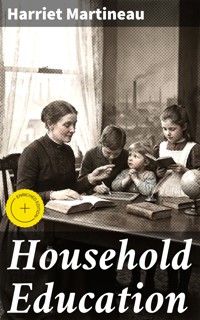
In "Household Education," Harriet Martineau presents a pioneering exploration of the intersection between domestic life and education, advocating for a comprehensive system of moral and intellectual instruction within the home. Written in a clear, accessible style, Martineau engages her readers with a blend of practical advice and keen social observation, reflecting the Victorian-era belief in the importance of character development as a foundation for personal and societal progress. The book underscores the role of women as educators and moral guides within the household, situating the domestic sphere as a critical space for shaping future generations. Martineau, a foremost thinker of her time, rose to prominence through her advocacy for social reform and her examinations of contemporary issues ranging from class inequality to women's rights. Her experiences as a sociologist and the challenges she faced as a female writer in the 19th century informed her perspectives on education and its transformative potential. Martineau's academic background and her commitment to improving societal conditions motivated her to address the undercurrents of educational philosophy and domestic responsibility within her work. "Household Education" is recommended for scholars and general readers alike who seek to understand the evolution of educational thought, particularly in the context of domestic roles. Martineau's insights offer a profound commentary on the responsibilities of caregiving and the foundational role of home education, making this work a vital addition to any exploration of gender, education, and social reform. In this enriched edition, we have carefully created added value for your reading experience: - A succinct Introduction situates the work's timeless appeal and themes. - The Synopsis outlines the central plot, highlighting key developments without spoiling critical twists. - A detailed Historical Context immerses you in the era's events and influences that shaped the writing. - A thorough Analysis dissects symbols, motifs, and character arcs to unearth underlying meanings. - Reflection questions prompt you to engage personally with the work's messages, connecting them to modern life. - Hand‐picked Memorable Quotes shine a spotlight on moments of literary brilliance. - Interactive footnotes clarify unusual references, historical allusions, and archaic phrases for an effortless, more informed read.
Das E-Book können Sie in Legimi-Apps oder einer beliebigen App lesen, die das folgende Format unterstützen:
Veröffentlichungsjahr: 2019
Ähnliche

















Household Education
Table of Contents
Introduction
Education begins at home, yet the home is also where power, habit, and inequality quietly take their most durable forms.
Harriet Martineau’s Household Education is a work of nonfiction devoted to the everyday formation of character and intelligence within domestic life. Written in the voice of a public moralist and social observer, it belongs to the nineteenth-century tradition of practical instruction that treats private conduct as a matter of public importance. Rather than offering a narrow manual of etiquette, the book approaches the household as a central institution through which societies reproduce their values. Its scope is deliberately ordinary, addressing the routines and relationships that appear small until one considers their cumulative force.
The book’s premise is straightforward and expansive: the household is the first school, and its daily arrangements teach lessons long before formal schooling begins. Martineau considers how children learn through example, discipline, conversation, and the atmosphere created by adults, and how these influences shape judgment as well as manners. Readers can expect an essayistic progression of reflections that move from principle to practical implication, keeping attention on what can be observed and altered in common life. The experience is more argumentative than narrative, with a sustained effort to connect ideals to conduct.
Martineau’s style is firm, lucid, and addressed to the reader as someone capable of moral reasoning. She proceeds by asserting claims, clarifying them, and pressing their consequences, often returning to the same core conviction: education is not confined to lessons, but embedded in tone, consistency, and the distribution of responsibility. The voice assumes the seriousness of domestic choices, and the tone tends toward earnest instruction rather than sentimental celebration of family life. At its best, the prose gives the impression of a careful mind testing what people say they value against what they habitually do.
A central theme is the continuity between private life and social life, in which household practices become a training ground for citizenship, fairness, and self-command. The book stresses the formative power of example, the ethical significance of truthfulness, and the way authority can either cultivate independence or encourage compliance without understanding. Another persistent concern is the relation between comfort and character: how indulgence, neglect, or inconsistency can shape expectations and resilience. Martineau treats education as a moral and intellectual process at once, refusing to separate reasoning habits from everyday behavior.
The work still matters because contemporary debates about education often concentrate on institutions while underestimating the pedagogical force of ordinary environments. Martineau’s insistence that children absorb norms through routines aligns with modern awareness of social learning, even when her conclusions reflect the assumptions of her time. The book invites readers to examine how rules are justified, how disagreements are handled, and how attention and respect are distributed within a family. It also speaks to the enduring question of how to raise thoughtful, responsible people in settings shaped by stress, work, and unequal resources.
Household Education can be read both as a period document and as a provocation to self-scrutiny. Its arguments encourage attention to the implicit curriculum of daily life: what is rewarded, what is ignored, and what is treated as inevitable. For modern readers, the value lies less in adopting prescriptions wholesale than in using the book as a framework for asking which domestic practices cultivate autonomy, empathy, and intellectual honesty. Martineau’s confidence that private discipline has public consequences gives the work a continuing relevance wherever families and caregivers negotiate the ideals they hope to live by.
Synopsis
Harriet Martineau’s Household Education is a practical, reflective work that treats the home as the primary school of character. Proceeding from the premise that early influences are decisive, it outlines how daily habits, conversation, and domestic arrangements can become an organized education rather than an accidental one. Martineau addresses parents and other caretakers as moral agents whose ordinary choices shape children’s reasoning, feeling, and self-command. The book’s movement is from general principles to concrete applications, maintaining a steady concern with how authority, affection, and example can cooperate without either indulgence or harshness.
Martineau develops an argument for educating the whole child through consistent guidance rather than sporadic correction. She emphasizes the power of example, suggesting that children learn most reliably by observing how adults manage truthfulness, patience, and fairness under pressure. Alongside moral training, she treats the cultivation of judgment as essential, encouraging practices that invite children to notice consequences and to connect actions with outcomes. The work frames discipline as a means to foster independence and responsibility, not merely obedience, and treats the household’s tone as an enduring influence.
A recurring concern is the formation of habits—of cleanliness, order, punctuality, and self-restraint—through routines that are intelligible to children and steadily maintained. Martineau presents domestic life as a field of continuous instruction where small tasks and shared responsibilities are not distractions from education but vehicles for it. She stresses that rules should be few, comprehensible, and justified in ways suited to a child’s understanding. The emphasis falls on preventing unnecessary conflict by aligning expectations, environment, and adult conduct, so that instruction is reinforced by lived experience.
The book also considers communication within the family as a core educational instrument. Martineau encourages frankness and clarity in answering children’s questions, while warning against evasions that undermine trust or foster superstition. She treats reading, stories, and conversation as opportunities to widen sympathy and cultivate intellectual curiosity, but insists that they should be connected to real life and moral discernment. Attention is given to the management of fear, anger, and disappointment, where she argues that adults should aim to steady feeling, not inflame it, and to teach resilience.
Martineau addresses the social dimension of household training, linking private conduct to public virtues. She treats honesty, respect for others, and consideration of the vulnerable as habits that begin in family interactions and extend outward. The work suggests that children should be gradually introduced to responsibilities and to the realities of social life in ways that encourage compassion without sentimentality. Throughout, she maintains that the home’s justice—how praise and blame are given, how conflicts are settled, how promises are kept—forms a child’s earliest model of society and authority.
The argumentative flow repeatedly returns to the tension between control and freedom. Martineau argues for firm boundaries that nonetheless make space for initiative, play, and self-directed effort, so that a child’s will is guided rather than broken. She cautions against inconsistent discipline and against adult impatience, both of which can convert minor faults into lasting patterns of deceit or defiance. Without presenting the subject as formulaic, she aims to make education an intentional, coherent practice, where affection is matched by steadiness and where instruction follows the child’s development.
In its final movement, Household Education leaves the reader with a vision of domestic life as an ethical and civic foundation. Martineau’s central claim is that a society’s character is prepared in its homes through ordinary acts that train attention, conscience, and judgment. By treating household management, conversation, and discipline as interlocking parts of education, the work speaks to enduring questions about how values are transmitted and how autonomy is cultivated. Its continuing resonance lies in its insistence that effective upbringing depends less on grand interventions than on consistent principles embodied in daily life.
Historical Context
Harriet Martineau’s Household Education appeared in Victorian Britain, when rapid industrialization and urban growth were reshaping family life and social expectations. The book addressed a readership formed by expanding print culture and rising literacy, supported by cheaper publishing and circulating libraries. It emerged in a society that treated the household as a key site of moral formation and social discipline, while simultaneously confronting new pressures from factory work, migration to cities, and widening gaps between wealthy and poor. Martineau wrote for parents and guardians navigating these transformations and debating what “education” should mean beyond formal schooling.
paragraphs
Early nineteenth-century Britain saw intensified debate over popular education, spurred by religious and political divisions as well as economic change. Voluntary schooling expanded through institutions such as the Church of England’s National Society (founded 1811) and the nonconformist British and Foreign School Society (founded 1808). These organizations promoted mass instruction but often tied it to denominational teaching, prompting disputes about control of curricula and the purpose of education. In parallel, educational reformers argued over monitorial methods and the merits of home instruction. Household Education speaks into this landscape by emphasizing the formative power of everyday domestic practice alongside, and sometimes instead of, institutional schooling.
paragraphs
The era also brought increasing state attention to children’s welfare and labor. The Factory Act of 1833 limited hours for child workers in textile mills and created factory inspectors, and the Mines and Collieries Act of 1842 prohibited underground work for women and girls and for boys under ten. These measures reflected public concern about physical and moral harms tied to industrial employment. They also reinforced a view that childhood required protection and structured development. Martineau’s discussion of discipline, habit, and moral training draws authority from a period in which legislation and inquiry were redefining the boundaries between family responsibility, employer power, and public oversight.
paragraphs
Religious and philosophical currents shaped Victorian ideas of character, duty, and the family. Evangelical movements promoted sobriety, self-examination, and domestic piety, while utilitarian thinkers emphasized rational improvement and education as a tool for social progress. Debates over poor relief after the Poor Law Amendment Act of 1834 further sharpened attitudes toward dependency and self-help. Martineau, known for her writings on political economy and society, contributed to these disputes by presenting the household as a practical arena where moral habits and social attitudes are learned. Her approach reflects a reform-minded belief that everyday conduct could help address broader social problems.
paragraphs must be array of strings, not a string at index 1. Correct JSON.




