


7,49 €
Mehr erfahren.
- Herausgeber: Klish T. Kinderman
- Kategorie: Ratgeber
- Sprache: Englisch
Are you tired of overanalyzing every text message, conversation, and interaction with your partner?
Do you feel like your thoughts are constantly spiraling out of control, leaving you anxious and unsure about the future of your relationship?
If so, it's time to put an end to the cycle of overthinking and start enjoying your relationship again.
In "How to Stop Overthinking Your Relationship," you'll discover proven strategies for breaking free from the endless loop of negative thoughts and doubts.
With practical strategies and exercises, you'll learn how to reframe your thinking, cultivate self-awareness, and communicate more effectively with your partner.
In this book, you will discover:
- How to identify your overthinking triggers and deal with them
- How to build trust in your relationship
- How to deal with being over-controlling
- How to stop being too clingy to your partner
- How to build emotional stability in your relationship
- How to make your partner fall in love with you and become committed to you
It’s time to say goodbye to sleepless nights and constant worry, and hello to a more confident, fulfilling relationship.
Don't let overthinking ruin what could be the best thing in your life. Get your copy of this book right now and start living your best love life.
Das E-Book können Sie in Legimi-Apps oder einer beliebigen App lesen, die das folgende Format unterstützen:
Veröffentlichungsjahr: 2023
Ähnliche













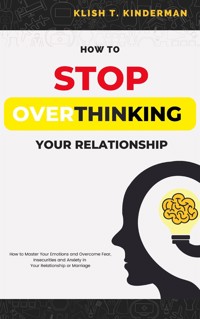
How to Stop Overthinking Your Relationship
How to Master Your Emotions and Overcome Fear, Insecurities and Anxiety in Your Relationship or Marriage
Klish T. Kinderman
Copyright ©
Klish T. Kinderman
© 2023 United Kingdom
All rights reserved. No part of this book may be reproduced or modified in any form, including photocopying, recording, or by any information storage and retrieval system, without permission in writing from the publisher.
Table of Contents
Title Page
Copyright Page
Introduction
Chapter One | Warning Signs You Overthink in Your Relationship and Why
Chapter Two | How to Gain Insight into Why You Overthink
Chapter Three | How to Develop Trust in Your Relationship
Chapter Four | Being Clear with Yourself About What You Really Need in a Relationship
Chapter Five | How to Deal with Being Over Controlling
Chapter Six | How to stop Overthinking Your Relationship by Stopping Being Too Clingy to Your Partner
Chapter Seven | How to Build Emotional Stability in Your Relationship
Chapter Eight | How to Make Your Partner Fall in Love with You and Become Committed to You
Conclusion
Introduction
Overthinking a relationship is a common phenomenon that many people experience. It occurs when you scrutinize every aspect of your relationship and over-analyze everything, often leading to stress, anxiety, and confusion.
You may find yourself constantly questioning your partner's love or interest in you, analyzing their words, actions, and behaviors for hidden meanings. This constant analysis can leave you feeling exhausted and drained.
Overthinking can also create unnecessary tension in the relationship itself. Your partner may feel like they are walking on eggshells or become defensive if they perceive that you are constantly questioning them.
This tension can lead to arguments and misunderstandings that could have been avoided if both partners were communicating openly and honestly about their thoughts and feelings.
It's important to strike a balance between paying attention to potential red flags in the early stages of a relationship while still allowing yourself to be vulnerable and open with your partner.
Overthinking may seem like a way to protect yourself from getting hurt, but it can ultimately harm the relationship if left unchecked.
Overthinking your relationship can be a challenging and exhausting experience. It's understandable to want to scrutinize every detail of your partnership, but constantly analyzing every interaction, word, or gesture can take a toll on the mental health of both individuals involved in the relationship.
Moreover, overthinking often leads to creating unrealistic expectations for the relationship. You may start comparing your partnership with others, imagining scenarios that seem perfect when in reality, they are unattainable. This kind of thinking creates pressure and tension in the relationship and puts you on a constant search for something that might not exist.
Overcoming this habit requires self-awareness and honesty with oneself. First, acknowledge that overthinking is not healthy for you or your partner; secondly, remind yourself why you chose them as your partner initially.
Realize that all relationships have ups and downs; therefore, it's normal to feel uncertain sometimes but don't let overthinking consume you entirely.
Finally, communicate effectively with your partner about how you feel without blaming them or making assumptions - this helps establish trust and bring clarity into the situation, which will help alleviate any doubts or fears.
You may believe you are simply being cautious and analytical and do not overthink things. The issue is that it is highly problematic to let your thoughts go over every single detail of the day, including what occurred, what was said, and how it was stated. You begin seeking issues where none exist. So you begin to scrutinize things to the extent that you lose sight of where you began.
You feel miserable and worn out from all of this, and you risk driving your partner insane.
Overanalyzing has the drawback of making you believe a false narrative. Making issues out of thin air leads to the development of a false sense of security.
You might also investigate a problem to the point where you truly discover a flaw and come to believe it's serious.




