


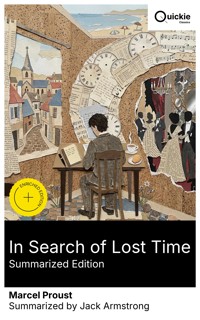
1,99 €
Mehr erfahren.
- Herausgeber: Quickie Classics
- Kategorie: Gesellschafts- und Liebesromane
- Sprache: Englisch
Marcel Proust's seven-volume In Search of Lost Time, here gathered complete, charts a narrator's apprenticeship in desire, art, and society from provincial Combray to Paris salons and Balbec's shore. A signature of modernism, it turns involuntary memory—a madeleine, a paving stone—into revelation. With sinuous sentences, recursive motifs, and free indirect interiority, Proust fuses social satire to metaphysical inquiry, modeling time's distortions and recoveries across the cycle's grand design. Situated alongside Joyce and Woolf, its psychology is inflected by Bergsonian durée. Proust, a chronically ill and hypersensitive observer, wrote much of the work in a cork-lined bedroom, turning seclusion into method. His immersion in Parisian salons, the moral shock of the Dreyfus Affair, filial devotion, and translations of Ruskin equipped him to merge acute social observation with an ethics of attention, and to treat art as the sole redemption of passing time. This complete seven-book collection is indispensable for readers of modern classics: scholars will relish its audacity, writers its lessons in style, and thoughtful newcomers its humane intelligence. Read patiently; the reward is a renewed sense of memory's power to shape, and finally redeem, experience. Quickie Classics summarizes timeless works with precision, preserving the author's voice and keeping the prose clear, fast, and readable—distilled, never diluted. Enriched Edition extras: Introduction · Synopsis · Historical Context · Author Biography · Brief Analysis · 4 Reflection Q&As · Editorial Footnotes.
Das E-Book können Sie in Legimi-Apps oder einer beliebigen App lesen, die das folgende Format unterstützen:
Veröffentlichungsjahr: 2026
Ähnliche





![In Search of Lost Time [volumes 1 to 7] - Marcel Proust - E-Book](https://legimifiles.blob.core.windows.net/images/7bfeaa53b3db8b804e58de22616f49ec/w200_u90.jpg)







In Search of Lost Time (Summarized Edition)
Table of Contents
Introduction
Between the moments we live and the memories we keep lies the fragile frontier where a life becomes a work of art. Marcel Proust’s In Search of Lost Time, presented here as a complete seven-book modern classics collection, follows a narrator who turns the raw material of experience into insight. The sequence unfolds not through sensational events but through the patient recovery of meaning in the textures of everyday life. As childhood impressions deepen into adult reflections, love, society, and art are sifted for what they reveal about time. The result is an intimate, exacting meditation on how remembrance reshapes existence.
First published in France between 1913 and 1927, the novel sequence stands as a cornerstone of literary modernism, a vast roman-fleuve set mainly in late nineteenth- and early twentieth-century France. Its landscapes range from a provincial town to Parisian salons and a windswept Atlantic resort, each place transformed by the narrator’s evolving perceptions. The cultural air of the Belle Époque and the unsettled years that followed provide context rather than spectacle. Proust’s project is neither historical tableau nor plot-driven saga; it is an inquiry into consciousness staged within a society obsessed with rank, taste, and the performances of intimacy.
The premise is elegantly simple: a sensitive observer grows up, enters the world, loves unwisely and ardently, moves among families, artists, and aristocrats, and slowly discovers what it might mean to make art from life. The narrative voice is first-person and retrospective, its tone by turns lyrical, ironic, and forensic. Instead of racing forward, the books spiral back over decisive moments, showing how small sensations can carry the weight of years. Public controversies flicker at the edge of drawing rooms, friendships flower and wither, and the narrator’s vocation clarifies without the need for revelations that would break the spell.
Proust’s style is renowned for sentences that unfold with patient amplitude, binding perception to analysis in patterns of memory and association. Scenes expand, contract, and refract through simile and metaphor until they become reflective chambers where the mind can dwell. Yet the books are also sharply comic, alive to vanity, self-deception, and the choreography of social life. The pacing encourages unhurried reading, rewarding attention with sudden recognitions. Each volume contributes motifs that echo across the sequence, so that a gesture, a room, or a change of light returns with fresh resonance, revealing how form itself can remember.
Themes of time and memory guide every turn. Involuntary recollection, when a present sensation unlocks a past long sealed, offers not nostalgia but a method for knowing experience without reducing it. Desire, often entwined with jealousy, exposes the ways perception is shaped by need. Social ambition and snobbery reveal how identities are negotiated in parlors and on promenades. Art emerges as a discipline of attention, a way to salvage meaning from the flux of days. These concerns intertwine without program, allowing readers to sense the work’s architecture as something discovered rather than imposed from above.
The book matters now because it restores depth to experiences that modern life often compresses into fragments. Its analysis of status games, attraction, and performance resonates in an era of curated selves and public opinion that shifts with alarming speed. By insisting on how perception is partial and revisable, it models intellectual humility alongside aesthetic ambition. It also offers a rare education in attention: how to watch, to listen, to wait for meaning to ripen. For contemporary readers, this is not merely a historical artifact but a living laboratory for thinking about identity, memory, and the ethics of observation.
Approach the seven volumes as one continuous experiment rather than a race to an ending. Let their cadences set the pace, and allow characters and places to accrue detail gradually, as they do in life. The collection ensures the full arc of recurrence and return is available, so earlier pages keep deepening as you go. Reading can be episodic or sustained; either way, the cumulative effect is one of heightened clarity. What begins as a private quest grows into a meditation that illuminates countless ordinary hours, inviting you to recognize, within your own days, the textures that endure.
Synopsis
In Search of Lost Time, Marcel Proust’s seven-volume novel published between 1913 and 1927, follows an unnamed narrator who looks back over his life to grasp how time and memory inform identity. Moving from provincial childhood to the salons of Paris and the shores of Normandy, the work fuses social observation with introspection and aesthetic inquiry. Its central questions—how involuntary memory transforms the past, how love and jealousy distort perception, and how art can redeem experience—unfold within a richly detailed portrait of French society from the late nineteenth to the early twentieth century. Each volume advances both a life story and an argument about consciousness.
Swann’s Way introduces the narrator’s childhood in Combray, where family rituals, illness, and nighttime anxieties shape his early sensibility. An unexpected sensory recollection opens the book’s guiding theme: memory that returns without will can recover a lost world. In Paris, he experiences first attachments and the lure of names that promise distant places. Interwoven is the story of Charles Swann’s passion for Odette, a study of desire, social maneuvering, and the transforming power of a musical motif associated with love. Through the Verdurins’ circle and hints of the Guermantes aristocracy, the novel establishes its social map and emotional stakes.
In the Shadow of Young Girls in Flower follows the narrator’s adolescence as he tests his ideals against reality. In Paris, he pursues aesthetic idols and learns the difference between art’s promise and performance. At the seaside resort of Balbec with a beloved relative, he encounters a band of girls whose vitality—especially that of Albertine—ignites desire and perplexity. Friendships broaden his world: a painter models how perception can be trained, and a young aristocrat, Robert de Saint-Loup, offers loyalty and access to elite society. The volume charts the narrator’s first sustained experiments in love, taste, and style, as observation begins to refine feeling.
The Guermantes Way centers on social initiation and disillusion. After moving into lodgings connected to the Guermantes, the narrator becomes fascinated by their lineage and by the Duchesse’s glamour, only to find the distance between myth and everyday personality. Visits to salons reveal wit, prejudice, and shifting alliances, while the Dreyfus Affair divides drawing rooms and tests loyalties. Time’s gravity asserts itself through a profound family bereavement that deepens the narrator’s meditation on loss and remembrance. Encounters with Saint-Loup’s military life further expose the codes and pressures of class. The volume sharpens the contrast between society’s spectacle and the inner life that judges it.
Sodom and Gomorrah expands the investigation of desire and secrecy. The narrator witnesses how social appearances mask hidden lives and how entire networks form around what remains unspoken. Baron de Charlus emerges as a pivotal figure linking aristocratic prestige, vulnerability, and the Verdurins’ increasingly influential salon. A second stay in Balbec complicates the narrator’s ties to Albertine, as jealousy, rumor, and surveillance begin to structure love. The book broadens Proust’s taxonomy of manners, tracing the ways language, gesture, and ritual conceal as much as they reveal. Through these revelations, the narrator refines his understanding of how society scripts, constrains, and exposes human relations.
The Prisoner narrows to a Paris apartment where the narrator lives with Albertine, attempting to secure happiness by controlling proximity and information. Domestic routines—visits, drives, music—become instruments of possession and anxiety. The Verdurins champion new performances of Vinteuil’s music, prompting reflections on how art can crystallize feeling and outlast lives. Yet aesthetic clarity does not quiet jealousy, and the narrator’s efforts to reduce uncertainty only multiply it. The volume probes the ethics of love transformed into watchfulness, contrasting inner narratives with the opacity of others. Confinement, literal and emotional, becomes a laboratory for studying the unstable boundary between knowledge and illusion.
The Fugitive confronts rupture and the afterlife of attachment. Sudden separation forces the narrator to reckon with grief, curiosity, and the stories he constructs to fill gaps in knowledge. Testimonies and hints yield partial truths about Albertine, revealing how memory edits and rearranges what it cannot verify. Travel—most notably a journey to Venice—offers a counterpoint to mourning, as art and place provide new frames for attention. The narrator’s efforts to master the past falter before its resistance, but that resistance itself becomes instructive. The volume tracks how loss alters perception, loosens old fixations, and prepares the mind to seek meaning rather than certainty.
Time Regained situates private life within public upheaval, as war reshapes Paris and accelerates social change. Returning to a city transformed, the narrator encounters friends visibly marked by time, their faces and habits bearing history’s imprint. A gathering among the Guermantes dramatizes aging and the instability of status, while streets, sounds, and textures unexpectedly trigger cascades of memory. These experiences suggest a method for making the past present without falsifying it, and for turning scattered sensations into form. The volume gathers the novel’s strands—society, love, art, and time—into a final meditation on perception’s labor and the responsibilities of creation.
Across its seven parts, In Search of Lost Time proposes that the texture of a life resides less in events than in the ways we recall, misremember, and finally arrange them. Love exposes the will’s limits; society reveals the performance of identity; art offers a discipline for recovering truth from fleeting impressions. Proust’s continuous, probing sentences model the very work of attention the book advocates. Without relying on revelations, the narrative builds an ethic of seeing and remembering that honors both beauty and difficulty. Its enduring significance lies in showing how time, once thought only to erode, can also return what matters—if one learns how to receive it.
Historical Context
Marcel Proust composed In Search of Lost Time between roughly 1909 and 1922, drawing on the social world of France’s Belle Époque under the Third Republic. The narrative ranges chiefly across Paris, its aristocratic Faubourg Saint‑Germain, and Normandy’s seaside resorts, institutions shaped by republican politics, Catholic tradition, and the newly codified secularism of the 1905 law separating church and state. First volume appeared in 1913; the cycle continued through posthumous volumes to 1927. Proust’s panorama records the habits of salons, theaters, and boulevards at a moment of prosperity and anxiety, and it subjects them to sustained observation, irony, and critique.
The Dreyfus Affair (1894–1906) convulsed French society, exposing entrenched anti‑Semitism and redefining the role of intellectuals. Captain Alfred Dreyfus’s wrongful conviction and Émile Zola’s 1898 J'accuse…! polarized salons, newspapers, and political clubs, forcing declarations of loyalty. Proust publicly supported Dreyfus and signed pro‑Dreyfus petitions; his mother, Jeanne Weil, was Jewish, sharpening his awareness of prejudice and assimilation. The Affair’s aftershocks persisted into the 1910s, shaping reputations and alliances. In the novel, political quarrels, newspaper campaigns, and social exclusions echo this history, allowing Proust to anatomize opinion, fashion, and conscience without reducing characters to mere allegorical positions.
Turn‑of‑the‑century France accelerated technologically and culturally: Haussmann’s rebuilt Paris hosted electric lighting, department stores, and grands boulevards; the Métro opened in 1900; telephones, photography, and early cinema spread; automobiles and railways altered travel and leisure. The Exposition Universelle of 1900 showcased imperial confidence and modern design, while Normandy’s resorts—such as Cabourg, which Proust frequented—prospered with new tourist rhythms. This compressed, mechanized time changed how Parisians experienced the city and memory itself. Proust’s work registers these upheavals in settings, schedules, and sensations, counterbalancing speed with patient introspection and demonstrating how technological modernity reframes perception, habit, and remembrance.
Under the Third Republic, the old nobility’s symbolic capital waned as financiers, industrialists, and republicans gained cultural authority. The Faubourg Saint‑Germain’s exclusive salons, modeled on real hosts like the Comtesse Greffulhe, coexisted uneasily with newer bourgeois gatherings and the press’s growing power to shape prestige. Etiquette, patronage, and lineage remained potent, yet careers increasingly depended on money, publicity, and administration. Proust records invitations, seating plans, and titles as instruments of distinction and social mobility. By anatomizing these rituals—while noting their fragility—his novel reveals a class order in transition and the comic, sometimes cruel, negotiations that sustain it.
The novel arises amid late‑nineteenth‑century aesthetic debates: Symbolism and Decadence in literature; Impressionism and Post‑Impressionism in painting; Wagnerism in music; and the cult of style across salons and journals. Proust translated John Ruskin, absorbing a rigorous attention to art, architecture, and moral perception. Philosophers such as Henri Bergson popularized ideas about duration and consciousness that permeated educated discourse. Parisian performances by Debussy and the conservatory training of a musical elite shaped listening habits. By staging criticism, performance, and taste within scenes of conversation and contemplation, Proust turns contemporary aesthetic doctrines into lived experience and subjects cultural authority to testing.
Fin‑de‑siècle medicine and psychology reframed the body and mind. Parisian clinicians like Jean‑Martin Charcot and Pierre Janet investigated hysteria, trauma, and memory; Théodule Ribot theorized recollection and forgetting; scientific networks debated neurasthenia and allergies. Proust, chronically ill with asthma, observed how sensation, illness, and routine shape consciousness. His father, Adrien Proust, was a prominent epidemiologist and hygienist, embedding medical discourse within the household. The novel’s attention to involuntary memory, habit, and bodily cues reflects this environment, transforming contemporary scientific interests into narrative method while insisting that subjective time eludes simple measurement or clinical reduction.
World War I shattered the Belle Époque’s confidence. Between 1914 and 1918, mobilization, casualties, rationing, and bombardments altered Parisian daily life; long‑range shells and air raids struck the capital. Proust continued revising the manuscript during the war, expanding earlier plans to incorporate its disruptions and aftermath. Institutions, titles, and fortunes were tested by loss and national service, accelerating shifts already under way. The later volumes trace how wartime pressures reconfigure sociability, careers, and memory without becoming a military chronicle. In doing so, the work measures the passage from gilded stability to fragility, exposing what endures and what collapses.
In Search of Lost Time entered print in a complex publishing climate. After the Nouvelle Revue Française initially rejected his manuscript—an error later acknowledged by André Gide—Proust published Swann’s Way with Grasset in 1913 and then moved to Gallimard/NRF. In 1919, Within a Budding Grove won the Prix Goncourt, cementing his reputation. Subsequent volumes appeared through 1922, with the final parts edited and issued posthumously by Gallimard under Robert Proust and the NRF. Arriving alongside European modernists, the cycle’s introspective method and social x‑ray made it both a summation of the Belle Époque and a critique of its illusions.
Author Biography
Marcel Proust (1871–1922) was a French novelist, essayist, and critic, a central figure of European modernism. Best known for the seven-volume cycle In Search of Lost Time (À la recherche du temps perdu), he transformed narrative prose by exploring memory, perception, and social life with unprecedented depth. Writing in the Belle Époque and its aftermath, he bridged nineteenth‑century realism and twentieth‑century experimentation, absorbing influences from Symbolism while developing a distinctive introspective voice. His work’s long sentences, reflective digressions, and acute social observation reshaped ideas about the novel’s scope and method, influencing generations of writers, critics, and philosophers across languages.
Raised in Paris, Proust received a rigorous classical education at the Lycée Condorcet, where he formed lasting literary ambitions. He later attended courses at the University of Paris, studying law and literature, while cultivating wide reading in philosophy, history, and the arts. Early encounters with Symbolist poetry, the salons of the capital, and the critical tradition surrounding Sainte‑Beuve informed his sense of style and argument. A devoted admirer of John Ruskin, he produced notable French translations with extensive prefaces, sharpening his attention to architecture, painting, and moral perception. These formative engagements prepared the technical and intellectual groundwork for his mature fiction and criticism.
In the 1890s Proust wrote essays and pastiches for periodicals, refining a voice that combined irony with psychological acuity. His first book, Les Plaisirs et les Jours (1896), gathered prose sketches and verse, revealing his talent for social portraiture. He drafted, then abandoned, the large-scale novel Jean Santeuil, and developed the critical project later known as Contre Sainte‑Beuve, in which he questioned biographical approaches to literature. Publicly, he took a Dreyfusard stance during the political crisis that divided France, aligning his name with the defense of legal justice and rational inquiry. These activities consolidated his reputation while clarifying the aesthetic problems he wished to solve.
Around the first decade of the twentieth century, Proust redirected his energies toward a single vast work that would absorb his earlier experiments. In Search of Lost Time emerged as a first-person narrative that blends recollection, analysis, and social comedy, placing involuntary memory at its center without reducing the book to a single device. The narrator’s observations track the workings of desire, art, snobbery, and perception across shifting contexts. Proust’s long periodic sentences and carefully modulated metaphors allow minute psychological transitions to be depicted with precision, while the book’s architecture links personal experience to broader historical and cultural changes.
The opening volume, Swann’s Way, appeared in 1913 after several rejections; Proust arranged publication at his own expense, and early reviews were divided. The war interrupted plans, but the series gained momentum with subsequent volumes issued after 1918. The second volume received widespread acclaim and won the Prix Goncourt in 1919, consolidating his standing. Between 1919 and 1922 additional installments appeared, and critical recognition deepened as readers grasped the project’s scope. Proust revised proofs obsessively, expanding and reconfiguring episodes to integrate new insights. His method—at once architectural and improvisatory—became a hallmark, shaping reception as much as the content itself.
Proust’s health remained fragile, and in his later years he withdrew from most social life to concentrate on writing, working long nights and correcting successive editions. He continued to publish volumes from the cycle while preparing the remainder, leaving extensive drafts at his death in 1922. The final parts were edited from these materials and published posthumously in the 1920s, completing the seven-volume design. Although the last installments reflect the state of his papers, they preserve the work’s overarching structure and thematic resolutions. The publication sequence ensured that readers could apprehend the novel both as a serial experience and as a completed whole.
Proust’s legacy rests on the novel’s synthesis of psychological insight, social analysis, and formal innovation. He offered a compelling account of how art converts fleeting sensation into durable meaning, shaping later discussions in philosophy, aesthetics, and literary theory. Writers across traditions—novelists, poets, and memoirists—have adapted his techniques of extended metaphor, interiority, and temporal layering. Translation and global scholarship have kept his work in active circulation, with readers returning to it for its reflections on memory, class, and the making of the self. In an era preoccupied with attention and time, Proust remains a touchstone for understanding experience through style.
In Search of Lost Time (Summarized Edition)
SWANN'S WAY (Du Côté De Chez Swann[1])
Summer lingers; the speaker dawdles when he ought to depart with the season, carrying "Swann" to lamp-lit London. He recalls sunlit days and fire-lit nights beneath a friend’s roof, the two of them, ‘sharp-tongued but smooth, like buttered knives,’ dissecting their private problems, ivory-ball small yet piercing. Laughter half-veiled pain, yet he promises not to return to unsettle the friend, though he may still watch Oakham spire[2] glowing over Catmos vale. A table of contents lists Overture, Combray, Swann in Love, Place-Names: The Name. Then the narrator begins: he long went to bed early, murmuring “I’m going to sleep” and slipping instantly into dreams.
Book still imagined in hand, he wakes after half an hour, gropes for a candle already out, mind still roaming among kings, quartets, churches until the visions flake away. He wonders at the darkness, hears trains whistle like birds, picturing an excited traveller racing home. Cheeks press the baby-soft pillow; a match flares: nearly midnight. He imagines an invalid in a strange hotel glimpsing light, believing help near, only to realize the gas is turned off and servants sleep while pain endures. Slipping back under heavy dreams, he hears boards creak, tastes shared slumber, and revisits childhood fears of his great-uncle tugging curls.
A woman sometimes forms from a twist of limbs: warm, yielding, born of desire, offering its fulfilment. Body and lips still feel her weight and kiss when he jolts awake; if she resembles someone known, he pursues her image until it dissolves. Sleep’s chain of hours and years then reorders, breaks, reforms: dozing in positions can fling him across time, yet even in his own bed a slumber erases identity. Emerging, he grasps memories like ropes, assembling lamps, collars, walls. Limbs search for furniture, conjure past rooms; suddenly he cries, “Why, I must have gone to sleep after all, and Mamma never said good night
The wall slid aside, and I was suddenly in Mme de Saint-Loup’s country room. “Good heavens, it must be ten o’clock, they will have finished dinner!” I thought, blaming the nap that follows our twilight walks. Years had passed since Combray, when sunset still burned on my windowpanes; life at Tansonville now meant moonlit strolls and, from afar, a lamp that waited like a beacon in my bedroom. Such memories blew through me in seconds, showing room after room: winter nests of pillow, blanket, shawl, and newspaper; glowing alcoves whose heat shifted with draughts; summer chambers where moonbeams laid ladders beside my bed.
I revisited the cheerful Louis-XVI[3] alcove whose slender columns ringed the bed, then the high, mahogany-walled pyramid where violet curtains glared, a chattering clock mocked me, and a mirroring giant loomed, until patient Custom softened colours, silenced metal, and lowered the ceiling. At last wide awake, I lay beneath familiar blankets while dresser, desk, fireplace, window, and doors steadied in the gloom; yet I stayed up, summoning Combray, Balbec, Paris, Doncières, Venice. Back at Combray, every afternoon ended in dread of the bedroom that would exile me from Mother. To distract me, someone balanced a magic lantern[15] on the lamp before dinner.
Through that lens Golo, plotting villainy, trotted from a dark wood toward Geneviève de Brabant’s yellow castle; Geneviève, blue-girdled, stood dreaming on the moor. My great-aunt read his speech, the knight bowed, then rode on. He crossed curtains, swelled over folds, flowed across the door-handle, red cloak and pale face unruffled. The glowing ghosts enchanted yet disturbed me, their beauty shattering habit; my private handle became an astral perch for Golo. When the dinner bell rang I dashed downstairs, comforted by the steady lamp, familiar beef, and my mother’s embrace, cherishing her more and scanning my conscience in the wake of Golo’s crimes.
But after dinner I always left Mamma chatting in the garden or the little parlour, for Grandmother refused shelter. "It is a pity to shut oneself indoors in the country," she protested when Father exiled me upstairs with a book. She mourned, "That is not the way to make him strong and active," while he shrugged over the barometer and Mother watched him in silent reverence. Even when rain came in sheets and Françoise hurried the wicker chairs to safety, Grandmother strode alone through the storm, hair flying, crying, "At last one can breathe!" heedless of mud splashing her plum skirt.
When her restless circuit brought her, moth-like, before the parlour lamp, my great-aunt would call, "Bathilde! Come in and stop your husband from drinking brandy!" Merely to tease, she pressed forbidden liqueur on Grandfather; Grandmother hurried in, pleaded, was defeated, and withdrew still smiling, her eyes brimming with unspent kisses. Horror made me long to strike my tormentor, yet, like any grown coward, I fled. Up under the roof I locked myself in the orris-scented room where a currant branch pushed through the window, and wept among books and dreams. I never guessed Grandmother fretted far more over my frailty.
My sole evening balm was Mamma's good-night kiss. I dreaded the instant her blue muslin skirt rustled along the corridor, for the bliss ended almost before it began. I yearned to whisper, "Kiss me just once again," yet feared the displeasure that would chase away the peace her presence poured over me like a sacramental Host. Worse were the nights she stayed downstairs for guests. Visitors were practically limited to M. Swann; at the double, timid peal of the bell everyone cried, "A visitor! Who in the world can it be?" Great-aunt urged silence, Grandmother scouted, loosening stakes from stiff roses.
We waited in the garden when Grandpapa murmured, 'I hear Swann's voice.' His features were lost in the light. I fetched syrups because Grandmama wanted them to appear ordinary. Though younger, Swann loved Grandpapa, who had known his father. Grandpapa often recalled how, the day Madame Swann died, the widower walked with him and cried, 'How lucky we are—look at the trees, feel the breeze—life is good, dear Amédée!' Grief returned; he dried his eyes, wiped his glasses, then said, 'I think of my wife often, but only a little at a time.' Grandpapa kept that line, adding, 'Yet he had a heart of gold.
For years Swann dropped in, and we never guessed the guest was a Jockey-Club star, friend to the Comte de Paris[8] and the Prince of Wales[9]. His discretion and our caste creed—stockbroker's son stays among stockbrokers—hid the truth. We imagined him doffing his hat to anyone above us. Had we rated him, we'd have placed him below other heirs, for he lived modestly, stacking antiques in a Quai d'Orléans[6] house my aunt called degrading. She feared dealers would cheat him, mocked his opinions on art, yet laughed when his recipe chat turned into tales of the chemist or coachman, ending, 'You're a character, M. Swann
To strangers my aunt boasted of his millions, insisting he could live on Boulevard Haussmann but liked his 'fad.' Each New Year, when he brought marrons glacés[5], she quipped, 'Still next to the Bonded Vaults so you won't miss your train to Lyons?' and watched the company. She would have been amazed to know that once he left us he slipped into glittering salons no stockbroker had entered, like Ali Baba into treasure. Françoise learned from the coachman he had dined 'with a princess'; my aunt snorted, 'Some princess,' and knitted on. Yet she expected peaches or raspberries every summer and Italian photographs for me.
It was routine to dispatch for Swann’s instructions whenever we craved a special sauce or a pineapple salad for grand dinners that never included him, judged unfit for new guests. When talk turned to the Princes of France, my great-aunt snapped, “Gentlemen, you and I will never know, nor wish to,” while Swann, letter from Twickenham[7] hidden, obeyed her summons to accompany songs and turn pages, a porcelain handled like a tin toy. The graceful figure famed in every club differed from the outline she conjured in Combray’s dusk, an outline swollen with our notions until voice and face mirrored the beliefs packed inside them.
One day Grandmother visited the Marquise de Villeparisis, an old Sacré-Cœur acquaintance, who remarked, “I hear you know Monsieur Swann well; he is close to my nephews, the des Laumes.” Grandmother came home enchanted with the Marquise’s garden flat and with a courtyard tailor whose wit made her cry, “Sévigné could not have said it better!” yet she dismissed a titled nephew as “so common.” My great-aunt, hearing that the exalted lady acknowledged Swann, scolded, “And you said she was kin to Marshal MacMahon[11]!” Her respect for the Marquise fell further when Swann married a notorious, fast woman he never dared bring to us.
A notice soon listed Swann among the Duc de X’s Sunday guests, intimates of statesmen my grandfather admired; delighted, he planned to ask for details, but my great-aunt muttered that social climbing meant ruin. Grandmother’s dreamy sisters, deaf to trivial talk, roused only when grandfather rapped a glass. On the eve of Swann’s visit he sent Asti[4], and Figaro tagged a Corot[10] “from the collection of M. Charles Swann.” “Did you see Swann mentioned?” the sisters breathed. “I’ve always said he had taste,” Grandmother chirped. “You just want to differ,” snapped their elder. They hoped to praise him; great-aunt vetoed it: “Printed fame would mortify him.
The maiden aunts, experts in polite circumlocution, rarely wounded anyone; yet Mother begged Father: "Just ask Swann how his little girl is. It must be hard for him." Father grumbled, "Absurd." I alone dreaded Swann's arrival, because Mother would not come upstairs later. I ate early, lingered at table, and at eight was exiled to bed, guarding her kiss like a perfume that must not fade. That evening the gate bell chimed; everyone understood. Grandfather warned the aunts, "Thank him clearly for the wine." Great-aunt scolded, "Stop whispering!" Father declared, "There's Swann—let's ask if tomorrow will be fine.
Mother pulled Swann aside, I clutching her skirt. "Tell me about your daughter; she already shares your good taste," she said. Grandfather beckoned, "Come sit on the verandah." Forced to yield, Mother whispered, "We'll speak again later; only a mother knows." We gathered round the iron table. I tried to skip across the coming night by imagining tomorrow, yet my gaze, stretched toward Mother, admitted nothing else. Grandfather began on the Duc d'Audriffet-Pasquier; Aunt Flora filled the pause: "I met a Swedish governess who knows co-operatives." Aunt Céline offered a neighbour versed in Maubant, flashing a thankful glance for the Asti.
Swann said, "Saint-Simon[12]'s Spanish journal shows little has changed. Maulevrier even tried to shake my sons' hands." Flora interjected, "Some bottles hold nicer stuff," saluting the Asti. He added, "'Ignorance or a trap,' Saint-Simon writes." Flora praised the papers; Céline agreed, "When they mention what interests us." Swann joked that if newspapers contained Pascal's Pensées[13] and gilt books reported fancy-dress balls, proportions would be right, then mocked their lofty chat. When he repeated the Maulevrier story Céline burst out, "So a duke is better than a groom? Abominable!" Grandfather, discouraged, whispered to Mother, "Remind me your line—yes: 'What virtues, Lord, Thou makest us abhor
Eyes fixed on his mother, he knew dinner would forbid the lingering kisses of bedtime and vowed to pour all his love into one swift embrace, selecting the precise spot on her cheek as a painter readies a palette for a brief sitting. Before the bell rang Grandfather said, “The little man looks tired; he’d better go to bed. Besides, we are dining late to-night.” Father echoed, “Yes, run along; to bed with you.” When the bell clanged he added, “No, no, leave your mother alone… Go on upstairs.” Exiled, he climbed the varnished stairs whose pungent scent stabbed his heart at every step.
Shutting himself in, he barred the shutters, shook out the nightshirt like a shroud and turned back the sheets as though digging a grave, then rebelled. He scribbled a note begging Mother to come upstairs for an urgent matter he dared not write. Fearing Françoise’s rigid code, he lied that Mother herself awaited the answer. The cook studied the envelope, her glance sighing, “What a dreadful thing for parents to have a child like this,” yet departed. She soon returned: dessert at ices, the butler would slip the note with the finger-bowls. Joy flooded him; the forbidden room now promised her whisper and her coming.
I pictured Swann laughing at my torment, unaware that the same pain had gnawed him for years: the misery of knowing the adored one is reveling somewhere we cannot reach. His came from love; mine, still unattached, drifted toward filial longing. When Françoise returned promising to deliver my note, I felt the false rapture Swann once felt when a kindly relative ushers the rejected lover inside a glittering party and murmurs, 'She’ll be thrilled to come down; talking to you is much more fun.' In that instant I loved Françoise, believing her single word had pierced the infernal gaiety.
Françoise soon reappeared without subterfuge: 'There is no answer.' I waved away her tea and lay rigid, like a girl in a mansion hall who refuses extra gas while waiting for a silent lover. Sleep became impossible; the moment I wrote that line I chained myself to seeing Mamma again. Panic throbbed until a healing resolve flooded me: I would stay awake, meet her on the landing, kiss her, and accept whatever sentence followed. I unfurled the window, perched at the bed’s foot, and held my breath while the moon silvered each leaf, the night’s tiniest tremor polished yet separate.
When the gate rattled and Swann departed, I listened. Mamma asked, 'Did you like the lobster? Did he try the coffee-pistachio ice? I found it only so-so; next time another flavor.' My great-aunt sighed, 'What a change in Swann—he’s positively antiquated!' The others noted that unnatural ageing which overtakes a lonely bachelor. Someone whispered of his unfaithful wife 'living with Monsieur de Charlus; the whole town talks.' Mamma answered, 'Still, he seems less unhappy; he hardly rubs his eyes now.' Grandfather concluded, 'Of course he doesn’t love her. He wrote me ages ago. By the way, thank him for the Asti.
Aunt Flora cries, "What! we never thanked him? I put it quite neatly." Céline applauds, "You managed it very well," and adds, "I liked my phrase about ‘nice neighbours.’" Grandfather explodes, "Do you call that thanking him? Swann never noticed it." Flora protests, "Swann is not a fool." Later, when the guests have gone, Father asks, "Well, shall we go up to bed?" Mother answers, "As you wish, dear; I’m not sleepy. Poor Françoise is waiting to unhook me—go and undress." She unbolts the stair-door, candle in hand, and climbs toward her room, unaware that I am slipping into the passage after her.
I seize her on the landing; surprise stiffens into anger. She hisses, "Run away at once. Don’t let your father see you like a crazy jane!" I plead, "Come and say good night to me!" As Father’s candle creeps up the wall I whisper, "I am done for!" He appears, hears the tale, then rules: "Go along with him; stay in his room. We’re not gaolers. Tell Françoise to make the big bed. Good night." Mother protests, "We must not make the child accustomed—" yet obeys. Long after, I still hear the sobs I smothered while he towered above us like Abraham.
Mamma spent that night beside me; after my unforgivable offense, banishment seemed certain, yet my parents gave a gift no good deed had earned. Father, moved by chance not principle, grasped at last how wretched evenings made me and said, "Go and comfort him." She held my hand while I wept. When Françoise entered, startled, she asked, "But, Madame, what is little Master crying for?" Mother answered, "He doesn’t know himself; it’s his nerves. Make up the big bed for me and then go to yours." For the first time my tears were treated as illness, not fault.
In the glow of that unexpected mercy I felt both pride and dread; her tenderness meant a victory over her, a dark date. My sobs deepened, and I saw her eyes blur; laughing through them she murmured, "Why, my little buttercup, my little canary-boy, you’ll make Mamma as silly as yourself. Since neither of us can sleep, let’s do something; I’ll fetch one of your books." None were near. "Shall I open the ones your grandmother saved for your birthday? Think first, you may have no surprise later." Delighted, I watched her bring a square, wrapped bundle holding La Mare au Diable, François le Champi, La Petite Fadette, and Les Maîtres Sonneurs.
My grandmother had first chosen Musset’s poems, a volume of Rousseau, and Indiana, judging light fare as harmful as sweets; Father almost called her mad. Alone in fierce heat she hurried back to the bookseller at Jouy-le-Vicomte, returned feverish, and the doctor forbade such exertion. She replaced the gifts with those four pastoral tales, telling Mother, "My dear, I could not allow myself to give the child anything that was not well written." Every present she chose sought profit of mind: antique chairs that collapsed at first sitting, photographs swapped for engravings after Corot or Turner, objects whose fading grace lured us from mere utility.
Mamma settles beside my bed, holding François le Champi, its reddish cover and cryptic title shining like a secret promise. I know no real novels yet; the name George Sand[18] whispers of wonders, and every phrase glows with singular perfume. While her calm voice flows, she skips the love passages, leaving the sudden shifts between the miller’s wife and the foundling Champi wrapped in crimson mystery. Her reading gentles the prose, guiding verbs and syllables into tender song, banishing affectation, pouring generosity and melancholy through the ordinary words. Soothed, I ride that night’s current, already fearing tomorrow’s solitary darkness.
Later, when wakeful nights summon Combray, only a bright panel emerges against formless dusk: the small parlour, the dining-room, the shaded path where M. Swann appears, the hall, the thin staircase rising like a pyramid to my room and the glass door that opens at seven o’clock. Everything else is dead, accessible only by forced thought, stripped of life. Perhaps, I muse, the lost hours lie imprisoned as Celtic souls do, hidden in a stone or tree, waiting for chance to break the spell. Hazard rules, and another hazard—our own final breath—may arrive before the rescuer touches the right object.
Years pass. On a bleak winter afternoon I come home chilled; Mother, seeing me shiver, offers tea. I refuse, then suddenly consent. She sends for plump, scalloped madeleines[16], and I lazily dip a piece into the steaming cup. The moment the soaked crumb meets my palate a delicious tremor races through me; calamities vanish, time dissolves, I feel infinite. The rapture seems tied to tea and cake yet soars far beyond them. I drink again; the miracle fades. Realizing the truth hides inside me, I set the cup down and descend to that dark region where memory must be created.
Again I chase that elusive happiness: I push aside every stray thought, block the sounds next door, press my fatigued mind to seize the flicker born with the first spoonful of tea. Nothing. I grant it a moment’s diversion, then clear a silent space and summon the taste once more. Something stirs, strains upward like an anchor heaved from depth, yet refuses shape. I lean over the abyss again and again, tempted to abandon the search and brood instead on today’s petty worries—when suddenly memory surges: the crumb of madeleine my aunt Léonie dipped in her lime-flower tea each Sunday morning at Combray.
Until taste unlocked it, the pastry’s image had grown common, detached from childhood. Now the old grey house rises like stage scenery, linking to the garden pavilion behind it, and with it come the square, the errand-laden streets, the country roads of fine days. Flowers from our garden and Swann’s park, water-lilies on the Vivonne, villagers, church, the whole of Combray unfold like Japanese paper shapes blooming in a bowl. Seen from the train, the church gathers the town within its cloak of dark stone houses; inside, sombre saint-named streets and cooking smells mingle with my longing to wander them again.
My grandfather's cousin—courtesy named great-aunt—bore Aunt Léonie, who after Uncle Octave’s death surrendered first Combray, then the house, room, and finally her bed, where she now lay amid grief, weakness, ailments, fixations, and prayers. Her window overlooked the Rue Saint-Jacques, stone steps lining a furrow that seemed carved for a Gothic Calvary. Her world shrank to two rooms: one aired while she rested in the other. Those chambers brewed dense, domestic perfumes—bread, frost, orchards, church incense—so savoury I lingered greedily on early Easter mornings. While the wintry sun warmed the lit hearth, I paced between prayer-desk and chairs, inhaling that invisible pastry of smells.
I could hear her murmuring in the next room; she never raised her voice, fearing a loose fragment in her skull might shift, yet she spoke constantly to keep her throat open and to give each sensation weight. Forgetting listeners, she would declare, "I must not forget that I never slept a wink," a title of honour the household protected: Françoise did not 'wake' her, she merely 'came to' her; naps were called 'being quiet.' After a minute I entered, kissed her, and Françoise brewed tea; if my aunt felt 'upset,' she asked for her tisane and I shook lime-blossoms on a plate for infusion.
The stems formed a trellis where petals glimmered like roses; in every grey ball I saw a green bud caught by spring, and their blush hovered in the dusk of flowers. My aunt dipped a madeleine and let me taste a crumb. Beside her stood a lemon-wood chest and a table half pharmacy, half altar—Our Lady’s statue, Vichy-Célestins[17], service books, prescriptions—timers for pepsin and vespers. The window framed the street whose chronicles she followed all day and rehearsed with Françoise. Presently she offered her brow: "Now, my poor child, go and get ready for mass; tell Françoise to come up if I want anything.
Throughout my childhood Françoise served Aunt Léonie, yet during the months we lodged there she half-deserted the sickroom for us. On a Paris New Year’s morning, before I knew her, Mother slipped a five-franc into my palm and whispered, “Wait till I say, ‘Good morning, Françoise,’ then drop it.” Inside the dark vestibule we spotted the rigid silhouette, cap frills glittering like sugar, a grateful smile already forming. Mother pinched my arm, spoke, the coin fell. Years later at Combray I knew her best: our favourite, welcoming us at Easter, lamenting the icy wind while Mother asked about daughter, nephews and grandson.
Alone with her, Mother recalled the dead parents, gently drawing stories from a heart few had questioned; she sensed the dislike of Julien, so when Françoise set off to her daughter’s she quipped, “If Julien’s away and you have Marguerite to yourself all day, you’ll be very sorry but manage, won’t you?” Françoise laughed, “Madame knows everything; Madame is worse than the X-rays that see your heart,” then hurried off, eyes shining. Aunt, resigned to the loss, prized the maid’s silent efficiency: boiling coffee, porcelain-stiff cap, tireless tread. Each morning, pepsin done, she fielded questions—Mme Goupil, giant asparagus, bells, passing-bell for poor Mme Rousseau.
Sometimes news grew urgent enough for a quadruple peal. “It isn’t pepsin time,” Françoise began. “I feel faint, but that’s not why,” Aunt answered. “I saw Mme Goupil with an unknown child. Fetch salt from Camus; Théodore will know her.” “Maybe Pupin’s little girl,” suggested Françoise. “Pupin’s? I’d recognise her… oh, the one from Jouy, home for holidays. Then Mme Sazerat will come; Galopin’s boy carried a tart.” Aunt, thrilled yet vexed, sighed, “Right in the middle of my luncheon! Give me creamed eggs on the plates.” Spectacles on, she spelled “Ali Baba,” “Aladdin,” whispered, “Good indeed.” “I’ll go to Camus,” Françoise said, slipping away.
"No, no, it’s surely the Pupin girl; sorry, Françoise, I bothered you." In Combray a stranger always dissolved into kin. One evening I said we’d met, near the Pont-Vieux, a man Grandfather didn’t know. "A man Grandfather didn’t know at all!" my aunt cried, summoned him, and heard, "Prosper, Mme. Bouilleboeuf’s gardener’s brother." Relieved, she lectured me. Later an unknown dog troubled her. "That must be Mme. Sazerat’s." "I know her dog." "Then Galopin’s new one from Lisieux." "Oh, if that’s it!" Françoise praised the beast, rushed to dress more asparagus; my aunt dismissed her, and I headed to mass.
The porch, black and pitted like a colander, and the scooped stoup showed how peasant cloaks and fingers had worn the stone. Inside, slabs above buried abbots had bulged, distorting Latin lines and drowning a Gothic capital. On dull days the windows blazed: one held a solitary king; at noon Mme. Sazerat knelt beneath it, a parcel of cakes on the chair. Another pane, a rosy snow-peak over battle, bathed the altar in dawn. Threadbare, the tall blue mosaic would flare into a peacock tail, then harden to sapphire armor, while the sun’s smile spread a carpet of glass forget-me-nots that softened the bleak earth.
Two high-warp tapestries showed Esther’s coronation; Ahasuerus bore a French king’s face, Esther that of a Guermantes beauty, and reds, yellows and fading greens spilled beyond their lines, adding life and relief. Nearby gleamed wonders from near-legendary donors—a golden cross forged, people said, by Saint Eloi for Dagobert, a porphyry tomb for Louis the Germanic’s sons. I entered the nave like a sprite-haunted valley: bay after bay pinned down one century after another, gothic arches flirtingly hiding harsh eleventh-century stone. Below, Théodore led us by candle through the crypt to Sigebert’s child’s grave, hollowed “by a crystal lamp which… had buried itself in the stone.
Outside, the apse looked raw and carceral: flints studded rough masonry, windows perched absurdly high. Years later, turning from a country lane onto three converging alleys, I met another crumbling wall with the same skewed windows; without thinking of art or piety I cried, “The Church!” At home Saint-Hilaire’s north door pressed between Mme Loiseau’s house and M. Rapin’s pharmacy like a simple neighbour awaiting the postman, yet my mind kept an unbridgeable frontier between its black stones and everything secular. Mme Loiseau’s fuchsias drooped to kiss the wall, purple cheeks cooling against it, but vision still felt the drop of an unseen abyss.
Far off, Saint-Hilaire’s steeple etched its needle on the sky; in the Easter train my father, seeing its iron cock whirl, cried, “Come, get your wraps together, we are there.” On walks it rose above vineyards, a pink scratch on blue; nearby the stones burned purple. At dusk jackdaws burst from twin windows, patterned the air, then dropped upon the turrets. My grandmother loved its quaint, distinguished air: “My dears… if it could play the piano, I am sure it would really play.” When Sunday sunlight set its slates ablaze I gasped, “Good heavens! nine o’clock! I must hurry to mass and kiss aunt Léonie.
After mass we step into the sacristy to tell Théodore to bring a larger loaf, our Thiberzy cousins having arrived for lunch, and outside the window the brown steeple, crusted with golden crumbs and sticky drops of sun, rises like an enormous piece of "holy bread" that pierces the flawless blue. Later, returning from my walk and dreading the moment I must leave my mother for the night, I see it again, now gentle, a velvet cushion pressed into the wan, compliant sky that swells on either side; circling birds cry, intensifying its silence and stretching its needle past the reach of words.
Even when errands carried us behind the church, the view seemed drawn around that spire: here it jutted above a roof-ridge near the post-office, there it dipped, marking the turn for Mme Sazerat, further off it wheeled into new facets as we walked to the station, or from the Vivonne its apse hurled the point to heaven, the Finger of God ruling the town. I compared it to Norman houses crowned by a spire, to the violet dome of Saint-Augustin glimpsed beyond Paris roofs, yet none held my being so completely. Let any belfry resemble it, and I linger, transfixed, until duty drags me on.
After mass we meet M. Legrandin, from Paris. Elegant, he denounces "snobbishness, the unpardonable sin," though his sister married a noble. My family admire him; Grandmother whispers he talks like a book. He smiles: "Well met! Tomorrow I squeeze back into my niche in Paris. I own everything useless but not this sky. Keep a patch of sky above your life, boy. You have an artist's soul; don't let it starve." At home Aunt Léonie asks if Mme Goupil was late; none noticed. Learning a painter is in the church, she sends Françoise, but Théodore is away. "Ah, if only Eulalie would come," she sighs.
Eulalie, a limping deaf spinster, had served Mme de la Bretonnerie since childhood; after the lady died she took a room beside the church and was forever darting out for mass, private prayers, or to help Théodore. She spent the rest of her day visiting the sick, especially bedridden Léonie, and earned sous by mending linen. Her white coif over black cloth and red-blotched face were well known. Léonie tolerated no other callers: anyone who advised, “A quick walk and steak would cure you,” or who echoed her lament, “Yes, you are dying,” was barred. Françoise rejoiced in the ruses that sent such people away.
Only Eulalie met the triple test: approve, commiserate, promise hope. When Léonie sighed, “The end has come, my poor Eulalie!” she instantly answered, “Knowing your complaint so well, Mme Octave, you’ll live to be a hundred, as Mme Sazerin said yesterday.” “I don’t ask to reach a hundred,” the patient replied, soothed. Her Sunday visit became sacred excitement; if the bell lagged, Léonie watched the clock, yawning through each symptom, and the final ring could almost make her faint. Meanwhile the noon chimes of Saint-Hilaire blazed above our lunch as Françoise heaped brill, turkey, cardoons, mutton, spinach, apricots, raspberries and first cherries on the table.
After those dishes came cream cheese, almond cake, the holy-bread loaf, and a chocolate cream Françoise composed like a fleeting concert piece; to refuse or leave a morsel was as rude as walking out while the composer played. At last Mother said, “Don’t stay here all day; breathe a little outside, then read.” I stepped into the small garden, settling on the backless bench by the pump carved with a salamander. In the lilac shade stood my aunt’s back kitchen, its red tiles glittering like porphyry, overflowing with milk, fruit and vegetables brought as first-fruits by distant vendors; a dove perpetually murmured above its roof.
In Combray I once slipped daily through the fragrant gun-room smell that clung to Uncle Adolphe’s ground-floor den; since our quarrel I no longer entered it. In Paris, however, I still paid duty calls after his lunch. Wearing an alpaca coat and served by a valet in purple-striped linen, he grumbled that I neglected him, pressed marchpane or a tangerine on me, then led me past an unused yellow drawing-room to the ‘study’ hung with plump, Pompeian goddesses. Presently the servant appeared: “What time for the carriage, sir?” My uncle wrestled, then unfailingly pronounced, “A quarter past two.” “A quarter past two! Very good, sir.
Though barred from theatres, I worshipped them, imagining each spectator saw a private stage. Every morning I sped to the Morris column; bright bills—Le Domino Noir, Les Diamants de la Couronne, Oedipe-Roi—conjured delights that left me helpless to choose. I ranked actors: “Got, Delaunay, Febvre,” reshuffling whenever a schoolmate disagreed until the names throbbed in my head. A glimpse of Maubant or a rose-crowned woman in a brougham pierced me like love. I recited my pantheon—Bernhardt, Berma, Bartet, Brohan, Samary. Uncle entertained such stars and dubious countesses; Father murmured, smiling, “One of your uncle’s friends,” and I yearned for the shortcut his favor promised.
Using a spare hour, I ran to Uncle’s house; a carriage with red carnations waited. Laughter drifted downstairs; after I rang, silence fell. The valet protested his master was busy but carried my name in. A woman called, “Oh yes, let him in, it will be amusing.” Uncle grumbled yet agreed. Marchpanes stood ready; his alpaca coat unchanged. Opposite him, a young woman in pink silk and pearls finished a tangerine. I blushed, kissed him. “My nephew!” he said. She smiled, “How like his mother— I passed her once on your stair.” Stroking my brow, she asked, “Is your niece’s name the same as yours
"He looks just like his father," my uncle muttered, unwilling to utter Mamma’s name or make introductions. "Like my poor mother, too." The lady in pink inclined her head. "I’ve never met his father, dear, nor your mother; we met after your great sorrow." I felt let down: she resembled the well-bred cousins who visited us at New Year, only better dressed. No actress’s allure, no wicked sparkle; yet the carriage, pink silk, pearls, and my uncle’s select circle marked her as one of those celebrated women. Her hidden, uncertain life disturbed me more than any blatant scandal.
We entered the study; my uncle, uneasy at my presence, offered her a cigarette. "No, dear friend. I only smoke the Grand Duke’s; I tease him that they make you jealous." She produced gold-lettered cigarettes. Suddenly she exclaimed, "Of course I met this young man’s father with you. Isn’t he your nephew? He was so nice, so charming to me." Knowing my father’s chill courtesy, I blushed at what must have been a brusque greeting, now reset like a jewel in her affectionate voice. I marveled at the way such idle, diligent women shape dull male lives into delicate works of art.
"Look here, my boy, time you went," my uncle said. Heart thudding, I seized the hand she offered and kissed it. "Isn’t he delicious? Let him come for tea if he sends me a blue," she laughed. Ignorant of the word, I kept silent. "No, impossible; he’s winning prizes," my uncle replied. She asked, "Who is Vaulabelle?" He hurried me away. Outside I kissed his tobacco-stained cheeks, swore gratitude, yet that night told all at home. My parents clashed with him; weeks later I passed his carriage, dared not lift my hat. Thinking I obeyed orders, he never forgave us, and we met no more.
And so I stopped entering Uncle Adolphe’s shuttered parlor. I lingered by the back-kitchen until Françoise said, “I’m letting the kitchen-maid bring coffee and hot water; time I went to Mme Octave.” Then I hurried upstairs with a book. The kitchen-maid was an unchanging post manned each year by a new girl; that Easter the post wore a frail, pregnant body, her swelling a hidden casket beneath Giotto-like smocks. Swann, seeing the likeness, would ask, “Well, how goes it with Giotto’s Charity?” Her stout face and belly evoked the Arena Chapel Virtues, while ‘Invidia,’ cheeks ballooned round a serpent, showed symbol, not feeling, in command.
At first the copies in my schoolroom repelled me—Charity without charity, Envy like a medical plate, Justice with the pinched features of certain pious Combray ladies already enlisted for Injustice. Later I grasped that their beauty sprang from giving the emblem huge, tangible life; as with the maid’s taut abdomen or the dying who feel death as thirst or weight, the symbol forces attention. True charity, I found in convents, often wears the brisk, undisturbed mask of a busy surgeon. Meanwhile the maid’s blunders glorified Françoise: she sent up watery coffee and tepid water while I lay reading on my bed.
My room trembled, defending its fragile coolness behind almost closed shutters where a splinter of sunlight hung like a golden butterfly. Below, Camus, assured by Françoise that my aunt was not “resting,” smashed packing-cases, the hot air scattering blood-red dust. Flies performed their chamber music, born with the sun and proof that summer stood close. The dim freshness, equal to a sunbeam as shadow is, offered the whole season to my resting body stirred by printed adventures. Yet Grandmother begged me outside; unwilling to abandon the book, I carried it into the garden, under the chestnut, hiding in a canvas sentry-box from callers.
My mind was its own refuge, a shadowy hiding-hole where I could watch the world through a film of consciousness that kept matter at a glowing distance, like steam before hot metal touches water. While reading, that inner screen unfurled, mottled with hopes and with the horizon beyond the garden, yet driven always by one lever: faith in the book’s philosophic richness and the hunger to claim it. I bought any volume praised by the school-master or a favoured school-friend, spotting it trussed with string outside Borange’s doorway, because I believed they guarded the secret of 'Truth and Beauty'.
That belief flowed outward into the story’s turmoil, so each afternoon teemed with more drama than many lifetimes. The characters were not what Françoise would call 'real people', yet only through such invented lives can feeling pass unhindered, for flesh is opaque, a dead weight the spirit cannot lift. The first novelist had replaced those solid sections with airy panes the mind absorbs, so the deeds and griefs unfolded inside me, quickening breath and eyes as I turned the pages. In that lucid dream he loosed every joy and sorrow, revealing even the slow, disguised mutations of the human heart.
Meanwhile the imagined country eclipsed the lawn before me: mountains, rivers, sawmills, logs beneath cress, and along crumbling walls purple flowers and red. The woman I yearned for always rose amid that freshness, water about her and those colours crowding close. Chosen by the author and welcomed by my expectant spirit, such landscapes felt truer than our gardener’s dull beds. Had my parents sent me there, I believed truth would stand within reach. Yet the soul is a resonant shell we haul everywhere; finding outside things barren, we chase them harder, and travel, love, desire surge together in one unstoppable jet.
Comfortably settled beneath the chestnut-tree, I relish the warm scent drifting through silent air, the certainty no caller will disturb me. Each chime from Saint-Hilaire lets me watch the spent afternoon drip away; the interval between two golden strokes seems mere seconds, yet an hour has slid inside the narrow blue arc that separates them. Once the story’s spell deafens me so completely that one whole bell vanishes. Those sweet Sunday hours, dappled by leaves, seal my imagined exploits in distant, living rivers; while heat declines they crystallise, sonorous and fragrant, around the adventures racing through my book until Françoise’s hearty dinner.
The gardener’s daughter bursts in, overturns an orange tree, cuts her finger, chips a tooth, and yells, "They're coming!" Cavalry flood the Rue Sainte-Hildegarde. Servants whisk chairs away as horses scrape the walls. Françoise weeps, "Poor children, mown like grass." The gardener retorts, "Fine sight, fellows not caring for their lives!" She says life is the Lord's gift, recalls '70, calls them "lions." Helmets flash in the gap; the girl returns with water and word of a thousand more. Françoise and the gardener decide revolution would be safer, rails stopped, "Ay, the cunning ones." Dust settles; townsfolk sit outside doors like seaweed left by tide.
Order restored, I read again. Swann's visit, praising Bergotte, moves the woman I imagine from blossoms to a gothic porch. I had heard of Bergotte from Bloch, a friend who jeered at my love of Musset and bellowed "La blanche Oloossone" and "La fille de Minos," claiming verse means nothing. He pressed a volume backed by Father Lecomte: "Read this prose, my master, and taste Olympus." We liked the title. Soon Bloch was excluded; my grandfather, divining Jewish blood in companions, hummed tunes from La Juive[14]. When I named Dumont, he crooned, "Archers, be on your guard! Watch without rest, without sound.
Grandfather questioned visitors, then cried “On guard!”; if one had confessed Jewish blood, he hummed “What! do you hither guide the feet…” or “Sweet vale of Hebron…”. Bloch soon vexed us. Seeing his soaked coat, Father asked, “Monsieur Bloch, has it rained?” Bloch replied, “I ignore physical contingencies.” Father muttered, “Imbecile.” When Grandmother felt unwell, Bloch wept; she declared, “He can’t be sincere.” Later he arrived ninety minutes late, boasting he obeyed neither weather nor time. My parents endured him until, after claiming women yield to love, he added my great-aunt had been “kept.” I repeated it; he was barred and bowed to me coldly.
At first Bergotte’s novel clung to me like a tune whose melody I had not yet grasped; I thought I stayed for the plot. Gradually the rare archaic phrases emerged: at their swell he spoke of “the vain dream of life,” “the inexhaustible torrent of fair forms,” “the sterile, splendid torture of understanding and loving,” and “moving effigies that ennoble our cathedrals.” Hidden harmonies began to harp behind the words, bearing an idealist philosophy in marvellous images. By the fourth such passage the earlier ones fused into a single dense essence, an “ideal passage” that opened a vast chamber inside me and enlarged my mind.




