


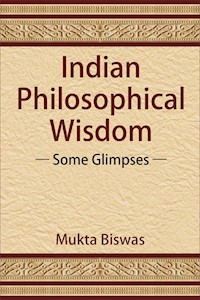
13,99 €
Mehr erfahren.
- Herausgeber: D.K. Printworld
- Sprache: Englisch
The title of the book Indian Philosophical Wisdom: Some Glimpses itself signifies its importance. Indeed, philosophy is involved in every sphere of human life — literature, creative art, culture, etc. The author in her zeal to unravel the precious accumulated wisdom of Indian philosophy delved in its treasure with different approaches — historical, analytical, comparative, etc. An attempt has been made in this book to expound Indian philosophical systems and to analyse critically their logical implications.
This work consists of twenty-seven articles both unpublished and published in journals and from different academic forums aimed towards making a documentation of discussions on various systems of Indian philosophy, Upaniṣadic and Yoga philosophy in particular. This could be a ready reckoner on the subject for young and enterprising students and scholars who possess innate inquisitiveness to unearth the sagacity enshrined in Indian philosophy.
Sie lesen das E-Book in den Legimi-Apps auf:
Seitenzahl: 403
Veröffentlichungsjahr: 2023
Ähnliche




















Indian Philosophical Wisdom
Indian Philosophical Wisdom
– Some Glimpses –
Mukta Biswas
Cataloging in Publication Data — DK
[Courtesy: D.K. Agencies (P) Ltd. <[email protected]>]
Biswas, Mukta, 1956- author.
Indian philosophical wisdom : some glimpses/
Mukta Biswas.
pages cm
Includes bibliographical references.
ISBN 9788124610022
1. Hindu philosophy. 2. Philosophy, Indic. 3. Sanskrit
literature – History and criticism. 4. Upanishads –
Criticism, interpretation, etc. I. Title.
LCC B131.B57 2019 | DDC 181.4 23
ISBN: 978-81-246-1189-0(E-Book)
ISBN: 978-81-246-1002-2(Hb)
© Author
First published in India in 2020
All rights reserved. No part of this publication may be reproduced or transmitted in any form or by any means, electronic or mechanical, including photocopying, recording or any information storage or retrieval system, without prior written permission of both the copyright owner, indicated above, and the publisher.
Printed and published by:
D.K. Printworld (P) Ltd.
Regd. Office : H-12, Bali Nagar
Ramesh Nagar Metro Station, New Delhi - 110015
Phones : (011) 2545 3975, 2546 6019
e-mail : [email protected]
Web : www.dkprintworld.com
Dedicated to
my teacher
Professor Rajendra Nath Sarma
as a token of reverence
Preface
The great treasure of Indian philosophical wisdom that is inherited through ages is undoubtedly a repository and reservoir of our priceless heritage. The Indian philosophers believe that wisdom is not meant for satisfaction of intellectual curiosity but for leading an enlightened life. As a student of Indian philosophy I have a keen interest to explore the vast and diversified nature of this great treasure.
This book entitled Indian Philosophical Wisdom: Some Glimpses, containing a collection of twenty-seven research articles, is the outcome of my research experience with an endeavour to unravel the knowledge pertaining to Indian philosophy and its relevance in the present-day society. Many of the articles incorporated in this volume have already been published in national as well as international journals, felicitation volumes, etc. while a few of them have been introduced for the first time. Most of the papers are devoted to Upaniṣadic and Yoga philosophy, however, some of them throw light on various systems of Indian philosophy. It is difficult to collect and maintain the journals published hither and thither and as such with a view to keep those research articles intact and making them available for the use of young students, scholars and researchers who are eager to know about the richness of various systems of Indian philosophy and its tradition, this book is a humble attempt.
I am extremely grateful to all the ancient authorities and the modern scholars as well whose works have helped me to explain and substantiate my views in this work. I express my sincere thanks and gratitude to Mr Susheel Mittal of D.K. Printworld, New Delhi who unhesitatingly agreed to publish this work.
I remain ever grateful to my husband Dr Ranjan Kumar Biswas, Professor, Assam Agricultural University, Guwahati, who has been a constant support and inspiration for me throughout this project.
I take this opportunity to express my deep sense of love and gratitude to my daughter Debaleena Biswas, my son Ritayan Kashyap and my son-in-law Arindam Bhattacharjee for their affection and support. Despite their busy schedule they have stood by my side to help me in the preparation of this work.
Lastly I make an appeal in the following scholastic words:
gacchataḥ skhalanaṁ kvāpi bhavatyeva pramādataḥ।
hasanti durjanāstatra samādadhati sajjanāḥ।।
When a person somehow falls down, the wicked people laugh at him; however, conscientious men express their sympathy. (Inner meaning is: Malicious men exaggerate the faults in a write-up, while the learned persons ignore them.)
Mukta Biswas
Guwahati
27 November 2019
Contents
Preface
Abbreviations
1. Yoga Thoughts in the Sāttvika Purāṇas
2. Universal Approach to Yoga Philosophy Perspectives of Patañjali and Sri Aurobindo
3. Reflection of Sāṁkhya and Yoga Concepts in the Works of Kālidāsa
4. Sāṁkhya and Yoga Views in the Prabodhacandrodaya
5. Śabda: A Sāṁkhya–Yoga Approach
6. Perception (Pratyakṣa)in Īśvarakr̥ṣṇa’s Sāṁkhyakārikā
7. Rasa as a Means of Liberation in the Context of Bhakti
8. Vedānta Philosophy in Mawlana Jalaluddin Rumi’s Works
9. Vijñānabhikṣu’s Concept of Kaivalya in the Light of Yogavārttika
10. Epistemology in Indian Philosophy in the Context of Valid Knowledge
11. Woman in Vedānta Philosophy Contemplation of Swami Vivekananda
12. Concept of Absolute as Perceived by Nimbārka and Śrīpati: A Comparative Note
13. Concept of Liberation in the Light of Śrīpati and Śrīkaṇṭha: A Comparative Study
14. Concept of Liberation: Views of Śrīpati and Nimbārka - A Comparative Study
15. Essence of Upaniṣadic Liberation as Depicted in the Tantraśāstras
16. Bhakti, a Way to Mukti
17. Reflections of Upaniṣadic Thoughts in the Literary and Philosophical Works of Western Scholars
18. Tāntric Culture in Assam
19. Religious Practices of Tāntric Sādhanā in Assam : Vedic Reflections
20. Value-Oriented Education and the System of Learning in the Upaniṣads
21. Spiritual Value-Oriented Education in the Upaniṣads
22. Social Value-Based Education in the Upaniṣads
23. Value-Oriented Education: Sri Aurobindo’s Concept in the Context of Indian Culture
24. Concept of Humanism in the Upaniṣads
25. Upaniṣadic Humanism in Śaṅkaradeva’s Philosophy
26. Compassion in Buddhist Humanism
27. Ahiṁsā in Sanskrit Literature
Bibliography
Index
Abbreviations
BBR
Bhagavad-Bhakti-Rasāyana
BP
Bhāgavata Purāṇa
BRS
Bhakti-rasāmr̥ta-sindhu
CC
Caitanya Caritāmr̥ta
ChāUp
Chāndogya Upaniṣad
GauT
Gautamīya Tantra
GP
Garuḍa Purāṇa
GT
Gandharba Tantra
KaṭhUp
Kaṭha Upaniṣad/Kaṭhopaniṣad
KG
Kīrtana Ghoṣā
KT
Kulārṇava Tantra
Ku
Kumārasambhavam
Megh
Meghadūtam
MNT
Mahānirvāṇa Tantra
MuṇḍaUp
Muṇḍakopaniṣad
MV
Māṭharavr̥tti
NBS
Nārada-Bhakti-sūtra
NM
Nyāyamañjarī
NP
Nāradīya Purāṇa
NŚ
Nāṭyaśāstra
PC
Prabodhacandrodaya
PLM
Paramalaghumañjūṣā
Raghu
Raghuvaṁśam
RIP
Reflexions on Indian Philosophy
ŚB
Śrīmadbhāgavata
ŚBS
Śāṇḍilya-Bhaktisūtra
SDS
Sarvadarśanasaṁgraha
SK
Sāṁkhyakārikā
SS
Sāṁkhyasūtra
STK
Sāṁkhyatattvakaumudī
SveUp
Śvetāśvatara Upaniṣad
SV
Ślokavārttika
TaitUp
Taittirīya Upaniṣad
TR
Tārkikarakṣā
TS
Tarkasaṁgraha
UN
Ujjalanīlamoṇī
VB
Vyāsabhāṣya
VP
Viṣṇu Purāṇa
Vpb
Vedāntaparibhāṣā
VRM
Vedānta Ratna Manjūṣā
YB
Yogabhāṣya
YD
Yuktidīpikā
YS
Yogasūtra
YT
Yoginī Tantra
YV
Yogavārttika
1
Yoga Thoughts in the Sāttvika Purāṇas
TheYoga philosophy is one of the oldest systems of Indian philosophy which constitutes an integral part of our rich heritage. It occupies a unique and esteemed place in the system by virtue of its rational and realistic approach towards systematizing the philosophical thinking. Here is an effort to trace out the Yoga thoughts enshrined in thesāttvika Purāṇas. Purāṇas are the inexhaustible treasure house of Indian religion and culture. It deals with every aspect of human life. The philosophical importance of the Purāṇas cannot be underestimated. Almost all the schools of Indian philosophical thoughts are discussed in them. Being so, the philosophy of Yoga is especially connected with the Purāṇas. The Mahāpurāṇasare classified by different scholars in different ways. According to some scholars, classification of the Purāṇas is based on the principle of edification of one of the three deities of Hindu trinity, viz. Brahmā, Viṣṇu and Maheśvara. The functions of these three gods being respectively creation, preservation and destruction, they came to be associated with the three guṇas, viz. rajas, sattva and tamas, respectively. Thus sometimes the Purāṇas came to be classified on the basis of these three guṇas. This classification is found in some Purāṇas themselves. According to the Padma Purāṇa, Bhāgavata, Viṣṇu, Nārada, Garuḍa, Padma and Varāha are sāttvika Purāṇas being dedicated to Viṣṇu.1 In the list of the GaruḍaPurāṇa, Matsya, Kūrma and Vāyu are included in the sāttvika Purāṇas instead of Nāradīya, Padma and Varāha.2 The Skanda Purāṇa (Kedārakhaṇḍa 1) on the other hand enumerates ten Purāṇas describing the greatness of Śiva, four of Brahmā and two each of Devī and Hari. However, in this paper, sāttvika Purāṇas enumerated by the Padma Purāṇa are taken into account. In the sāttvika Purāṇas various yogic concepts are found. Despite many differences in approach, the yogic concepts that find reflections in the sāttvika Purāṇas are highlighted here.
The theory of creation or cosmogony is one of the fundamental topics discussed in the Purāṇas. Out of the fivefold characteristics of the Purāṇas, the sarga (the creation of the universe) is the first and foremost. The sāttvika Purāṇas elaborately discuss about this topic. In the Yoga philosophy prakr̥ti and puruṣa play a pivotal role in the scheme of evolution. In the sāttvika Purāṇas also, prakr̥ti and puruṣa are regarded as the basic factors for the creation of the universe. Like the Yoga system, here also prakr̥ti or pradhāna is described as the material cause of the world and in it all the evolutes are resolved. But they are not the ultimate realities as the Yoga philosophers hold. In the sāttvika Purāṇas it has been said that out of God the world has been created. All the sāttvika Purāṇas accept God as the Ultimate Reality and the whole creation of this universe is the outer form of Him. Again the trinity theory of God is generally mentioned in the sāttvika Purāṇas. Accordingly, the three gods, namely, Brahmā, Viṣṇu and Śiva are regarded as the creator, preserver and destructor of the universe, respectively. The Yoga system also accepts the existence of God. But with the conviction that He is neither the creator nor the destroyer of the universe. The Yoga system postulates the existence of God over and above that of prakr̥ti and puruṣa. According to Yoga, Īśvara is the special puruṣa unaffected by affliction, action, fruitions and dispositions (YS 1.24). God is said to be inactive efficient cause of the evolution of prakr̥ti. Vyāsa does not regard God as the efficient cause but Vācaspati Miśra clearly states that God is the efficient cause of evolution of prakr̥ti into various effects, whose function consists in the removal of barriers for fruition of merits and demerits, which are the effects of prakr̥ti.3 They hold that prakr̥ti is the material cause of the world, while God is its efficient cause in the sense that He disturbs the equilibrium state of the guṇas and removes all barriers to their redistribution into various modes and guides their evolution for the enjoyment and liberation of the puruṣa. God also brings about the conjunction and dissolution of the world. Thus God is described as the perfect self free from all taint of imperfections who supervises the strategy of evolution. Patañjali used the term draṣṭā for puruṣa and dr̥śya for prakr̥ti. Puruṣa is pure consciousness without any movement of any kind but prakr̥ti is impure and changing. When this pure puruṣa identifies itself with prakr̥ti the world comes into being. On the other hand, the sāttvika Purāṇas recognize God as the Ultimate Reality. According to the sāttvika Purāṇas, as they are followers of the Viṣṇu cult, Lord Viṣṇu otherwise called Bhāgavata, Vāsudeva, Kr̥ṣṇa, Hari, Nārāyaṇa, Govinda, etc. is the prime cause of the universe and He is the Absolute (VP I.1.31; II.7.40). Further, the Purāṇas hold that the Supreme Cause is one and He takes the forms of Brahmā, Viṣṇu and Śiva for the purpose of creation, preservation and destruction of the universe, respectively (GP 1.4.12). Before creation prakr̥ti lay merged with Supreme Spirit without separate existence. But when the desire for creation was aroused, this Supreme Spirit divided itself into two parts, viz. prakr̥ti and puruṣa (VP 1.2.23-24). Then both of these prakr̥ti (matter) and puruṣa (spirit) united together for the creation purpose by the will of God Viṣṇu. And therefore it is said that prakr̥ti and puruṣa are not independent realities as in the Yoga. They are nothing but two different manifestations of God. However, almost all the sāttvika Purāṇas maintain that these two are the original causes from which all material things are evolved.
The Yoga philosophy holds that the cosmic process of evolution is independent. On the other hand, the sāttvika Purāṇas hold that the cosmic process of evolution is entirely dependent on God. While describing the evolutionary process the Yoga says that sāttvikaahaṁkāra gives rise to manas, rājasaahaṁkāra to the ten organs and tāmasaahaṁkāra to the five tanmātras. But according to the Viṣṇu Purāṇa, the Bhāgavata Purāṇa and the Padma Purāṇa the ten gods, namely, Dik, Vāta, Arka, Pracetas, Aśvins, Vahni, Indra, Upendra, Mitra and Prajāpati who preside over the ten organs and manas, emerge from the vaikārika or sāttvika type of ahaṁkāra, so the ten organs naturally are relegated to a different origin and therefore are stated to have come out of the taijasa or rājasaahaṁkara. The products of tāmasaahaṁkāra, i.e. the five tanmātras are same as in the Yoga and in the sāttvika Purāṇas.
The Yoga system recognizes twenty-six principles, viz. puruṣa, prakr̥ti, mahat, ahaṁkāra, pañca-jñānendriyas, pañca-karmendriyas, manas, pañca-tanmātras,pañca-mahābhūtas and Iśvara. The sāttvika Purāṇas also mention all the above-mentioned principles of Yoga philosophy. In addition to these principles of Yoga, kāla is enumerated as the twenty-seventh principle in almost all the sāttvika Purāṇas. Some sāttvika Purāṇas regard kāla as a potency of puruṣa whereas the Bhāgavata Purāṇa says that the Lord Himself is designated as kāla.
The common characteristics of prakr̥ti and puruṣa, the two co-present and co-eternal realities of the Yoga system, find reflection in the sāttvika Purāṇas too. According to the Yoga system, prakr̥ti is a material, non-intelligent, independent principle. It is indeterminate, unmediated and undetermined. It is unconscious but active. In the sāttvika Purāṇas also, prakr̥ti and puruṣa are regarded as the basic factors for the creation of the universe. Like the Yoga system, here also prakr̥ti or pradhāna is described as the material cause of the world and has no beginning and in it all the evolutes are resolved. In the Viṣṇu Purāṇa, prakr̥ti is described as the chief principle from which all material things evolve. It is also called pradhāna, the unmanifested cause of the world. The Viṣṇu Purāṇa mentions it as subtle, uniform and sadāsadātmaka (the nature of both existent and non-existent). It is self-sustained, illimitable, undecaying and subtle. The Yoga philosophers describe prakr̥ti as being beyond both the states of existence and non-existence. The existence consists in possessing the capacity of effecting the fulfilment of the objects of the puruṣa. Thus, it does not exist as such. On the other hand, it does not admit of being rejected as non-existent like an imaginary lotus of the sky. It is therefore not non-existent. Hence it is said that prakr̥ti neither exists nor does it non-exist. Vyāsa describes this prakr̥ti or pradhāna as that which is devoid of existence and non-existence, neither real nor unreal, the ultimate principle, in which all the evolutes of the universe, namely, the intellect, the ego, the subtle-elements, the gross elements, the senses of cognition and of action and the mind, merge (VB II.19).
Patañjali uses the term dr̥śya as synonym of prakr̥ti. In the Yogasūtra (II.17-18) it is mentioned that the dr̥śya is of the nature of illumination, activity and inertia; it consists of the elements and the sense organs; it is for the purpose of experience and emancipation. Vyāsa mentions that this is the final merging point of all the evolutes and thus it is called pradhāna.
Regarding puruṣa, Yoga is of the view that puruṣa (self) is a spiritual entity and is different from prakr̥ti, the material cause of the world. Patañjali describes puruṣa as draṣṭā or dr̥śimātra, i.e. to say, it is consciousness (YS II.20). It is śuddha (pure), that is, without any contact with any feature of dr̥śya or the knowable consisting of either what is possibly the subject of an awareness or its object (ibid.). Vyāsa mentions it as sadājñātaviṣayaḥ (ibid.), means constantly aware of things. Puruṣa is apariṇāmī or it has no pariṇāma or change, transformation. Puruṣa is self-luminous, self-complete and self-satisfied. It is free from bondage and liberation.
The puruṣa in its real nature is distinct from the physical body, senses, mind and intellect; but in the empirical state, it is neither quite similar nor quite distinct from them. In this context Vyāsa says that the puruṣa is not quite dissimilar to the elements of prakr̥ti, because, had it been so, it could not perceive the ideas in the form of mental modification.4
The word puruṣa is used in the sense of self or spirit in the Viṣṇu Purāṇa. It is called pumān. It is described as pure, eternal, all-pervading, uniform and perfect. Like the Yoga philosophy, the sāttvika Purāṇas also say that puruṣa is avyaya, apariṇāmī, different from prakr̥ti or the matter and also devoid of any qualities. It is devoid of birth, growth and decay. It is omnipresent and is of the nature of supreme knowledge. According to the Viṣṇu Purāṇa, puruṣa or self in its real nature is never bound and never have been subject to change. By a false imposition the puruṣa conceives itself to be the agent in the changes that take place by the natural movement of the guṇas of prakr̥ti. In reality, the prakr̥ti itself is the cause and agent of all and puruṣa is only a passive enjoyer of all pleasure and pains (VP I.1.31; VI.7.22-24).
The word puruṣa is used in two senses in the sāttvika Purāṇas, i.e. jīvātman (the individual self) and paramātman (the transcendental self). According to the Nāradīya Purāṇa,5 the puruṣa or ātman is differentiated into twofold, viz. the parā (higher) and the aparā (lower). That which is devoid of the guṇas is called as parā, and the aparā is that which is combined with ahaṁkāra. Again that which is stationed in the heart as the witness in the body, which is constituted by the five elements, is spoken of aparā, while the Supreme Self is known as parā. In the Nārādīya Purāṇa (I.33.58-59) puruṣa is also termed as kṣetrajña because it exists in the body (kṣetra).
Both the Yoga philosophy and the sāttvika Purāṇas describe the guṇas as the constituent elements or components of prakr̥ti, from which the entire universe is created. Sattva, rajas and tamas are called guṇas in their manifested forms and in their unmanifested forms, they are known as prakr̥ti (the primitive matter).
Regarding the nature of the three guṇas, a similar description has been found in both Yoga and in the sāttvika Purāṇas. Thus, in both Yoga and in the sāttvika Purāṇas, sattva is described as illuminating, conducive to pleasure, light and bright. Rajas is activating, conducive to pain and unsteady and stimulating. Tamasis restraining, conducive to delusion, heavy and enveloping. Thus, the universe is an effect of illumination, activity and restrain.
However, regarding the role of the guṇas in the process of creation some minor differences are found between Yoga and the sāttvika Purāṇas. Both Yoga and the sāttvika Purāṇas believe that the entire creation and its process of evolution are carried out by these three guṇas. In the sāttvika Purāṇas, it is commonly found that the three guṇas correspond to the three major deities: Brahmā, Viṣṇu and Śiva. Again, it is said that the creator creates all the phenomena in accordance with the three guṇas. But in the Yoga system, such a description is not found.
Both Yoga and the sāttvika Purāṇas accept mokṣa (liberation) as the ultimate goal of human life. Again, both are of view that ignorance is the cause of bondage and right knowledge is the cause of liberation. However, the concept of liberation of the sāttvika Purāṇas fundamentally differs from the Yoga concept of liberation. According to Yoga, liberation is the viyoga (separation) of puruṣa from prakr̥ti; while according to the sāttvika Purāṇas, liberation means saṁyoga (union) of the individual self with the Supreme Self or God. The sāttvika Purāṇas uphold that liberation consists in reaching the blessed region inhabited by Lord Viṣṇu. Thus, they define the word yoga as the spiritual union with God or Brahman through the concentration of the mind (VP VI.7.31). On the other hand, according to Patañjali, the word yoga does not mean union but spiritual effort to attain perfection through control of the body, mind and senses and through right discrimination between puruṣa and prakr̥ti.
The Yoga offers an elaborate practical discipline as the prerequisite for the attainment of liberation. Patañjali systematized the entire discipline and laid down a comprehensive scheme of eightfold path, known as aṣṭāṅga-yoga or yogāṅga. The aṣṭāṅga-yoga (eightfold path of yoga) is discussed in the Viṣṇu Purāṇa in almost similar to that of the Yoga philosophy and the sāttvika Purāṇas. Observation of the five yamas like ahiṁsā, satya, asteya, brahmacarya and aparigraha, and five niyamas, i.e. śauca, santoṣa, tapas, svādhyāya and īśvara-praṇidhāna are common in both Yoga and the sāttvika Purāṇas. The BhāgavataPurāṇa advocates the path of Yoga as one of the ways of attaining liberation. The practices of the eightfold yoga are repeatedly mentioned in the Bhāgavata Purāṇa. In the twenty-eighth chapter of the third skandha of the Bhāgavata Purāṇa the process of the eightfold yoga is discussed. However, regarding the number of yama and niyama, the Bhāgavata Purāṇa and Garuḍa Purāṇa have their own views. The Padma Purāṇa assigns that yoga occupies an important position in the path of liberation. It propagates that the affliction caused by ignorance can be overcome by the practice of yoga. In this way, the sāttvika Purāṇas describe the eightfold path of yoga with some variations. However, both Yoga philosophy and the sāttvika Purāṇas have emphasized on the practising of meditation as an infallible means for the attainment of liberation and the complete destruction of the veil of ignorance.
Yogic concepts find reflection in most of the sāttvika Purāṇas. Despite many differences in approach, the sāttvika Purāṇas are closer to the Yoga philosophy on different aspects.
1 mātsyamkaurmam tathā laiṅgam śaivam skandam tathaivaca।
āgneyam ca ṣaḍetāni tāmasāni nibodha me।।
vaiṣṇavam nāradīyam ca tathā bhāgavatam śubham।
gāruḍam ca tathā pādmam varāham śubhadarśane।
sāttvikāni purāṇāni vijñeyāni śubhāni vai।।
brahmāṇḍam brahmavaivarttam mārkaṇḍeyam tathaiva ca।
bhaviṣyam vāmanam brāhmam rājasāni nibodha me।।
– Padma Purāṇa (Uttarakhaṇḍa) 163.81-84
2 sattvādhame mātsyakaurme tathāhurvāyum cāhuḥ sāttvikam mādhyamamca।
viṣnoḥ purāṇam bhāgavatam purāṇam sattvottamam gāruḍam cāhurāryāḥ।।
– Garuḍa Purāṇa, Brahmakhaṇḍa I.52
3 īśvarasyāpi dharmādhiṣṭhānārtham pratibandhāpanāya eva vyāpāro veditavyaḥ। – Tattvavaiśāradī IV.3
4 sabuddher na sarūpa nātyantam virūpa iti। – Vyāsavhāṣya II.20
5 ātmānaṁ dvividhaṁ prāhuḥ parāparavibhedataḥ। – Nyāyapariśuddhi I.33.56
2
Universal Approach to Yoga Philosophy
Perspectives of Patañjali and Sri Aurobindo
Yoga philosophy, one of the most developed systems of Indian philosophy, constitutes an integral part of the rich heritage of India. The origin of yoga is untraceable and is lost in antiquity. Yoga postures depicted on seals, stones and statues discovered among the relics of the Indus Valley Civilization indicate that it was prevalent in India even before the advent of Aryans. The word yoga is used in various senses. It means spiritual unification, i.e. the union of the soul with the Absolute, concentration of the mind and complete suppression of the mental modes. In the Amarakoṣa1 and the Mahābhārata2 the word yoga is used in the sense of means. In most of the Vedic texts the concept of yoga has been clearly mentioned. In the R̥gveda (I.34.9) the term yoga has been taken in the sense of yoking or harnessing, achieving the unachieved and the like. The sense of yoking is used in many later Vedic works also, e.g. Śatapatha Brāhmaṇa (XIV.7.1.11), Taittirīya Brāhmaṇa(I.5.1.3) etc. In the Gāyatrī hymn of the R̥gveda, Viśvāmitra meditated upon the glory of the Sun for the illumination of his understanding, bhargo devasya dhīmahi (R̥V III.39.10). Here, it is not only a prayer but an intellectual meditation. The meaning of yoga as meditation is echoed in the Sāmaveda (1.2.10.3) and Śuklayajurveda (I.14) too. With the growth of religious and philosophical ideas in the R̥gveda, the word yoga, which was originally applied to control of steeds, began to be applied to the control of senses. In the Upaniṣadic literature yoga is spoken of as restraint of the senses through which the final realization can be achieved (KaṭhaUp II.6.11). The Śrīmadbhagavadgītā defines yoga as that higher state of mind from where a person is never shaken even by the greatest pain or misery. That state free from all pain and misery is yoga according to Gītā. Yoga is also defined in the Gītā as skill of preserving the equanimity or equality of the mind (II.48). Yoga, according to Patañjali’s definition, is the final annihilation of all the mental modes (YS 1.2). According to Patañjali, yoga means an internal discipline by which the mind is progressively stilled and taken up into the stage of samādhi. This concept of yoga had a great impact on the life and works of many modern Indian philosophers like Swami Vivekananda, Sri Aurobindo, Mahatma Gandhi, S. Radhakrishnan, Rabindranath Tagore and others. They emphasized the importance of yoga. Sri Aurobindo, one of the greatest mystic philosophers of the twentieth century, maintains that yoga is a process by which an individual transcends from the empirical to the trans-empirical level. It raises the ordinary human mind to the higher and wider modes of consciousness. In brief, yoga transforms ordinary human personality into a supermind.
In this paper an attempt has been made to highlight Patañjali and Sri Aurobindo’s views in the context of Yoga philosophy. Aurobindo’s concept of yoga had an immense impact on Indian mind, impressed the public opinion in Western countries and influenced the leaders of various civil, political and human rights movement. The yoga system of Sri Aurobindo is called Supramental Yoga or Integral Yoga or Yoga of Self-Surrender. It is a system of spiritual practice with the aid of which a sādhaka may ascend to the level of trans-empirical reality and also descend to the level of life and matter and divinize them. According to Sri Aurobindo, the supermind is the higher level of existence, which is beyond matter, life and mind. It has the capacity for growing upwards and coming face to face with Saccidānanda Brahman and descending down to the level of matter, life and ordinary mind and divinizing them. A direct link is established between Saccidānanda Brahman on the one hand and the state of ordinary human existence on the other through the supermind.
It is to be noted that besides Pātañjala Yogasūtra, there are numerous works on yoga, viz. Śiva Saṁhitā, Devībhāgavata, Haṭhayogapradīpikā, Yogaśāstra of Dattātreya, Gheraṇḍa Saṁhitā, Ṣaṭcakranirūpaṇa, etc. There are numerous Upaniṣads affiliated to yoga, viz. Nādabindu, Yogatattva, Mauktika, Yogacūdāmaṇi, etc. Moreover, numerous Tantra works and works by Gorakhnātha also deal with the philosophy of Yoga. Yoga philosophy, an ancient school of thought, has a perennial value for the human beings in all ages and in all spheres of life. Yoga aims at making human personality healthy, normal and balanced by removing its physical and mental disorders. It considerably increases an individual’s physical fitness and mental energy. The higher and pure consciousness is aroused in an individual through yoga. An individual is able to rise to higher state of existence by following the methods of yoga. In the present modern scientific age, life is replete with tensions and stresses. The prolonged suppression of emotions like anger, fear and despair results in various mental disorders. Modern medical science also accepts that emotional disturbances lead to physical and mental ailments.
According to Patañjali, physical health and mental health are equally important for the normal development of personality. Nonetheless, mental health is more important than physical health because it is the mind, which can give appropriate orientation to personality development. It has been found by modern psychiatrists that certain types of physical disorders are due to mental causes. For instance in some cases indigestion, constipation, headache, afflictions of the heart and kidneys are caused by certain types of afflictions of the mind. Persons living in advanced societies are fast loosing meaning of their lives. Despite the fact that they live in the midst of crowds they have a dreadful feeling of loneliness and isolation and despite the fact that they live in the midst of material abundance, they have a feeling of boredom, worthlessness and aimlessness. Many of them suffer from insomnia, free-floating anxiety, hypertension, split personality and so on. There is high incidence of mental ill health in industrially advanced societies.
According to Patañjali, the mental modes are the sources of sufferings. The main causes of sufferings are nescience or ignorance (avidyā), feeling of individuality (asmitā), love (rāga), disgust (dveṣa) and will to live (abhiniveśa) (YS 2.3). The concept of avidyā is accepted by almost all the schools of Indian philosophy as the root cause of sufferings.
According to Yoga, avidyā consists in mistaking the non-eternal for the eternal, the impure for the pure, the unpleasant for the pleasant and not-self for the self.3 Due to avidyā, one forgets the real identity of anything. On the other hand, avidyā is the cause of asmitā. Self-esteem, egoism, the sense of the supreme importance of I are the results of avidyā. In the Yogasūtra, asmitā is defined as erroneous identification of oneself with the instruments of body and mind.4 With such an identification, everybody wants to assert himself and dominate the objective world. If one fails to do so, he or she gets frustrated. The third kind of sufferings is rāga which is defined by Patañjali as the desire for an object which yielded pleasure in the past and is remembered in the present time.5 It arises from recollection of pleasurable memories. Anything that is pleasant and agreeable to one mind becomes attached to that. The thrust and the hankering after pleasure or the means to get it preceded by a remembrance of the pleasure, who has enjoyed it is called rāga (attachment). Dveṣa is the fourth kind of suffering.
According to Patañjali, dveṣa is the anger towards an object which yielded pain in the past and is remembered in the present time.6 It is not only aversion to painful things but also anger towards them. The anxiety wish for removal or the means to overcome preceded by remembrance of the pain is called rāga. The last kind of sufferings is abhiniveśa (fear for death). People want to enjoy every moment and tries to avoid the painful feeling of death.Yoga philosophy defines abhiniveśa as the instinctive love of life and dread of death.7Vācaspati Miśra in his Tattvavaiśāradī (II.9) defines that abhiniveśa is the fear of death. This fear is common to both the men and animals, wise and ignorant. It is possible for an individual to reduce those five sufferings of his mind through the practice of Yogic concentration. Yoga advocates control over the body, the senses and the mind. A sound mind needs a sound body. Sensual and passions distract the body as well as the mind. To overcome them, Yoga advocates the eightfold path of discipline (aṣṭāṅga-yoga)8 consisting of abstention (yama), observance (niyama), posture (āsana), regulation of breath (prāṇāyāma), withdrawal of senses (pratyāhāra), attention (dhāraṇā), meditation (dhyāna) and concentration (samādhi). Patañjali describes the usefulness of practising the yogāṅgas. He says that through the performance of the yogāṅgas and with the dwindling of impurity, there comes about the radiance of wisdom, which develops up to the vision of discernment.9Yama is the first limb of aṣṭāṅga-yoga which means abstinence. It involves the conscious effort on the part of a practitioner to refrain from doing things that keep his mind involved in the discriminate struggle for survival and satisfaction within the existing scale of values in life. The yamas are five in number, viz. ahiṁsā (non-violence), satya (truthfulness), asteya (non-theft), brahmacarya (continence) and aparigraha (non-acceptance).10Ahiṁsā is regarded as an important vow in Patañjali’s Yogasūtra.11 In the view of Patañjali, ahiṁsā does not only means abstinence from killing animals or human beings, but also restraining from injuring others physically, verbally and mentally. Satya is a great virtue and accepted by all the people. According to Patañjali through the practice of truthfulness, the practitioner gets the power of attaining the fruits of work for himself and for others.12 The third kind of yama is asteya. Greediness of money leads to theft and refrain from steya (theft) is called asteya.13 The next rule in Patañjali’s code of social conduct is brahmacarya which is actually observed in spiritual discipline. The Yoga philosophy accords high value to brahmacarya.14 Here, aspirants are asked to practise continence for the attainment of ultimate goal. The fifth and the final yama is aparigraha. Through the practice of non-accumulation, the practitioner becomes non-attached to the worldly things even to the body itself.15 The second yogāṅga of Patañjali’s rāja-yoga is niyama (observance).16Niyama consists of śauca (cleanliness), santoṣa (contentment), tapaḥ (austerity), svādhyāya (self-study) and īśvara-praṇidhāna (surrendering to God). Śauca means purity. It has two aspects. One is internal and the other is external. Yoga refers not only the external cleanliness, but also internal cleanliness. Internal śauca of mind occupies an important position in Yogic discipline. Hence, it is necessary on the part of the practitioner to be pure by mind. When the impurities of mind, viz. pride, jealousy, hatred, etc. are completely washed away, then the person is said to be internally pure.17 The second type of niyama is santoṣa. Discontentment leads to suffering. In the Yoga philosophy, it is said that contentment culminates into the best type of happiness.18 The third type of niyama is tapas which traditionally means austerity. Tapas has its spiritual value. Through the practice of austerity, the body and senses have got the resistance power.19 The fourth kind of niyama is svādhyāya. One should read such books which is beneficial and will help one to realize the transitoriness of the world.20Īśvara-praṇidhāna means surrendering to God. Patañjali in his Yogasūtra declares that in surrendering to God, the practitioner attains the supra-conscious ecstasy.21Āsana (posture) is the third step of aṣṭāṅga-yoga. It means different postures of the body. Yogic āsanas produce physical well-being in an individual. If one regularly practises āsanas, he or she may be free from physical ailments and remain fit in all circumstances.22 The fourth limb of Patañjali’s Yoga is prāṇāyama which means control of breath. Patañjali in his Yogasūtra defines that by throwing out and restraining the breath, mind becomes controlled.23 The last outer aspect of the Yoga, according to Patañjali is pratyāhāra (withdrawal of the senses). Patañjalisays that when the senses are restrained from their external objects, it is called pratyāhāra.24 The fifth step of rāja-yoga is dhāraṇā (concentration). Patañjali in his Yogasūtra, defines that holding the mind on a particular object is called dhāraṇā.25 The next aspect of the main discipline of yoga is dhyāna (meditation). Patañjali defines that dhyāna is the uninterrupted flow of citta towards the object of meditation.26Samādhi (contemplation) the final and last step in the practice of yoga is the ultimate tranquil state of mind. It leads to the realization of the inner self, which is not separate from the universal soul.27
Patañjali’s view on yoga, that it is the complete suppression of all mental modes and that it has the kaivalya of the sādhaka alone for its aim which can be attained by yogāṅgas, is not acceptable to Sri Aurobindo. He aims at the liberation of the cosmos, i.e. the liberation not only of the spirit but also of the matter, life and mind from the laws of necessity. Sri Aurobindo had direct intuitive vision of the Ultimate Reality and he records his spiritual experience in vivid detail. Certain contradictions and inconsistencies, which are found in some of the Vedāntic scriptures, were resolved and reconciled by Sri Aurobindo in his Supramental Yoga. According to Sri Aurobindo the spiritual progress of entire humanity may be achieved through the method of Supramental Yoga. In his view, the spiritual ascent of all mankind is the ultimate goal of the Supramental Yoga. According to Sri Aurobindo human beings may attain perfection by following the method of Supramental Yoga. Here the term “perfection” does not mean the perfection of spirit but rather it means the perfection of the entire personality, both physical and spiritual. It is necessary, therefore, that the body of an individual must undergo transformation so that it may perform its functions in accordance with the highest spiritual of the human personality. In his view, the body of an individual must be ultimately divinized. The actions of an individual may become divinized when his body becomes divinized. The Vedic seers speak of jyotirmaya-deha through its spiritual transformation. Sri Aurobindo also believed that the human body could be divinized and it could he made luminous through adhyātma-yoga. Sri Aurobindo laid stress on the quietness and peace of mind for practising Supramental Yoga. In his view, silence and equanimity of mind are most important prerequisites for practising Supramental Yoga.
In modern age, the advancement of science has made tremendous material progress but there is a rapid decline in moral values among human beings. The moral principles are essential for a sound health. It may also be noted that the moral principles laid down in Yoga philosophy enable a person to be a good human being and to be an embodiment of character, nobility and humanity. Many individuals try to reach their final goal of affluence and power by ignoring ethical principles while adopting their means. The technologically advanced nations of the world are engaged in developing the science of mechanized warfare for the mass annihilation of life and property of weaker and less developed nations. Many philosophers and scientists are deeply concerned about the destructive and pernicious effects of mechanized warfare on human beings. In 1955, Albert Einstein and Bertrand Russel expressed their deep concern over the possibility of a nuclear holocaust. The Russel–Einstein appeal cautioned mankind in the following word, “we appeal as human beings to human beings. Remember your humanity and forget the rest. If you can do so the way lies to a new paradise; if you cannot, there lies before you the risk of universal death.” It is not suggested here that mankind should completely arrest the development of modern civilization and revive the atmosphere of Yogic sādhanā. It may be emphasized that the Yogic view of life may give a new orientation to the development of human civilization. Human beings may be able to rediscover the deeper significance of human existence if the development of people is regulated by the basic principles of Yoga philosophy. In today’s ever-changing, fast moving world with its frenetic pace of life and mental pressure more and more people are turning towards ancient ways to relieve stress and regain balance in their lives and thoughts. Studies have shown that people practising yoga have experienced dramatic increases in lung capacity, improved ability to handle stress and reducing in body weight, cholesterol and blood sugar levels.
The concept of Yoga philosophy presents a novel, optimistic, exhilarating and ennobling world-view, which may save mankind from its present state of aimlessness. Philosophers like Patañjali and Sri Aurobindo have brought out the spiritual value of Yoga philosophy in the midst of the masses and used it as an effective weapon to fight against several social evils and to bring about communal harmony in the society.
1 yoga saṁnahana upāya dhyāna saṁgati yuktisu।
– Amarakoṣa 3.3.22
2 eko hi yoga’sya bhaved badhāya cchidre hyenaṁ svapramattaḥ pramattvam। – Mahābhārata, Droṇa Parva181.31
3 anityāśuciduḥkhānātmasunityaśucisukhātmakhayātirvidyā।
– Yogasūtra 2.5
4 dr̥gdarśanaśaktyorekātmate vāsmita।– Ibid.2.6
5 sukhānuśayī rāg।– Ibid. 2.7
6 duḥkhānuśayi dveṣa। – Ibid.2.8
7 svarasavāhī vidūṣo ’pi tathā ruḍha ’bhiniveśaḥ।– Yogasūtra 2.9
8 yamaniyamāsanaprāṇāyāmapratyāhāradhāraṇādhyānasamādhayo ’ṣṭāvaṅgāni। – Ibid. 2.29
9 yogāṅgānusthānādaśuddhikṣaye jñānadīptirāvivekakhyāteḥ।– Ibid. 2.28
10 ahiṁsāsatyāsteyabrahmacaryāparigrahā yamāḥ।– Ibid. 2.30
11 ahiṁsāpratiṣṭhāyāṁ tatsannidhau vairatyāgaḥ।– Ibid.2.35
12 satyapratiṣṭhāyāṁ kriyāphalāśrayatvam।– Yogasūtra 2.36
13 asteyapratiṣṭhāyāṁ sarvaratnopasthānam।– Ibid. 2.37
14 brahmacaryapratiṣṭhāyāṁ vīryalābhaḥ।– Ibid.2.38
15 aparigrahasthairyai janmakathantāsaṁbodhaḥ।– Ibid. 2.39
16 śaucasantoṣatapaḥsvādhyāyeśvarapraṇidhānāni niyamāḥ।– Ibid. II.32
17 śaucātsvāṅgajugupsā parairasaṁgraḥ।– Ibid.II.40
18 santoṣādanuttamaḥ sukhalābhaḥ।– Ibid.II.42
19 kāyendriyasiddhiraśuddhikṣayāttapasaḥ। – Ibid. II.43
20 svādhyāyādiṣṭadevatāsaṁprayogaḥ।– Yogasūtra II.44
21 samādhisiddhirīśvarapraṇidhānāt।– Ibid. II.45
22 sthirasukhamāsanam। – Ibid. II.46
23 tasminsati śvāsapraśvāsayorgativicchedaḥ prāṇāyamaḥ।– Ibid.II.49
24 svaviṣayāsaṁprayoge cittasya svarūpānukāra ivendriyāṇām pratyāhāraḥ̣।
– Ibid. II.54
25 deśabandhaścittasya dhāraṇa।– Ibid. III.1
26 tatrapratyaikatānatā dhyānam।– Ibid. III.2
27 tadevārthamāranirbhāsaṁsvarūpaśūnyamivasamādhiḥ।– Ibid.III.3
3
Reflection of Sāṁkhya and Yoga Concepts in the Works of Kālidāsa
Kālidāsa was the brightest star in the firmament of Indian classical literature. He was a poetic titan with gigantic vision pervading an ocean. He is the supreme poet of aesthetic beauty with sensuous emotions. Kālidāsa is an eternal pleasure, a joy for ever. Bāṇabhaṭṭa said:
निर्गतासु न वा कस्य कालिदासस्य सूक्तिषु।
प्रीतिर्मधुरसान्द्रासु मञ्जरीस्विव जायते।।
nirgatāsu na vā kasya kālidāsasya sūktiṣu।
prītirmadhurasāndrāsu mañjarīsviva jāyate।।
– Harṣacarita 1.16
The writings of Kālidāsa are as gratifying like that of delightful stooping of a flower full of nectar. Kālidāsa was not only a great poet but also a dramatist of eminence and well-versed in philosophy. He was a multifaceted personality engrossed in art, sculpture, music, etc. A critical study of Kālidāsa’s works reveals his very close acquaintance with the various branches of Indian philosophy. Almost all the schools of Indian philosophy – the Sāṁkhya, Yoga, Vedānta and Mīmāṁsā – have been discussed by him. V.V. Mirashi, an eminent scholar, remarked:
Kālidāsa must have studied a Veda or the Vedas in a gurukula. His inclinations seem to be more towards the jñāna-kāṇḍa than the karma-kāṇḍa. His knowledge of the Bhagavadgītā is sound. In addition, he seems to have studied the different branches of Indian philosophy and he seems to have a thorough knowledge of the Yoga system in particular.1
The predominance of the concepts of Sāṁkhya and Yoga systems of philosophy is often evident in the works of Kālidāsa. Bhavabhūti’s comments appear to substantiate this. Bhavabhūti, a great scholar, tried to criticize his successful predecessor with whom he wanted to compete and whose success had almost aroused the feeling of jealousy in him. Bhavabhūti said:
यद्वेदाध्ययनं तथोपनिषदां साख्यस्य योगस्य च।
ज्ञानं तत्कथनेन किं न हि ततः कश्चिद्गुणो नाटके।।
yadvedādhyayanaṁ tathopaniṣadāṁ sāṁkhyasya yogasya ca।
jñānaṁ tatkathanena kiṁ na hi tataḥ kaścidguṇo nāṭake।।
– Mālatīmādhava 1.7
The great predecessor of Bhavabhūti alluded to in the śloka, who flourished in Sāṁkhya and Yoga and evoked such remarks from Bhavabhūti, could only be the great Kālidāsa.
Though Kālidāsa discussed almost all the schools of Indian philosophy, the present discussion is restricted to the reference of Sāṁkhya and Yoga concepts as found in Kālidāsa’s works.
The Sāṁkhya and the Yoga, considered to be the oldest in the arena of Indian philosophy, occupy a unique and an esteemed place in the system by virtue of rational and realistic approach towards systematizing the philosophical thinking in explaining the nuances of reality.
According to Sāṁkhya philosophy, prakr̥ti is the root cause of the worldly objects.2 As the uncaused root cause, it is called prakr̥ti, as the first principle of this universe, it is called pradhāna, as the unmanifested state of all effects, it is known as avyakta. Following Sāṁkhya, Kālidāsa calls prakr̥ti as avyakta.3Prakr̥ti is said to be consisted of three guṇas:sattva, rajas and tamas. Kālidāsa accepted the Sāṁkhya–Yoga view of the nature of the universe. The three constituents of nature have found constant mention in his works.4Puruṣa is the other eternal reality of Sāṁkhya which coexists with prakr̥ti. Puruṣa is the soul, the self, the spirit, the subject, the knower. According to Sāṁkhya, the universe is the development of prakr̥ti, and puruṣa takes no part in its creation. He is a passive onlooker. Observing puruṣa’s passive character, Kālidāsa said:
शब्दादीन् विषयान् भोक्तुं चरितुं दुश्चरं तपः।
पर्याप्तोऽसि प्रजाः पातुमौदासीन्येन वर्तितुम्।।
śabdādīn viṣayān bhoktuṁ carituṁ duścaraṁ tapaḥ।
paryāpto ’si prajāḥ pātumaudāsīnyena vartitum।।
– Raghuvaṁśam X.25
Prakr̥ti acts for the benefit of puruṣa. Prakr̥ti is said, by the poet, to be the accomplisher of the desire or purpose of the puruṣa.5 The epithet puruṣārthapravartinī used by Kālidāsa for prakr̥ti is strictly in keeping with the Sāṁkhya system.6The term guṇavatī in Sāṁkhyakārikā7 is a significant description with reference to women which is used by Kālidāsa in his Meghadūta where Yakṣa calls his wife Guṇavatī.8Īśvarakr̥ṣṇa, the author ofSāṁkhyakārikā, describes the beauty of the lady prakr̥ti as:
प्रकृतेः सुकुमारतरं न कििञ्चदस्तीति मे मतिर्भवति।
prakr̥teḥ sukumārataraṁ na kiñcidastīti me matirbhavati।
– Sāṁkhyakārikā 61
Here the phrase sukumārataraṁ reminds one of Kālidāsa’s words from the Vikramovarśīya where he also tries to describe Urvaśī’s charm – urvaśīsukumāraṁpraharaṇaṁmahendrasya. The sense organs, according to the Sāṁkhya system,9 are divided into two classes: external (bāhyendriya) and internal (antaḥkaraṇa). The external organs are of two kinds – the five organs of perception (jñānendriya) and five organs of actions (karmendriya). The poet refers to antaḥkaraṇa in his drama.10Antaḥkaraṇa carries the consciousness and feelings of misery from one birth to another. The control of the senses, the indriyas, the poet says, is to be achieved through tattva-jñāna – knowledge of the real nature of things (Raghu IV.60, V.23, VIII.100). This is in consonance with the Sāṁkhya philosophy.11 The Sāṁkhya system of thought accepts three pramāṇas – perception, inference and verbal testimony – as the means of valid knowledge (SK 64). Pramāṇa is defined as the karaṇa (extraordinary cause) of a pramā (right knowledge). The word pramā is used only in the sense of true knowledge (yathārtha-jñāna) which is distinct from false knowledge. Since all the objects can be cognized only through these three means, the Sāṁkhyāites do not feel the need for other means of knowledge. Kālidāsa, following the Sāṁkhya school, refers to the three pramāṇas (means) for acquiring true knowledge of the nature of all existing things. They are pratyakṣa (perception), anumāna (inference) and āptavāk (verbal testimony).12
The concept of yoga has been frequently mentioned by Kālidāsa in his works. The Yoga system was propounded by Patañjali which came into existence almost at the same time as the Sāṁkhya. Yoga is intimately allied to Sāṁkhya. The word yoga is used in various senses. It means spiritual unification, i.e. the union of the soul with the absolute, concentration of the mind and complete suppression of the mental modes. In Yoga philosophy yoga is defined as the cessation of the modifications of citta.13 This cessation is through meditation or concentration which is also called yoga.14 Mentioning on this aspect of yoga,Kālidāsa wrote:
आत्मेश्वराणां नहि जातु विघ्नाः, समाधिभेदप्रभवो भवन्ति।
ātmeśvarāṇāṁ nahi jātu vighnāḥ, samādhibhedaprabhavo bhavanti।
– Kumārasambhavam III.40
Again the poet uttered vikārahetau sati vikriyante yeṣāṁ na cetāṁsi ta eva dhīraḥ (Ku I.59). Yoga advocates control over the body, the senses and the mind. A sound mind needs a sound body. Sensual attachment and passions distract the body as well as the mind. Yoga suggests the eightfold path of discipline to overcome them. Yama is one of them. It is abstention from injury inflicted thought, word, deed, or by falsehood, by stealing, passions, lust and avarice. Mentioning this




