


31,19 €
Mehr erfahren.
- Herausgeber: Packt Publishing
- Kategorie: Fachliteratur
- Sprache: Englisch
Information security and risk management best practices enable professionals to plan, implement, measure, and test their organization's systems and ensure that they're adequately protected against threats.
The book starts by helping you to understand the core principles of information security, why risk management is important, and how you can drive information security governance. You'll then explore methods for implementing security controls to achieve the organization's information security goals. As you make progress, you'll get to grips with design principles that can be utilized along with methods to assess and mitigate architectural vulnerabilities. The book will also help you to discover best practices for designing secure network architectures and controlling and managing third-party identity services. Finally, you will learn about designing and managing security testing processes, along with ways in which you can improve software security.
By the end of this infosec book, you'll have learned how to make your organization less vulnerable to threats and reduce the likelihood and impact of exploitation. As a result, you will be able to make an impactful change in your organization toward a higher level of information security.
Das E-Book können Sie in Legimi-Apps oder einer beliebigen App lesen, die das folgende Format unterstützen:
Seitenzahl: 402
Veröffentlichungsjahr: 2021
Ähnliche



















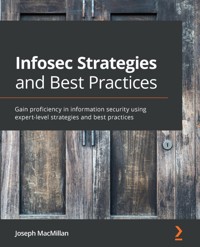
Infosec Strategies and Best Practices
Gain proficiency in information security using expert-level strategies and best practices
Joseph MacMillan
BIRMINGHAM—MUMBAI
Infosec Strategies and Best Practices
Copyright © 2021 Packt Publishing
All rights reserved. No part of this book may be reproduced, stored in a retrieval system, or transmitted in any form or by any means, without the prior written permission of the publisher, except in the case of brief quotations embedded in critical articles or reviews.
Every effort has been made in the preparation of this book to ensure the accuracy of the information presented. However, the information contained in this book is sold without warranty, either express or implied. Neither the author, nor Packt Publishing or its dealers and distributors, will be held liable for any damages caused or alleged to have been caused directly or indirectly by this book.
Packt Publishing has endeavored to provide trademark information about all of the companies and products mentioned in this book by the appropriate use of capitals. However, Packt Publishing cannot guarantee the accuracy of this information.
Group Product Manager: Wilson D'souza
Publishing Product Manager: Sankalp Khatri
Senior Editor: Shazeen Iqbal
Content Development Editor: Romy Dias
Technical Editor: Nithik Cheruvakodan
Copy Editor: Safis Editing
Project Coordinator: Shagun Saini
Proofreader: Safis Editing
Indexer: Rekha Nair
Production Designer: Shankar Kalbhor
First published: April 2021
Production reference: 1240521
Published by Packt Publishing Ltd.
Livery Place
35 Livery Street
Birmingham
B3 2PB, UK.
ISBN 978-1-80056-635-4
www.packt.com
To Helen, my best friend and the love of my life. Her support made all of the difference while I was trying to write this thing.
Contributors
About the author
Joseph MacMillan is a technological utopian and cybersecurity junkie, currently living in Amsterdam.
Employed by Microsoft as a Global Black Belt for Cybersecurity, Joseph uses his experience in senior information security roles to transform businesses into secure organizations rooted in risk management principles to drive decision making.
Much of Joseph's work has been focused on enabling businesses to achieve their goals by removing the ambiguity surrounding risk, which enables the CEO and C-Suite to plan and achieve their goals in a secure manner with confidence.
Joseph holds various certifications, including the CISSP, CCSP, CISA, CSSLP, AlienVault Certified Engineer, and ISO 27001 Certified ISMS Lead Auditor.
I would like to take this opportunity to thank my wife and best friend, Helen, for her support and care along the way. Furthermore, I would like to thank all of the members of the Packt team who have supported me in the creation of this book, from beginning to end.
About the reviewer
Kyle Reidell has world-class experience leading, developing, and architecting cybersecurity and engineering solutions for numerous government agencies, as well as Fortune 500 companies, and cutting-edge technology start-ups. His background is truly multi-disciplinary: from developing and defending global operations centers to securing communications for the highest levels of government and designing cloud-native architectures while continuing to serve as a Cyber Officer in the Air National Guard.
Kyle is a Marine Corps veteran who is actively engaged as a mentor for aspiring youth and cybersecurity professionals. He holds multiple degrees and industry certifications, including a master's degree in information security.
I would like to thank my family, especially my wife and son, for the continuous support they have provided throughout my career and endeavors; I could not have done any of this without them!
Table of Contents
Preface
Section 1: Information Security Risk Management and Governance
Chapter 1: InfoSec and Risk Management
Basic InfoSec terminology
Understanding why risk management is important
Understanding assets7
Understanding vulnerabilities9
Performing a basic risk assessment
Defining and calculating impact11
Defining and calculating likelihood12
Calculating risk13
Risk appetite, risk treatment, and risk acceptance 16
Considering legal regulations, investigations, and compliance structures
Compliance structures18
Understanding legal and regulatory requirements19
Responding to and undertaking investigations21
Further compliance optimization22
Proven methodologies in creating a strategy
Creating InfoSec policies, procedures, and playbooks 23
Establishing and maintaining a security awareness, education, and training program24
Managing third-party risk 25
Continual improvement and reporting27
Summary
Chapter 2: Protecting the Security of Assets
Implementing an ISMS
Responsibilities of top management31
Developing an ISMS32
Educating members of your organization47
Evaluating the effectiveness of the ISMS47
Improving the policy48
Identifying and classifying information assets
Structuring information asset classifications49
Determining the roles for assets50
Methods of identifying and protecting information assets50
Retention policies52
Securing information assets
Disposing of assets
Data remnants59
Summary
Section 2: Closing the Gap: How to Protect the Organization
Chapter 3: Designing Secure Information Systems
Understanding the risks your organization faces
Threats, threat actors, and motivations65
Vulnerabilities69
System exploitation methods 73
Best practices in assessing and mitigating vulnerabilities
Hardware security81
Software security83
Network security83
Physical security84
Selecting appropriate controls/defense against the dark arts84
Best practices in designing secure information systems
Secure design principles86
Well-known controls and their mitigations88
Considering alternative devices90
Summary
Chapter 4: Designing and Protecting Network Security
Designing secure network architectures
Internet Protocol suite and the OSI model97
Network components and protocols102
Network devices and applications106
Attacks, defense, and detection113
Strategies for protecting network security
Creating a policy119
Keep it simple121
Business continuity and disaster recovery121
Backup and restore procedures121
Insider threat mitigations/third-party threats121
Software and firmware updates123
Ensuring secure communication123
Cloud network security124
Education and awareness125
Security Operations Center125
Chapter 5: Controlling Access and Managing Identity
Access control models and concepts
State machine model129
Information flow model130
Confidentiality models130
Integrity models132
Real-world access control models 133
Selecting and implementing authentication and authorization mechanisms
Authentication versus authorization 136
Authentication and security137
Authorization144
Identity and access management (IAM)
Leveraging identity services146
Controlling physical access to assets
Physical access control147
Electronic access control148
Preventing exploitation148
Summary
Section 3: Operationalizing Information Security
Chapter 6: Designing and Managing Security Testing Processes
Preparing for security assessments
Defining your requirements155
Understanding the different types of security assessments
Automated assessments and scanning160
Internal assessments166
Third-party assessments167
Best practices in performing security assessments
Interpreting results from security assessments
Summary
Chapter 7: Owning Security Operations
Effective strategies in provisioning resources and maintaining assets
Provisioning resources176
Focusing on availability, disaster recovery, and business continuity
Defining, implementing, and testing disaster recovery processes184
Managing business continuity design, planning, and testing186
Implementing and managing physical security186
Managing upgrades, patching, and applying security controls
Education187
Change control188
Security improvement program189
Investigating events and responding to incidents
Defining your incident response plans191
Performing security investigations193
Implementing and utilizing detective controls
Using security monitoring to improve visibility
Security monitoring best practices
Establish requirements and define workflows200
Define specific rules and ensure their effectiveness201
Continuously improve your SIEM configuration and incident response policies202
Summary
Chapter 8: Improving the Security of Software
Exploring software security paradigms
Buyer beware208
Legal documentation208
Understanding the secure development life cycle
Compatibility with various software development methodologies210
Defining business and security requirements211
Designing secure software212
Testing plans for secure software212
Securing software development215
Testing the software215
Utilizing the OWASP Top 10 Proactive Controls
Define security requirements217
Leverage security frameworks and libraries218
Secure database access219
Encode and escape data220
Validate all inputs221
Implement digital identity221
Enforce access controls222
Protect data everywhere223
Implement security logging and monitoring224
Handle all errors and exceptions224
Assessing software security
Reducing the risk from software developed by a third-party vendor227
Improving the security of in-house software231
Summary
Why subscribe?
Other Books You May Enjoy
Preface
In this book, we will cover various topics within the information security (InfoSec) domain, and help you to translate your organization's strategic requirements into actionable improvements in securing their most valuable assets.
You can expect to learn about a wide range of InfoSec paradigms, including the foundations of risk management, implementing processes and controls, designing information systems securely, and managing the day-to-day activities required to ensure security is maintained at your organization.
Upon completion, you should be well on your way toward converting the theory of your InfoSec certifications into actionable and practical changes you can make to ensure your organization is more secure. Beyond that, delving deeper into any and all of the topics covered in this book will help you to progress in your career as an InfoSec professional.
Who this book is for
This book is for those who are looking to begin (or have recently begun) working in an InfoSec role. Perhaps you've been taking courses and studying for an industry-standard certification such as the CISSP or CISM, but you're looking for a way to convert the concepts (and seemingly endless number of acronyms) from theory into practice and start making a difference in your day-to-day work at your organization.
What this book covers
Chapter 1, InfoSec and Risk Management, establishes the core principles of InfoSec and ensures the topics central to the discipline are well-understood.
Chapter 2, Protecting the Security of Assets, implements effective processes to ensure you can identify the assets of an organization and avoid common pitfalls that InfoSec professionals encounter.
Chapter 3, Designing Secure Information Systems, explores how to assess architectures and systems for vulnerabilities and mitigate those vulnerabilities with controls, including cryptography.
Chapter 4, Designing and Protecting Network Security, covers designing secure network systems, selecting the appropriate network components, and ensuring their effectiveness for your organization's requirements.
Chapter 5, Controlling Access and Managing Identity, examines both physical and digital access to your organization, and the various aspects of selecting and implementing the appropriate identity and access management controls.
Chapter 6, Designing and Managing Security Testing Processes, covers adopting a mindset of continuous improvement by testing existing implementations and utilizing any findings to optimize your InfoSec program.
Chapter 7, Owning Security Operations, covers aligning the day-to-day tasks involved with maintaining InfoSec to an organization's strategies.
Chapter 8, Improving the Security of Software, covers enforcing secure practices in procuring and developing software.
To get the most out of this book
Bring your inquisitive nature and interest in securing information systems. This book covers an extremely wide set of subjects, offering the opportunity to investigate further on your own. If a topic interests you, make sure you delve deeper into the content available online.
After completing this book, challenge the conclusions made, don't accept anything as a hard-and-fast rule, and cater all the solutions to suit you and your organization.
Download the color images
We also provide a PDF file that has color images of the screenshots/diagrams used in this book. You can download it here: http://www.packtpub.com/sites/default/files/downloads/9781800566354_ColorImages.pdf.
Conventions used
The following is how tip and information notes will be shown throughout this book:
Tips or important notes
Appear like this.
Get in touch
Feedback from our readers is always welcome.
General feedback: If you have questions about any aspect of this book, mention the book title in the subject of your message and email us at [email protected].
Errata: Although we have taken every care to ensure the accuracy of our content, mistakes do happen. If you have found a mistake in this book, we would be grateful if you would report this to us. Please visit www.packtpub.com/support/errata, selecting your book, clicking on the Errata Submission Form link, and entering the details.
Piracy: If you come across any illegal copies of our works in any form on the Internet, we would be grateful if you would provide us with the location address or website name. Please contact us at [email protected] with a link to the material.
If you are interested in becoming an author: If there is a topic that you have expertise in and you are interested in either writing or contributing to a book, please visit authors.packtpub.com.
Reviews
Please leave a review. Once you have read and used this book, why not leave a review on the site that you purchased it from? Potential readers can then see and use your unbiased opinion to make purchase decisions, we at Packt can understand what you think about our products, and our authors can see your feedback on their book. Thank you!
For more information about Packt, please visit packt.com.
Section 1: Information Security Risk Management and Governance
In this section, we'll establish the core principles of information security, and ensure the topics central to the discipline are well understood.
This section contains the following chapters:
Chapter 1, Infosec and Risk ManagementChapter 2, Protecting the Security of Assets




